Token Vesting for Employees: Cliffs, Lockups and What You Actually Keep
Token vesting decides whether your offer is real money or a story. Here is how cliffs, lockups and TGEs work and what to ask before you sign.

TL;DR
- Standard token vesting is four years with a one year cliff.
- Expect a further 6 to 12 month lockup after any token generation event.
- Token grants typically add 30 to 100% on top of base salary.
- Leave before the cliff and you keep nothing.
Token vesting decides whether the number in your offer letter is real money or a story. The market standard in 2026 is a four year vest with a one year cliff, usually followed by a six to twelve month lockup after the token generation event.
Which means that between signing and actually being able to sell anything, two years is common. Most people signing these offers have not done that arithmetic.
This guide covers what each term actually means for you as an employee, not as an investor and which questions to ask before you sign. If you are comparing offers now, browse web3 jobs to see how packages are being structured across the market.
1. What does token vesting actually mean?
Vesting is the schedule by which a promised token grant becomes genuinely yours. Until tokens vest, they are a commitment your employer has made, not an asset you hold.
The purpose is retention. Companies want you to stay, so they release the grant gradually and you forfeit whatever has not vested when you leave.
At most protocols, token grants add 30% to 100% on top of base salary. Senior engineers at established protocols commonly see $150,000 to $250,000 base plus $80,000 to $200,000 in tokens across four years.
2. How does a one year cliff work?
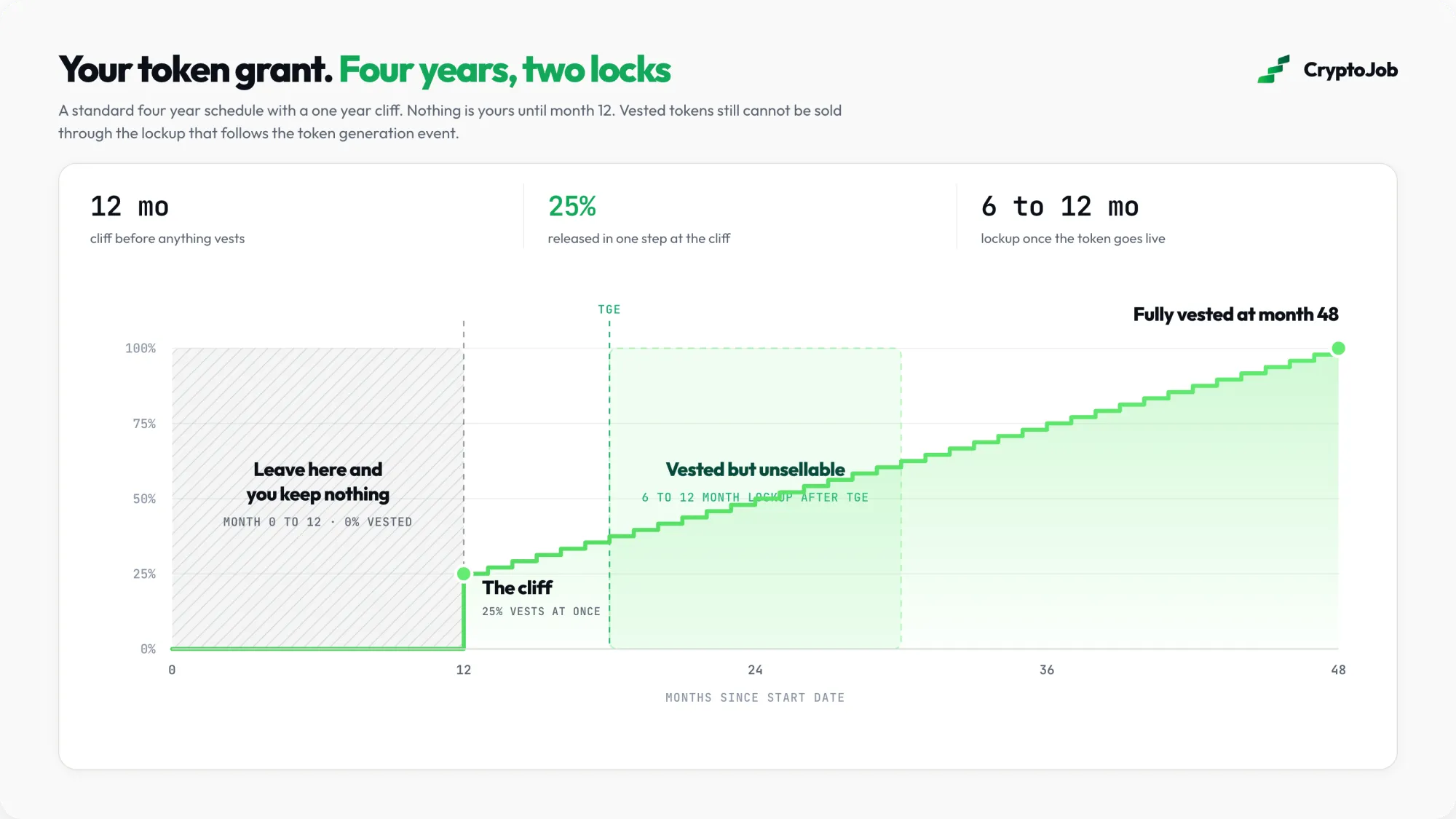
The cliff is the part that catches people out. Nothing vests at all until you reach it, typically your one year anniversary, at which point twenty five percent vests in a single event.
Leave at eleven months and you keep nothing. Not a partial amount, not a pro rated slice. Nothing.
After the cliff, the remainder usually vests monthly or quarterly across the following three years.
| Timing | What you have vested | What you can sell |
|---|---|---|
| Month 6 | 0% | Nothing |
| Month 12 (cliff) | 25% | Nothing if TGE has not happened |
| Month 24 | 50% | Depends on lockup status |
| Month 48 | 100% | Fully, assuming lockup expired |
3. What is a TGE lockup and why does it matter?
Vesting and liquidity are two different things, and confusing them is the single most expensive mistake in web3 compensation.
Tokens can be fully vested and still impossible to sell. After a token generation event, most employee allocations carry a hard lockup of six to twelve months during which no transfers are permitted.
If your company has not launched a token yet, there is no lockup clock running at all, because there is nothing to lock. Your vested tokens exist as a contractual promise until a TGE happens, and if it never happens, they remain exactly that.
Ask directly whether a TGE is planned, when and what the lockup terms will be. A company that cannot answer is telling you something.
4. How should you value a token grant in an offer?
4.1 Ask what valuation the number is based on
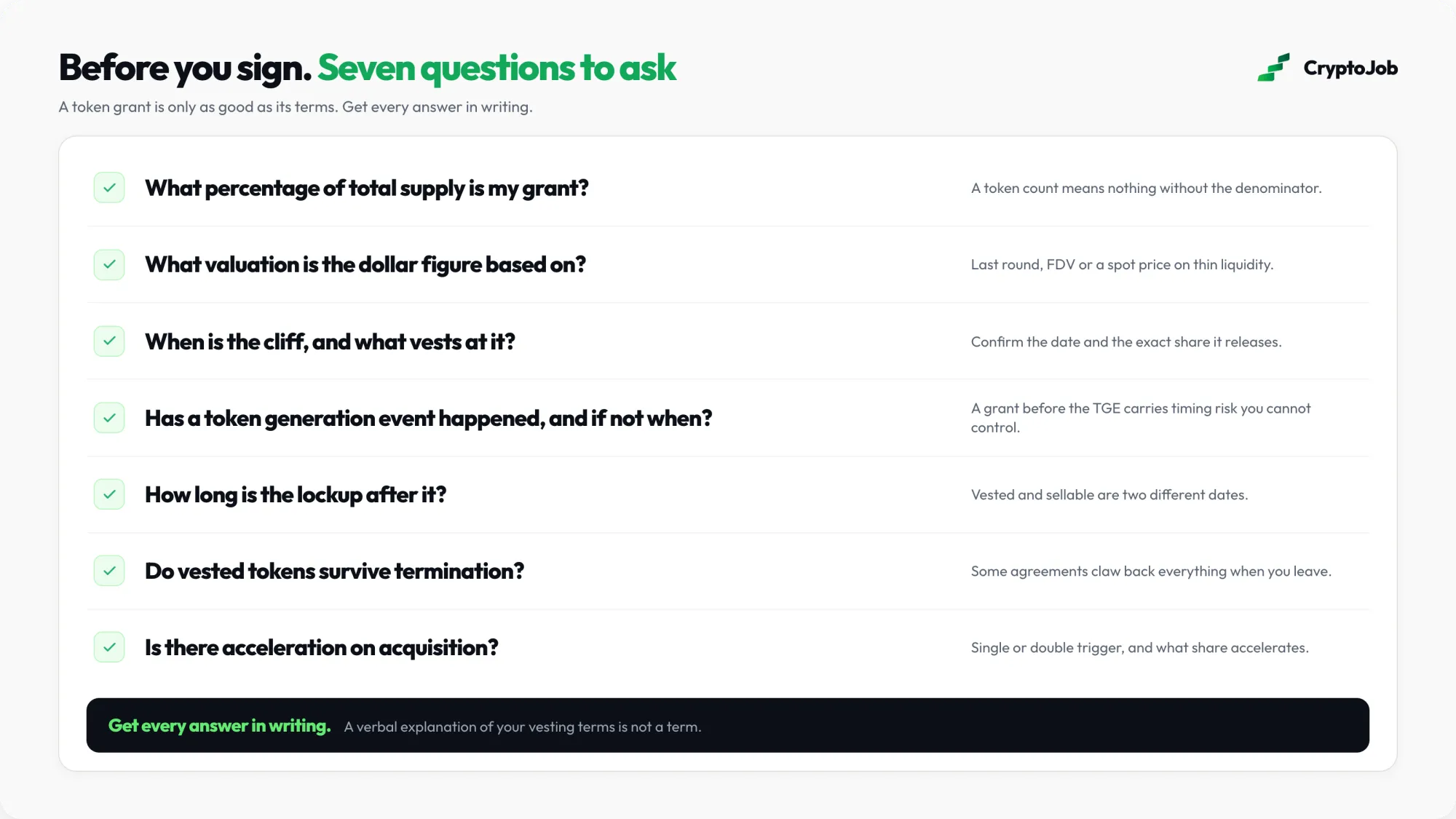
A grant quoted as "$200,000 in tokens" is derived from some assumed price. Find out which one, the last funding round, an internal projection or a market price if the token already trades.
Grants based on projected valuations are the least reliable, and they are also the most commonly quoted.
4.2 Ask for the percentage, not just the dollar figure
A percentage of total supply is a stable fact. A dollar figure is a snapshot of an assumption that will change.
Knowing you hold 0.05% of supply tells you far more over four years than knowing someone valued it at $200,000 in August.
4.3 Discount it, and say so
Experienced candidates apply a heavy discount to token components, and employers know this. The era of paying mostly in tokens has closed precisely because candidates stopped accepting it at face value.
A package that is 70% tokens is transferring risk to you. That may be a trade worth making at an early stage protocol you believe in, but make it deliberately.
5. What happens to your tokens when you leave?
Unvested tokens are forfeited. That much is near universal.
What varies is everything else, and the variation is where you should focus your questions.
| Question | Why it matters |
|---|---|
| Do vested tokens survive termination? | Usually yes, but some agreements include clawback provisions |
| Is there acceleration on acquisition? | Determines whether a sale benefits you or just your employer |
| What counts as "cause"? | A broad definition can void your grant entirely |
| Does the lockup still apply after leaving? | Almost always yes, leaving does not unlock anything |
| Are you paid in tokens or a right to tokens? | A contractual right is weaker than a held asset |
Get the answers in writing. Verbal reassurance from a founder during a hiring process is not enforceable and rarely survives a change of leadership.
6. Is token compensation worth taking at all?
Often, yes, but for the right reasons. A meaningful token allocation at a protocol you understand and believe in is genuine upside that salary cannot replicate.
The problems arise when tokens substitute for cash you actually need, or when the grant is large enough to distort your judgement about whether the job is right.
A useful test: would you take this role if the token component turned out to be worth nothing? If the answer is no, you are being paid in optimism rather than compensation.
Frequently asked questions
What is a standard token vesting schedule in 2026?
Four years with a one year cliff, then monthly or quarterly vesting for the remaining three years. Most grants also carry a six to twelve month lockup after any token generation event.
What happens if I leave before the cliff?
You forfeit the entire grant. There is no partial vesting before the cliff date, which is precisely what the cliff is designed to enforce.
Can I sell tokens as soon as they vest?
Not usually. Vesting and liquidity are separate. Tokens can be fully vested but locked, and if no TGE has occurred there is nothing tradeable at all.
How much of my package should be tokens?
Most candidates should keep base salary sufficient to cover living costs independently. Token grants typically add 30 to 100% on top of base, and packages weighted much more heavily than that transfer significant risk to you.
Do tokens count as income for tax?
Usually yes, and treatment varies considerably by jurisdiction, some tax at vest, others at sale. Get country specific advice before your first vesting event rather than after.
Where to go from here
Token compensation is not inherently good or bad. It is a risk transfer, and it becomes a bad deal only when you accept it without understanding what you are being asked to carry.
Ask the seven questions above before you sign. And when you are comparing what different employers are offering, browse web3 jobs.
Related reading: How to Get Paid in Crypto and How to Negotiate a Web3 Job Offer.