How to Get Hired at Circle (USDC) in 2026
Circle went public, got cleared to operate as a bank and is hiring across engineering, product and compliance. Here's what it pays by level and how the interview loop works.

TLDR
- Circle jobs span remote US and hub roles in NYC, Boston, Dublin, Singapore and Dubai
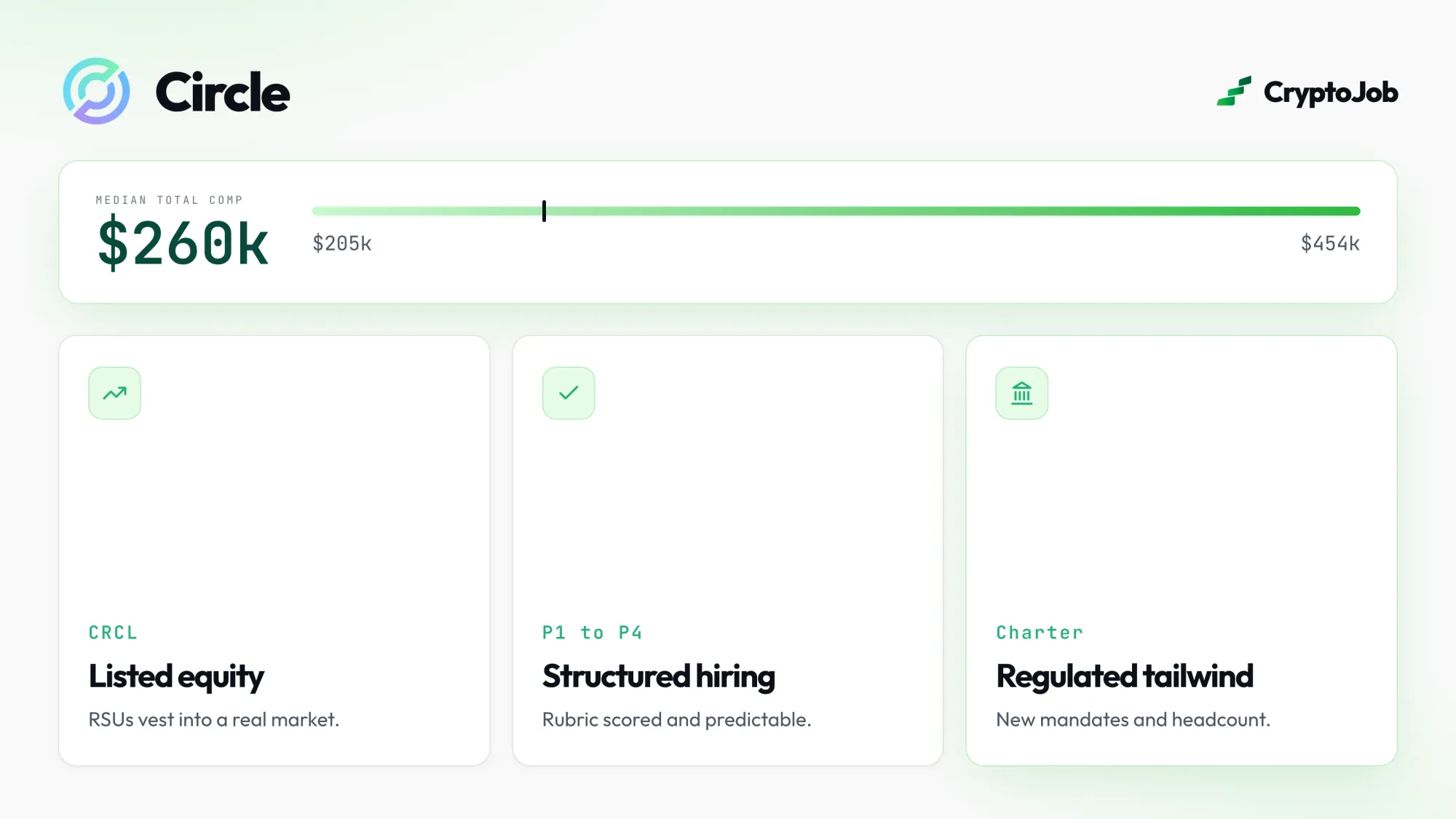
- Engineer comp runs ~$205k (P1) to ~$454k (P4); company median ~$260k
- NYSE listed since June 2025, ~1,100 employees, offers real RSUs
- Interview loop: recruiter screen, manager screen, 60 min design + 90 min coding
- Cleared to operate as a bank in July 2026. Compliance hiring is growing
Circle jobs have become some of the most sought after roles in fintech, and the timing explains why. Circle (NYSE: CRCL) issues USDC, $77 billion in circulation as of Q1 2026, up 28% year over year, went public in June 2025 and in July 2026 got the regulatory greenlight to operate as a bank. That combination of crypto scale growth and TradFi grade legitimacy is rare.
This guide breaks down what Circle is hiring for, what it actually pays by level, how the interview loop works and how it compares to the other stablecoin giant, Tether. If you're running a broader search alongside this one, you can browse web3 jobs on CryptoJob as you go.
The short version: Circle hires like a public fintech company, not a crypto startup. That means structured levels, real equity, Workday applications. And a bar to match.
1. Why Are Circle Jobs in Demand Right Now?
Three forces collided in 2025 to 2026. First, the GENIUS Act made regulated stablecoin issuers the centre of US crypto policy and Circle is the flagship regulated issuer. Second, the IPO turned Circle offers into liquid compensation. RSUs you can actually value. Third, the business is compounding: Q1 2026 revenue hit $694 million (up 20%) and USDC settled $21.5 trillion on chain in that quarter alone, up 263%.
Circle is also building far beyond the stablecoin. Arc, its own layer 1 blockchain, raised a $222 million token presale at a $3 billion network valuation from investors including a16z crypto and BlackRock. Add the Circle Payments Network, StableFX and a Visa settlement partnership and you get hiring demand across engineering, product, GTM and risk simultaneously.
For candidates, the July 2026 bank approval matters most. Operating as a bank means sustained hiring in compliance, risk, audit and regulatory roles. Functions most crypto companies barely staff.
2. What Roles Is Circle Hiring for in 2026?
Circle employs roughly 1,100 people per its 2025 filings, up from about 900 in 2024 and hiring is active across most functions. Recent openings give a representative picture:
- Engineering: blockchain and payments infrastructure engineers, Lead Security Engineer, Senior Staff Data Engineer, engineering managers; the work centres on scalable microservices and secure APIs bridging blockchains and banking rails
- Product & GTM: growth leads for Arc and the Circle platform, StableFX go to market, product marketing for digital assets, Director of Product Partnerships for the Circle Payments Network
- Risk & compliance: global fraud risk leadership, plus the regulatory roles a banking licence demands
- Regional leadership: roles like Managing Director for the Middle East, reflecting expansion into Singapore, the UAE and Europe
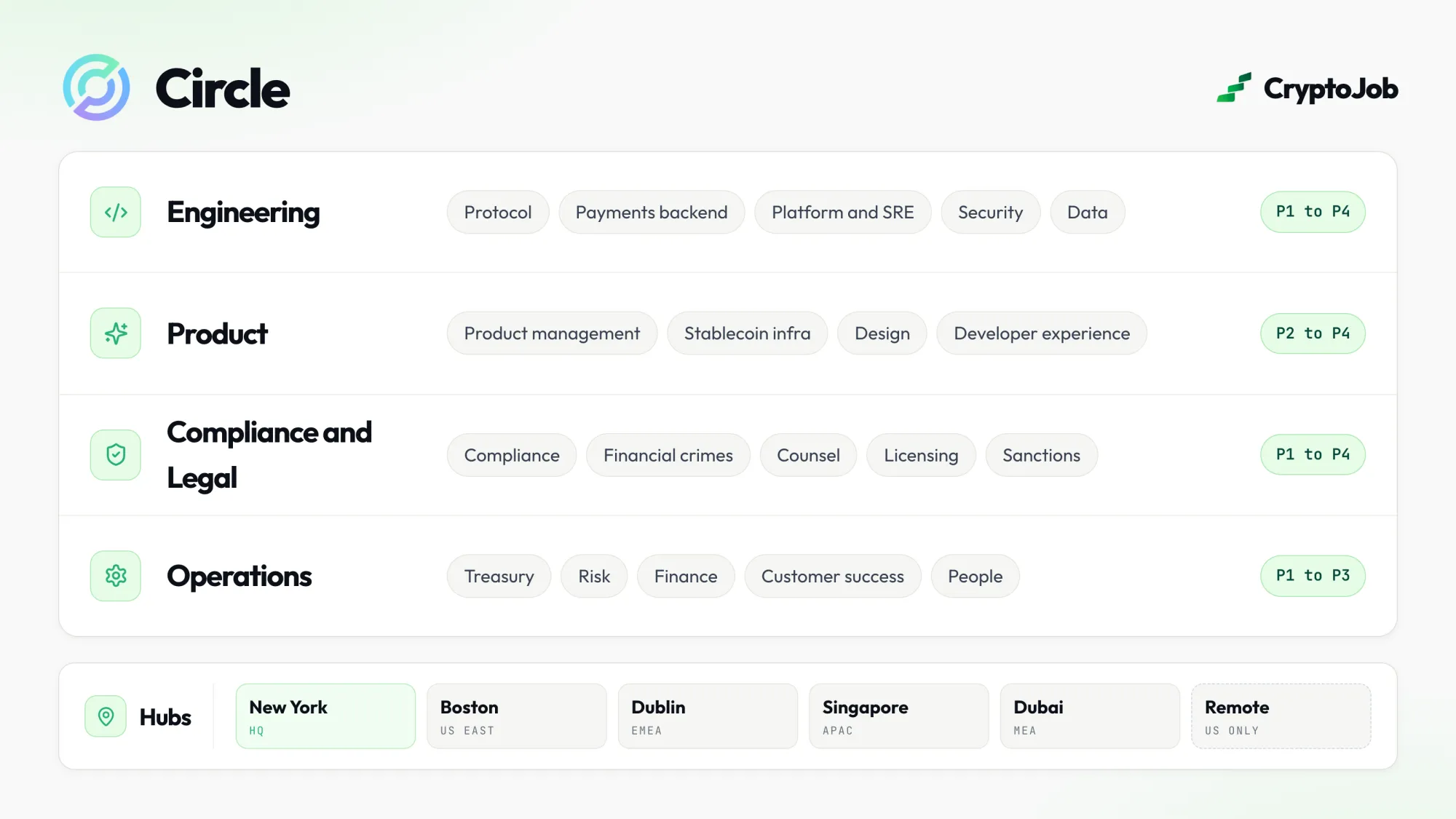
Locations cluster around New York (HQ), Boston, Dublin, Singapore and Dubai, with many US roles fully remote.
2.1 Where do you find official Circle careers listings?
All legitimate Circle careers listings live at careers.circle.com, which routes applications through Circle's Workday portal. The same roles syndicate to boards like Built In and Cryptocurrency Jobs, but always apply through the official page. It's also where Circle publishes an unusually transparent outline of its interview stages.
3. How Much Do Circle Jobs Pay?
Well, by crypto standards and by fintech standards. Levels.fyi data puts US software engineer total compensation between roughly $205k at P1 and $454k at P4, with a median around $244k. And a company wide median near $260k. Because Circle is public, the stock component is real, liquid value rather than paper tokens.
Posted base salary bands back this up: recent US listings showed ranges like $145k to $192.5k in New York and $270k to $310k for senior California roles. International bands run lower. Roughly $91k to $117k in Singapore and $105k to $157k in the UAE on recent listings.
Employees rate compensation 4.4/5 on Glassdoor across 300+ salary reports, which is unusually high. Median total pay there lands at about $148k for Software Engineer, $158k for SWE II and $214k for Senior Software Engineer. Base heavy figures that sit below Levels.fyi's totals because they capture less stock. Expect real offers to vary with level, location and negotiation.
3.1 How does Circle salary compare with Tether?
This is the comparison most stablecoin candidates actually want, so here it is directly. (Full breakdown in our guide to Tether jobs.)
| Factor | Circle (USDC) | Tether (USDT) |
|---|---|---|
| Headcount | ~1,100 | ~100, expanding by ~150 |
| Structure | Public company (NYSE: CRCL) | Private |
| Equity | Liquid RSUs | No public equity |
| Listed pay range | ~$91k to $454k by level/region | ~$100k to $500k |
| Remote policy | Remote first + office hubs | 100% remote, no offices |
| Hiring style | Workday, structured levels (P1. P4) | Recruitee, lean and fast |
| Regulatory posture | US regulated, bank greenlight 2026 | Offshore, El Salvador HQ |
Rule of thumb: Circle suits people who want structure, equity upside and a US regulated resume line. Tether suits senior operators who want maximum autonomy and full location freedom.
4. What Is Circle's Hiring Process?
Circle publishes its interview stages on its careers page, and candidate reports on Glassdoor match it closely. A typical engineering loop:
- Application via careers.circle.com (Workday)
- Recruiter screen. Background, motivation, logistics
- Hiring manager screen. ~30 minutes with an engineering manager
- Technical loop. A ~60 minute system design interview plus a ~90 minute coding interview
- Offer. One recent senior candidate reported the whole process took about two weeks
4.1 How hard is the Circle interview?
Harder than Tether's, by most accounts. And Circle levels strictly. One documented case saw a senior candidate pass coding but get down levelled after the design round, receiving a lower title, lower pay offer instead. Prepare for system design at the level you're targeting, not the level below it.
Expect values screening too. Circle's stated values, High Integrity, Future Forward, Multistakeholder, Mindful, Driven by Excellence, show up in behavioral questions, so bring examples of transparent decision making and cross team work.
4.2 What should you prepare?
For engineering: distributed systems design, secure API patterns and payments or banking integration experience. Circle's core work is moving value between blockchains and banks. For non technical roles: know the product surface (USDC, EURC, Arc, CPN, StableFX) and the GENIUS Act's basic mechanics. Interviewers notice candidates who understand reserves and redemption, not just token prices.
5. How Do You Stand Out When Applying to Circle?
Lead with regulated industry credibility. Circle is becoming a bank, so experience in fintech, payments, banking infrastructure or compliance adjacent engineering beats generic "crypto passion." Quantify it: transaction volumes handled, audits passed, systems scaled.
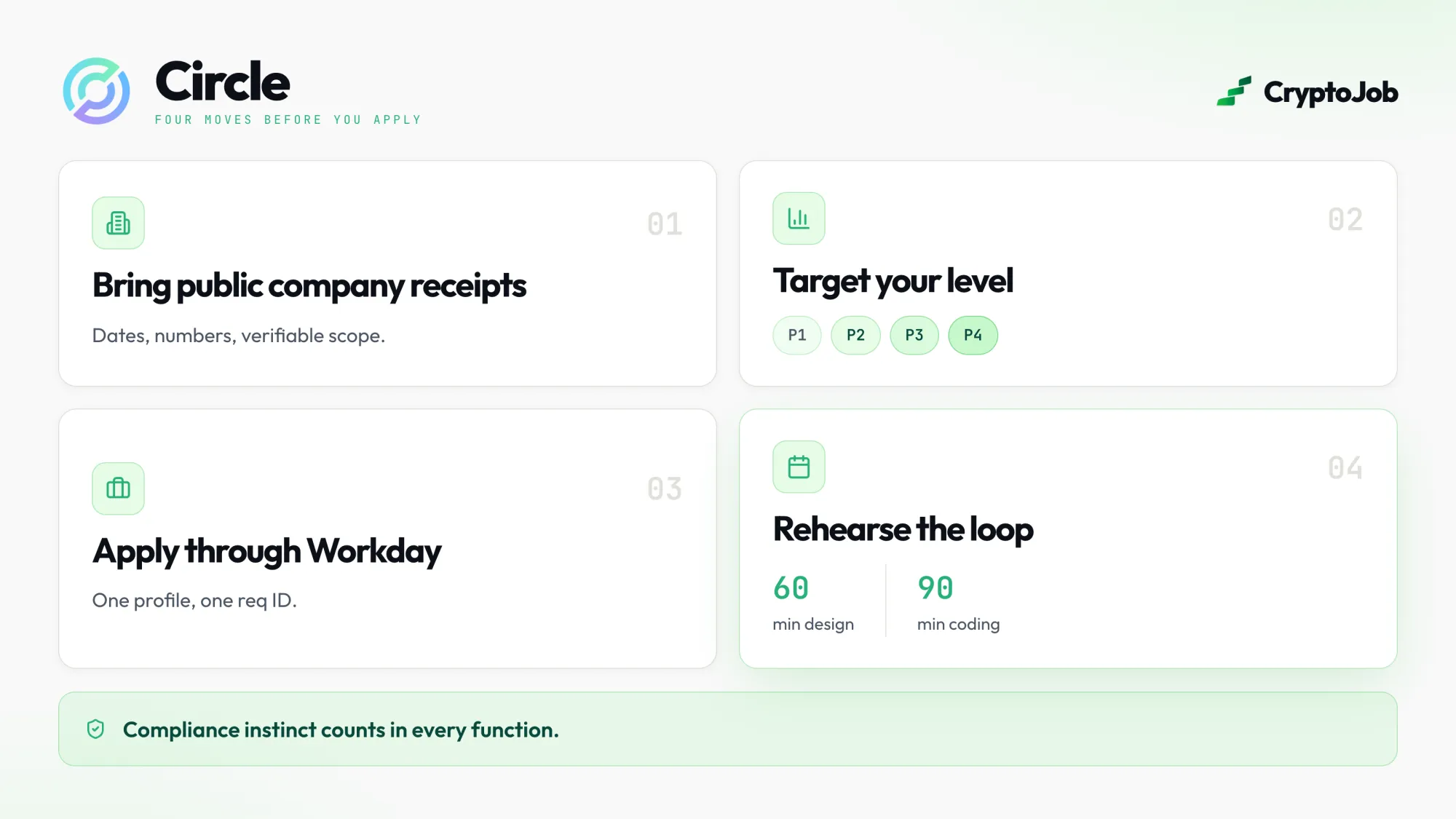
Second, target the growth surfaces. Arc, the Circle Payments Network and StableFX are where 2026 headcount is going. Referencing them specifically in applications signals you did more than skim the homepage. If you're still building the technical base, our guide to blockchain developer jobs covers the groundwork.
5.1 How does Circle compare with other web3 jobs?
Among web3 jobs, Circle is the closest thing to a traditional tech company experience: levels, performance cycles, liquid equity, US benefits. You trade some of crypto's chaos and upside energy for stability. Glassdoor's 4.3/5 overall rating and 4.0/5 career opportunities score suggest most employees consider that trade worth it.
6. Is Circle Remote First?
Circle describes itself as remote first, and many US roles are fully remote. But it's remote first with gravity: office hubs in New York, Boston, Dublin, Singapore and Dubai anchor teams and some leadership and GTM roles are tied to a region.
Practical implication: US based candidates have the widest remote access, while international candidates should target hub cities or regional roles. Compensation localizes accordingly. The same job pays differently in Singapore than in New York.
6.1 How does Circle stack up against other remote crypto jobs?
Against other remote crypto jobs, Circle offers rarer things: employer of record employment (not contractor agreements), US style benefits and equity you can sell. The constraint is geography. Tether or DeFi native teams will hire from more countries. Candidates comparing locations can start with our guide to the best cities for crypto jobs.
7. Final Take: Is a Circle Job Worth Chasing in 2026?
Yes. Especially if you want crypto exposure without crypto startup risk. The business is growing (USDC +28% YoY), the regulatory tailwind is real and the bank approval guarantees hiring in functions far beyond engineering. The process is structured and beatable with system design prep and product knowledge.
Just calibrate your level honestly, because Circle will. And keep parallel options moving, browse web3 jobs across issuers, exchanges and infrastructure teams so you're negotiating from strength if that Circle offer lands.
FAQ
Does Circle hire outside the US?
Yes. Circle has hubs in Dublin, Singapore and Dubai and hires regionally across Europe, Asia and the Middle East, though the deepest role selection and fully remote options are US based. Compensation is localized by market.
Does Circle pay in equity?
Yes. As a public company (NYSE: CRCL since June 2025), Circle grants RSUs with real market value. Levels.fyi reports show stock forming a meaningful share of total compensation, with engineer packages ranging from about $205k to $454k by level.
How long does Circle's hiring process take?
Candidate reports suggest around two to three weeks for engineering roles: recruiter screen, hiring manager screen, then a design interview and a coding interview. Senior and leadership roles can run longer.
Do you need crypto experience to work at Circle?
No. Payments, fintech and banking backgrounds are often preferred, especially after Circle's 2026 bank approval. You should still understand how USDC reserves, minting and redemption work before interviewing.
Is Circle a stable employer?
By crypto standards, very. It reported $694 million in Q1 2026 revenue, holds a public listing and received the greenlight to operate as a bank in July 2026. Its revenue does depend heavily on interest earned on USDC reserves, so rate cuts are the main business risk to watch.