How to Get a Job at a Crypto Exchange
What crypto exchange jobs pay, how Binance, Coinbase and Kraken actually hire and a step-by-step plan to get in without crypto experience.

TLDR
- Crypto exchange jobs pay roughly $40K for support roles up to $200K+ for senior engineering, per Glassdoor data
- Hiring takes 2 to 4 weeks at Binance, longer at Coinbase and Kraken
- Support, compliance and community roles are the easiest entry points
- You don't need to be a developer. Around half of open roles are non-technical
Getting hired at a crypto exchange comes down to four things: pick a realistic entry role, show proof you actually use crypto, apply directly on the exchange's careers page and tailor every application to the specific team. Crypto exchange jobs span far more than engineering. Exchanges hire for compliance, support, marketing, legal and operations and many roles are fully remote.
This guide covers what these jobs pay, how the big three exchanges hire and how to get in without prior crypto experience. If you want to see what's open right now, you can browse web3 jobs on CryptoJob while you read.
One thing to know upfront: exchanges hire in cycles that follow the market. Bull markets mean hiring sprees. Bear markets mean freezes and layoffs. Timing your applications matters more here than in almost any other industry.
1. What Do Crypto Exchange Jobs Actually Pay?
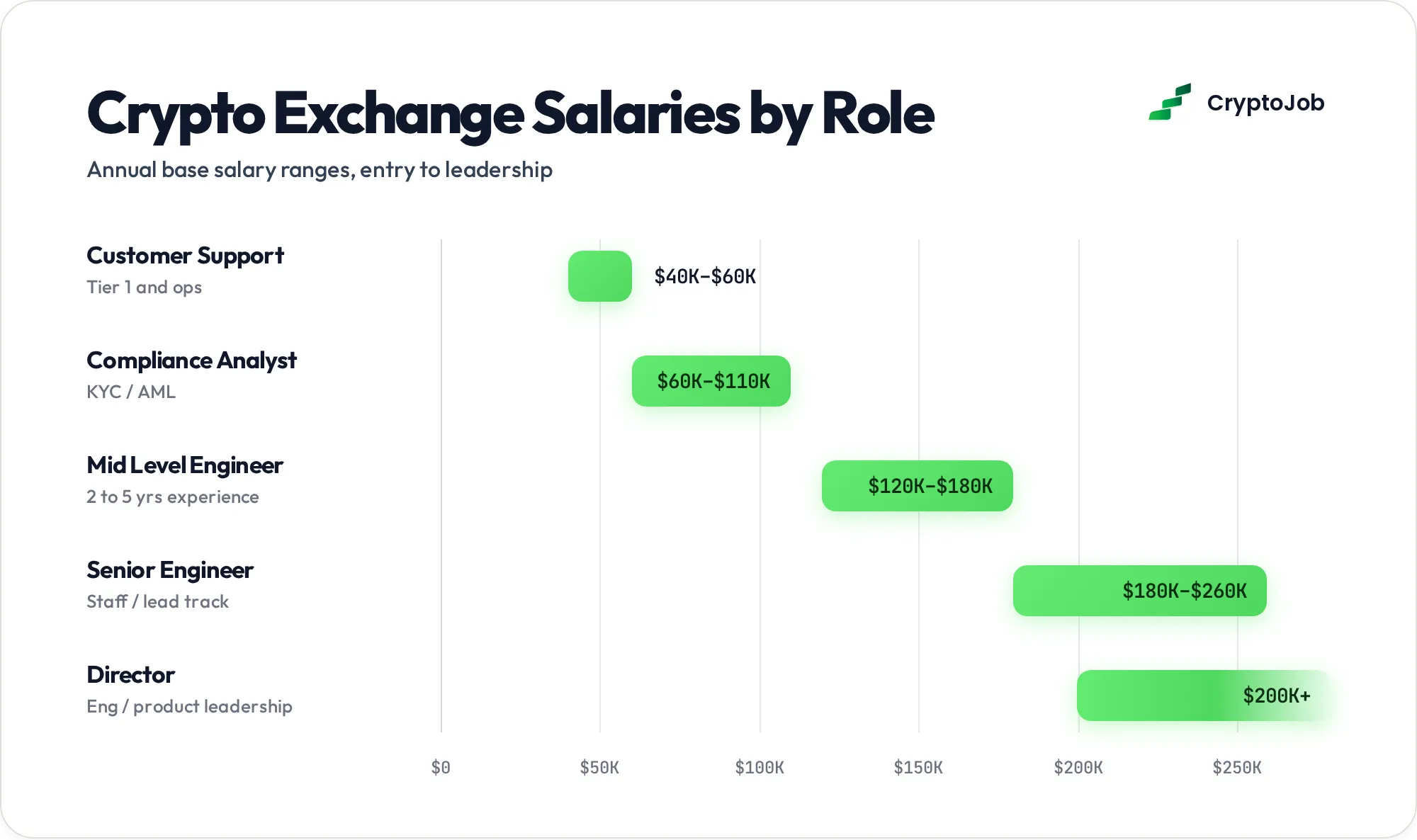
Pay varies a lot by role, location and seniority, so treat these as ranges rather than guarantees.
At Kraken, Glassdoor data from June 2026 shows US salaries running from about $40,000 for customer service representatives up to around $229,000 for directors. Coinbase skews higher at the top end. Glassdoor reports US salaries from roughly $49,000 for support roles up to $600,000+ for senior engineering managers, with most employees landing between $104,000 and $140,000.
A few concrete examples help calibrate expectations:
- Entry-level support: $40,000 to $60,000
- Compliance analyst (AML/KYC): $60,000 to $110,000
- Mid-level engineer: $120,000 to $180,000 base
- Senior engineer: often $180,000 to $260,000 base at major exchanges
- Finance and analyst rotational programs: Coinbase has listed rotational analyst roles at $95,000 to $112,000 base
On top of base salary, most exchanges add equity or token-based compensation plus a bonus. Binance even offers the option to be paid in crypto. Total compensation at senior levels frequently matches or beats traditional finance.
2. Which Crypto Exchange Jobs Are Easiest to Break Into?
If you're new to the industry, these roles have the lowest barriers and the most openings.
Customer support. Exchanges run 24/7 global operations and constantly need support agents. Language skills are a real advantage here, especially English paired with Chinese, Spanish or another major market language.
Compliance and AML. This is the fastest-growing job family at regulated exchanges. Compliance and legal headcount at major players has expanded sharply in recent years as regulation tightened. A CAMS certification or banking compliance background transfers directly.
Community and social. If you're already active in crypto communities, that's a portfolio. Exchanges hire community managers, content writers and regional marketers who understand the culture natively.
Internships and graduate programs. Binance runs the Binance Accelerator Program across multiple regions, and Coinbase runs rotational analyst programs. These are the most structured paths in if you're early career.
Engineering, security and quant roles pay the most but face the toughest competition. Expect leetcode-style interviews plus system design rounds similar to big tech.
3. How Do Binance, Coinbase and Kraken Compare for Job Seekers?
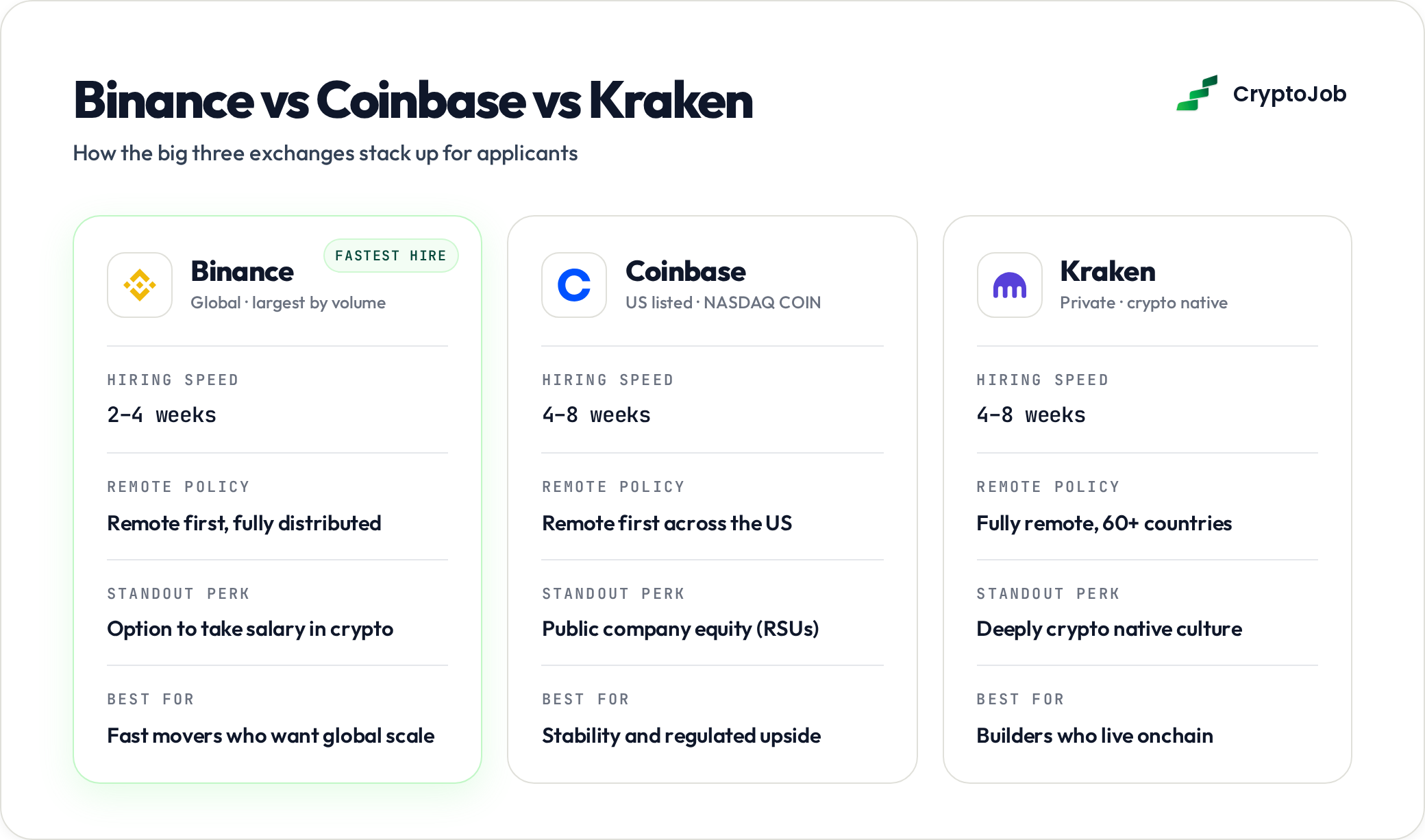
The big three each hire differently. Here's the quick comparison, then details on each.
|
|
Binance |
Coinbase |
Kraken |
|
Hiring process |
2 to 4 weeks, about 4 interviews |
4 to 8 weeks typical, includes AI screening pilots |
4 to 8 weeks typical, values-heavy screening |
|
Remote policy |
Remote for many roles, globally distributed |
Remote-first for most roles, periodic in-person events |
Remote-first, globally distributed |
|
Typical US pay range |
Varies by region, crypto pay option |
~$104K to $140K midband (Glassdoor) |
~$40K to $229K across levels (Glassdoor) |
|
Standout perks |
Free language classes, relocation support, crypto salary option |
Equity in a NASDAQ-listed company, 401(k) |
Strong comp satisfaction (4.2/5 on Glassdoor) |
|
Best for |
Global candidates, multilingual talent |
US candidates wanting public-company equity |
Crypto-native candidates who value the culture |
3.1 What Should You Know About Binance Careers?
Binance is the largest exchange by trading volume and hires globally on a near-constant basis. Its careers page describes an average 2 to 4 week process with around 4 interviews, which is fast for the industry.
The company is heavily distributed, with remote roles across Asia, Europe, the Middle East and beyond. Multilingual candidates have a real edge since Binance operates in dozens of markets. It also discloses that AI tools may assist with resume screening, so write your CV with clear keywords matching the job description.
If you're a student or recent grad, look at the Binance Accelerator Program, which runs remote and hybrid cohorts in multiple regions.
3.2 How Competitive Are Coinbase Jobs?
Very. Coinbase is a NASDAQ-listed company with a famously high bar and an intense culture it openly advertises. Most roles are remote-first with occasional in-person events.
Two practical details matter for applicants. First, Coinbase caps candidates at 4 applications per 30-day period, so choose your roles carefully instead of spraying applications. Second, it's piloting AI-led initial screening interviews for some roles, so expect a structured, recorded first round.
Coinbase pays well even at entry level. Its rotational analyst program has listed base salaries of $95,000 to $112,000 before equity and bonus.
3.3 What Makes Kraken Careers Different?
Kraken leans hard into crypto-native culture. It was the first major exchange to run Proof of Reserves audits and it screens heavily for mission alignment, so genuine crypto conviction shows up in interviews.
The company is remote-first and globally distributed, with employees rating compensation 4.2 out of 5 on Glassdoor. Pay spans a wide range, from around $40,000 for support up to about $229,000 for director-level roles in the US.
Practical tip: Kraken interviewers often ask why crypto matters to you personally. Have a real answer that goes beyond price speculation.
4. What Does the Application Process Look Like Step by Step?
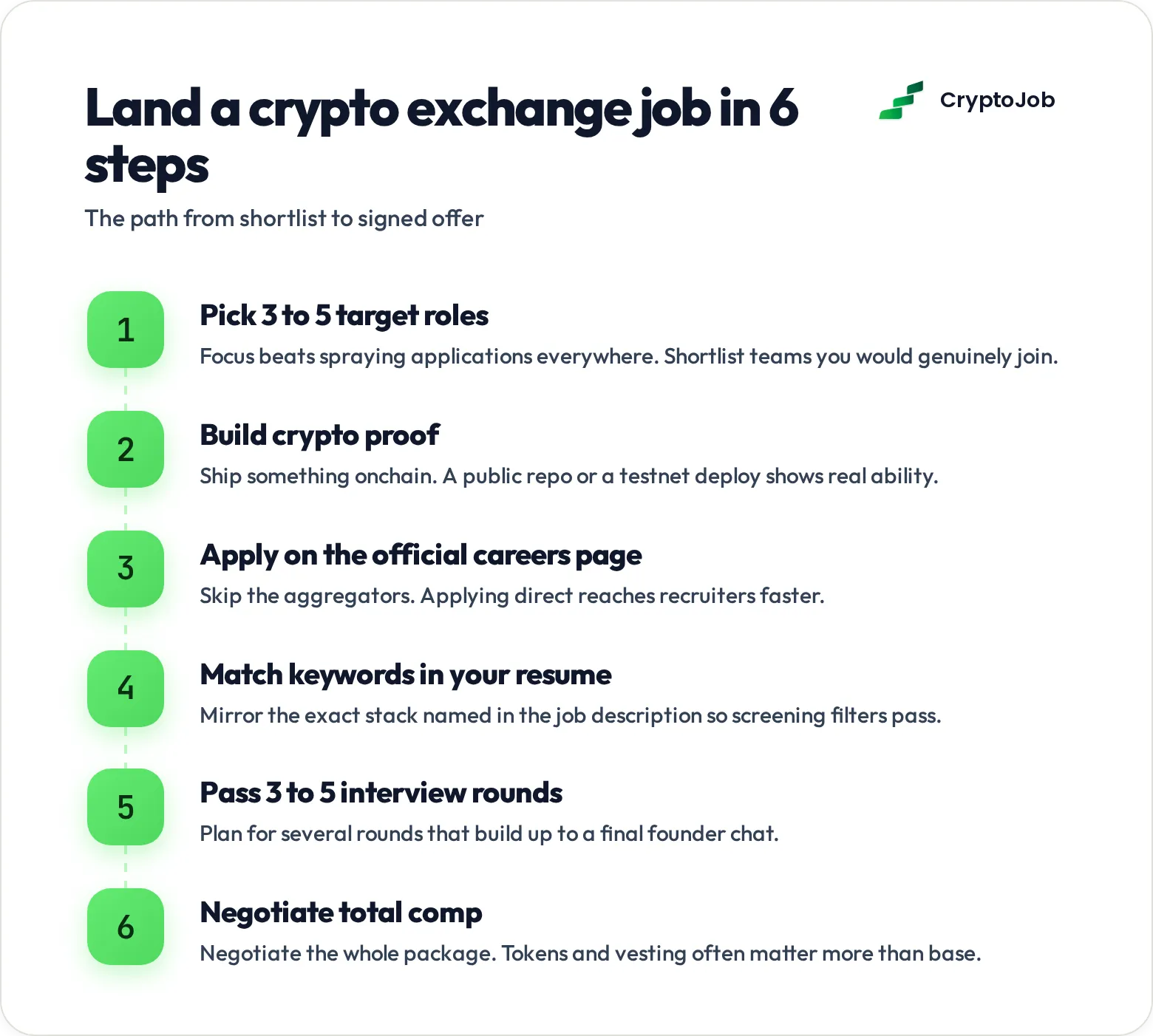
Most exchange hiring follows the same rough shape. Here's the playbook.
1. Pick 3 to 5 target roles. Match your existing skills to a specific job family. Don't apply as a generalist.
2. Build crypto proof. Use the products. Trade on the exchange you're applying to, try their staking or earn features and be ready to critique the UX. Interviewers ask.
3. Apply on the official careers page. Exchanges get flooded with fake job scams, so only apply via binance.com/careers, coinbase.com/careers, kraken.com/careers or a verified job board.
4. Tailor your resume with keywords. Multiple exchanges now use AI screening. Mirror the exact skill terms from the job description.
5. Prepare for 3 to 5 rounds. Typical flow: recruiter screen, hiring manager interview, technical or case round, then values or team fit. Binance averages 4 interviews over 2 to 4 weeks.
6. Negotiate total comp, not just base. Ask about equity or token grants, bonus structure and whether crypto payment options exist.
5. Can You Get Crypto Exchange Jobs Without Crypto Experience?
Yes, and it happens constantly. Exchanges hire far more people from banking, big tech, customer service and law than from other crypto companies.
The move is to translate your existing skills. A bank AML analyst is a crypto compliance analyst after a few weeks of learning chain analysis tools. A SaaS support lead is an exchange support lead who understands wallets. A fintech PM is a crypto PM who has used the product for six months.
What you can't skip is demonstrated interest. That means using the products, following the industry and being able to explain concepts like custody, KYC or staking in plain language. Free certifications help too. Coursera blockchain courses, the CAMS certification for compliance and exchange-run academies all signal seriousness without costing much.
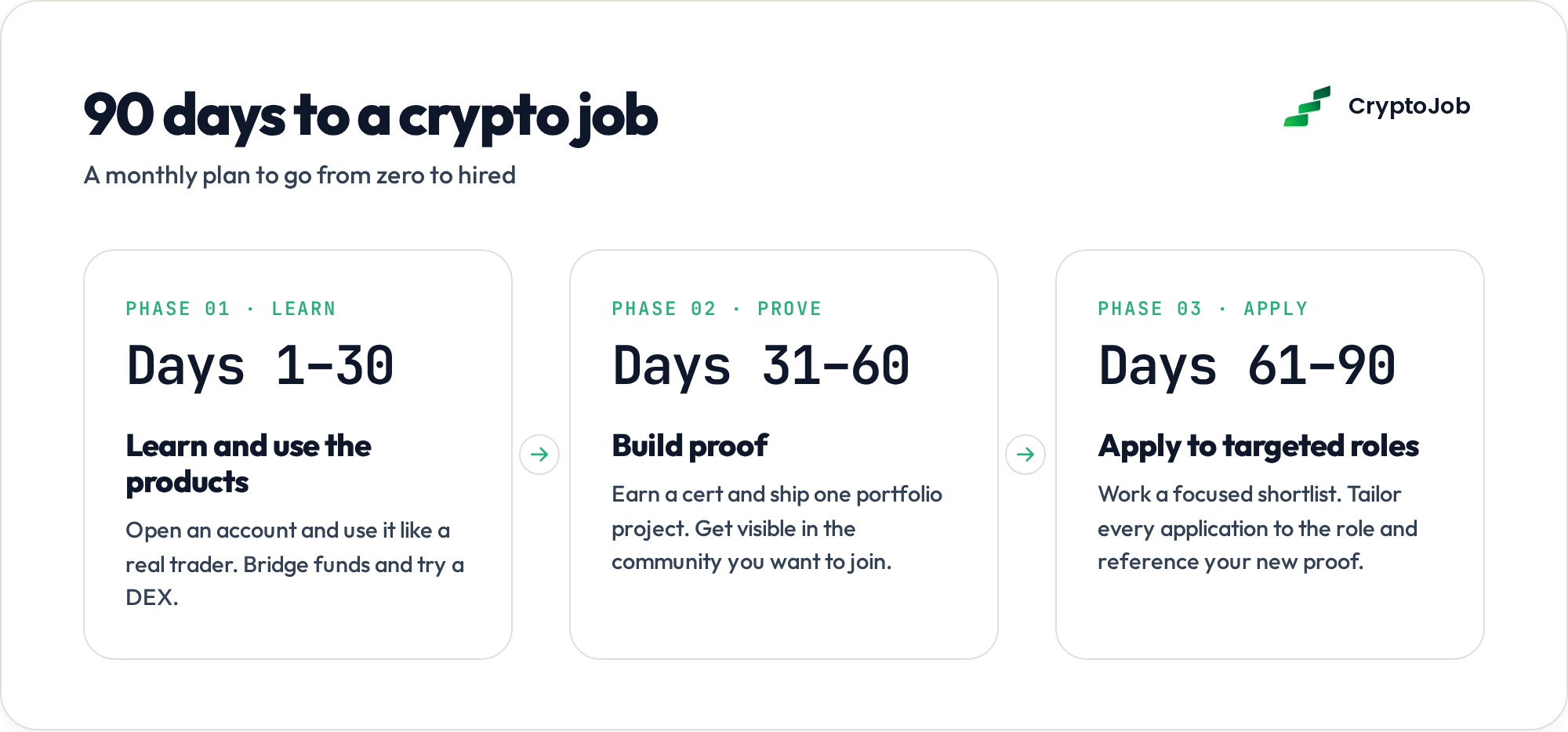
Give yourself a 90-day runway: 30 days learning and using products, 30 days building proof (a portfolio, community activity, a certification), 30 days applying to targeted roles.
Ready to Start Applying?
Crypto exchange jobs are more accessible than most people assume. Half the roles are non-technical, remote work is standard and the pay competes with traditional finance. The candidates who win are the ones who show real product knowledge and apply to specific roles instead of spraying resumes.
Start by shortlisting 5 target roles this week. You can browse web3 jobs on CryptoJob to see live openings at exchanges and other crypto companies right now.
FAQ
Do crypto exchange jobs require a degree?
Usually not for support, community or marketing roles, where skills and demonstrated crypto knowledge matter more. Engineering, legal and compliance roles typically expect a relevant degree or equivalent professional experience.
How long does it take to get hired at a crypto exchange?
Binance averages 2 to 4 weeks with about 4 interviews. Coinbase and Kraken commonly take 4 to 8 weeks depending on the role and seniority. Senior and specialized roles can run longer.
Are crypto exchange jobs remote?
Mostly yes. Coinbase and Kraken are remote-first for the majority of roles, and Binance offers remote work across many positions globally. Some compliance and office-based roles require specific locations for regulatory reasons.
What's the highest paying job at a crypto exchange?
Senior engineering and engineering management roles top the charts. Glassdoor data shows senior engineering managers at Coinbase earning $600,000+ in total US compensation, while senior engineers at major exchanges commonly earn $180,000 to $260,000 base.
Is it risky to work at a crypto exchange?
There's real cyclical risk. Exchanges hire aggressively in bull markets and cut staff in downturns, so build savings and keep your skills transferable. Choosing regulated, established exchanges reduces the risk of sudden collapse.