How to Network Your Way Into a Crypto Job (X, Discord and IRL)
How to network your way into a crypto job in 2026 using X, Discord and in-person events and turn connections into offers.

TLDR: Roughly 70% of senior web3 roles are filled through private networks, not public job boards., Web3 hiring is public-output-first: a visible GitHub, Dune profile or shipped project opens doors.: The three highest-leverage channels are X (Twitter), Discord and in-person events.: A warm introduction beats a cold application almost every time.
Learning how to network into a crypto job is arguably the highest-leverage career move in web3, because most of the best roles never hit a job board. Around 70% of senior positions are filled through private networks, and hiring managers consistently favor people whose work they can already see. The good news: crypto networking is unusually open and merit-driven if you show up and contribute.
This guide covers the three channels that matter most, X, Discord and in-person events, plus how to turn connections into offers. To see what is posted publicly, you can browse web3 jobs as you read.
1. Why does crypto job networking matter so much?
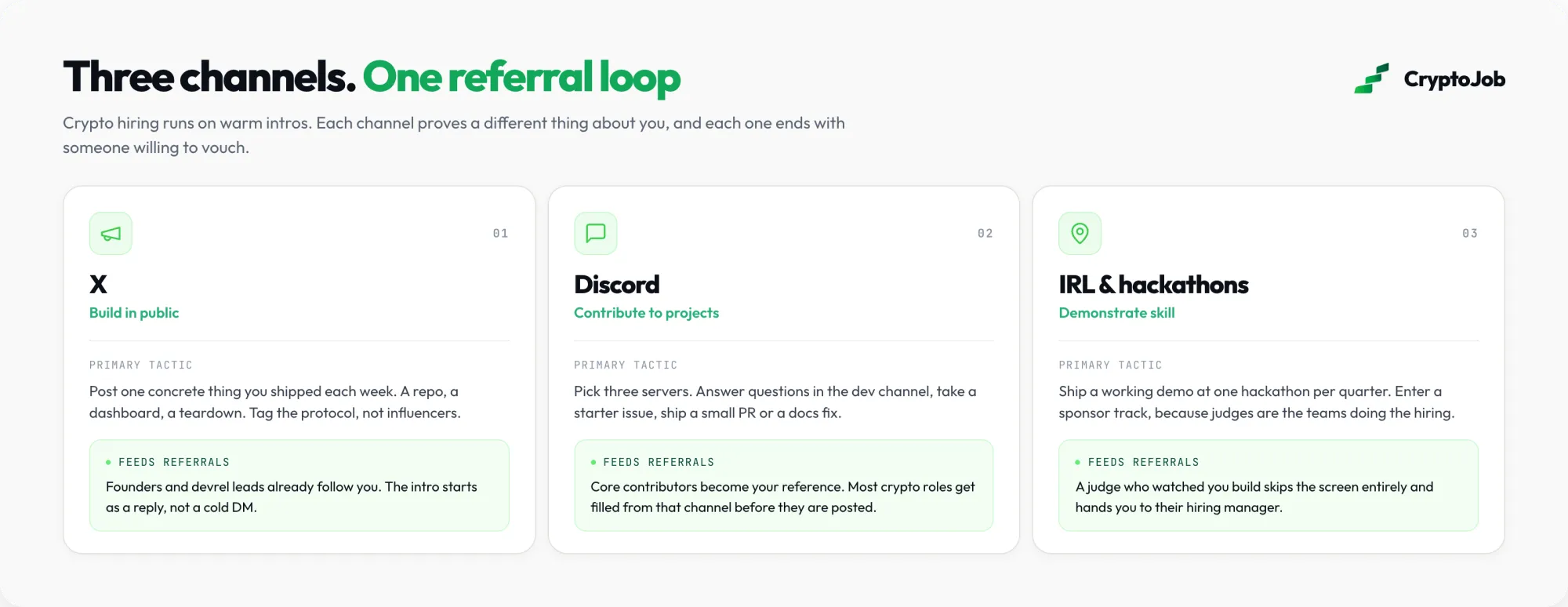
Crypto job networking matters because the sector hires through relationships and visible work far more than through applications. A large share of senior roles are filled through private networks, so the people who hear about them first are those already embedded in the community. Applying cold to public posts means competing for the small slice of roles that get advertised.
There's also a cultural reason. Web3 hiring is public-output-first: contributing to an open-source protocol, running an on-chain dashboard or shipping a small dApp is more legible to hiring managers than a polished CV. Networking and building in public reinforce each other. In practice, the two are almost inseparable: the act of contributing publicly is what gives you something to talk about and someone to talk to. That's why the most effective networkers aren't the most outgoing people, but the ones consistently shipping visible work that gives others a reason to reach out.
2. How do you get a web3 job through Twitter (X)?
Getting a web3 job through Twitter, now X, starts with building in public rather than asking for jobs. Share what you're learning and building, engage thoughtfully with people at teams you admire and let your work speak. Over time, that visibility turns into inbound conversations and referrals.
A few practical habits help:
- Build in public: post projects, findings and progress consistently.
- Engage substantively: add value to threads rather than just liking posts.
- Follow the right people: founders, engineers and recruiters at target teams.
- Make your profile legible: link your GitHub, Dune or portfolio clearly.
3. How do crypto Discord jobs work?
Crypto Discord jobs work through communities, because many protocols run their day-to-day in Discord servers where jobs, bounties and contributor opportunities surface first. Joining the servers of projects you care about and helping out, answering questions, fixing docs, contributing code, is often how people get noticed. Contribution comes before any ask.
Many teams post roles or bounties directly in dedicated channels, and active contributors are frequently invited to apply. Because participation is visible, consistent helpfulness builds a reputation that recruiters and maintainers notice. Bounties in particular let you earn and prove yourself before a full-time conversation.
4. What are the best web3 networking tips for events and IRL?
The best web3 networking tips for in-person events center on giving before getting. Conferences, hackathons and local meetups are where a lot of hiring conversations actually happen and hackathons especially let you demonstrate skill in real time. Showing up with something you've built is far more memorable than a business card.
A few tips that consistently work:
- Prioritize hackathons: they double as networking and proof of skill.
- Lead with your work: show a project rather than pitching yourself abstractly.
- Follow up fast: send a specific, short message within a day of meeting.
- Be genuinely useful: introductions and help compound over time.
Here's how the three main channels compare and what each is best at:
| Channel | Best for | How it leads to a job |
|---|---|---|
| X (Twitter) | Visibility and building in public | Inbound interest and referrals |
| Discord | Direct project involvement | Bounties and contributor invites |
| Events and hackathons | Proving skill in person | Memorable demos and warm intros |
5. How do you turn crypto job networking into an actual offer?
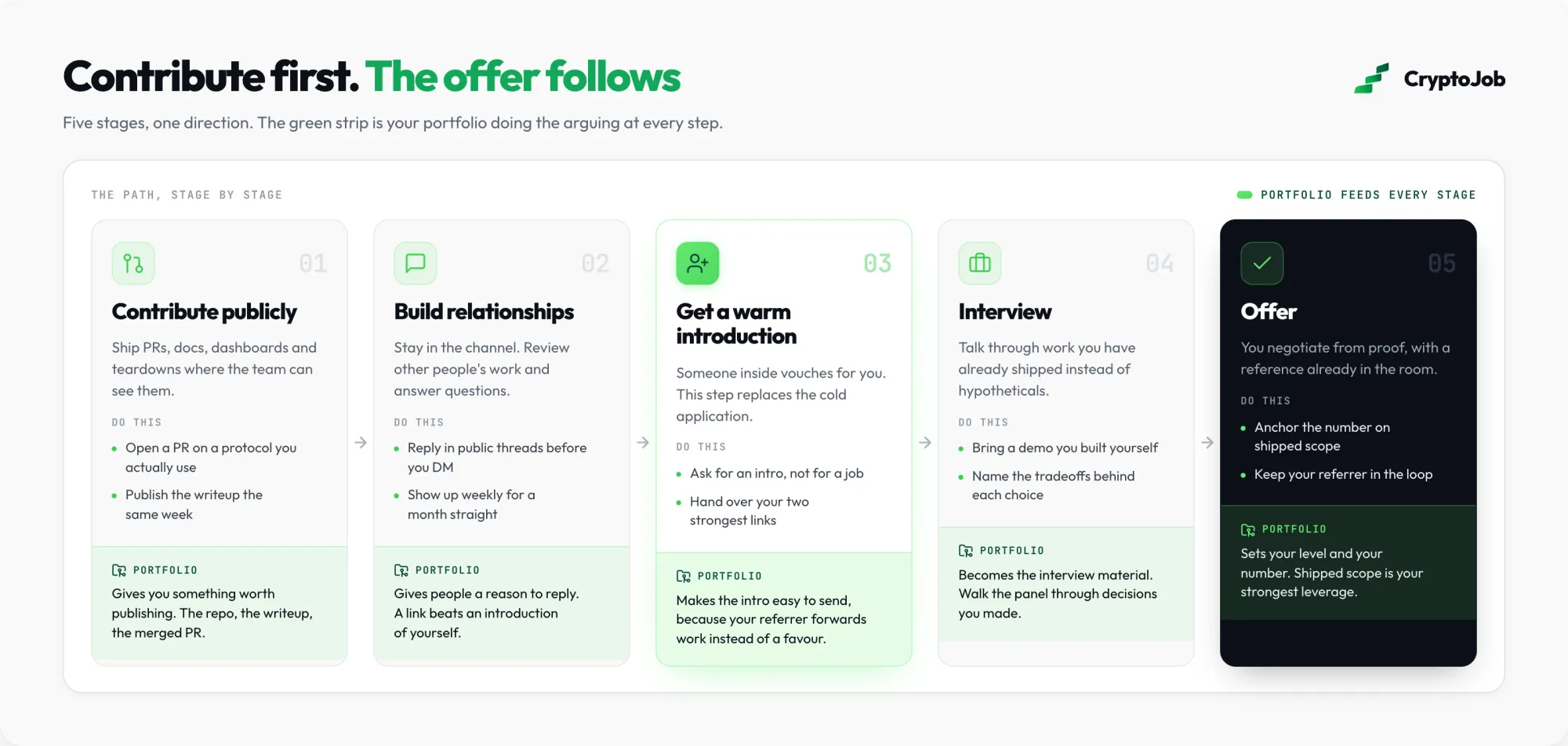
Turning crypto job networking into an offer means converting visibility and relationships into a concrete conversation. The bridge is almost always a piece of work plus a warm introduction, someone who can vouch for you to a hiring manager. A referral from a respected contributor carries enormous weight in this space.
The sequence tends to be: contribute publicly, build relationships through that contribution, then ask for a specific introduction or flag your interest when a role opens. Pair that with a strong portfolio, and you convert far better than through cold applications. Our guides to getting a web3 job with no experience and web3 interview questions help you close once you're in the door.
6. What crypto job networking mistakes should you avoid?
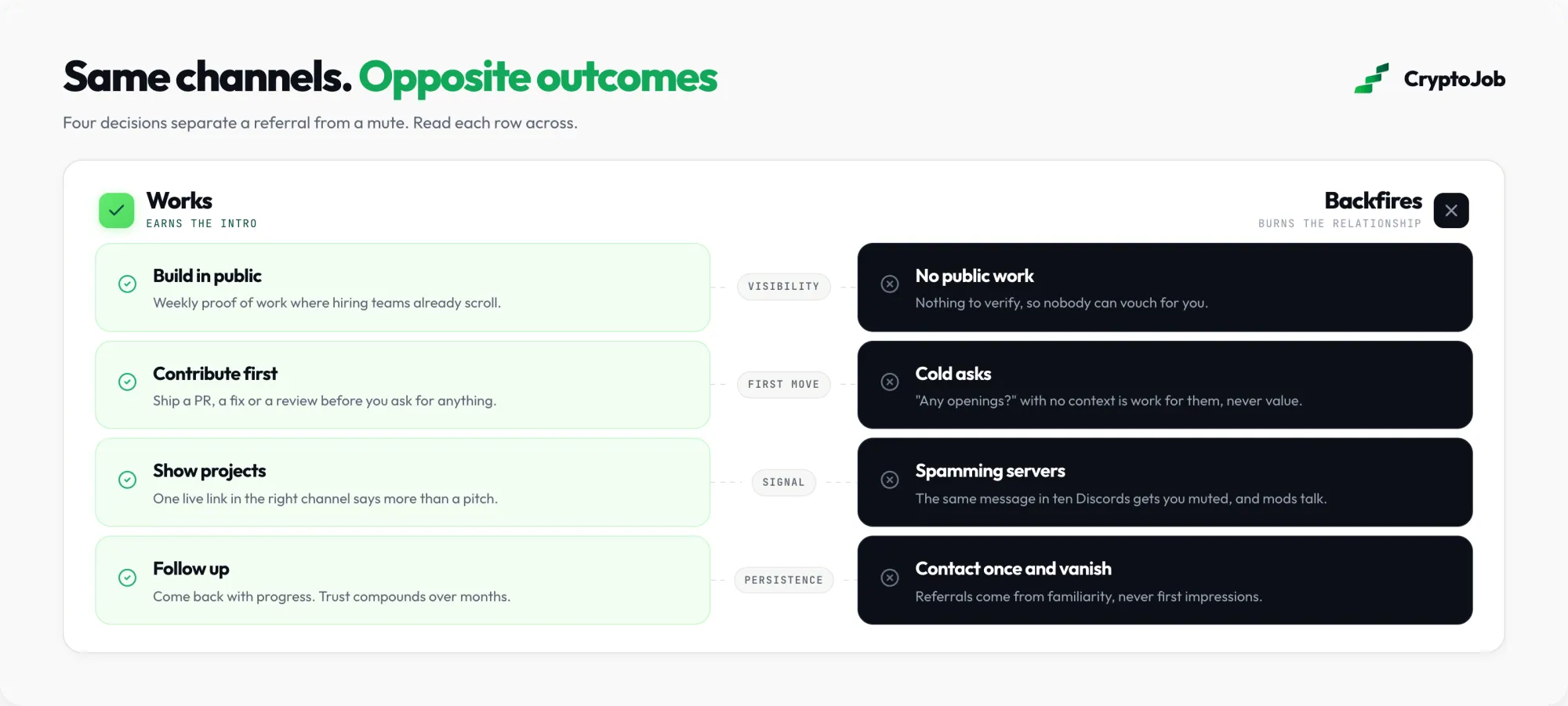
The most common crypto job networking mistakes come down to taking before giving. Cold-messaging strangers to ask for jobs, spamming servers with "hiring?" posts or showing up to events with nothing to show rarely works. The community rewards contribution and reciprocity, and penalizes pure self-promotion.
Another frequent mistake is invisibility: having no public GitHub, Dune profile or shipped project, which hiring managers often read as a sign you haven't built anything. Fix that first, then network from a position of demonstrated skill. Consistency also matters, showing up once and disappearing doesn't build the relationships that lead to referrals.
7. How long does it take to network into a crypto job?
Networking into a crypto job is usually a matter of months rather than weeks, because it depends on building a genuine reputation. Consistent contribution, shipping small projects, helping in Discords, completing bounties, compounds over time into the relationships and visibility that generate referrals. There's no shortcut that replaces showing up repeatedly.
That said, the timeline compresses dramatically once you have visible proof of skill. Someone with a strong public GitHub or a well-known Dune dashboard often gets inbound interest quickly, while someone starting from zero visibility needs longer to build a track record. The work you do in public is what accelerates everything else.
A practical expectation is a few months of steady presence before it reliably pays off, running in parallel with your learning and applications. Because much of it happens alongside building skills anyway, the time isn't wasted even if a specific role doesn't materialize, you're accumulating reputation that keeps working for you.
8. Do recruiters help with crypto job networking?
Specialist crypto recruiters can be a useful complement to your own networking, particularly for senior roles. Because a large share of high-level positions are filled privately, recruiters who are plugged into those networks sometimes have access to roles you'd never see on a job board. Building a relationship with one or two reputable ones can widen your options.
Recruiters are most valuable when you already have a clear profile and target. They can match you to roles, advocate for you and smooth the process, but they can't substitute for demonstrated skill or a portfolio. Treat them as one channel among several rather than a replacement for building your own presence.
The strongest approach combines both: cultivate your own community relationships and public track record, and engage a specialist recruiter for reach into roles that aren't advertised. That way you're covered on both the public and private sides of a market where most of the best opportunities never get posted.
Frequently asked questions
Do you really need to network to get a crypto job?
It's not strictly required, but it dramatically improves your odds, since a large share of senior roles are filled through private networks. You can still apply to public postings, but networking gives you access to the many roles that never get advertised.
Which platform is best for crypto job networking?
X (Twitter) and Discord are the two most important online channels, complemented by in-person hackathons and conferences. X is best for visibility and building in public; Discord is best for getting involved directly with specific projects.
How do you network in crypto without experience?
Contribute before you ask, fix documentation, answer questions, complete bounties and build small public projects. That visible contribution is what earns introductions and gets you noticed, even without prior crypto experience.
Are hackathons worth it for getting hired?
Yes. Hackathons are among the highest-leverage activities, because they combine networking with a live demonstration of your skills. Many people trace a job offer back to a project or connection made at a hackathon.
How important is a GitHub or Dune profile for networking?
Very important. Web3 hiring is public-output-first, so a visible GitHub, Dune dashboard or portfolio is often the thing that turns a networking conversation into an interview. Its absence is frequently read as a red flag.
The bottom line
Networking your way into a crypto job works because web3 hires through relationships and visible work, not just applications. Build in public, contribute through X and Discord, show up to hackathons and let a warm introduction do the rest. When you're ready, browse web3 jobs alongside the connections you're building.