Ethereum Developer Jobs: The Complete 2026 Career Guide
What Ethereum developer jobs pay in 2026, which skills get you hired and how to break in within 6 to 12 months, even without web3 experience.

TLDR
- Ethereum developer jobs pay roughly $80k to $260k in 2026, with US averages around $135k to $151k
- Solidity, TypeScript and security auditing are the highest-value skills
- Most roles are remote and Layer 2 teams are hiring fastest
- You can go from web2 developer to hired in 6 to 12 months
If you're hunting for Ethereum developer jobs in 2026, here's the short version. Demand is steady, pay beats most traditional software roles and the majority of positions are remote. The average US salary sits around $135,000 according to Glassdoor, while web3-native job boards report averages closer to $151,000 with senior roles reaching $260,000. The catch is that hiring bars have risen since the 2021 free-for-all, so teams now expect shipped code, not just enthusiasm.
This guide covers what roles exist, what they pay, which skills actually get you hired and how to break in. You can browse web3 jobs on CryptoJob right now if you want to see live openings while you read.
1. What Ethereum developer jobs are actually in demand in 2026?
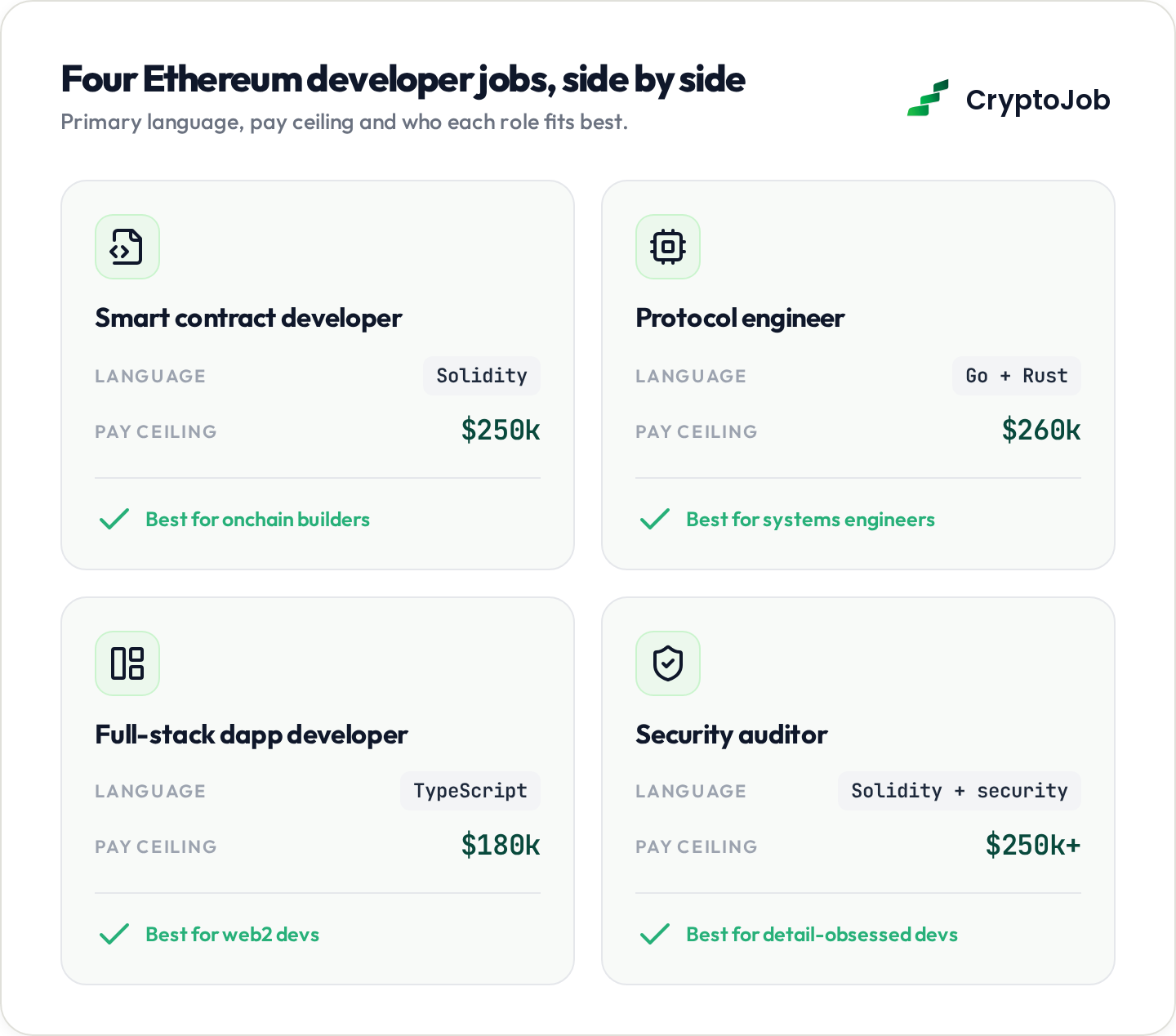
"Ethereum developer" is an umbrella term. In practice, job postings break down into a handful of distinct roles and knowing which one fits you saves months of scattered applications.
Smart contract developer. The classic role. You write, test and deploy Solidity contracts for DeFi protocols, NFT platforms or tokenized asset projects. Foundry has largely replaced Truffle and Hardhat as the expected toolkit, so learn it.
Protocol engineer. You work on Ethereum clients, Layer 2 rollups or infrastructure like bridges and oracles. These roles lean heavily on Go and Rust rather than Solidity and they pay at the top of the market.
Full-stack dapp developer. You connect smart contracts to frontends using TypeScript, React and libraries like viem or wagmi. This is the most common entry point for web2 developers because half the stack is already familiar.
Security researcher or auditor. You find vulnerabilities in smart contracts before attackers do. Audit firms and bug bounty platforms pay exceptionally well and it's one of the few paths where a public track record (audit contests, disclosed findings) can replace formal experience entirely.
The hiring hotspots in 2026 are Layer 2 ecosystems, real-world asset (RWA) tokenization and zero-knowledge proof projects. Wealthvieu's 2026 blockchain salary guide flags ZK development as the highest-growth, highest-pay frontier skill and that matches what shows up in job postings.
2. How much is an Ethereum developer salary in 2026?
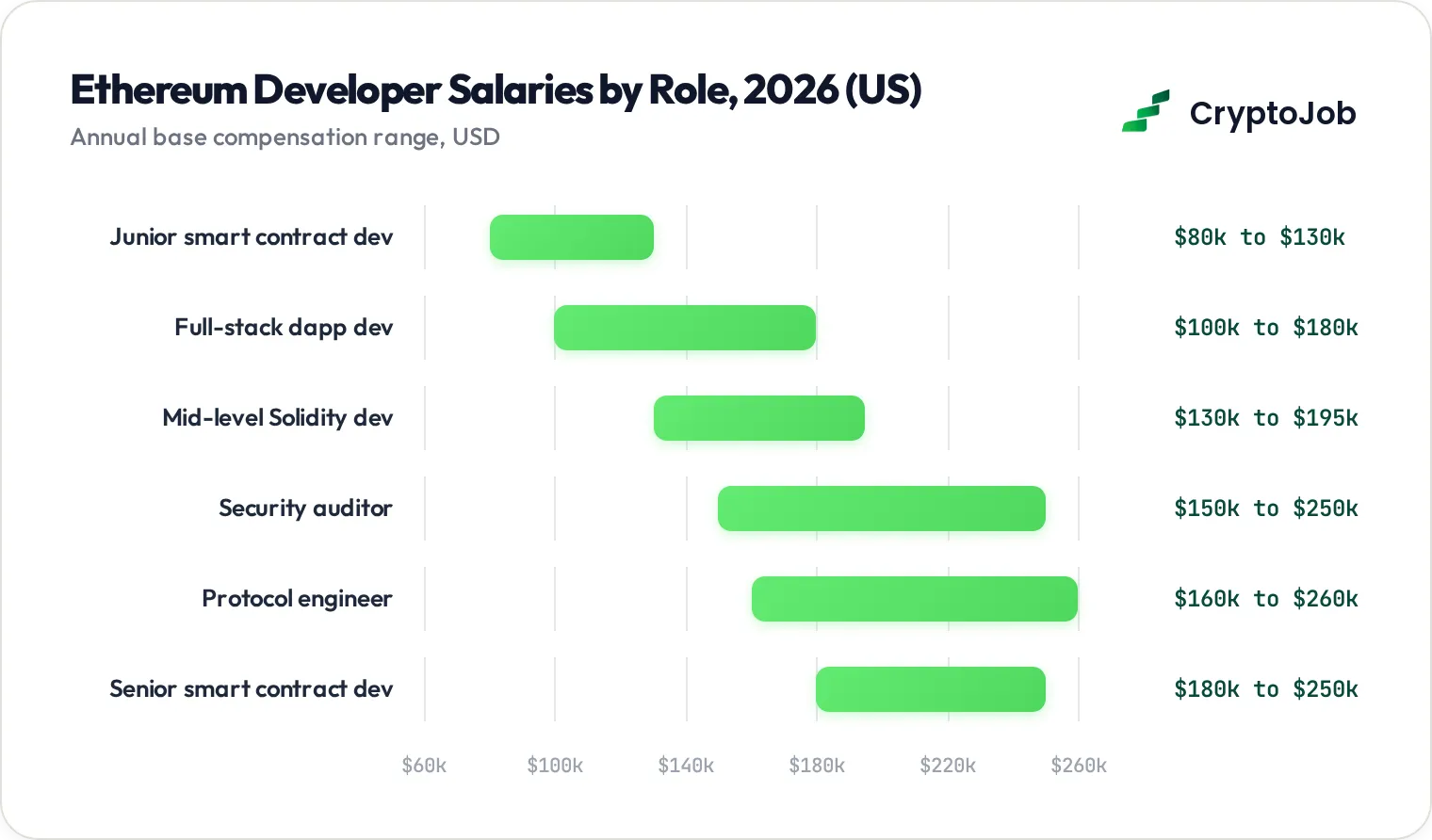
Short answer: it varies a lot by role, seniority and whether the company is web3-native. Here's what the data actually shows.
Glassdoor puts the average Ethereum blockchain developer at about $135,000 per year in the US, with a typical range of $108,000 to $171,000 and top earners above $209,000. Web3.career, which tracks crypto-native postings, reports an average of $151,000 with a floor around $80,000 and a ceiling near $260,000. Crypto.jobs data on Solidity developers specifically shows juniors starting around $120,000, mid-level at $160,000 to $195,000 and seniors reaching $250,000 or more.
Why the spread? Web3-native companies and DeFi protocols pay more than enterprises adding blockchain features. Token or equity packages also stack on top of base salary at many startups, sometimes doubling total compensation. Take averages as a rough map, not a promise.
2.1 How does pay compare across roles?
|
Role |
Typical US range (2026) |
Notes |
|
Junior smart contract dev |
$80k to $130k |
Portfolio required, degree optional |
|
Mid-level Solidity dev |
$130k to $195k |
2 to 4 years or equivalent shipped work |
|
Senior smart contract dev |
$180k to $250k+ |
Often includes token allocation |
|
Protocol engineer (Go/Rust) |
$160k to $260k |
Highest base salaries |
|
Security auditor (mid to senior) |
$150k to $250k+ |
Contest winnings and bounties on top |
|
Full-stack dapp dev |
$100k to $180k |
Easiest transition from web2 |
These are US-market figures. Remote roles at global companies often pay 10 to 30 percent less if benchmarked to your location, though many web3 teams pay location-agnostic rates.
2.2 Does location still matter for pay?
Less than in traditional tech, but yes. Most Ethereum teams hire remotely and hubs like New York, London, Berlin, Singapore and Dubai still anchor the highest offers for hybrid or in-person roles. If you're outside a hub, remote-first protocols are your best shot at US-level pay.
3. What skills do you need to land Ethereum developer jobs?
Hiring managers in 2026 filter hard on demonstrated ability. Here's the stack that shows up again and again in postings.
Core skills:
- Solidity, including gas optimization and common vulnerability patterns like reentrancy and oracle manipulation
- Foundry for testing and deployment (fuzz tests are a strong signal)
- TypeScript with viem or ethers.js for contract interaction
- Understanding of the EVM at the opcode level for senior roles
Differentiators that raise your offer:
- Rust, for protocol work and the growing Arbitrum Stylus ecosystem
- ZK proof systems like Circom or Noir
- A security mindset, ideally with Code4rena or Sherlock contest results
- Experience with account abstraction (ERC-4337) and L2 deployment quirks
Notice what's not on the list: certifications. Web3 hiring is portfolio-driven. One well-tested, deployed protocol on GitHub beats any certificate.
4. How do you break in without professional web3 experience?
A realistic 6 to 12 month path looks like this. First, learn Solidity fundamentals through free resources like CryptoZombies, the Cyfrin Updraft courses or Speedrun Ethereum. Second, build and deploy two or three real projects on a testnet and then mainnet, with full test suites in Foundry.
Third, get public proof. Enter audit contests, contribute to open source protocols or win a hackathon like ETHGlobal. Hackathon wins convert to job offers more often than any other single credential in this industry.
Finally, apply where competition is thinner. Smaller L2 ecosystem projects and infrastructure teams get far fewer applicants than the big-name DeFi protocols.
5. Where do you actually find eth dev jobs?
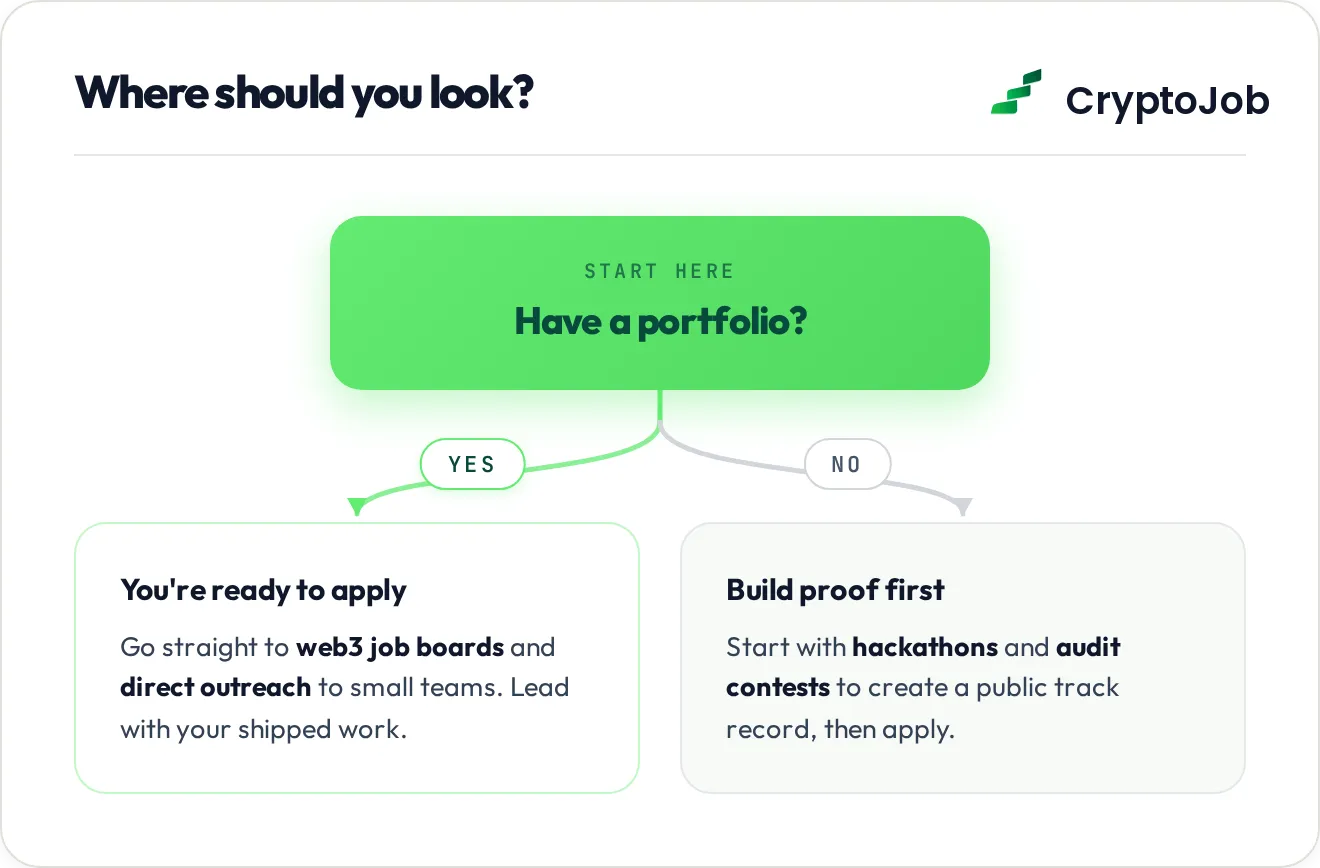
Generalist boards like LinkedIn carry some listings, but the best eth dev jobs cluster on crypto-native channels. Here's where to look, in order of signal quality.
Web3 job boards. Dedicated boards list roles from protocols, L2s, wallets and audit firms that never hit LinkedIn. Filter for "Solidity," "smart contract" or "protocol engineer" rather than the generic "blockchain developer."
Ecosystem channels. The Ethereum Foundation, major L2 teams and DeFi protocols post openings in their Discord servers and governance forums first. If you use a protocol daily, watch its channels.
Hackathons and contests. ETHGlobal events and audit platforms double as recruiting pipelines. Teams routinely hire finalists on the spot.
Direct outreach. Web3 teams are small. A short message to a founder with a link to a relevant project you built gets replies at a rate that would shock anyone used to web2 job hunting.
Set up alerts on one or two boards, then spend the rest of your energy building things worth pointing to. Applications without proof of work mostly go nowhere in this market.
6. Is 2026 a good time to become an Ethereum developer?
Honestly, yes, with one caveat. The market matured after the last cycle, which means fewer moonshot startups but a much stronger institutional floor. Tokenized real-world assets, stablecoin infrastructure and L2 scaling all have enterprise money behind them now, so demand is less tied to token prices than it was in 2021.
The caveat is that the bar is higher. The developers getting hired in 2026 are the ones who ship, test and can talk about security. If you're willing to put in 6 to 12 months of focused building, the supply of genuinely skilled Ethereum developers is still small enough that you'll stand out.
Ready to test the market? Browse web3 jobs on CryptoJob and see which roles match the skills you already have.
FAQ
Do I need a computer science degree for Ethereum developer jobs?
No. Web3 hiring is portfolio-first. Deployed contracts, audit contest results and hackathon wins carry more weight than a degree at most crypto-native companies. A CS background helps for protocol engineering roles that involve cryptography or client development, but it's not a gate.
How long does it take to become job-ready?
For a developer with existing programming experience, 6 to 12 months of focused work is realistic. Complete beginners should budget 12 to 24 months. The timeline depends less on study hours and more on how quickly you start shipping real projects.
Are Ethereum developer jobs remote?
Mostly, yes. The majority of web3 teams are remote-first and distributed globally. Some larger companies and exchanges prefer hubs like New York, London or Singapore, but remote roles dominate the listings.
What's the difference between an Ethereum developer and a blockchain developer?
An Ethereum developer specializes in the Ethereum ecosystem: Solidity, the EVM and L2s like Arbitrum, Base and Optimism. "Blockchain developer" is broader and can include Solana (Rust), Cosmos (Go) or enterprise chains. Ethereum skills transfer well across all EVM-compatible chains, which is most of them.
Do Ethereum developers get paid in crypto?
Sometimes. Many teams offer a base salary in fiat or stablecoins plus a token allocation that vests over time. Ask how tokens are valued and what the vesting schedule looks like before comparing offers, because a big token grant at an early-stage project is a lottery ticket, not salary.