Blockchain Protocol Engineer Jobs: Path to a Six-Figure Role
Protocol engineers build the chains themselves and earn $130k to $250k+. Here's what the work involves and how to break in.

TLDR
- Protocol engineer jobs in the US typically pay $120k to $200k base, with senior roles at $200k to $300k+ once tokens are included
- Rust and Go dominate; Solidity alone won't get you hired
- Most hires have 2+ years of systems or backend experience first
- Open source contributions to a live protocol beat certifications every time
If you can write low-level systems code and understand distributed consensus, protocol engineering is one of the highest-paying paths in crypto. These are the people who build the blockchains themselves, not the apps on top. Compensation regularly clears six figures at entry level, remote work is the norm and demand has stayed strong even through bear markets. This guide covers what the role involves, what it pays, the exact skills hiring teams screen for and how to break in. You can browse web3 jobs on CryptoJob to see what's live right now.
1. What do protocol engineer jobs actually involve?
A protocol engineer works on the base layer of a blockchain. That means consensus mechanisms, peer-to-peer networking, transaction execution, state management and node client software. If the chain goes down, this is the team that gets paged.
Day to day, you might be optimizing block propagation, implementing a new EIP in a client like Geth or Reth, hardening the mempool against spam or shipping a hard fork upgrade. The work is closer to operating systems and databases than to typical web development. Correctness matters more than shipping speed because bugs at this layer can cost users real money.
Typical employers include Layer 1 foundations (Ethereum, Solana, Avalanche), Layer 2 teams (Optimism, Arbitrum, Base, zkSync), client teams (Sigma Prime, Nethermind, Paradigm's Reth contributors) and infrastructure companies building rollup stacks or data availability layers.
1.1 What is a core protocol developer responsible for?
Core protocol developer is often used interchangeably with protocol engineer, but it usually signals the most senior tier of the work. Core devs own the reference implementation of a chain, coordinate network upgrades across multiple client teams and make design decisions that every app on the chain inherits.
On Ethereum, for example, core devs debate and implement EIPs through the AllCoreDevs process. It's part engineering, part standards-body work. Expect to write specs and defend design tradeoffs in public, not just push code.
2. How much do protocol engineer jobs pay?
Salaries vary a lot by company stage, location and token package, so treat these as realistic ranges rather than guarantees. That said, the data across major job boards is fairly consistent.
Aggregated job board data puts the average US blockchain engineer at roughly $151k, with a typical range of $117k to $198k. Web3-native boards show a similar picture, with blockchain developer pay averaging around $150k and topping out near $262k on web3.career. Protocol-specific roles tend to sit at the upper end of those figures because the skill bar is higher than for general blockchain development.
A reasonable breakdown by level for US or US-equivalent remote roles:
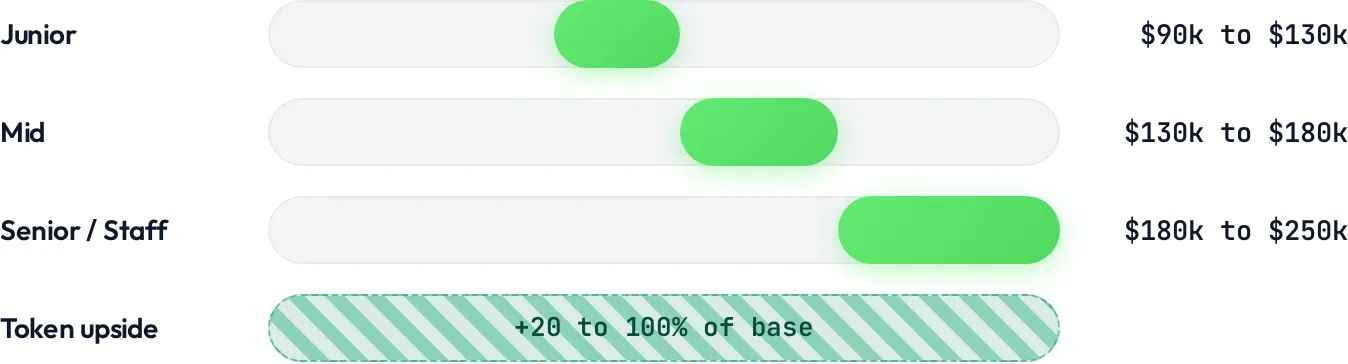
- Junior (0 to 2 years relevant experience): $90k to $130k base. True juniors are rare in this niche.
- Mid-level (2 to 5 years): $130k to $180k base.
- Senior and staff: $180k to $250k base, sometimes more at well-funded foundations.
- Token or equity: often adds 20% to 100% of base at early-stage teams, though vesting and volatility make it hard to bank on.
European and remote-global salaries usually run 15% to 30% below US numbers. Foundations like the Ethereum Foundation historically pay below market in cash but offer stability and reputation that compounds later in your career.
3. Core protocol developer vs smart contract developer: which pays more?
These two roles get confused constantly, so here's the honest comparison. Smart contract developers build applications on top of chains. Protocol engineers build the chains.
|
|
Protocol engineer |
Smart contract developer |
|
Works on |
Consensus, networking, clients, VMs |
DeFi, NFTs, dApps on existing chains |
|
Main languages |
Rust, Go, C++ |
Solidity, Vyper, some Rust |
|
Typical base (US) |
$130k to $250k |
$110k to $200k |
|
Open roles |
Fewer, higher bar |
More plentiful |
|
Background needed |
Systems, distributed computing |
Backend or full-stack web dev |
|
Bear market resilience |
High, chains still need maintainers |
Lower, tied to app funding |
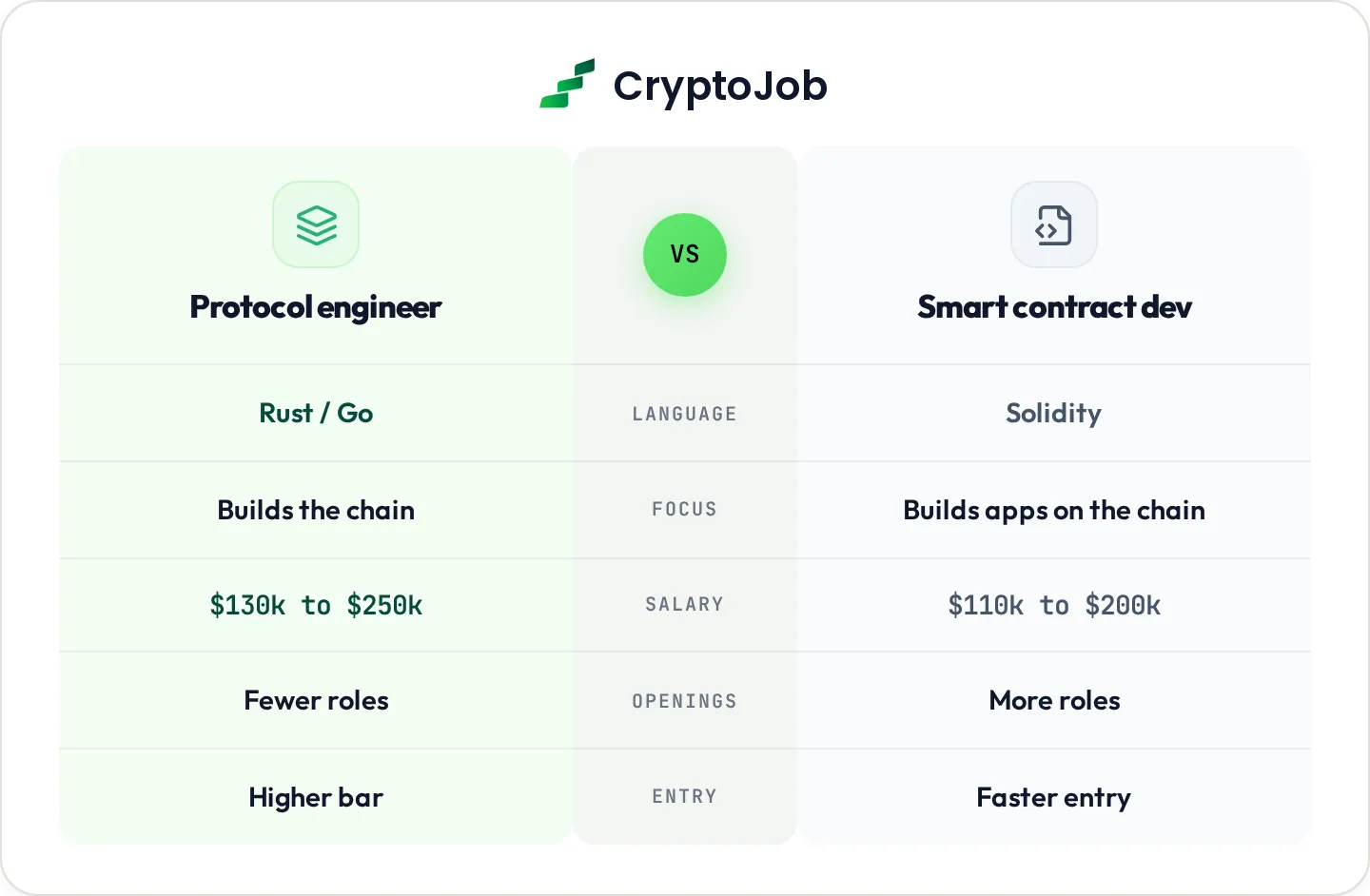
Protocol roles pay more on average and are more stable, but there are fewer of them and the interview bar is steeper. Smart contract work is the faster entry point into web3, and many protocol engineers started there before moving down the stack.
4. What skills do you need for blockchain protocol engineer roles?
Job listings in this niche are remarkably consistent. Here's what shows up in nearly every one.
Languages. Rust is the dominant requirement, appearing in the majority of protocol listings thanks to Solana, Polkadot, Reth and most zk projects. Go matters for Ethereum (Geth) and Cosmos chains. C++ still appears for Bitcoin Core and some older codebases.
Distributed systems fundamentals. You'll be asked about consensus algorithms (Nakamoto consensus, PBFT variants, HotStuff), state machine replication, gossip protocols and CAP tradeoffs. This is the part that filters out most applicants.
Cryptography literacy. You don't need to invent schemes, but you should understand signatures, hash functions, Merkle trees and, increasingly, the basics of zero-knowledge proofs. ZK-adjacent protocol roles frequently pay a premium because so few people qualify.
Systems performance. Profiling, memory management, concurrency and networking at the socket level. Protocol code has to be fast and predictable under adversarial conditions.
A computer science degree helps but isn't required. Shipped code in a public repo matters far more than credentials at almost every team in this space.
5. How do you get protocol engineer jobs without prior web3 experience?
The good news: most protocol engineers didn't start in crypto. Teams actively recruit from database, networking, gaming engine and high-frequency trading backgrounds because the core skills transfer directly. Here's a realistic path.
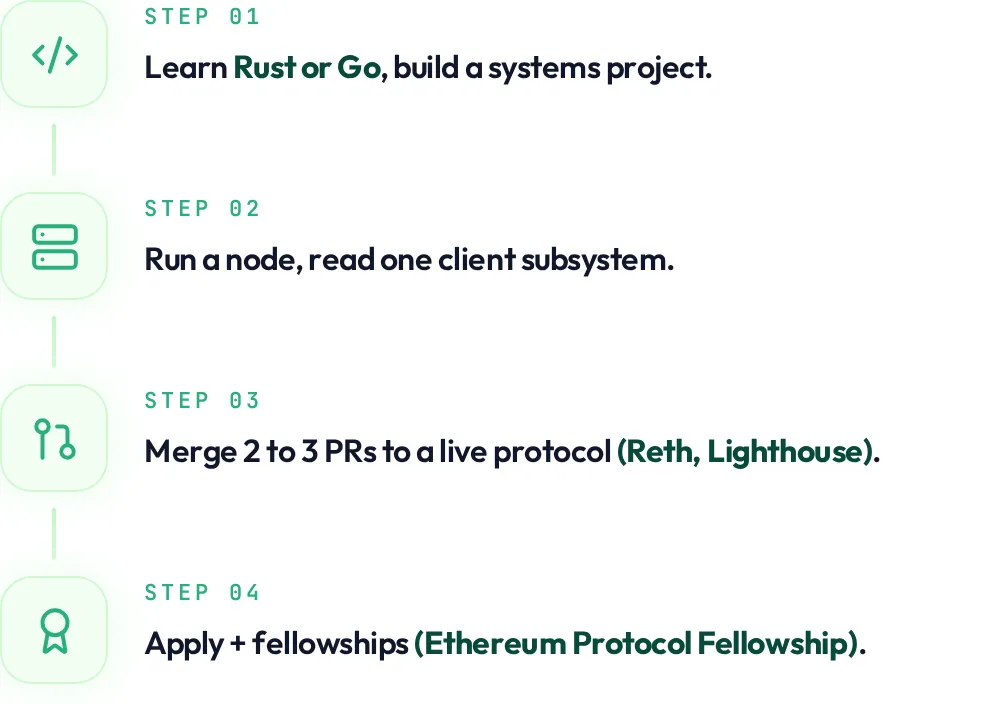
Step 1: Get strong in Rust or Go first. Build something non-trivial like a key-value store, a toy consensus implementation or a networking library. This is your proof of systems ability.
Step 2: Run a node and read a client. Sync an Ethereum or Solana node yourself, then pick one subsystem of a client (the txpool, the p2p layer) and actually read the code. Interviewers can tell immediately who has done this.
Step 3: Contribute to a live protocol. Nearly every major client team (Reth, Lighthouse, Nethermind, Solana Labs) tags good-first-issues on GitHub. One merged PR to a real client is worth more than any certificate. Two or three merged PRs plus a writeup of what you learned is a genuinely competitive application.
Step 4: Apply before you feel ready. Protocol teams are chronically understaffed. If you can pass a systems interview and show one real contribution, you're already ahead of most of the pipeline. Grant programs and fellowships, like the Ethereum Protocol Fellowship, are another underrated on-ramp that pays you to learn the codebase.
The whole path takes roughly 6 to 12 months of focused effort for someone with existing backend experience. It varies by starting point, but that's the honest range.
6. Where should you look for openings?
Generic job boards bury these roles under thousands of unrelated blockchain listings. Web3-native boards are far more efficient. Filter for keywords like "core protocol," "client engineer," "consensus" or "node," and check the GitHub and Discord of protocols you admire, since many teams post there before anywhere else.
Foundations also list roles directly on their sites, and following core devs on X surfaces openings early. Referrals from open source maintainers carry serious weight, which is another reason contributions beat cold applications.
7. Final take
Protocol engineer jobs sit at the intersection of high pay, remote flexibility and genuinely hard engineering. The bar is real, but the path is legible: learn Rust or Go deeply, master distributed systems basics, contribute publicly and apply. Six figures at entry level is normal, and $200k+ within a few years is realistic for people who stick with it.
Ready to start looking? Browse web3 jobs on CryptoJob and filter for protocol and infrastructure roles hiring right now.

FAQ
Do protocol engineer jobs require a computer science degree?
No. Teams hire on demonstrated ability, usually shown through open source contributions and systems interview performance. A degree helps with fundamentals but a merged PR to a live client is stronger evidence.
Is Solidity enough to get a protocol engineering role?
On its own, no. Solidity is for smart contracts, which run on top of the protocol. For protocol work you need Rust, Go or C++ plus distributed systems knowledge. Solidity experience is still useful context, especially for execution-layer roles.
Are protocol engineer roles remote?
Mostly yes. The majority of listings are remote-first, often with async collaboration across time zones. Some foundations and L2 teams prefer hubs like Berlin, Lisbon, New York or Singapore, but fully remote is the industry default.
How long does it take to become a blockchain protocol engineer?
For a developer with 2+ years of backend or systems experience, roughly 6 to 12 months of focused learning and open source contribution is realistic. Starting from scratch, expect 2 to 3 years. It varies with how much systems programming you already know.
Do protocol engineers get paid in crypto?
Often partially. Common structures are fiat base plus a token grant vesting over 2 to 4 years. Some teams offer a choice of payout mix. Treat token compensation as upside, not guaranteed income, since value fluctuates heavily.