Remote Web3 Jobs: How to Find Legit Flexible Roles
Web3 hires remote by default, but scam listings are everywhere. Here's where to find legit roles, what they pay and how to verify a listing.

TLDR
- Most web3 companies hire remote by default. Dedicated crypto job boards list hundreds of open roles at any time.
- Remote web3 jobs pay roughly $50k to $250k+ depending on role and seniority.
- Smart contract engineers earn the most, often $130k to $250k.
- Legit roles never ask for upfront payments, "equipment fees" or your seed phrase.
The fastest way to find remote web3 jobs is through dedicated crypto job boards, official project careers pages and community channels like Discord. Web3 is one of the few industries where remote is the default, not a perk. Most protocols and exchanges run distributed teams across time zones because crypto markets never close.
The catch is that the space also attracts scammers who post fake listings to steal money or wallet access. This guide covers where to look, what different roles actually pay and how to filter out the junk before you waste time applying.
You can browse web3 jobs on CryptoJob right now to see what companies are hiring for this week, then use the rest of this guide to sharpen your search.
1. Where Can You Find Remote Web3 Jobs?
There are four main channels, and each one works differently. Job boards are the fastest way to see volume. Community channels are the fastest way to get noticed.
Crypto-native job boards like CryptoJob's careers page aggregate roles from exchanges, protocols, wallets and infrastructure companies. Unlike LinkedIn, listings are pre-filtered for the industry, so you skip the "blockchain-adjacent" noise.
DAO contributor platforms work differently. Instead of applying for a job, you pick up bounties or grants, get paid per task and often convert that work into a full-time offer. Platforms in this category include Dework and Gitcoin.
Then there is the direct route. Follow projects you actually use, join their Discord and watch the announcements or jobs channel. Many teams post openings to their community before any job board sees them.
|
Channel |
Best for |
Effort |
Scam risk |
|
Crypto job boards |
Volume and salary transparency |
Low |
Low if the board vets listings |
|
DAO bounty platforms |
Building proof of work, no CV needed |
Medium |
Low to medium |
|
Project Discords and X |
Early access to unposted roles |
High |
Medium, verify official channels |
|
|
Corporate crypto roles (exchanges, custody) |
Low |
Medium, fake recruiters are common |
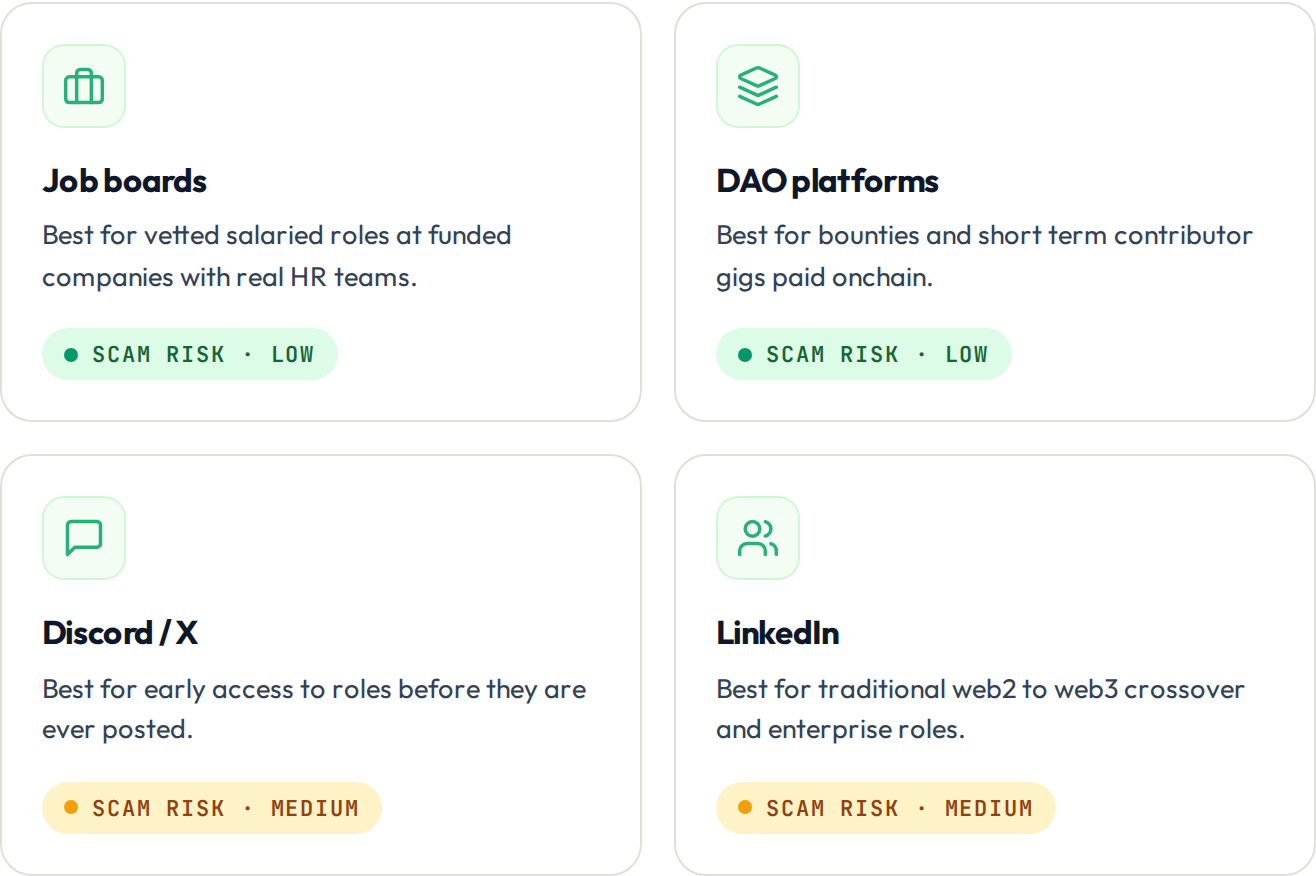
One warning on LinkedIn specifically. Fake recruiter profiles impersonating real crypto companies are a known attack vector. Always verify the recruiter works at the company by checking the company's official site or asking in their public Discord.
2. How Much Do Remote Crypto Jobs Pay?
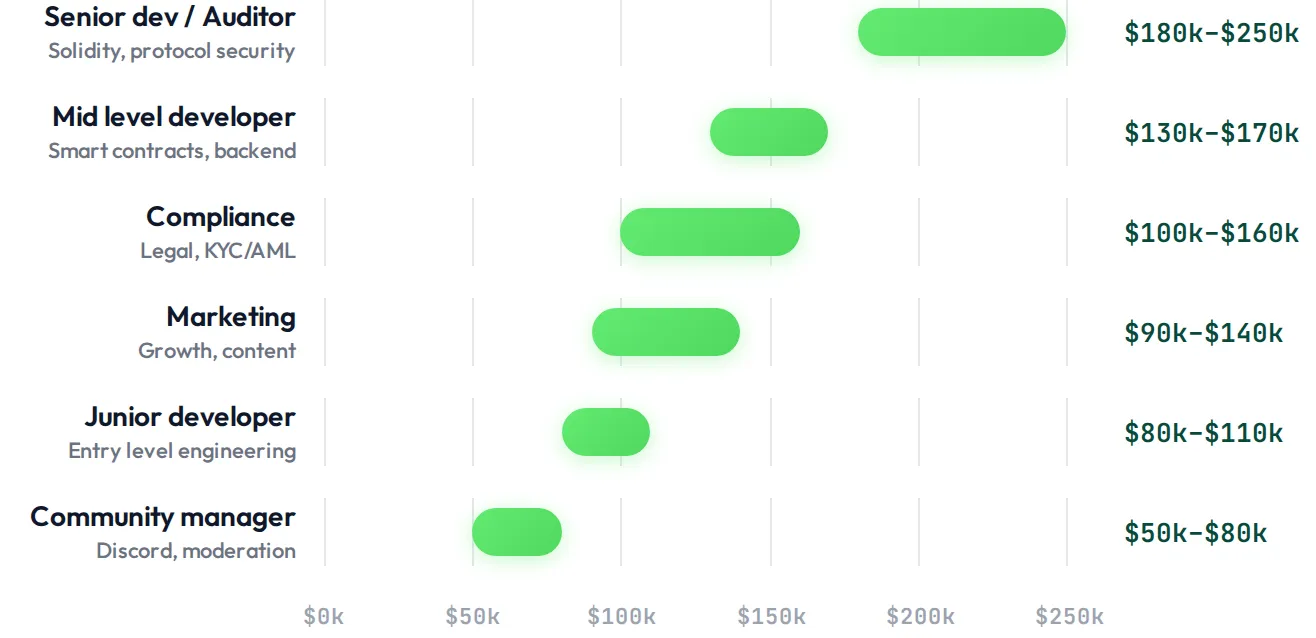
Pay varies a lot by role, seniority and how the company handles geography, so treat every figure here as a range rather than a promise. Based on aggregated data from crypto job boards and salary reports in 2026, these are realistic bands for full-time remote roles.
2.1 Technical roles
- Junior smart contract or blockchain developers: roughly $80k to $110k
- Mid-level engineers with 2 to 4 years of experience: roughly $130k to $170k
- Senior engineers, security auditors and protocol researchers: roughly $180k to $250k, sometimes higher at well-funded DeFi teams with token allocations on top
2.2 Non-technical roles
- Community managers: roughly $50k to $80k
- Growth and marketing at funded startups: roughly $90k to $140k
- Compliance and legal operations: roughly $100k to $160k depending on jurisdiction expertise
Two trends matter for negotiation. First, the "hire from anywhere at San Francisco rates" era is fading. More companies now benchmark pay to your region, so ask early whether the range is location-adjusted. Second, token compensation has become more structured, with vesting schedules and cliffs, so always ask about total comp rather than base salary alone.
2.3 Which remote crypto jobs pay the most?
Security-focused roles top the market. Smart contract auditors and protocol security engineers command a premium because one exploit can drain a treasury, and the talent pool is small. If you already write Solidity or Rust, adding security auditing skills is the highest-leverage move you can make for your salary.
3. Are Work From Home Blockchain Jobs Legit?
Most are, but the fake ones are designed to look identical to real ones, so you need a filter. Work from home blockchain jobs at real companies follow normal hiring logic. Scam listings break it in predictable ways.
3.1 What are the red flags of a fake web3 job?
Walk away immediately if you see any of these:
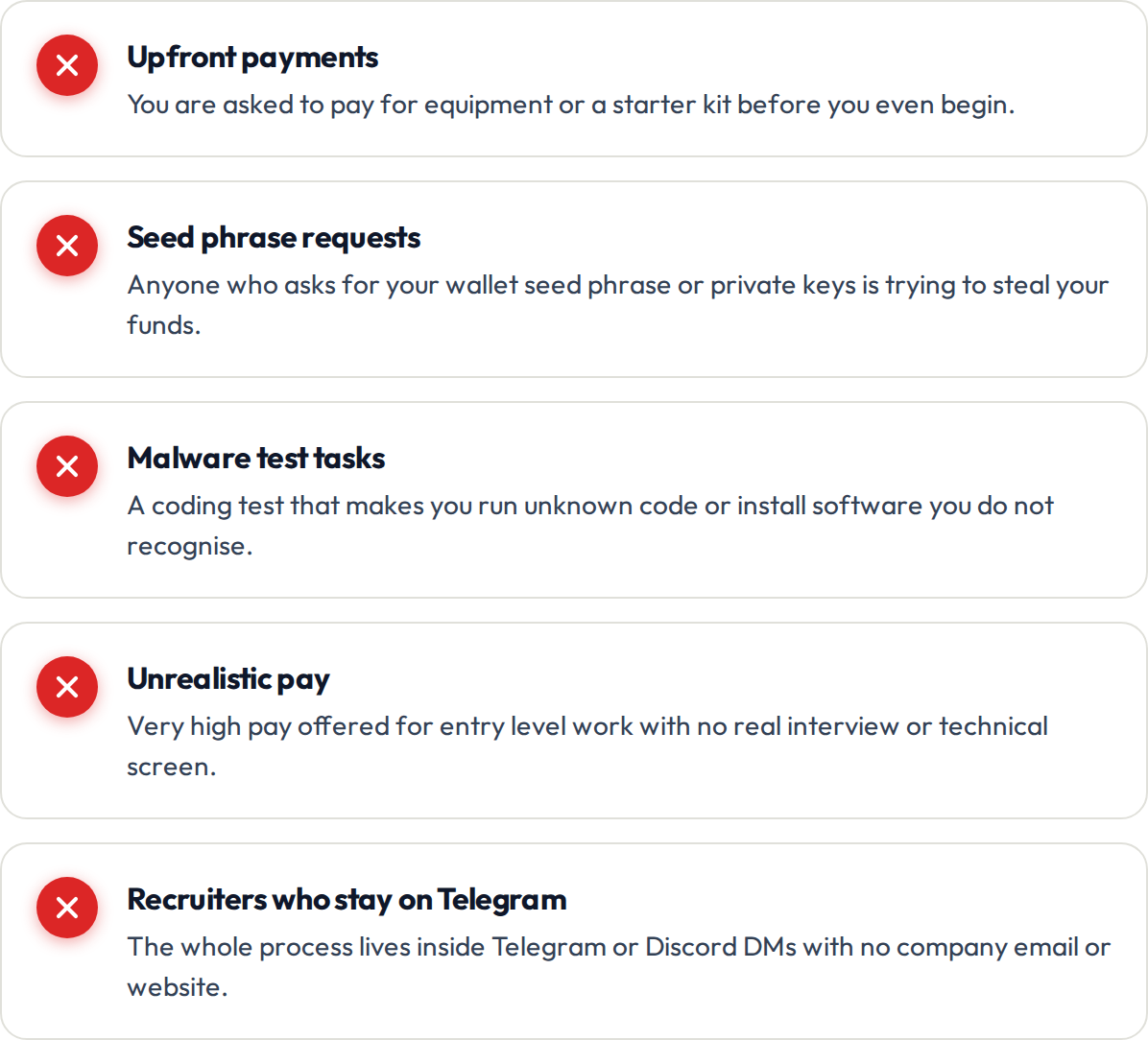
- Upfront payments. No legit employer charges for training, equipment, onboarding or "verification". Ever.
- Wallet access requests. No interview process needs your seed phrase or private keys. This is theft, not a test.
- Test tasks that involve running unknown code. A common attack sends candidates a "coding challenge" repo containing malware that drains wallets. Only run take-home tasks in an isolated environment.
- Pay that ignores gravity. A $200k offer for an entry-level community role with a same-day start is bait.
- Off-platform pressure. Recruiters who push you to Telegram immediately and dodge video calls are usually fake.
3.2 How do you verify a listing is real?
Cross-check the role on the company's official careers page. Confirm the recruiter's identity through the company's verified X account or Discord. Ask for a video interview, since scammers almost always refuse. Five minutes of checking beats weeks of a fake "onboarding" process.
4. How Do You Land Remote Web3 Jobs Without Experience?
Proof of work beats a CV in this industry. Hiring managers in web3 care far more about what you have shipped, written or contributed than where you used to work. That is good news if you are switching from web2, because you can build that proof in weeks rather than years.
A realistic path looks like this:
- Pick a niche. Developer, analyst, marketer, community, BD. Generalist applications get ignored.
- Learn in public. Post threads breaking down protocols, publish Dune dashboards or push code to GitHub. Visibility compounds.
- Do bounties and hackathons. Gitcoin bounties, hackathon projects and DAO tasks are paid practice that doubles as portfolio material.
- Contribute to one community consistently. Teams hire the person already helping in their Discord more often than the stranger with a polished CV.
- Apply with evidence. Lead every application with links to work, not adjectives.
Entry-level openings do exist, including internships and junior roles aimed at web2 switchers, but they are competitive. Contributing first shortens the queue dramatically. Many people in the industry got their first full-time offer from a team they had already done paid bounty work for.
5. What Should You Expect From Remote Web3 Work?
Remote in web3 usually means async-first. Your team might span 10 time zones, so written communication and self-directed output matter more than being online at fixed hours. If you need constant meetings and direction, you will struggle.
Employment structure is different too. Many roles are contractor agreements rather than traditional employment, especially at DAOs and early-stage protocols. That means you handle your own taxes, insurance and retirement in most cases, so factor that into salary negotiations.
Payment can arrive in fiat, stablecoins, tokens or a mix. Stablecoin salaries are common and practical. Token allocations can be significant upside, but ask hard questions about vesting, cliffs and lockups before you count them as income.
Ready to Start Applying?
The formula is simple even if the work is not. Use vetted boards for volume, communities for access, salary data for negotiation and the red flag checklist to protect yourself. Build public proof of work while you apply, because in web3 that portfolio is your CV.
Start with live listings and browse web3 jobs on CryptoJob to see which teams are hiring remotely today.
FAQ
Do remote web3 jobs require coding?
No. Engineering roles dominate the headlines, but companies also hire remotely for marketing, community, BD, operations, design, compliance and content. Non-technical roles typically pay $50k to $140k depending on function and seniority.
Can I get a remote web3 job with no experience?
Yes, but you need proof of work first. Bounties, hackathons, open source contributions and active community participation substitute for a traditional track record. Entry-level listings exist but expect competition.
How are remote web3 workers paid?
Usually via bank transfer or stablecoins like USDC, sometimes with token allocations on top. Many roles are contractor agreements, so you are often responsible for your own taxes and benefits.
How do I know a remote crypto job is legit?
Verify the listing on the company's official careers page, confirm the recruiter through official channels and insist on a video interview. Refuse anything involving upfront payments, seed phrases or running unverified code on your main machine.
What is the highest paying remote web3 role?
Smart contract security auditors and senior protocol engineers, commonly in the $180k to $250k range with token upside on top. Exact figures vary by company funding, region policy and experience.