Ripple Jobs in 2026: Working at the Company Behind XRP
Ripple pays staff engineers like a trading firm and runs one of crypto's best reviewed interview loops. But promotion scores are weak. Here's the full ladder and how to get in.

TLDR
- Ripple jobs: ~180 to 290 open roles across engineering, BD, compliance and payments
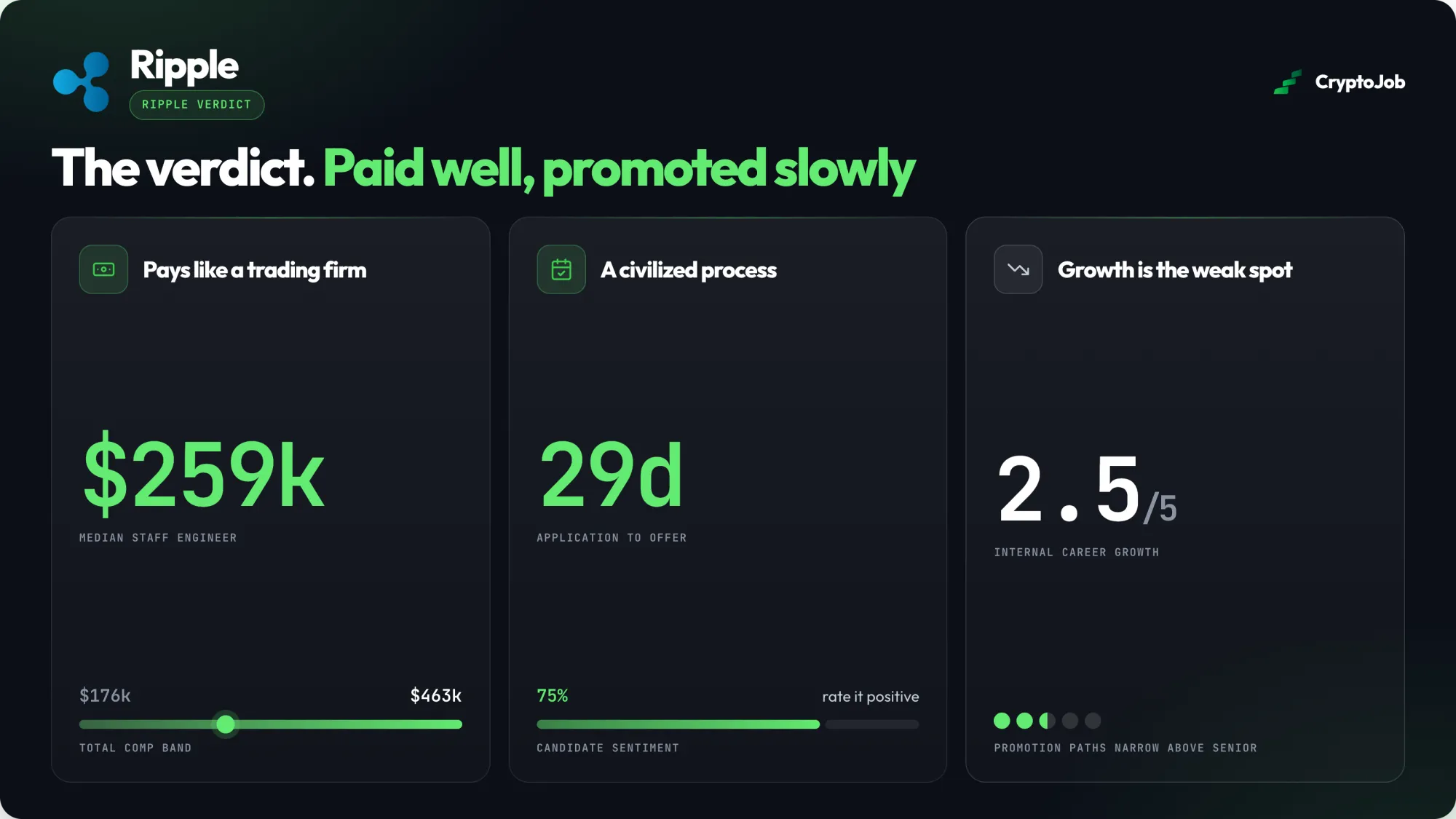
- US engineer pay runs $176k (SWE I) to $463k (Senior Staff); median ~$259k
- Security engineers report a $410k median. Among crypto's highest
- Hiring averages ~29 days, ~37 for engineers; 75% rate the process positive
- Career growth ratings are weak (2.5/5). Pay is the draw, promotion isn't
Ripple jobs pay some of the highest engineering salaries in crypto. And in 2026 the company is hiring at scale, with roughly 180 open roles on Glassdoor's tracker and nearly 290 on another. With its SEC case behind it, the RLUSD stablecoin live and the $1.25 billion Hidden Road acquisition pushing it into prime brokerage, Ripple is building for institutional payments in a way that requires a lot of new people.
This guide covers the full pay ladder, the interview loop from real candidate reports and the one weakness the recruiting pitch won't mention. To weigh Ripple against the wider market as you read, browse web3 jobs on CryptoJob.
The one line summary: Ripple pays staff level engineers like a trading firm, runs a civilized interview process and scores poorly on internal career growth. Optimize accordingly.
1. Why Are Ripple Jobs Paying So Much Right Now?
Because Ripple is competing for bank grade engineers, not crypto generalists. Its products, cross border payments for financial institutions, custody (via acquisitions), the RLUSD stablecoin and now prime brokerage through Hidden Road, sit closer to Wall Street infrastructure than to a retail exchange and the comp reflects it.
The numbers are striking. Levels.fyi puts US software engineer packages at $176k for SWE I rising to $463k for Senior Staff, with a median around $259k. Security engineering is the standout: a reported median of $410k, reflecting how existential security is for a company moving institutional money. Aggregate profiles across roles average around $242k.
Regulatory clarity is the other driver. With the SEC litigation resolved in 2025, Ripple can finally sell aggressively into US institutions. Which is why business development is its single highest reported pay category, topping out above $540k.
2. What Roles Is Ripple Hiring for in 2026?
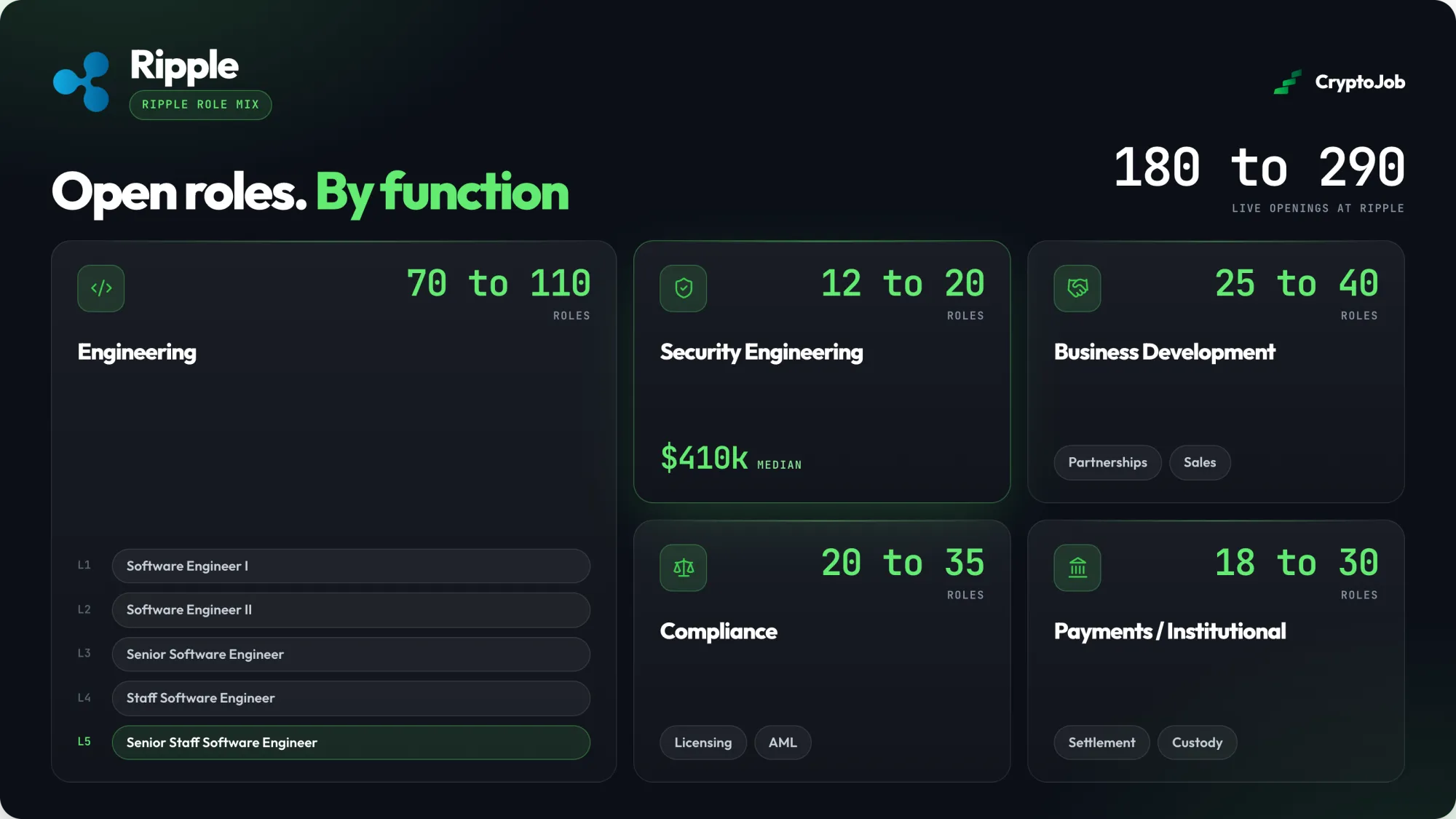
The 180+ openings cluster in:
- Engineering: payments infrastructure, custody, RLUSD/stablecoin systems, XRP Ledger tooling; Java, Spring Boot, Docker and Kubernetes recur in interview reports
- Security: the premium pay track. Application security, infrastructure security, key management
- Business development & institutional sales: bank and fintech coverage, post SEC expansion
- Compliance & legal: licensing and regulatory roles across jurisdictions
- Product: payments, stablecoin and custody product lines
Ripple is office anchored rather than remote first: many roles specify hubs like San Francisco and New York, with international offices adding London, Dublin, Singapore, Toronto and Bengaluru. Perks lean into that model. Catered lunches, stocked kitchens and in person events feature in its own listings. Ripple also sponsors H 1B visas, which matters for international candidates targeting US roles.
2.1 Where do you find official Ripple careers listings?
The official Ripple careers page at ripple.com/careers is the source of truth; roles syndicate from there to LinkedIn and crypto job boards. Listings state which hub cities each role is open to, so filter by location before investing in an application.
3. How Much Do Ripple Jobs Pay?
The most complete ladder we have, from Levels.fyi and Glassdoor (453 US salary reports):
| Level / role | US total comp |
|---|---|
| Software Engineer I | ~$176k |
| Software Engineer (median) | ~$239k to $259k |
| Staff Software Engineer | ~$393k (Glassdoor median) |
| Senior Staff Software Engineer | up to ~$463k |
| Security Software Engineer | ~$410k median |
| Manager (all functions) | ~$208k median |
Employees rate compensation 3.8/5. Solid, though notably the same reviewers rate career opportunities just 2.5/5. Read that pairing honestly: Ripple pays market topping rates to hire you at a level, but internal promotion velocity draws consistent criticism. Negotiate your level hard on the way in, because the data says the ladder moves slowly afterward.
For how these figures sit against the broader market, see our guide to the highest paying web3 jobs.
4. What Is Ripple's Hiring Process?
Faster and better reviewed than most crypto employers. Company wide, hiring averages about 29 days; engineering runs closer to 37. Software engineer candidates rate the experience 75% positive. Dramatically above the 41.5% company wide average, suggesting the engineering loop specifically is well run.
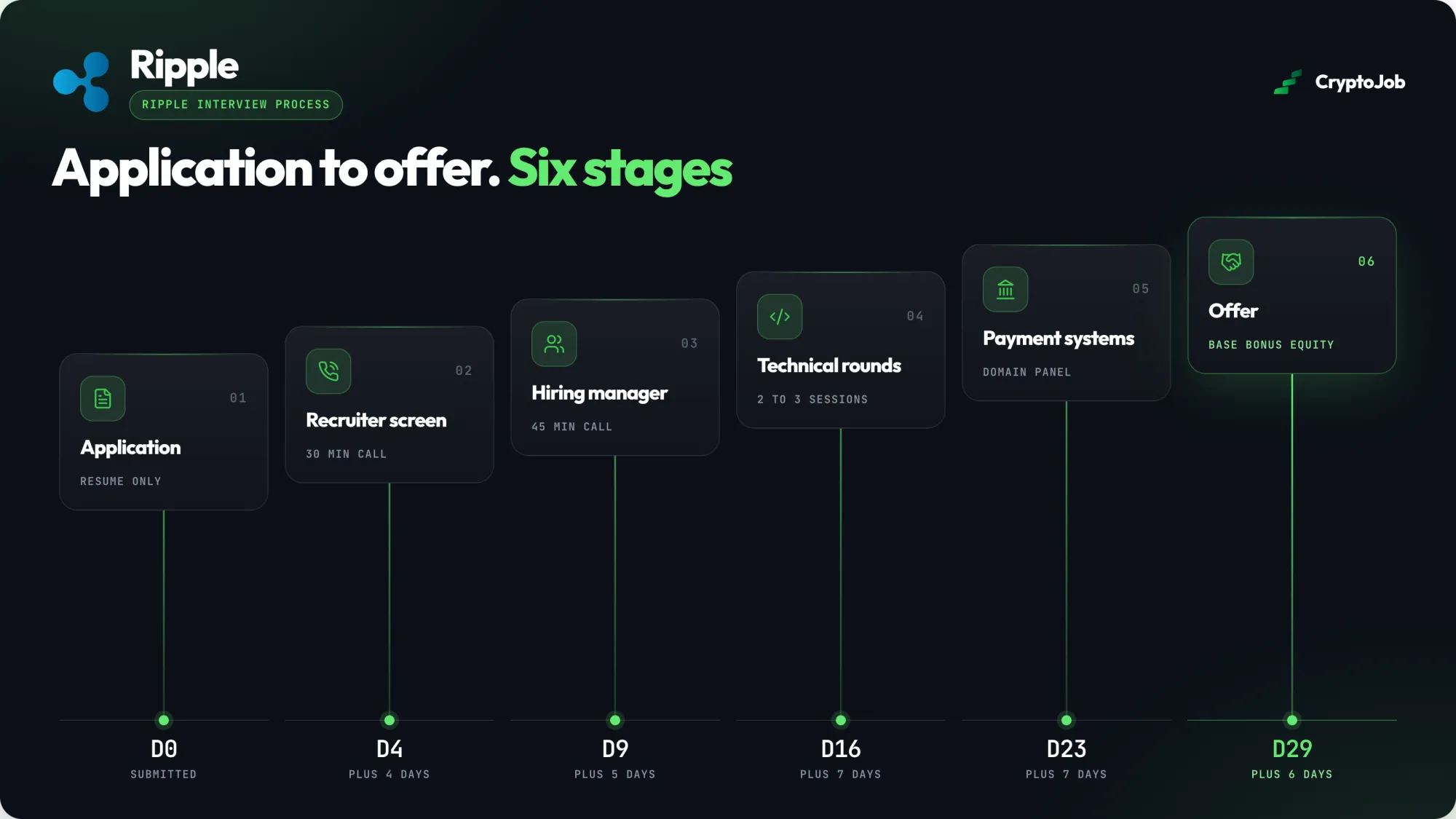
From candidate reports, the typical engineering loop:
- Recruiter screen. Background, logistics, level targeting
- Technical phone screen. One report described a single coding question with an optimization follow up, conversational in tone
- Main loop. Commonly three 45 minute rounds mixing technical and behavioral; deeper loops report three technical rounds covering Java fundamentals, system design and Spring Boot, with Docker, Kubernetes and CI/CD touched on, plus one live coding round
- Hiring manager / behavioral. Accountability and leadership themes recur
- Offer
One practical note: candidates report signing an NDA partway through, which is why detailed Ripple interview questions are scarce online. Prepare fundamentals rather than hunting for leaked questions.
4.1 What should you prepare?
Payment systems design is the signature question domain. Candidates report being asked to design payment systems outright. Practice ledger patterns, idempotency, reconciliation and the reliability trade offs of moving money. For behavioral rounds, prepare ownership stories: times you were accountable for an outcome end to end.
4.2 How do XRP jobs differ from other crypto engineering roles?
Roles touching the XRP Ledger and RLUSD skew toward C++ and distributed consensus fundamentals, while the larger payments organization is Java services territory. Neither requires you to be an XRP believer. But you should understand what the ledger does, how RLUSD competes with USDC and why banks care. For the incumbent's side of that stablecoin fight, see our Circle jobs guide.
4.3 How do you prepare for the payment systems round?
Build fluency in four patterns before the loop. Idempotency: every money movement keyed so a retried message can never double pay. Ledgering: append only entries with derived balances, never mutated totals. Reconciliation: detecting and repairing drift between your system and an external rail. And failure handling on unreliable networks. Timeouts, partial failures and the illusions of exactly once delivery.
Candidate reports suggest the design conversations reward production war stories over textbook answers, so pick two incidents you owned end to end and be ready to walk the timeline, the fix and what you changed structurally afterward. If you've never run payments in production, a well built side project moving testnet value beats hand waving. And it gives the behavioral rounds their accountability story too.
5. How Do You Stand Out When Applying to Ripple?
Lead with regulated finance credibility. Ripple sells to banks, so payments, banking infrastructure or fintech experience beats generic blockchain enthusiasm. The same dynamic we documented at Coinbase, whose profile you can compare in our Coinbase jobs guide.
Second, target the growth surfaces by name: RLUSD, custody and the Hidden Road prime brokerage integration are where new headcount is going. Name the product line in your application and your opening interview answers. Generic "excited about crypto" framing is exactly what this hiring bar is built to filter out. Third, if you're US based, geography helps. SF and NY hub roles have the deepest selection, and our guide to the best cities for crypto jobs covers how those hubs compare.
6. Final Take: Is a Ripple Job Worth Chasing in 2026?
For senior engineers and security specialists, emphatically yes. Few employers anywhere pay $400k+ medians for security work, and the interview process is among the best reviewed in crypto. The honest caveats: it's an office anchored culture and the 2.5/5 career opportunities score means you should treat Ripple as a place to be hired high, not promoted fast.
So calibrate your level before you interview, anchor on the data above and keep alternatives live, browse web3 jobs so your Ripple negotiation happens from strength.
FAQ
How much do Ripple software engineers make?
US packages run from about $176k at SWE I to $463k at Senior Staff, with a median around $259k per Levels.fyi. Security engineers report a $410k median, and Glassdoor's 453 US salary reports show staff engineers around $393k.
Is Ripple remote friendly?
Partially. Ripple is office anchored with hubs in San Francisco, New York, London, Dublin, Singapore, Toronto and Bengaluru and many listings specify eligible hub cities. Fully remote roles exist but are the exception.
How long does Ripple's hiring process take?
About 29 days on average company wide and roughly 37 days for software engineers, per Glassdoor interview data. Engineering candidates rate the experience 75% positive.
Do you need to hold XRP or be a crypto native to work at Ripple?
No. Payments, banking and fintech backgrounds are highly valued and interview reports emphasize Java fundamentals and system design over crypto trivia. You should still understand the XRP Ledger, RLUSD and Ripple's institutional positioning.
Is Ripple a stable employer?
Ripple resolved its SEC litigation in 2025, operates globally and expanded via major acquisitions including the $1.25 billion Hidden Road deal. Note the internal trade off: employees rate pay 3.8/5 but career opportunities just 2.5/5.