Smart Contract Developer Jobs: Skills, Salary and How to Apply
Smart contract developer jobs pay $100k to $150k+ and hire on proof, not pedigree. Here's what to learn, what to expect and how to land one.

TLDR
- Smart contract developer jobs in the US typically pay $100k to $150k, with senior roles reaching $180k or more
- Solidity is still the most in-demand language, with Rust growing fast
- Most roles are fully remote and open to global applicants
- A public GitHub portfolio beats a degree in almost every hiring process
- Fastest entry paths: open source contributions, audit contests and hackathons
Smart contract developer jobs are among the best paid roles in web3, and demand has stayed strong even through market cycles. Most positions pay six figures, hire remotely and care far more about what you've shipped than where you studied. This guide covers the skills employers actually screen for, realistic salary ranges by experience level and a step-by-step way to land your first offer.
If you want to see what's open right now, you can browse web3 jobs on CryptoJob and filter for smart contract roles.
Here's everything you need to know before you apply.
1. What Do Smart Contract Developer Jobs Actually Involve?
Smart contract developers write the on-chain code that handles money, assets and logic for blockchain applications. Think DeFi lending protocols, token launches, NFT marketplaces, DAO governance systems and cross-chain bridges. Unlike most software, this code is usually immutable once deployed and often secures millions of dollars, so security is the core of the job.
A typical week includes writing and testing contracts, reviewing teammates' code, gas optimization and preparing for external audits. You'll work closely with frontend developers who connect your contracts to the app, and with auditors who try to break your code before attackers do.
Common job titles to search for include Smart Contract Developer, Smart Contract Engineer, Solidity Developer, Protocol Engineer and Blockchain Engineer. Protocol Engineer roles tend to sit at the deeper end, building core infrastructure rather than application-layer contracts and usually pay more.
2. What Skills Do You Need for Smart Contract Developer Jobs?
Job listings vary, but the same core requirements show up again and again. Here's what hiring teams actually screen for.
Non-negotiables:
- A smart contract language. Solidity for Ethereum and EVM chains, or Rust for Solana and Cosmos. Move (Aptos, Sui) is a smaller but growing niche.
- Security fundamentals. You should be able to explain reentrancy, integer overflow, front-running, oracle manipulation and access control failures and show how you prevent them.
- Testing and tooling. Foundry is the current standard for EVM work, with Hardhat still common. Expect to write unit tests, fuzz tests and fork tests.
- General software engineering. Git, code review habits and at least one general-purpose language like JavaScript, TypeScript or Python.
Strong differentiators:
- Audit experience, even from public contests on Code4rena, Sherlock or Cantina
- Gas optimization skills with before-and-after numbers you can point to
- Understanding of DeFi primitives like AMMs, lending markets and staking
- Familiarity with proxy patterns and upgradeable contracts
You don't need a computer science degree. Plenty of hired developers came from web2 backgrounds or are self-taught, but every one of them had public code to show.
3. Are Solidity Jobs Still Worth Targeting First?
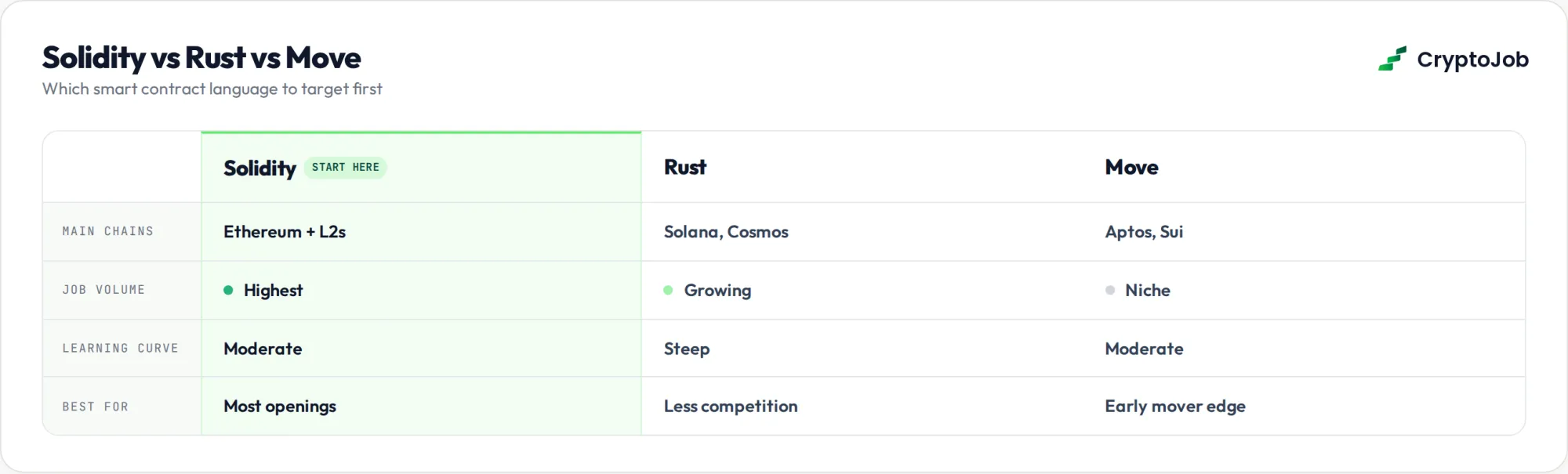
Yes. Solidity jobs make up the largest share of smart contract openings because Ethereum and its Layer 2 ecosystem (Arbitrum, Base, Optimism) still host the majority of DeFi activity. If you're choosing your first language purely on job volume, Solidity wins.
That said, Rust roles are growing on the back of Solana's activity and often face less competition per opening. Rust is harder to learn, which thins the applicant pool. A reasonable strategy is Solidity first for volume, then Rust later to widen your options and raise your rate.
3.1 Which Tools Should You Learn Alongside the Language?
Learn Foundry properly, including its fuzzing and invariant testing features, since many interviews now include a live Foundry exercise. Get comfortable reading verified contracts on Etherscan, because "read this contract and find the bug" is a common screening task. Round it out with OpenZeppelin's contract library, a wallet workflow for testnets and basic scripting to deploy and interact with contracts.
4. How Much Is a Smart Contract Developer Salary in 2026?
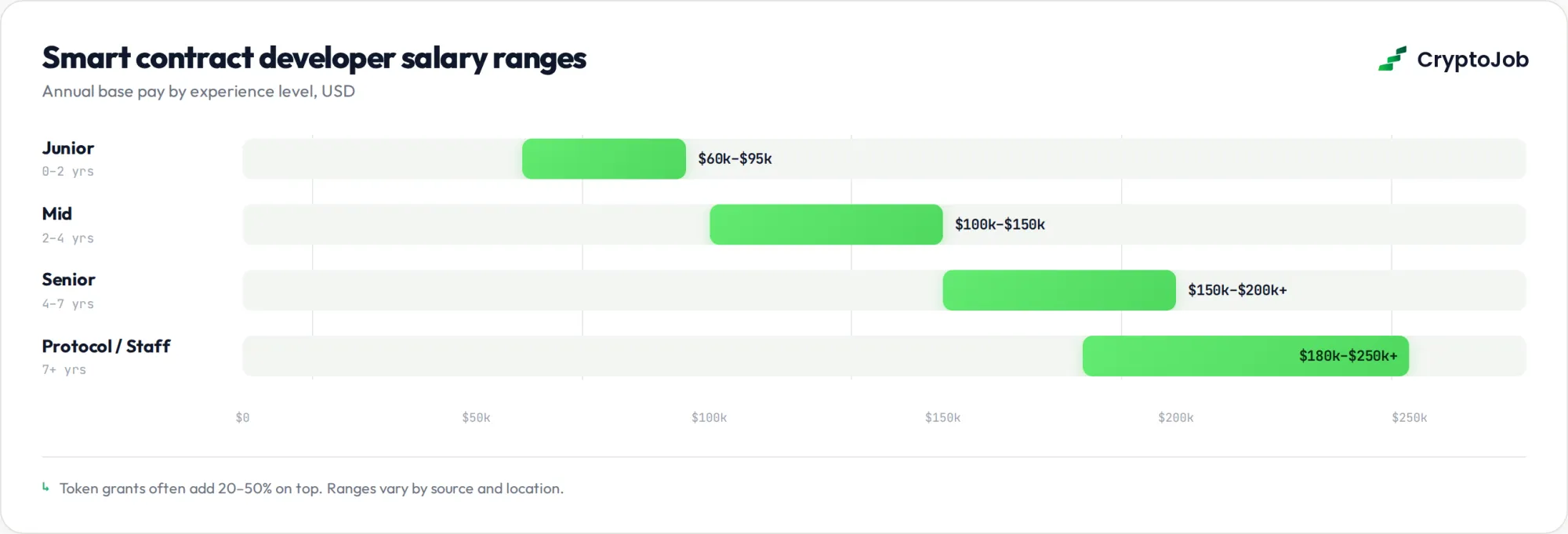
Smart contract developer salary data varies by source, but the picture is consistent: this is a six-figure role for most full-time positions. US-based averages cluster around $112k to $140k depending on the dataset, while global averages sit lower, roughly $85k to $125k, because so many roles hire worldwide.
Here's a realistic breakdown by experience level. Treat these as ranges, not guarantees, since company stage, location policy and market conditions all move the numbers.
|
Experience level |
Typical base salary (USD) |
What gets you there |
|
Junior (0 to 2 yrs) |
$60k to $95k |
Portfolio projects, testnet deployments, hackathon wins |
|
Mid-level (2 to 4 yrs) |
$100k to $150k |
Mainnet contracts in production, audit contest results |
|
Senior (4+ yrs) |
$150k to $200k+ |
Led protocol launches, survived audits, mentored devs |
|
Protocol/staff engineer |
$180k to $250k+ |
Core infrastructure, novel mechanism design, ZK or L2 work |
Two things push real compensation above these figures. First, token or equity grants are standard at crypto companies and can add 20% to 50% on top of base, sometimes much more if the token performs. Second, security specialization pays a premium and independent auditors or contest hunters can out-earn salaried peers in good months, though income is far less predictable.
Location still matters even for remote roles. Some companies pay location-adjusted salaries, while others pay a flat global rate, so always ask which model applies before negotiating.
4.1 Does Freelance or Contract Work Pay More?
Often yes, on an hourly basis. Experienced freelance smart contract developers commonly charge $80 to $200 per hour depending on specialization, with security review work at the top of that range. The trade-off is pipeline risk: you're hunting for the next contract while finishing the current one, and bear markets dry up freelance budgets faster than full-time headcount.
5. Where Can You Find Smart Contract Developer Jobs?
Smart contract developer jobs rarely show up on general job boards in any quality or volume. Look where crypto companies actually post:
- Crypto-native job boards. Start with the CryptoJob careers board, plus filters for "Solidity" or "smart contract" wherever you search.
- Company careers pages. Protocols like Uniswap, Aave, Chainlink and major L2 teams post directly and often don't syndicate everywhere.
- Audit contest platforms. Code4rena, Sherlock and Cantina leaderboard performance regularly turns into job offers without a formal application.
- Crypto Twitter/X and Discord. A surprising share of roles are filled through DMs after someone shares useful work publicly.
- Hackathons. ETHGlobal events are a known hiring funnel, and winning teams get approached on the spot.
One practical tip: smaller protocols and newer teams reply faster and interview quicker than the big names. Applying to ten funded seed-stage teams usually beats sending ten applications into a top-20 protocol's pipeline.
6. How Do You Apply and Actually Get Hired?
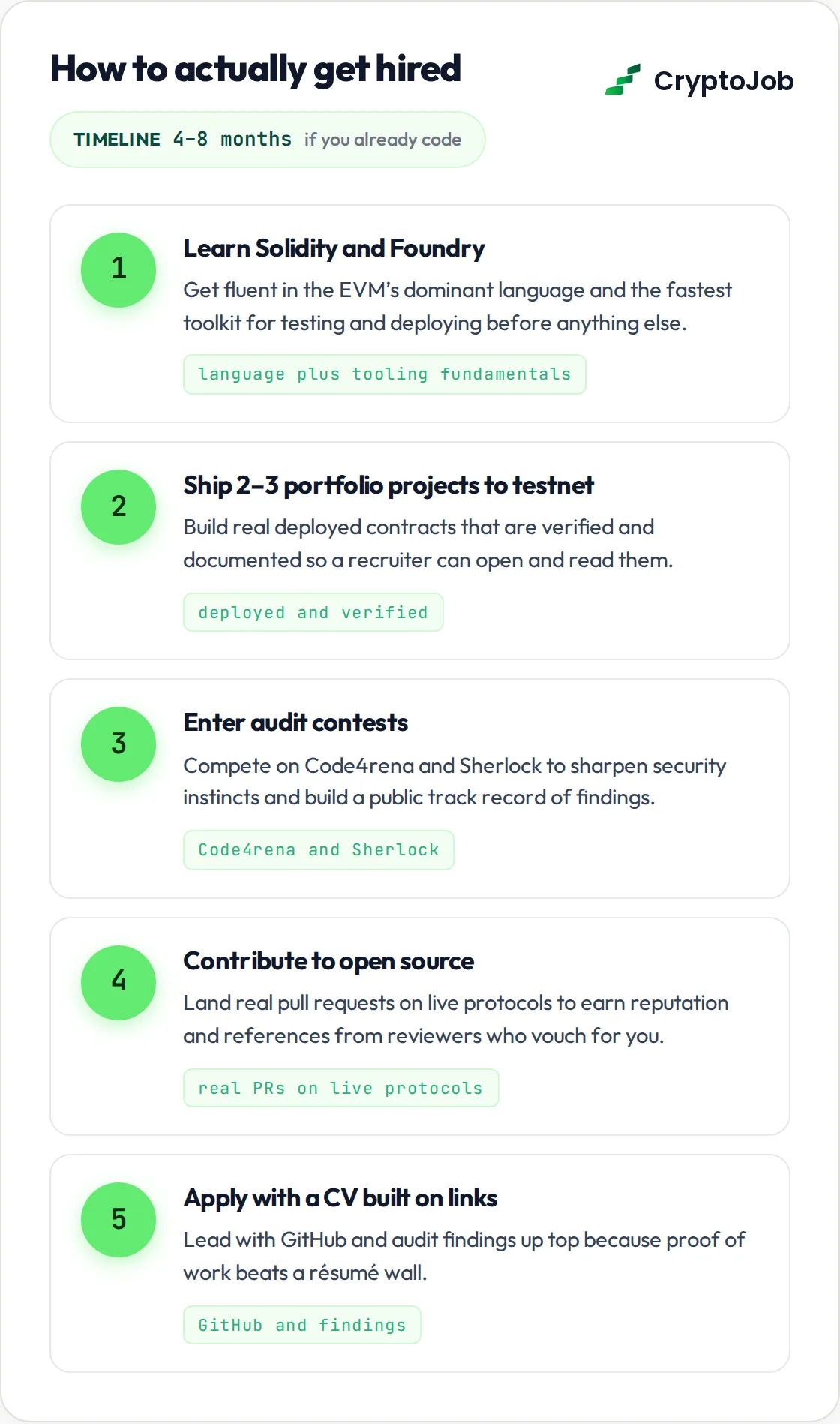
Here's the path that works for people breaking in, in order:
- Build in public. Ship 2 or 3 real projects to a testnet or mainnet: a staking contract, a small AMM, an NFT mint with allowlist logic. Push everything to GitHub with clean READMEs and tests.
- Enter audit contests. Even one valid finding on Code4rena or Sherlock is concrete proof you understand security, which is the hardest thing to signal otherwise.
- Contribute to open source. Fix issues in tooling or protocol repos. Maintainers notice, and "contributor to X" carries weight on a CV.
- Tailor a one-page CV around proof. Lead with links: GitHub, deployed contracts, contest profiles. Recruiters in web3 click links before they read prose.
- Prepare for the technical loop. Expect a take-home or live coding round in Foundry, a security review of a deliberately buggy contract and a systems conversation about gas, upgradeability and design trade-offs.
The whole process typically takes 2 to 4 weeks from application to offer at smaller teams, longer at large protocols. If you get rejected, ask for feedback on the round you failed. Teams in this space usually give it, and it tells you exactly what to fix before the next application.
Negotiate the token component, not just base salary. Ask about vesting schedule, cliff length and whether grants are in tokens or token options. A 4-year vest with a 1-year cliff is standard, and anything worse deserves pushback.
Frequently Asked Questions
Do I need a degree to get a smart contract developer job?
No. Most web3 teams hire on demonstrated ability: public code, deployed contracts and audit contest results. A computer science degree helps with fundamentals but almost never appears as a hard requirement in listings.
How long does it take to learn Solidity well enough to get hired?
If you already know how to program, 4 to 8 months of consistent work is a realistic range to become employable, including security study and portfolio projects. Starting from zero programming experience, expect 12 months or more. It varies a lot with hours invested per week.
Are smart contract developer jobs remote?
Mostly yes. Web3 is one of the most remote-friendly industries, and a large share of roles hire globally with async-first teams. Some companies adjust pay by location, so check the compensation model early.
Is it too late to get into smart contract development?
No. Demand for developers who can write secure contracts still exceeds supply, especially at the senior and security-focused end. Competition at the junior level is real, which is exactly why portfolio proof and audit contest results matter so much.
What's the difference between a smart contract developer and a blockchain developer?
Smart contract developers focus on on-chain application code, like DeFi protocols and token contracts. Blockchain developer is a broader title that can also cover node infrastructure, core protocol work and off-chain services. Salaries overlap heavily, with protocol-level work paying the most.
Ready to Apply?
Smart contract developer jobs reward proof over pedigree. Pick a language, ship projects people can inspect, get a security finding or two on the board and apply to teams small enough to actually read your GitHub. When you're ready, browse web3 jobs on CryptoJob and set up alerts for Solidity and smart contract roles so new openings hit your inbox first.