Tether Jobs in 2026: Inside the Company Behind USDT
Tether runs a $186B stablecoin with one of the leanest teams in tech. And it's hiring ~150 people in 2026. Here's what it pays, how the process works and how to get in.
TLDR
- Tether jobs are 100% remote; roughly 470 roles were listed open in mid 2026
- Listed pay spans roughly $100k to $500k depending on role and seniority
- Hiring averages ~20 days: recruiter screen, assessment, manager interview
- Apply only via tether.recruitee.com. Recruiters never use WhatsApp or Telegram
- 2026 expansion: ~150 new hires in engineering, AI, compliance and investments
Tether jobs are among the most searched roles in crypto for one simple reason: the company behind USDT runs a $186 billion stablecoin with a famously tiny team, pays top of market and hires 100% remotely from almost anywhere. In 2026 Tether announced plans to add around 150 people, focused on engineering, AI, regulatory work and venture investing.
This guide covers what's actually open, what Tether pays, how the interview process works and how to avoid the fake recruiter scams that target applicants. If you're benchmarking Tether against other openings, you can browse web3 jobs on CryptoJob while you read.
One thing to know upfront: Tether is not a typical crypto startup. It is arguably the most profitable company per employee on the planet, which shapes everything about how it hires.
1. Why Are Tether Jobs So Hard to Get?
Tether operated for years with roughly 100 employees while generating billions in annual profit. $6.2 billion in 2023 alone. Bloomberg analysis put its profit per employee above $33 million, compared with roughly $600k to $800k at Apple or Microsoft.
That math means Tether never needs to mass hire. Every open seat attracts thousands of applicants because the company is fully remote, pays globally competitive rates and sits at the center of the stablecoin economy: USDT briefly overtook Ethereum as the second largest crypto asset by market cap in 2026.
The bar reflects this. Job listings consistently emphasize excellent English communication, self direction and the ability to work async across time zones with minimal oversight. Lean team, no hand holding.
2. What Roles Is Tether Hiring for in 2026?
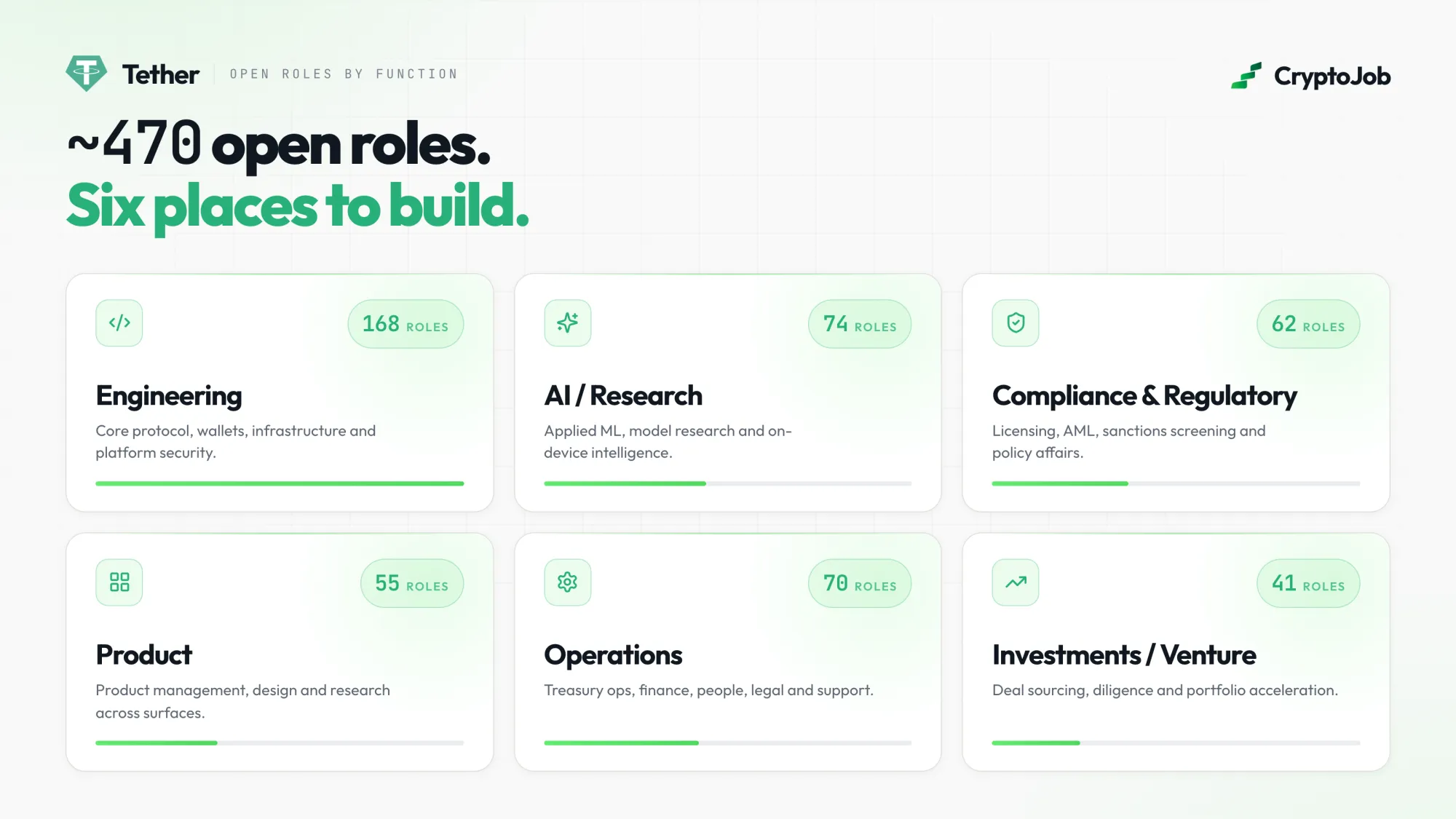
Tether's 2026 expansion targets four areas: engineering, AI development, regulatory and compliance and venture investments. The company has also diversified well beyond USDT. Into Bitcoin mining and energy (Tether Power), AI infrastructure (its QVAC project), P2P communications and an investment arm that has taken stakes like $775 million in Rumble.
Recent openings give a picture of the mix:
- Engineering: Technical Lead (Wallets), Senior QA Engineer, backend and Node.js heavy roles; common stack tags include JavaScript/TypeScript, Node, React, C++, Docker and Kubernetes
- AI/ML: Machine Learning Engineer, AI Research Engineer, AI Inference Engineer (QVAC)
- Legal & compliance: Junior Legal & Compliance Analyst, Compliance Governance Analyst
- Non technical: Social Media Manager (AI/Tech), Developer Advocate (P2P), Investment Manager (RISE fund)
Aggregators like TrueUp counted around 470 open Tether roles in 2026, every one of them tagged remote. The exact number moves week to week, so always check the live board.
2.1 Where do you find official Tether careers listings?
All legitimate Tether careers listings live at tether.recruitee.com (also reachable via careers.tether.io). Tether states it does not use third party agencies for recruitment unless clearly disclosed and job boards like web3.career, Cryptocurrency Jobs and WeWorkRemotely mirror the same listings.
If you find a "Tether opening" anywhere that doesn't exist on the official portal, treat it as fake. More on scams below, because they're rampant.
3. How Much Do Tether Jobs Pay?
Public listings on web3.career show Tether roles advertised from roughly $100k to $500k per year. Glassdoor data is thin, under 30 submitted salaries, but reported figures include around $152k for a senior software engineer, with site estimates for that title averaging closer to $206k.
Two honest caveats. First, Tether hires globally and calibrates offers to seniority and negotiation more than location, so ranges are wide. Second, employees rate compensation 2.9/5 on Glassdoor, suggesting pay is strong but not universally top of market for every role.
3.1 What does Tether salary data show by role?
Based on listed ranges and public salary reports, here's a realistic picture. Treat these as directional. Actual offers vary by seniority, interview performance and negotiation.
| Role family | Realistic annual range (USD) | Notes |
|---|---|---|
| Senior/Lead Engineering | $150k to $350k+ | Highest listed bands; wallets, backend, infra |
| AI/ML Engineering | $150k to $500k | Top of Tether's advertised range; QVAC push |
| Legal & Compliance | $60k to $150k | Junior analyst roles open in 2026 |
| Marketing & Social | $50k to $120k | Fewer openings, high competition |
| Product/Project Mgmt | $90k to $180k | Assessment heavy hiring process |
For context on how these bands compare across the industry, see our breakdown of the highest paying web3 jobs.
4. What Is Tether's Hiring Process?
Candidate reports on Glassdoor describe a consistent structure with about a 20 day average from application to decision (some engineering hires closed in a week; managerial roles stretched to four weeks).
The typical sequence:
- Online application through the official portal
- Recruiter screen. ~30 minutes, friendly, process focused
- Assessment. A take home task (one PM candidate reported a 3 day project) or a technical interview covering algorithms and data structures for engineers
- Hiring manager / technical manager interview. Deeper dive on experience and fit
- Offer. Or a rejection email, sometimes fast and without detailed feedback
4.1 How hard is the Tether interview?
Candidates rate difficulty around 2 out of 5 on Glassdoor. Easier than FAANG style gauntlets. The filter is less about puzzle solving and more about proven shipping ability, English fluency and remote self management. Engineers report standard data structures questions rather than exotic whiteboard traps.
4.2 What should you prepare?
Bring specifics: systems you built, uptime you owned, incidents you handled. Tether's job descriptions repeatedly stress lean teams and high ownership, so "I need a spec and a manager" energy is the fastest way out. For behavioral rounds, expect conflict resolution questions about distributed teams.
5. How Do You Stand Out When Applying?
Three things move the needle. First, ship public work: open source contributions in Node.js, Rust or Bitcoin tooling map directly to Tether's stack. Second, show stablecoin literacy. Understand reserves, attestations and why Tether holds ~$141 billion in US Treasuries. Third, write well; every listing calls out excellent English because the entire company runs on written async communication.
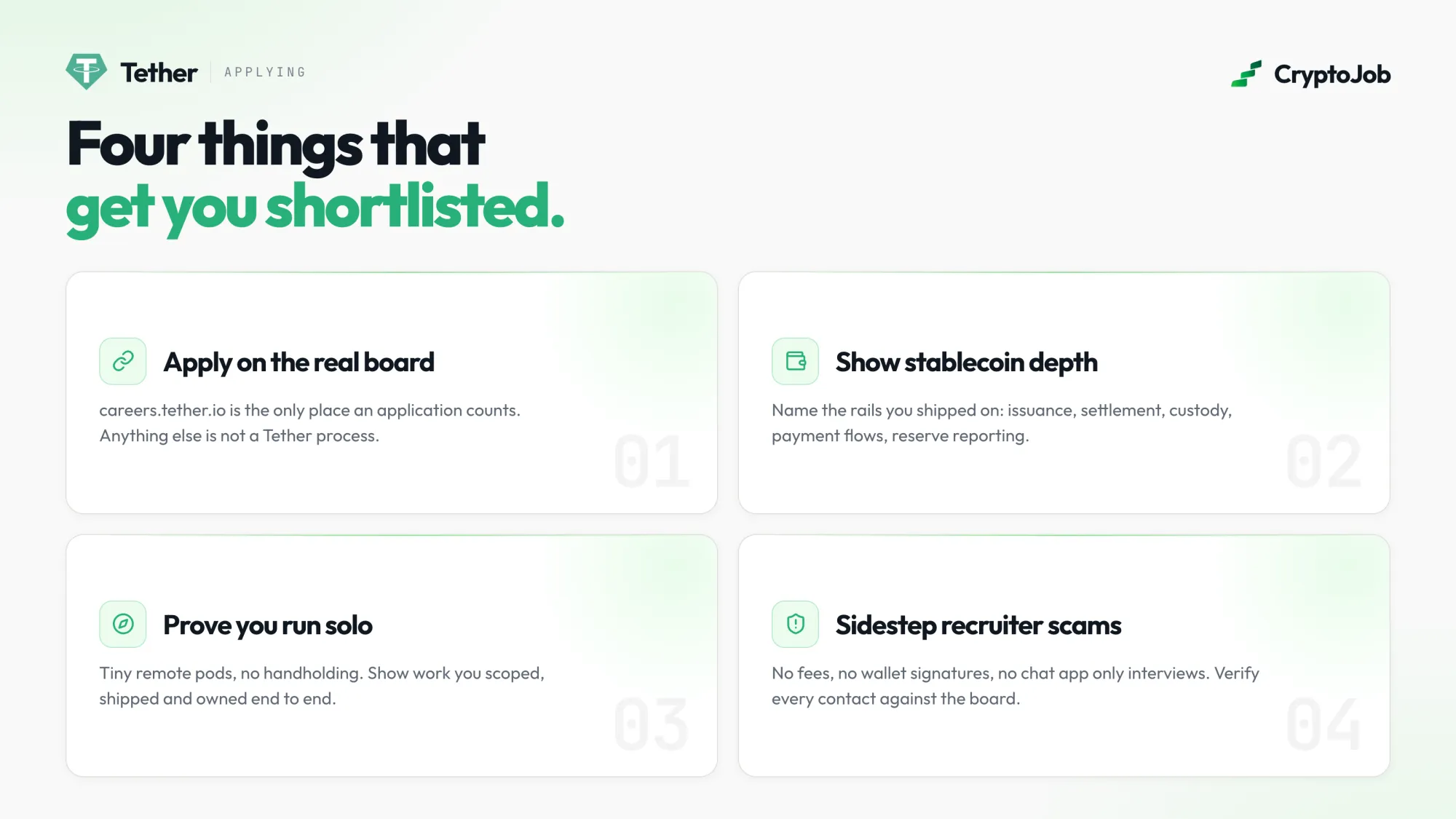
Applicants from strong regional talent pools do well here. Tether has hired heavily across Europe, Latin America and Asia. If you're building your profile first, our guide to blockchain developer jobs covers the same positioning tactics.
5.1 How is this different from other web3 jobs?
Most web3 jobs at exchanges or L1 foundations involve teams of hundreds and heavy process. Tether is the opposite: a conglomerate's balance sheet with a startup's headcount. You'll get more scope per person, less structure and a brand every recruiter in crypto recognizes on a resume.
6. Are Tether Jobs Fully Remote?
Yes. Effectively all of them. TrueUp's tracker showed 100% of Tether's open roles tagged remote, and the company describes its team as distributed across every region. Listings appear localized to hubs like London, Madrid, Dubai, Buenos Aires, São Paulo and Bangalore, but these are talent pool markers, not office mandates.
Tether relocated its headquarters to El Salvador in 2025, yet day to day work remains location independent. Expect async collaboration, flexible hours anchored to your team's overlap window and communication almost entirely in writing.
6.1 How does Tether compare with other remote crypto jobs?
Among remote crypto jobs, Tether stands out for having no hybrid creep. No "remote but near an office" asterisks that exchanges increasingly add. The trade off is contractor style arrangements are common for global hires, so clarify employment structure, currency of payment and benefits during the offer stage. Hiring norms differ by market too; our guide to remote web3 jobs shows how distributed employment changes the picture.
7. How Do You Avoid Fake Tether Job Offers?
Tether is one of the most impersonated employers in crypto. The company's own guidance is explicit:
- All real roles are listed at tether.recruitee.com. Nowhere else
- Official email comes only from @tether.to or @tether.io addresses
- Tether never interviews over WhatsApp, Telegram or SMS
- No legitimate process ever asks for payment, deposits or financial details
- Recruiters have verifiable LinkedIn profiles you can cross check
If any of those five checks fails, walk away and report it. This matters doubly in crypto, where "job offers" are a common phishing vector for draining wallets.
8. Final Take: Is a Tether Job Worth Chasing in 2026?
If you're senior, self directed and strong in writing, yes. Few companies offer this combination of scope, pay ceiling and full remote flexibility. The realistic strategy is to apply for a specific role you're clearly qualified for, prepare a concrete portfolio of shipped work and expect a fast, assessment driven process.
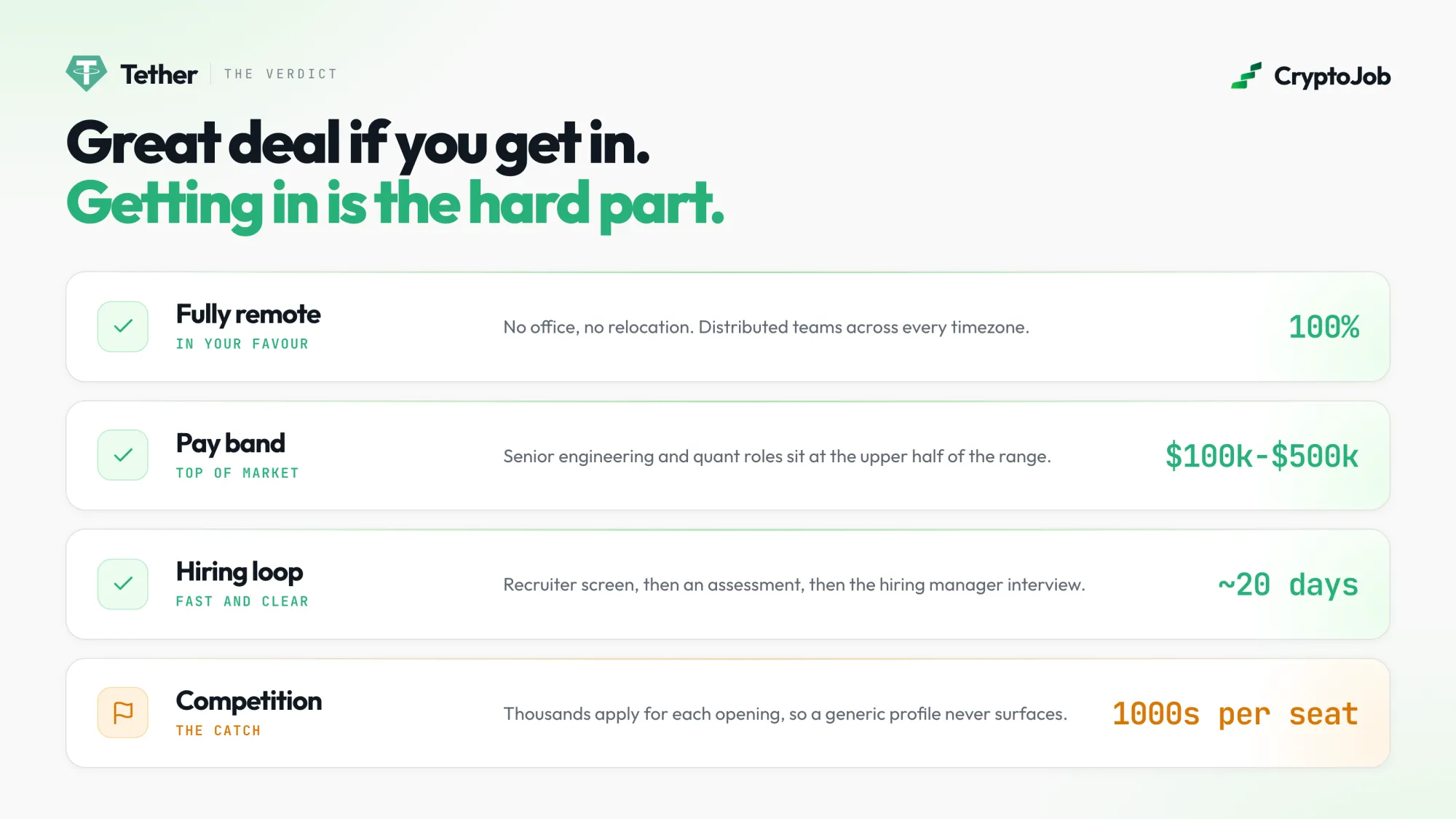
And don't single thread your search on one famously selective employer. Line up parallel applications and browse web3 jobs across exchanges, L1s and infrastructure companies so a Tether rejection is a data point, not a dead end.
FAQ
Does Tether hire junior candidates?
Occasionally, 2026 openings included a Junior Legal & Compliance Analyst, but the overwhelming majority of roles are senior. Juniors have better odds building 2 to 3 years of experience at larger crypto companies first, then applying.
Do you need crypto experience to get a Tether job?
Not strictly for engineering or AI roles, where general backend, ML or infrastructure depth matters most. It helps enormously for product, compliance and advocacy roles and every candidate should understand how USDT, reserves and attestations work before interviewing.
How long does Tether's hiring process take?
Around 20 days on average based on Glassdoor interview reports, with a range from about one week for some engineering hires to four weeks for managerial roles.
What skills does Tether look for most?
Node.js/JavaScript and TypeScript dominate engineering listings, alongside C++, Docker, Kubernetes and Bitcoin protocol knowledge. AI roles want ML and inference experience. Across every role: excellent written English and proven remote self management.
Is Tether a stable employer given crypto volatility?
Tether's revenue comes largely from yield on ~$141 billion in US Treasury holdings, making it less exposed to token prices than exchanges. It reported over $1 billion net profit in Q1 2026 alone. No employer is risk free, but few in crypto have a stronger balance sheet.