How to Switch From Web2 to Web3: Career Transition Guide
Almost every web2 skill transfers to web3. Here's the role mapping, pay comparison and 6-step plan to make the switch in 3 to 6 months.

TLDR
- Most web2 to web3 transitions take 3 to 6 months of focused upskilling
- Your existing skills transfer. Web3 needs devs, marketers, PMs and designers
- Solidity developers typically earn $100k to $200k+, often paid in fiat plus tokens
- You don't need to code. Roughly half of web3 roles are non-technical
- Build public proof of work, then apply
Switching from web2 to web3 is less dramatic than it sounds. You keep most of your existing skills, add a layer of blockchain knowledge on top and prove you can operate in the space. For most people that takes 3 to 6 months, not years.
The demand is real. Web3 companies hire engineers, marketers, product managers, community leads, designers, lawyers and analysts. You can browse web3 jobs right now and see how many listings ask for classic web2 skills with a crypto twist.
This guide covers what actually changes, which skills carry over, what the roles pay and the exact steps to make the move.
1. What Actually Changes When You Move From Web2 to Web3?
The core work stays familiar. A frontend developer still writes React. A marketer still runs campaigns. A PM still ships products.
What changes is the environment. Web3 companies are usually smaller, remote-first and move faster. Ownership is more distributed, compensation often includes tokens and your work is frequently public on-chain or on GitHub.
The other big shift is culture. Community matters more than in web2. Users are often investors and community members at the same time, so reputation, transparency and being active on X or Discord carry real career weight.
2. Which Web2 Skills Transfer Directly to Web3?
Almost all of them. Web3 companies are still companies. They need people who can build, sell, design, write and manage.
Here's how common web2 roles map to their web3 equivalents:
|
Web2 role |
Web3 equivalent |
New skills to add |
|
Frontend developer |
dApp frontend developer |
wallet connections, ethers.js or viem, signing flows |
|
Backend developer |
Protocol or infra engineer |
Solidity or Rust, smart contract patterns, node infra |
|
Product manager |
Web3 PM |
tokenomics basics, on-chain metrics, governance |
|
Digital marketer |
Web3 growth marketer |
community-led growth, KOLs, on-chain attribution |
|
Community manager |
Discord or DAO community lead |
Discord ops, governance forums, token-gated communities |
|
Data analyst |
On-chain analyst |
Dune, SQL for blockchain data, wallet behavior analysis |
|
UX designer |
dApp designer |
wallet UX, transaction flows, self-custody patterns |
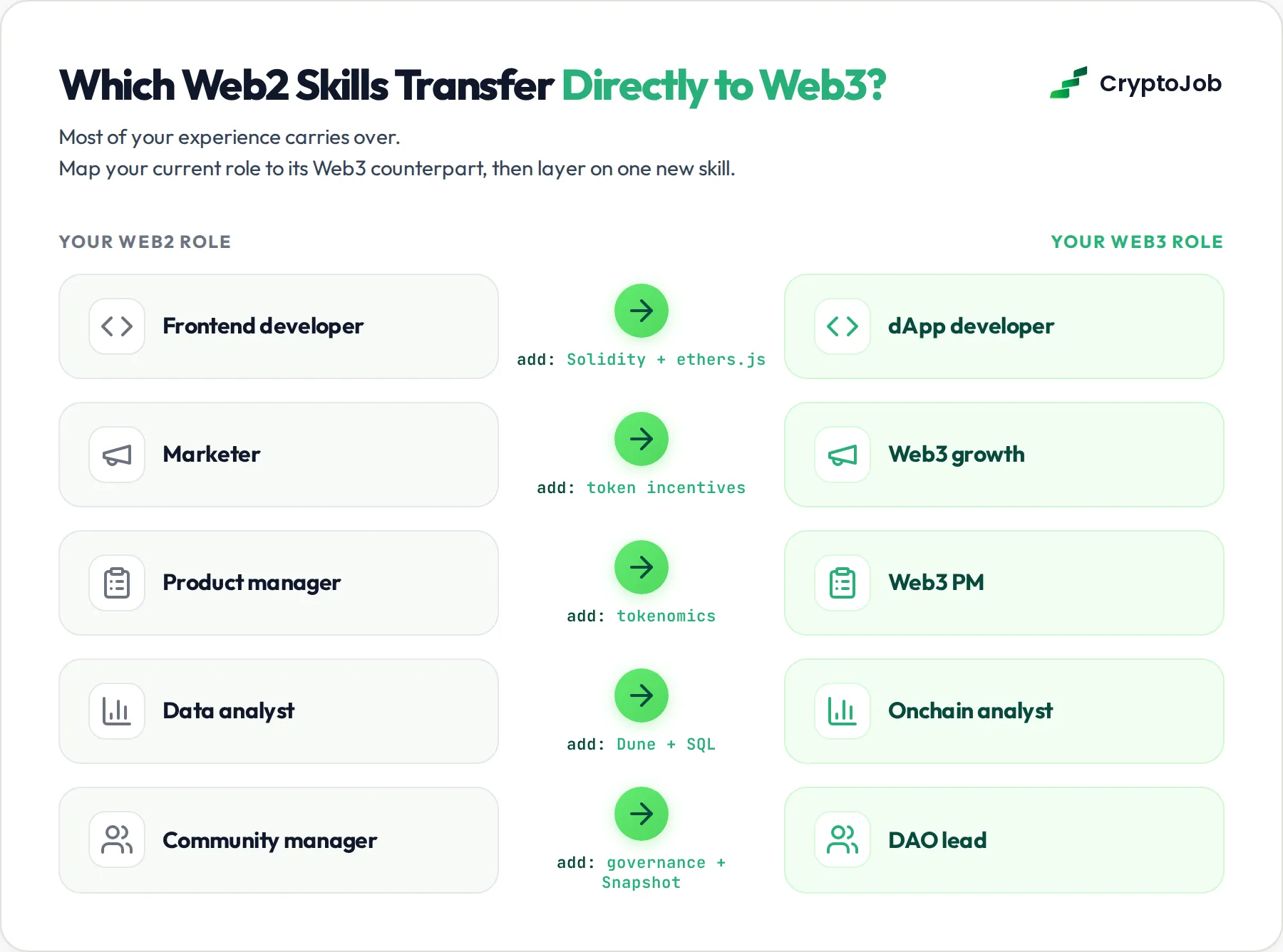
The pattern is consistent. Your core craft transfers and you bolt on a web3-specific layer. That layer is learnable in months.
3. Do You Need to Learn to Code to Transition to Web3?
No. This is the biggest myth stopping people. A large share of web3 roles are non-technical: marketing, community, BD, operations, content, legal and design.
What every role does require is fluency. You need to understand wallets, tokens, DeFi basics, NFTs and how blockchains work at a conceptual level. You should be able to explain gas fees or staking to a friend without googling.
If you do want to go technical, Solidity is the highest-demand entry point for Ethereum ecosystems and Rust for Solana. Free resources like CryptoZombies, Alchemy University and Cyfrin Updraft can take you from zero to deploying contracts.
4. How Much Do Web3 Jobs Pay Compared to Web2?
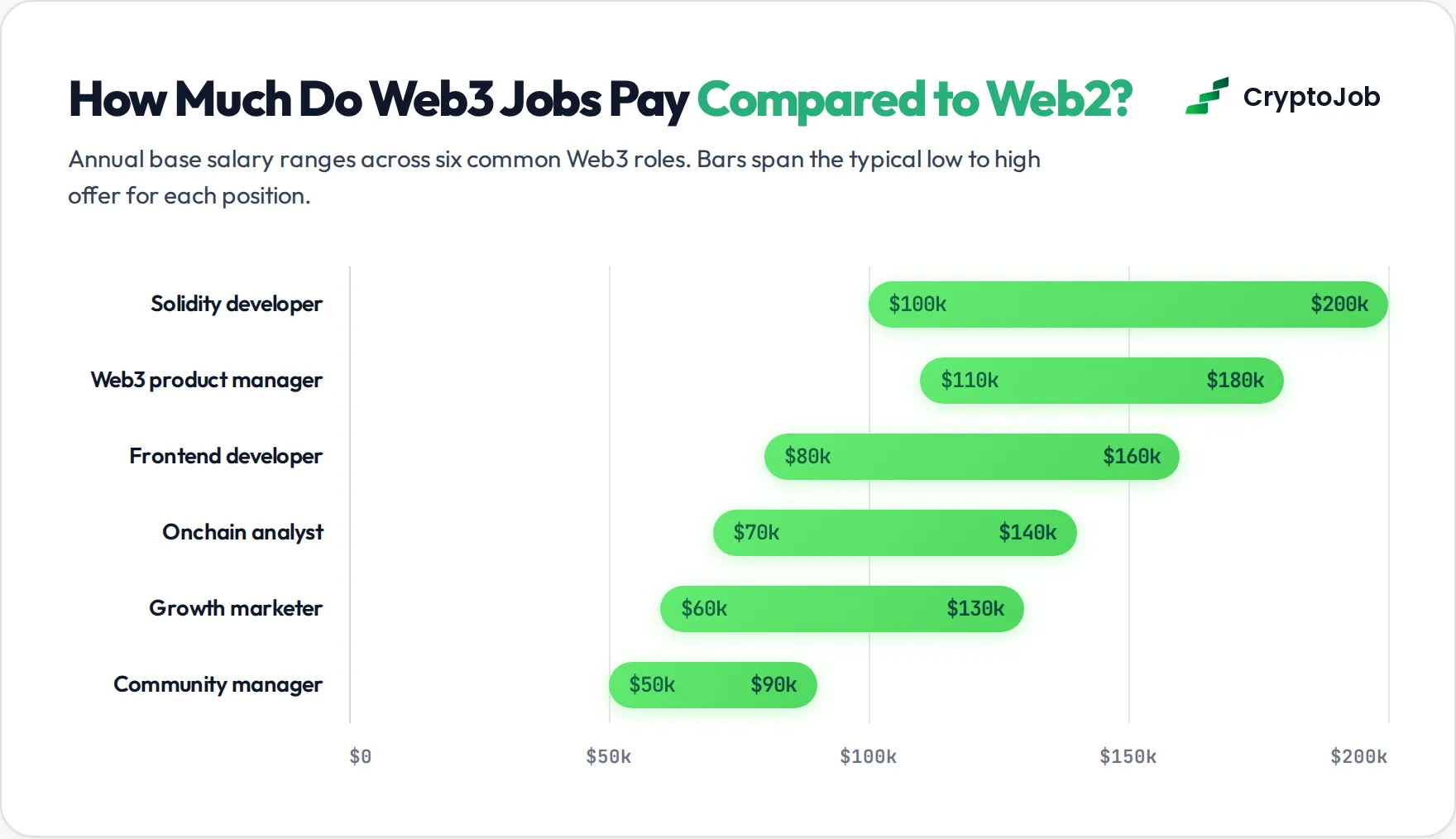
Web3 typically pays at or above web2 rates for equivalent roles, with token allocations as upside. Exact figures vary a lot by region, company stage and market conditions, so treat these as realistic ranges rather than guarantees:
- Solidity or smart contract developers: $100k to $200k+, senior roles can exceed $250k
- Web3 frontend developers: $80k to $160k
- Web3 product managers: $110k to $180k
- Growth and marketing roles: $60k to $130k
- Community managers: $50k to $90k
- On-chain analysts: $70k to $140k
Two things to know about web3 comp. First, token compensation can be worth a lot or nothing, so evaluate the vesting schedule and the project's fundamentals. Second, many roles are paid in stablecoins to fully remote contractors, which opens global salaries to people outside the US and Europe.
5. How Do You Switch to a Blockchain Career Step by Step?
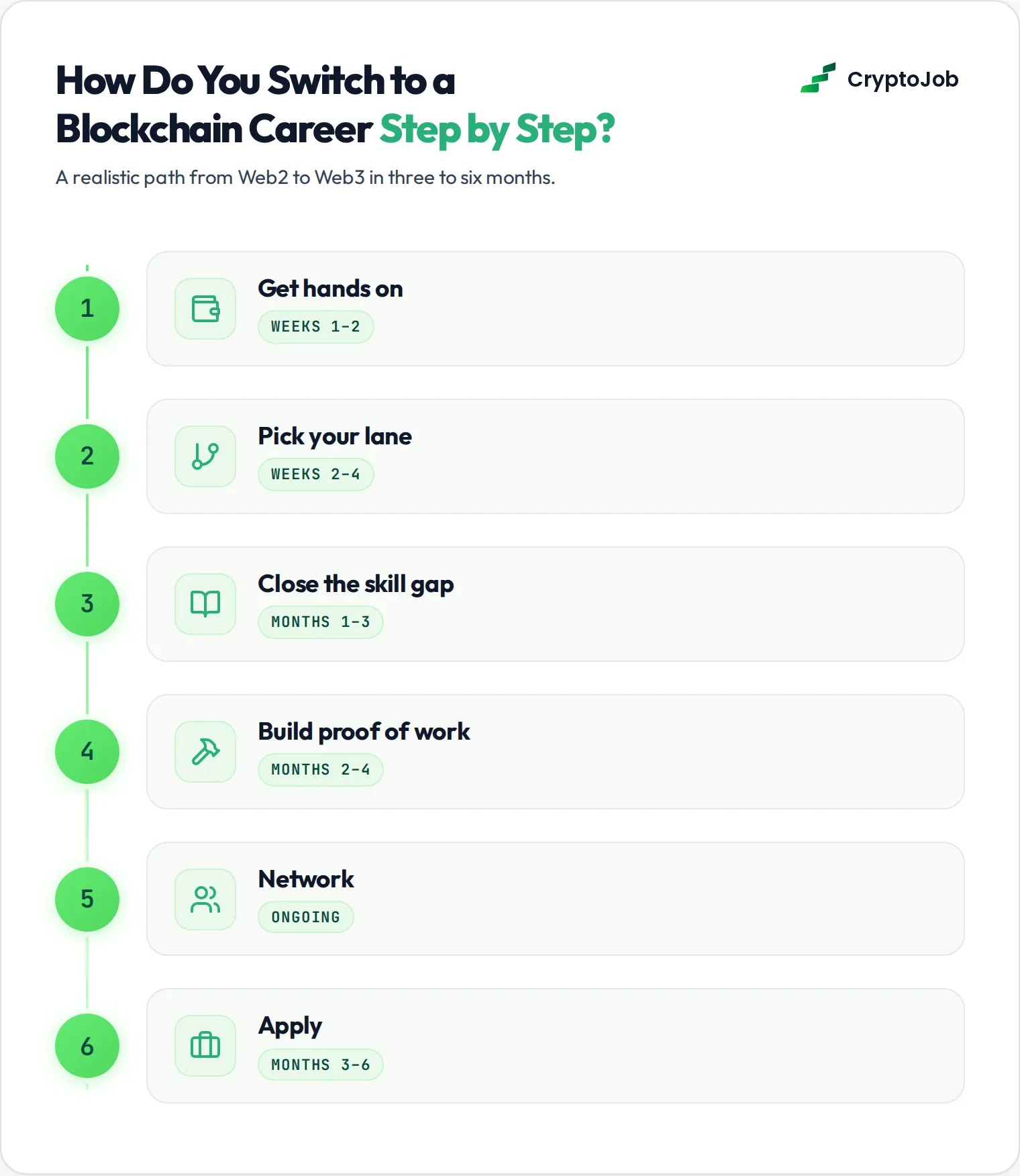
Here's the roadmap that works for most people. Budget 3 to 6 months if you're doing this alongside a full-time job.
5.1 Step 1: Get hands-on with the tech (weeks 1 to 2)
Set up a wallet like MetaMask or Phantom. Swap a small amount on a DEX, mint an NFT, try a lending protocol on a testnet. You can't work in web3 without having used it.
5.2 Step 2: Pick your lane (weeks 2 to 4)
Choose one target role based on your web2 background using the table above. Depth beats breadth. A focused "web2 marketer becoming a web3 growth marketer" story is far more hireable than "crypto enthusiast open to anything".
5.3 Step 3: Close the skill gap (months 1 to 3)
Learn the web3 layer for your lane. Devs build and deploy contracts or dApps. Marketers study successful token launches and community playbooks. Analysts learn Dune and publish dashboards.
5.4 Step 4: Build public proof of work (months 2 to 4)
This is the step most people skip and it's the one that gets you hired. Ship something visible: a deployed dApp, a Dune dashboard, a governance proposal, a content series breaking down protocols, contributions to a DAO.
Web3 hiring leans heavily on demonstrated ability over credentials. A GitHub repo or a dashboard with real usage beats a certificate every time.
5.5 Step 5: Network where web3 lives (ongoing)
Be active on X, join the Discords of protocols you like and contribute before you ask for anything. Many web3 jobs are filled through community reputation before they're ever posted publicly.
5.6 Step 6: Apply strategically (months 3 to 6)
Target 20 to 30 quality applications, not 200 generic ones. Reference the project's actual product in your application and link your proof of work. Web3 teams are small and can tell instantly who has done their homework.
6. What Are the Risks of Moving Into Web3?
Be honest with yourself about the downsides. The industry is volatile and hiring follows market cycles. Bull markets create hiring sprees, bear markets bring layoffs.
Company quality varies wildly. Some projects are well-funded with serious teams, others are undercapitalized or outright scams. Before accepting an offer, check the funding, the team's track record and whether the token or treasury can actually cover payroll.
The mitigation is the same as anywhere: keep runway savings, favor salaries in fiat or stablecoins with tokens as upside and join teams with real users and revenue.
7. Where Should You Look for Web3 Jobs?
Web3 hiring happens in three places. Dedicated job boards, Discord and X communities and direct outreach to teams whose products you use.
Start with the job boards to understand what's in demand, then layer in community networking. The candidates who get hired fastest combine visible proof of work with warm connections inside a project's community.
Your transition doesn't need to be a leap either. Freelance or part-time contributions to a DAO or protocol while still employed in web2 is the lowest-risk path in, and it often converts to full-time offers.
Ready to see what's out there? Browse web3 jobs on CryptoJob and filter by your target role to see exactly which skills companies are asking for right now.
FAQ
How long does it take to switch from web2 to web3?
Most people need 3 to 6 months of focused effort. Non-technical roles with strong transferable skills can move faster, sometimes in 6 to 8 weeks. Deep technical pivots like becoming a smart contract auditor take longer, often 6 to 12 months.
Can I get a web3 job with no crypto experience?
Yes, if you bring strong web2 skills and can show genuine engagement with the space. Use the products, build something public and speak the language. Companies regularly hire web2 talent for marketing, product, design and engineering roles.
Is web3 still a good career move in 2026?
Demand for skilled people has stayed consistent even through market swings, especially in infrastructure, security and real-world asset projects. Hiring volume varies with market cycles, so timing and company selection matter more than in web2.
Do web3 jobs pay in crypto?
It varies. Many companies pay base salaries in fiat or stablecoins like USDC, with tokens as a bonus or equity-style allocation. Fully token-based comp exists but carries more risk, so check vesting terms before accepting.
What's the easiest web3 role to break into?
Community and content roles have the lowest barrier because you can build proof of work for free by being active in Discords, writing threads and contributing to DAOs. For technical people, frontend dApp development is the fastest path since it's mostly React plus wallet integration.