Web3 Job Interview Questions and How to Answer Them
The exact web3 interview questions companies ask in 2026, from blockchain fundamentals to Solidity security, plus sample answers and salary ranges.

TLDR
- Most web3 interview questions fall into 4 buckets: blockchain fundamentals, technical depth, crypto culture fit and scenario questions
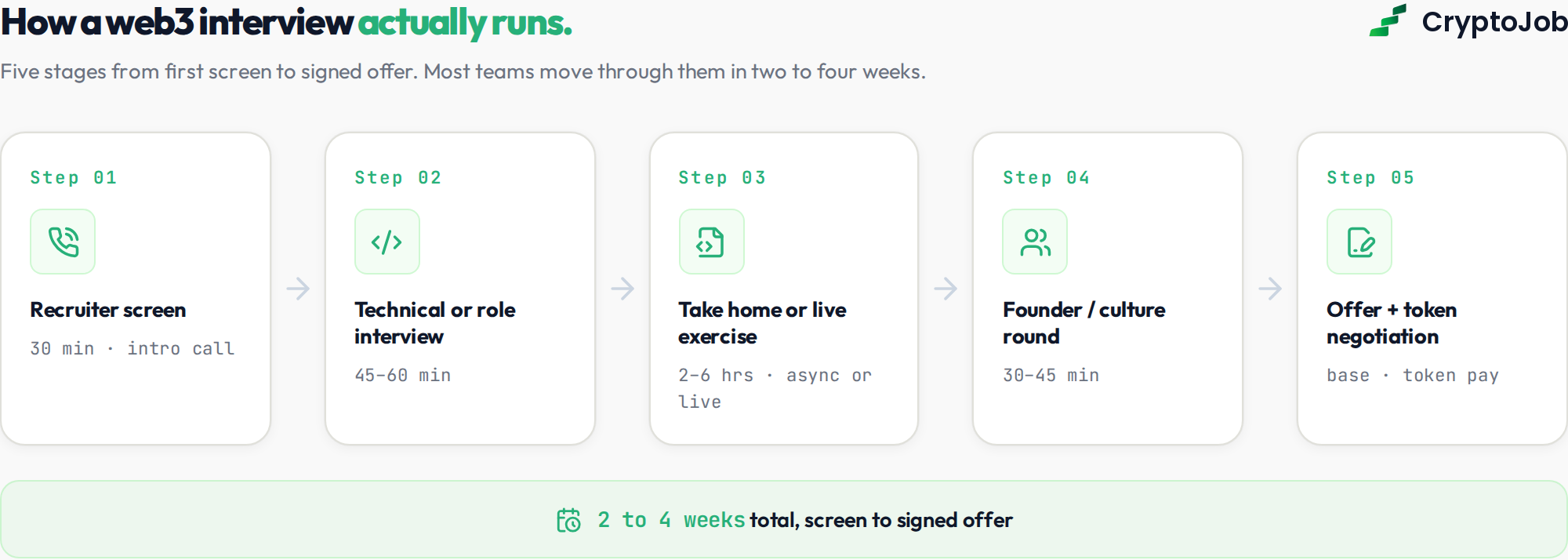
- Expect 3 to 5 rounds over 2 to 4 weeks
- Solidity devs earn roughly $100K to $250K base in 2026, so anchor high
- Always explain trade-offs, not just definitions
- Ship something on-chain before you interview
If you have a web3 interview coming up, here is what to expect. Web3 interview questions test three things: whether you understand how blockchains actually work, whether you can do the job and whether you genuinely care about crypto. Nail those and you are ahead of most candidates. This guide covers the exact questions hiring managers ask, strong sample answers and the salary numbers you should walk in with.
Interview processes in web3 move fast. Most companies run 3 to 5 rounds over 2 to 4 weeks, often fully remote. If you are still lining up interviews, browse web3 jobs on CryptoJob to get more offers in the pipeline. Competing offers are your best negotiating tool.
Let's break down each question type.
1. What web3 interview questions should you expect first?
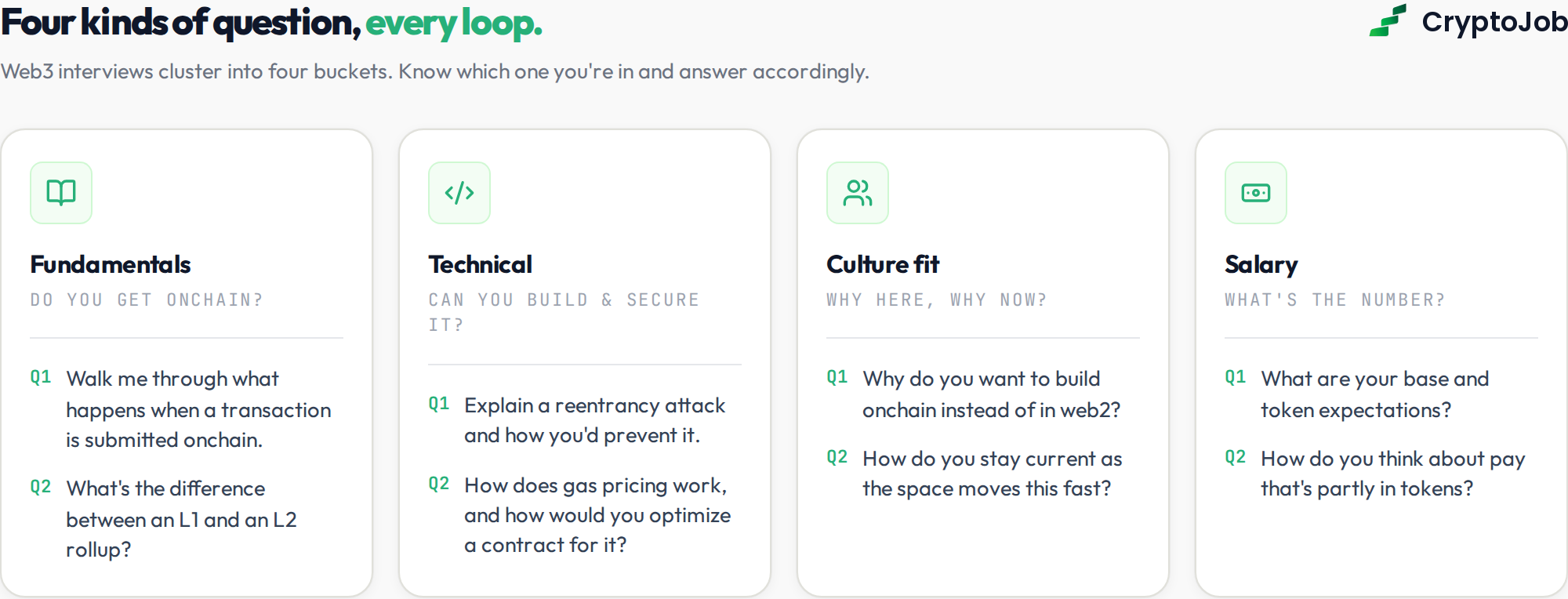
The screening round is usually 30 minutes with a recruiter or founder. The questions are predictable, so there is no excuse for winging them.
"Why do you want to work in web3?" Weak answers mention price action or "getting in early." Strong answers name a specific problem the technology solves. Example: "I watched friends in Argentina lose savings to 100%+ inflation. Stablecoins gave them a real alternative, and I want to build the infrastructure that makes that safer."
"What projects are you following right now?" Have 2 or 3 ready with an actual opinion on each. "I've been watching how L2s handle sequencer decentralization" beats "I like Ethereum" every time.
"Walk me through something you've built or contributed to." This is where most candidates lose the interview. If you have nothing on-chain, spend a weekend fixing it: deploy a contract to a testnet, contribute a pull request to an open source repo or complete a bounty on a platform like Gitcoin. Interviewers weigh shipped work far more heavily than credentials.
"How do you keep up with the space?" Name your actual sources. Research newsletters, protocol governance forums, X accounts of core devs, whatever you genuinely read. Specificity signals authenticity.
2. How do you answer blockchain interview questions?
Blockchain interview questions test fundamentals and they show up in interviews for every role, not just engineering. Marketers, analysts and BD hires get lighter versions of the same questions. Here are the ones that come up constantly.
"Explain how a blockchain works to a non-technical person." Use a simple analogy and stop before you over-explain. Example: "It's a shared spreadsheet that thousands of computers keep identical copies of. To change it, most of them have to agree, which is why nobody can quietly edit history." Then offer to go deeper if they want.
"Proof of Work vs Proof of Stake, which is better?" Never pick a side without trade-offs. PoW has a longer security track record and simpler trust assumptions but burns enormous energy. PoS cut Ethereum's energy use by roughly 99.9% and enables faster finality, but introduces different attack surfaces like stake concentration. Frame your answer around what the network is optimizing for.
"What is the difference between Layer 1 and Layer 2?" L1 is the base chain that provides security and settlement, like Ethereum or Solana. L2s process transactions off the base chain and post proofs or data back to it, trading some trust assumptions for much lower fees. Bonus points for mentioning how rollups differ from sidechains: rollups inherit L1 security, sidechains have their own validator sets.
"What happens when you send a transaction?" Walk through it step by step: you sign with your private key, the transaction goes to the mempool, a validator includes it in a block, the network reaches consensus and the state updates. Mentioning the mempool and gas pricing shows you understand the messy middle, not just the endpoints.
"What's a real limitation of blockchains?" Honest criticism is a green flag. Good answers: state bloat, MEV, UX friction with key management or the oracle problem. Candidates who think blockchains have no downsides read as tourists.
3. What solidity interview questions come up in technical rounds?
If you are interviewing for a smart contract role, expect a live coding round or take-home plus a deep dive on security. These solidity interview questions separate people who did a tutorial from people who can be trusted with contracts holding real money.
"What is a reentrancy attack and how do you prevent it?" This is the single most asked security question. Explain the pattern: an external contract calls back into your function before the first invocation finishes updating state, letting it drain funds. The 2016 DAO hack, which cost around $60M at the time, is the canonical example. Prevention: follow checks-effects-interactions ordering, use a reentrancy guard and be suspicious of any external call.
"Explain the difference between call, delegatecall and staticcall." call executes code in the target contract's context. delegatecall runs the target's code with the caller's storage, which is how upgradeable proxies work and also how they get destroyed when done wrong. staticcall guarantees no state changes. If you can explain why a storage collision in a proxy is dangerous, you are ahead of most candidates.
"How do you optimize gas?" Give concrete techniques: pack storage variables into single slots, use calldata instead of memory for external function inputs, cache storage reads in local variables, prefer custom errors over revert strings and use events instead of storage where you only need off-chain data.
"What's your testing workflow?" Name your stack and your process. Foundry is the expected answer in 2026 for most teams, with fuzz testing and fork tests against mainnet state. Mentioning invariant testing or a tool like Slither for static analysis signals security maturity.
"Storage vs memory vs calldata?" Storage persists on-chain and is expensive. Memory is temporary per-call and cheaper. Calldata is read-only input data and the cheapest of the three. Simple question, but fumbling it ends technical interviews quickly.
Expect a practical too. Common take-homes include building a staking contract, a token vesting schedule or auditing a deliberately broken contract to find 3 to 5 planted vulnerabilities.
4. How do web3 companies test culture fit?
Crypto companies filter hard for genuine interest because tourists churn out in the first bear market. Expect questions like these.
"Do you use crypto yourself?" Be ready with real usage: a wallet setup you can describe, a DeFi protocol you have used, an on-chain transaction you can talk through. You do not need a big portfolio. You need proof you have touched the tools.
"How do you feel about payment partly in tokens?" Know your answer before the interview. A common structure is base salary in fiat or stablecoins plus token grants vesting over 2 to 4 years. It is fine to negotiate the mix, but visible discomfort with tokens is often read as a mismatch.
"Tell me about a time you worked async or remote." Most web3 teams span 5+ time zones. Have one concrete story about documentation, written communication or handling a decision without a meeting.
5. What salary should you ask for in a web3 interview?
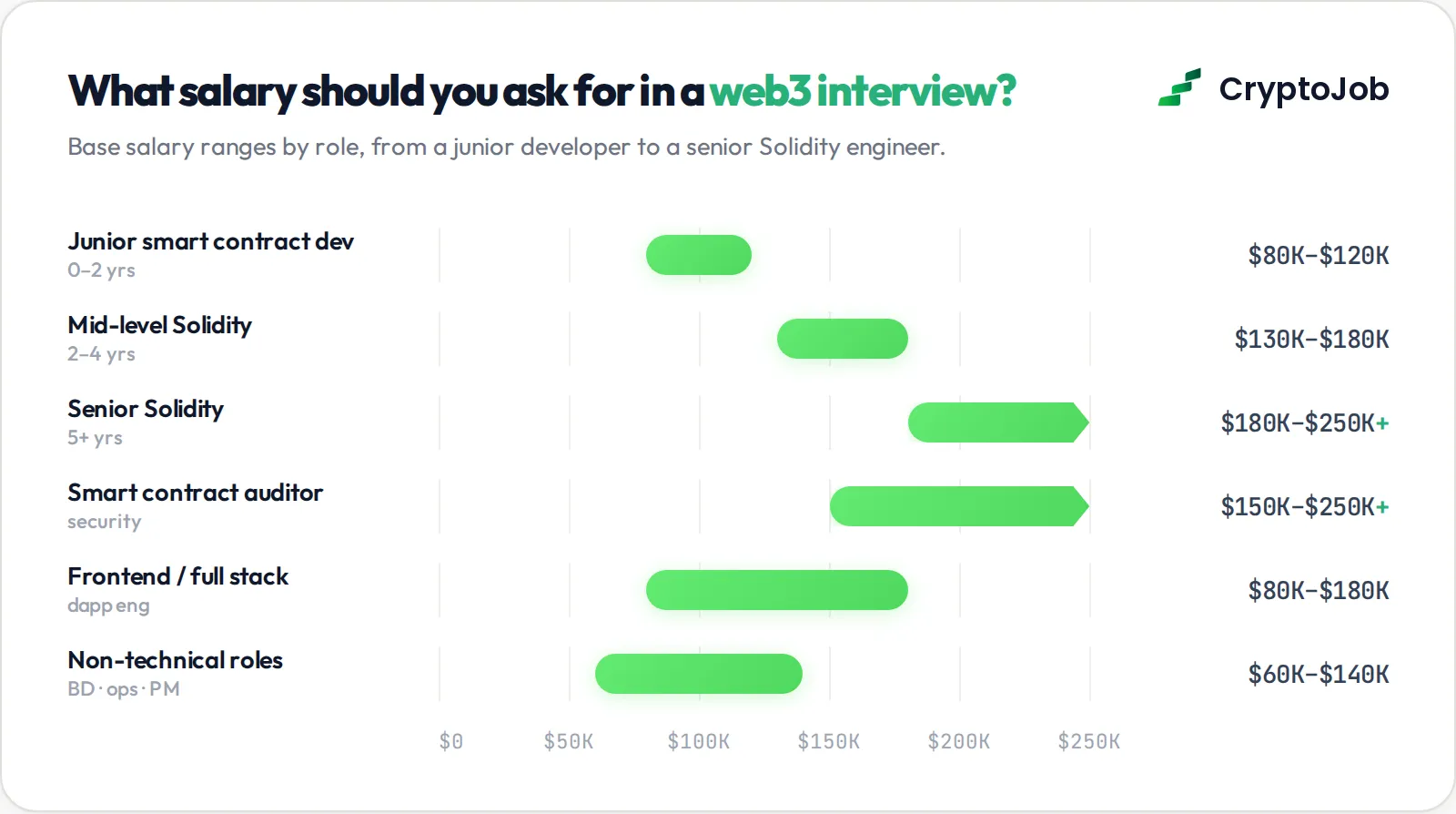
Come armed with numbers, because ranges in this industry are wide and negotiation is expected. Base salaries vary a lot by region, company stage and whether pay includes tokens, so treat these 2026 figures as directional rather than exact.
|
Role |
Typical base range (2026, USD) |
Notes |
|
Junior smart contract dev |
$80K to $120K |
Portfolio matters more than years |
|
Mid-level Solidity dev |
$130K to $180K |
2+ years production experience |
|
Senior Solidity / protocol engineer |
$180K to $250K+ |
Top DeFi protocols pay above this |
|
Smart contract auditor (mid to senior) |
$150K to $250K+ |
Plus bounty income at top firms |
|
Frontend / full-stack web3 dev |
$80K to $180K |
Wide gap between UI work and protocol work |
|
Non-technical (marketing, BD, community) |
$60K to $140K |
Highly variable by company stage |
Sources like web3.career, ZipRecruiter and crypto recruiting firms report averages anywhere from about $90K to $175K for Solidity roles depending on methodology and geography, which tells you how much it varies. Two rules hold regardless: always ask for total compensation including tokens, and never accept the first number. Token grants can add 30% or more on top of base at well-funded companies, so ask about vesting schedule, cliff and whether grants are in liquid or locked tokens.
6. How should you prepare in the final week?
Keep it focused. Re-read the company's docs and recent governance or blog posts, and use their product if it is live. Prepare your 3 project stories in problem, action, result format. Do one mock technical round on the fundamentals above. Then prepare 3 questions to ask them, because "no questions" is a silent rejection.
Good questions to ask: "What does your audit process look like before deployment?" or "How did the team handle the last major market drawdown?" Both show you think about risk, which is the trait web3 teams value most.
The best preparation is volume. The more interviews you run, the calmer and sharper you get and competing offers move salary numbers more than any negotiation script. Browse web3 jobs on CryptoJob and line up several processes at once.
FAQ
How many rounds do web3 interviews usually have?
Most companies run 3 to 5 rounds: recruiter screen, technical or role-specific interview, a take-home or live exercise and a final culture conversation with founders. The full process usually takes 2 to 4 weeks, faster than most traditional tech pipelines.
Do I need a computer science degree to pass web3 interviews?
No. Web3 hiring is unusually portfolio-driven. Deployed contracts, open source contributions, hackathon projects and bounty work carry more weight than degrees. Many working smart contract developers are self-taught or moved over from web2.
What is the most common technical question in web3 interviews?
For smart contract roles, reentrancy is the most reliably asked topic. Be able to explain the attack, reference the DAO hack and describe checks-effects-interactions plus reentrancy guards. For general roles, "explain blockchain to a non-technical person" is the most common.
Should I accept part of my salary in tokens?
It depends on your risk tolerance and the token's liquidity. A common split is fiat or stablecoin base plus tokens vesting over 2 to 4 years. Ask whether tokens are liquid, what the vesting cliff is and how grants were valued. Negotiating a higher fiat base with fewer tokens is normal and acceptable.
How do I get web3 interview experience with no crypto background?
Build first, apply second. Deploy a simple contract to a testnet, complete 2 or 3 bounties, contribute to an open source repo and use DeFi apps with small amounts so you can speak from experience. Two focused weekends of shipping beats months of passive reading.