Web3 Portfolio Projects That Actually Get You Hired
3 to 4 deep web3 portfolio projects beat 10 tutorial clones. Here's exactly what to build, how to present it and what it can earn you.

TLDR
- 3 to 4 deep web3 portfolio projects beat 10 tutorial clones. Depth wins.
- Deploy to a real testnet or mainnet, verify contracts and write tests. Hiring managers check.
- A DeFi protocol fork with your own twist is the single highest-signal project.
- Junior smart contract roles typically pay $70k to $120k, seniors $150k to $250k+. Varies by market and region.
If you're hunting for a web3 job right now, here's the direct answer: the web3 portfolio projects that get people hired are ones that look like real production work. That means deployed contracts, a public GitHub with clean commits, tests, documentation and at least one project that solves a problem you can explain in two sentences.
Recruiters and engineering leads spend under five minutes on a portfolio. Tutorial NFT mints and to-do dApps get skipped instantly because thousands of applicants have the same repo. This guide covers exactly what to build instead, how to present it and what it can realistically earn you.
Once your portfolio is ready, browse web3 jobs on CryptoJob to see what teams are actually asking for and reverse-engineer your project choices from live listings.
1. What web3 portfolio projects do hiring managers actually want to see?
They want proof you can ship. In practice that means a project with all of these traits:
- Deployed to a public network (Sepolia, Base, Arbitrum or mainnet if you can afford gas)
- Verified source code on a block explorer like Etherscan
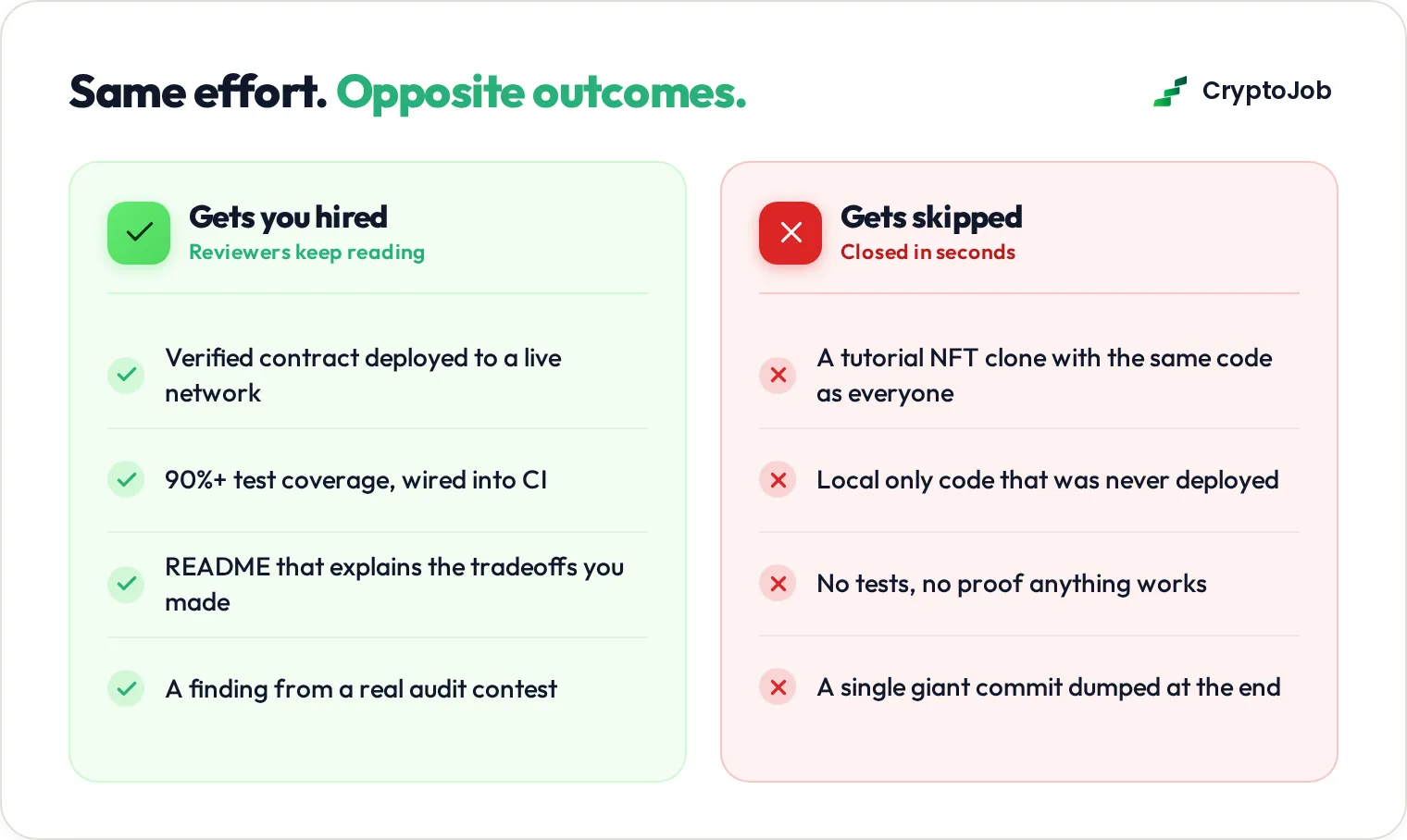
- A test suite with meaningful coverage, not two placeholder tests
- A README that explains the problem, your design decisions and known trade-offs
- Some evidence of real usage, even if it's just 20 testnet users from a Discord post
Notice what's missing from that list: originality for its own sake. A well-built fork of an existing protocol with one genuine improvement beats a half-finished "revolutionary" idea every time.
Quality over quantity is the rule. Three or four projects at this standard will outperform a wall of shallow repos.
2. Which web3 portfolio projects should you build first?
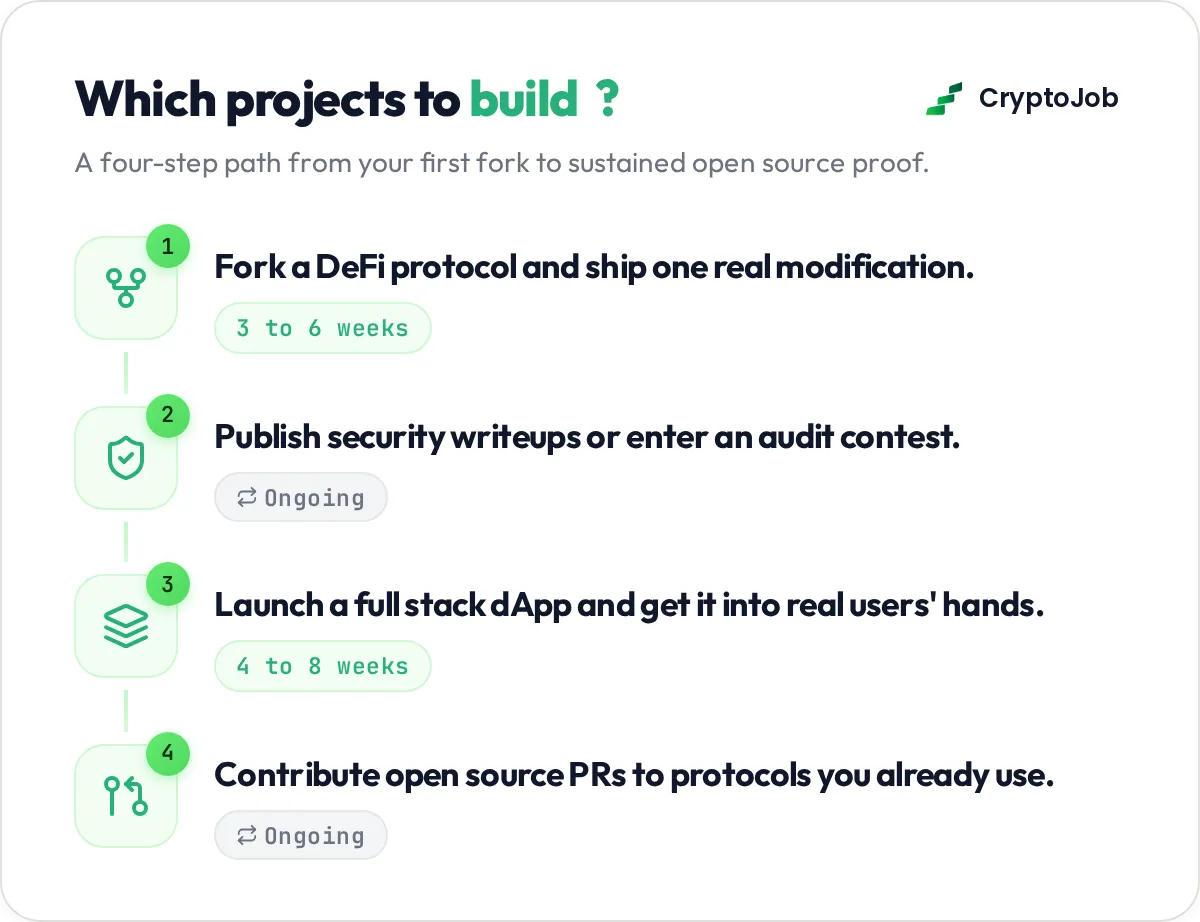
Build in this order if you're starting from a thin portfolio. Each project maps to a skill hiring teams screen for.
1. A DeFi protocol fork with a real modification
Fork a lending protocol or AMM, then change something meaningful. Add a new interest rate curve, support a different collateral type or build a simplified single-pool version from scratch.
This proves you can read production Solidity, which is most of the actual job. Explain in your README what you changed and why. Expect this to take 3 to 6 weeks part time.
2. A security-focused project
Complete challenges on Ethernaut or Damn Vulnerable DeFi, then write up your solutions as blog posts or a repo with explanations. Better yet, participate in one audit contest on Code4rena or Sherlock, even if you find nothing.
Security awareness is the most in-demand signal in smart contract hiring. A single valid finding in a public contest can carry an entire application.
3. A full-stack dApp people can actually use
Build something with a frontend, wallet connection and a deployed contract. Good examples include an on-chain splitwise for group expenses, a token-gated content tool or a simple prediction market.
This shows you understand the whole stack, from wagmi or ethers.js on the frontend down to events and gas optimization on the contract side. Frontend-heavy web3 roles often start here rather than with pure Solidity work.
4. Open source contributions
Pick one active protocol or tooling repo (Foundry, OpenZeppelin, a mid-size DeFi project) and land 2 or 3 merged PRs. Start with documentation or test fixes if the codebase is intimidating.
Merged PRs are third-party validation. A stranger with commit access reviewed your code and accepted it, which is exactly what an interviewer wants to see.
3. How should you structure a blockchain portfolio for recruiters?
Your blockchain portfolio has about four minutes to make its case, so structure it for skimming.
Lead with a pinned GitHub profile README. List your top 3 projects with one-line descriptions, deployed contract links and tech stack. Recruiters land on GitHub first, so treat that page as your homepage.
Every project needs the same README skeleton. Problem, solution, architecture diagram or bullet flow, how to run it, deployed addresses and what you'd improve. A hiring manager should understand the project without cloning it.
Show the on-chain proof. Link verified contracts directly. An Etherscan link with green verified source code is worth more than any screenshot.
Add a short demo video or GIF for anything with a UI. Nobody installs your dApp locally. A 60-second Loom in the README gets watched, a setup guide doesn't.
Keep commit history honest. One giant "initial commit" containing a finished project reads as copied work, whether it was or not.
4. What Solidity projects for a resume actually stand out?
If you only have one line of space per project on the resume itself, these Solidity project types punch hardest, roughly in order of signal strength:
|
Project type |
Signal to employers |
Effort |
Best for |
|
Audit contest finding (Code4rena, Sherlock) |
Very high |
Medium, ongoing |
Security and protocol roles |
|
Protocol fork with modification |
High |
3 to 6 weeks |
Smart contract engineer roles |
|
Gas-optimized library or tool |
High |
2 to 4 weeks |
Senior-leaning contract roles |
|
Full-stack dApp with real users |
Medium to high |
4 to 8 weeks |
Full-stack and frontend web3 roles |
|
Merged PRs to known repos |
Medium to high |
Ongoing |
All roles, especially juniors |
|
Tutorial NFT mint or ERC-20 clone |
Low |
Days |
Nothing, skip it on the resume |
Write each resume bullet as outcome plus proof. "Built and deployed a lending pool on Base with 94% test coverage, verified at [address]" beats "Experienced with Solidity and DeFi."
Quantify wherever it's honest. Test coverage, gas savings versus a baseline, number of testnet users and lines of audited code all work.
5. What can these projects realistically earn you?
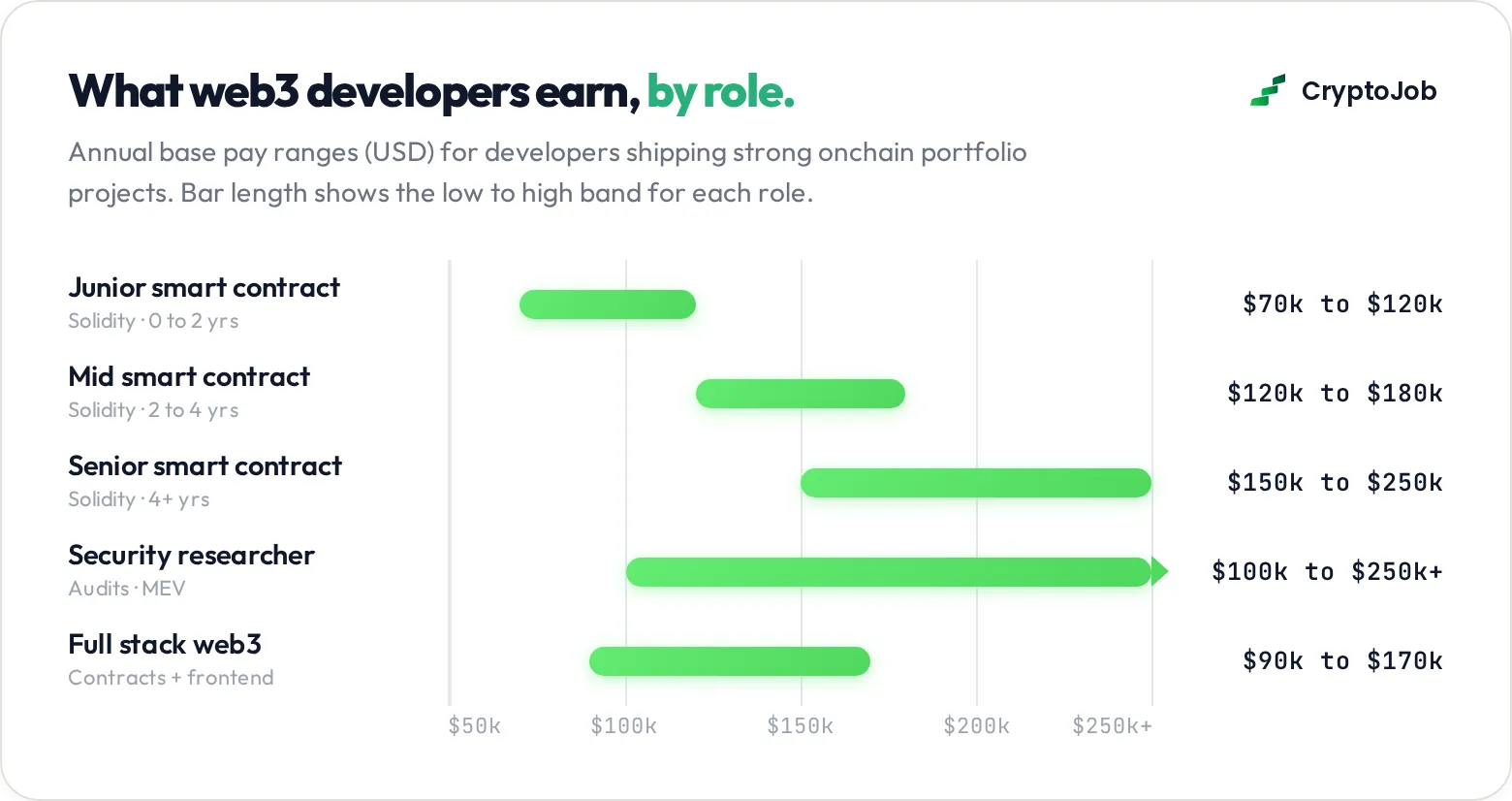
Web3 salaries swing with market cycles, so treat these as current rough ranges rather than promises. They also vary a lot by region, with US and remote-first protocol teams at the top end.
- Junior smart contract engineer: roughly $70k to $120k
- Mid-level smart contract engineer: roughly $120k to $180k
- Senior smart contract or protocol engineer: roughly $150k to $250k, sometimes higher with token packages
- Security researcher or auditor: roughly $100k to $250k+, with contest earnings on top for the best
- Full-stack web3 developer: roughly $90k to $170k
Token or equity grants are common and can meaningfully change total compensation, in both directions. Always ask how grants vest and what happens in a downturn.
The portfolio's job is to get you into these conversations. A strong security writeup or a live protocol fork routinely gets candidates interviews that their resume alone wouldn't.
6. How do you turn portfolio projects into interviews?
Building is half the work. Distribution is the other half, and most candidates skip it.
Post every project publicly. A short thread on X or a post in the protocol's Discord when you ship gets you feedback, users and sometimes a DM from a hiring team.
Write one technical blog post per project. Explain a specific problem you solved, like reentrancy protection in your vault or how you cut gas 30% on a mint function. These posts rank, get shared and prove communication skills.
Reference the project in every application. Cover letters and application forms should link the one project most relevant to that specific job, not your whole GitHub.
Use projects as interview ammunition. Most web3 technical interviews include a "walk me through something you built" section. Candidates who can defend their design decisions under questioning convert far better than leetcode grinders.
7. Common mistakes that quietly kill applications
A few patterns show up constantly in rejected portfolios.
Everything is a tutorial. If your project appears in a popular YouTube series, assume the reviewer has seen it 50 times this month.
Nothing is deployed. Code that only runs locally suggests you've never dealt with real deployment, verification or gas costs.
No tests anywhere. In an industry where a bug can drain millions, shipping untested contracts reads as a serious judgment problem, not a shortcut.
Dead projects with broken links. Check your demo links quarterly. A 404 on your best project is worse than not listing it.
Ten shallow repos instead of three deep ones. Archive the noise. Your portfolio is judged by its weakest visible project.
8. Conclusion
The formula is simple even if the work isn't. Build 3 or 4 web3 portfolio projects that are deployed, tested and documented, make at least one of them security-focused, then distribute them publicly instead of letting them sit in a private repo.
Do that and you're ahead of the large majority of applicants, because most people never get past the tutorial stage. When you're ready to put the portfolio to work, browse web3 jobs on CryptoJob and start matching your projects to real openings this week.
FAQ
How many web3 portfolio projects do I need to get hired?
Three or four strong ones. Each should be deployed, tested and documented well enough that a hiring manager understands it in five minutes. More projects at lower quality actively hurt you.
Do web3 portfolio projects need to be on mainnet?
No. A verified contract on a testnet like Sepolia or a cheap L2 like Base is enough for most roles. Mainnet deployment is a nice bonus because it shows you've handled real gas costs, but it's not required for juniors.
Can I get a web3 job with no professional experience?
Yes, and it happens regularly. A strong portfolio plus visible activity like audit contest participation, merged open source PRs or hackathon wins substitutes for work history better in web3 than in almost any other tech field.
Are hackathon projects good portfolio pieces?
They're good starting points but weak finished pieces. Hackathon code is rushed by design. Take your best hackathon project, add tests, clean the code, redeploy it and write a proper README, then it becomes a real portfolio item.
How long does it take to build a hireable portfolio?
Roughly 3 to 6 months part time if you already know how to code, longer if you're learning Solidity from scratch. It varies with how much time you can commit, but consistency beats intensity here.