Bitcoin Jobs in 2026: Lightning, Mining and the Companies Hiring
Where bitcoin pays in 2026: mining ops from $23 per hour, Lightning engineering near $101K and the companies hiring for each track.

TL;DR
- Bitcoin jobs run on four tracks: protocol work, Lightning, mining ops and finance
- Lightning engineers average near $101K in the US, seniors clear $130K
- Mining technicians start around $23 to $30 per hour
- Miners pivoting into AI data centers are hiring hardest in 2026
Bitcoin jobs in 2026 split into four clear tracks: protocol and open source development, Lightning Network engineering, mining and data center operations and the finance roles forming around corporate bitcoin adoption. Pay stretches from roughly $23 per hour for entry level site technicians to $200K and beyond for senior engineers at established firms. This guide breaks down who is hiring, what each role pays and how to get in.
The bitcoin side of the industry gets less coverage than the wider web3 scene, which is exactly why it is less crowded. You can browse web3 jobs that include bitcoin native companies and filter by the skills you already have.
One thing to know upfront: bitcoin companies tend to hire believers. Hiring managers at these firms consistently screen for genuine interest in bitcoin itself, not just blockchain as a category.
1. What counts as a bitcoin job in 2026?
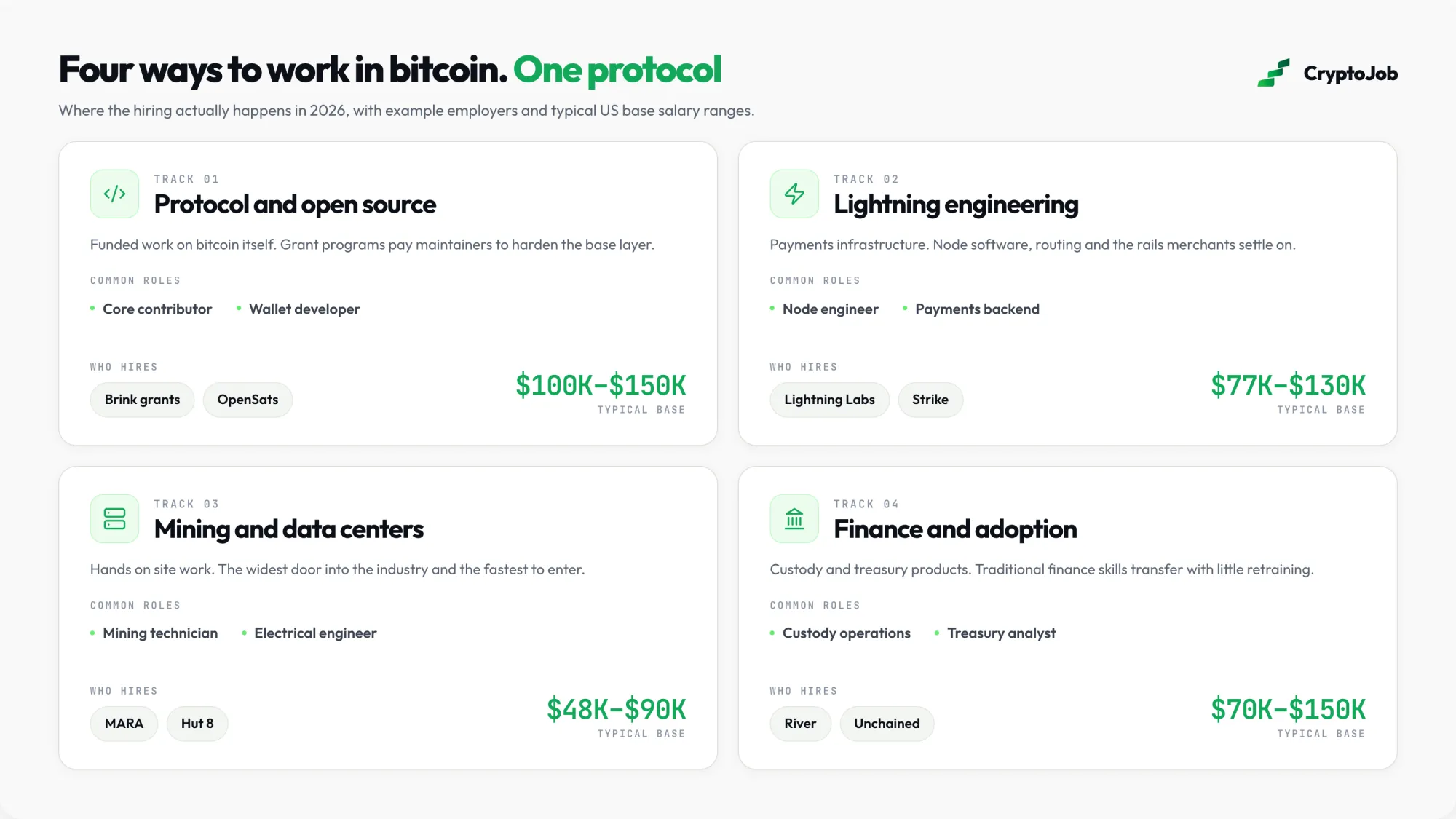
A bitcoin job is any role at a company whose core product is built on bitcoin rather than on general purpose chains. That includes exchanges and brokerages like River and Swan, custody firms like Unchained and Casa, payment companies like Strike and Lightning Labs and the public mining fleet led by names such as MARA, Riot, Hut 8 and CleanSpark.
It also includes open source protocol work funded by grant programs such as Brink, OpenSats and Spiral. These grants let developers work on Bitcoin Core and related tooling full time without a traditional employer.
The skill mix differs from the rest of crypto. Solidity barely matters here. C++, Rust, Go, systems engineering and hardware or electrical skills carry far more weight.
2. Which bitcoin companies are hiring right now?
Job listing data from mid 2026 shows steady demand in a market that has otherwise cooled. Lightning Labs has been recruiting for product marketing and engineering. Bitdeer has open roles across communications and operations for its AI and mining data center business. Hut 8 describes itself as building data centers for AI, cloud and bitcoin workloads and hires accordingly.
On the software and finance side, watch Block, Strike, River, Swan, Unchained and Casa. Block alone spans hardware wallets and mining chips, so one company covers several tracks.
Hardware and services firms round it out. Bitmain, the largest miner manufacturer, hires sales and support staff in the US, while service shops like Advanced Crypto Services recruit field technicians in Texas and the mountain states.
3. What do bitcoin mining jobs pay?
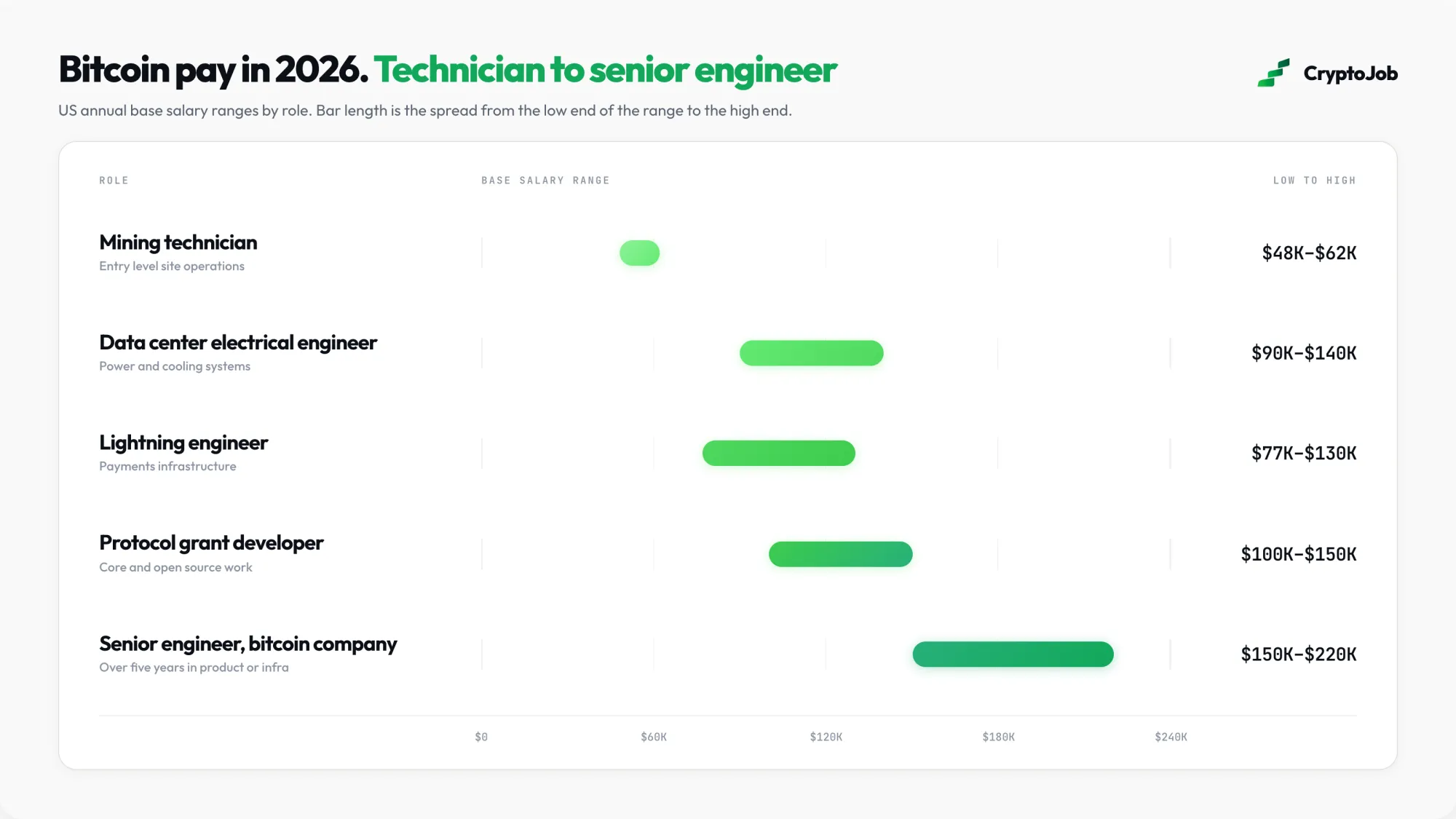
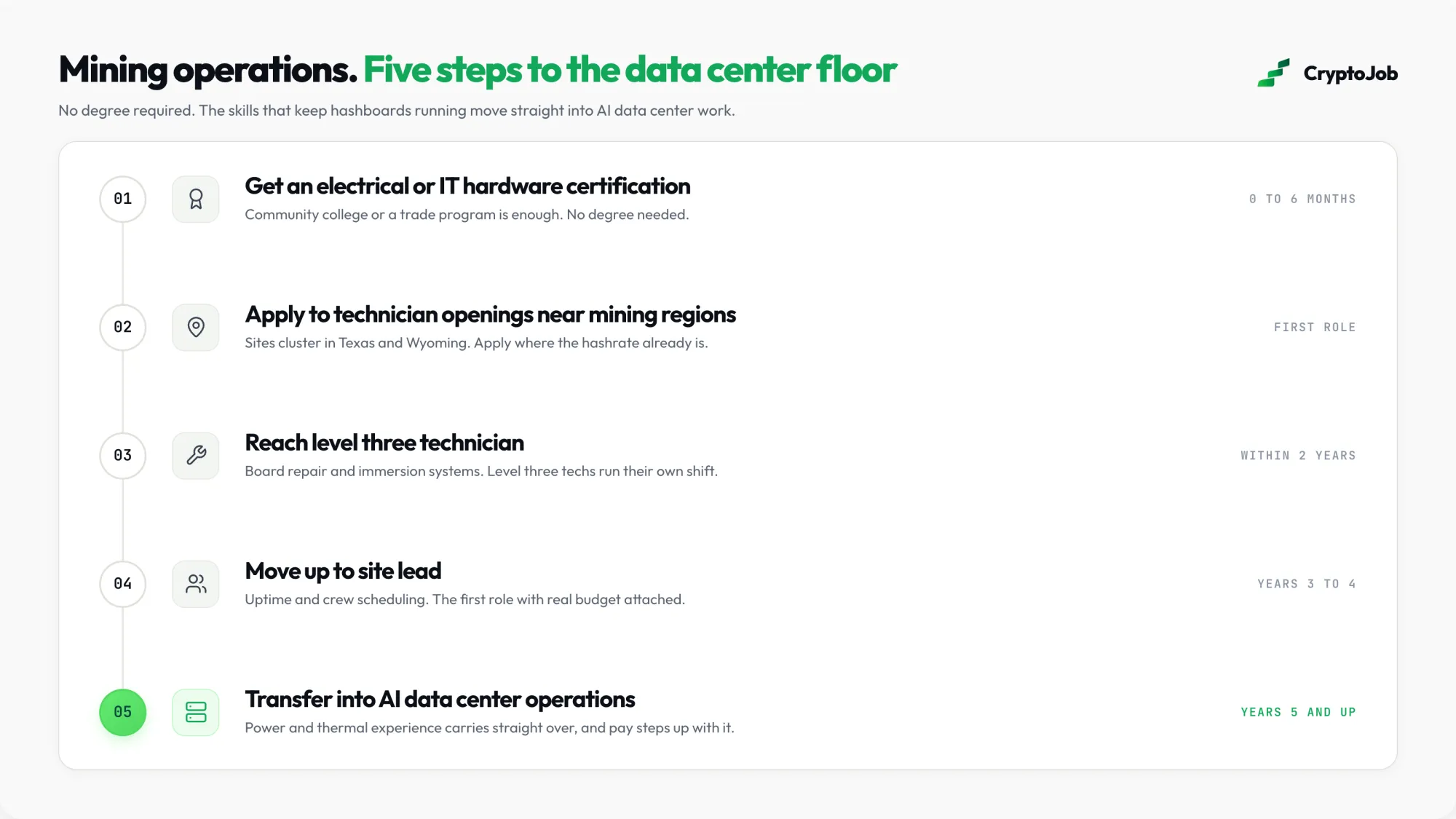
Bitcoin mining jobs are the most accessible entry point because they value hands on hardware skill over a computer science degree. ZipRecruiter data from mid 2026 puts typical mining technician pay between $23 and $30 per hour, with an average near $27, which annualizes to roughly $48K to $62K. Salaried site technician roles commonly land between $40K and $61K.
Progression is fast. Level three technicians at repair firms can pass $30 per hour within a couple of years, and site leads or facility managers move into the $70K to $100K band depending on region.
The bigger story is the AI pivot. Miners such as Hut 8, Bitdeer and Core Scientific now run high performance computing alongside bitcoin hashing, which creates demand for electrical engineers and data center operators. Those crossover roles typically pay $90K to $140K and teach skills that transfer straight into the broader AI infrastructure boom.
4. What are Lightning Network jobs and what do they pay?
Lightning Network jobs center on the payment layer that makes bitcoin usable for everyday transactions. Employers include Lightning Labs, Strike, Breez, Voltage and the payments teams inside exchanges that route withdrawals over Lightning.
ZipRecruiter listed the average US rate for Lightning Network work at about $49 per hour as of July 2026, with most roles between $37 and $62. Annualized, that is roughly $77K to $130K, and senior protocol level engineers negotiate well above it.
The stack is specific: Go or Rust, LND or Core Lightning node experience and comfort with networking concepts like channel management and routing. Running your own node and contributing a small patch or plugin is the fastest way to prove you can do this work.
5. What is a realistic bitcoin developer salary beyond Lightning?
For general engineering at bitcoin companies, remote listings in 2026 mostly fall between $52K and $138K, while senior engineers at established firms typically sit at $150K to $220K base. The most specialized positions reach $200K to $500K at the top end according to ZipRecruiter. Grant funded protocol work through Brink or OpenSats commonly pays in the $100K to $150K range, though each grant is negotiated individually and varies.
Compensation structure differs from typical startups. Token allocations do not exist here, so packages lean on cash and equity, with bitcoin denominated bonuses at some firms. If you are comparing offers across the industry, our guide to blockchain developer jobs covers how the wider market pays.
6. Which finance and corporate roles are growing around bitcoin?
The fourth track gets the least attention and is growing the fastest. Public companies keep adding bitcoin to their balance sheets, brokerages like River and Swan sell bitcoin services to businesses and retirement savers and custody firms like Unchained build lending and inheritance products on top of multisig.
That activity creates jobs that look nothing like protocol work. Client advisors who can explain custody to a nervous CFO, treasury analysts who model bitcoin on a balance sheet, private client managers for high net worth holders and compliance officers who know both banking rules and bitcoin mechanics all appear in 2026 listings.
Pay follows finance norms more than tech norms. Advisory and client roles commonly run $70K to $120K with bonuses, treasury and finance specialists $90K to $150K and the accounting side benefits from new fair value rules that made corporate bitcoin holdings far easier to book.
The entry path is friendlier too. A background in wealth management or corporate treasury translates directly, and firms in this lane care more about client trust than GitHub commits.
7. How do you get hired without prior bitcoin experience?
Start with public proof of work. For engineering, that means commits to open source bitcoin tooling or a well documented node setup. For mining, an electrical or IT certification plus willingness to relocate near a site in Texas or Wyoming beats a polished resume.
Second, learn the culture. Bitcoin firms interview for conviction and low ego collaboration, and they notice when candidates only discovered the space last month.
Third, use adjacent experience. Data center staff, energy analysts, fintech compliance people and payments product managers all map cleanly onto open roles. Rust experience is especially portable, and our breakdown of Rust developer jobs in crypto shows where else that skill pays.
8. How do the four bitcoin career tracks compare?
| Track | Typical 2026 pay | Background needed | Remote friendly |
|---|---|---|---|
| Protocol and open source | $100K to $150K grants | C++ or Rust, cryptography basics | Yes, fully |
| Lightning engineering | $77K to $130K | Go or Rust, node operations | Yes, mostly |
| Mining and data centers | $48K to $140K | Electrical, HVAC or IT hardware | No, onsite |
| Finance and corporate | $70K to $150K | Fintech, treasury or compliance | Mixed |
9. Where should you start your search?
Bitcoin only job boards exist, but most roles also surface on general crypto boards and company career pages. Set alerts for the company names above, follow their engineering leads on X and check grant program pages quarterly.
A simple weekly routine outperforms bursts of effort. Spend one session applying to two or three well matched roles, one session on visible work like a node upgrade writeup or a client case study and one short session engaging in the communities where these teams actually talk, which for bitcoin means X, developer mailing lists and a handful of technical Discords.
Conferences punch above their weight in this niche. Bitcoin specific events in Nashville, Riga and Prague function as hiring fairs in disguise, and grant reviewers and engineering leads are unusually approachable there compared with big tech recruiting.
The market rewards patience here. Openings are fewer than in the wider industry, yet competition per role is thinner and retention is famously high. You can browse web3 jobs right now and shortlist the bitcoin native companies that match your track.
FAQ
Do bitcoin jobs pay less than other crypto jobs?
Base salaries are broadly similar for engineers, though bitcoin firms rarely offer token upside. What you lose in speculative tokens you often gain in company stability and equity that behaves like normal startup stock.
Can I get a bitcoin mining job with no experience?
Yes. Entry technician roles hire from electrical, HVAC, automotive and IT support backgrounds and train on the specifics, one of the clearest examples in our guide to web3 jobs without a degree. Expect shift work at physical sites rather than remote work.
Is Lightning still worth learning in 2026?
Yes for the payments niche. The talent pool is tiny, employers like Lightning Labs and Strike keep hiring and the skills overlap with general distributed systems work if you later change direction.
Do I need to know Solidity for bitcoin jobs?
No. Bitcoin companies build in C++, Rust, Go and Python. Solidity is an Ethereum ecosystem skill and carries little weight with bitcoin employers.