Pump.fun Now Prices Memecoins in Tokenized Nvidia. Here's What Breaks.
Pump.fun opened 93 new quote assets on Wednesday and its fee docs don't cover any of them. Here's the engineering problem that creates, the incidents that already happened at this exact step, and the launchpad developer jobs it opens.

TLDR
- Role: the engineers who build and maintain token launchpads, the bonding curves under them and the AMM pools they graduate into
- Stack: Rust and Anchor on Solana, Solidity on EVM chains, Foundry or Solana's test validator, an oracle or a firm reason you don't need one
- Pay: $150K to $250K base for launchpad developer jobs at the established platforms, drawn from the DeFi and protocol guides on this site; token comp on top at most of them
- The filter: "Your quote asset halts trading at 4pm New York. What does your curve do at 4:01?"
- Verdict: yes, if the team can answer that question. No, if they look at you blankly.
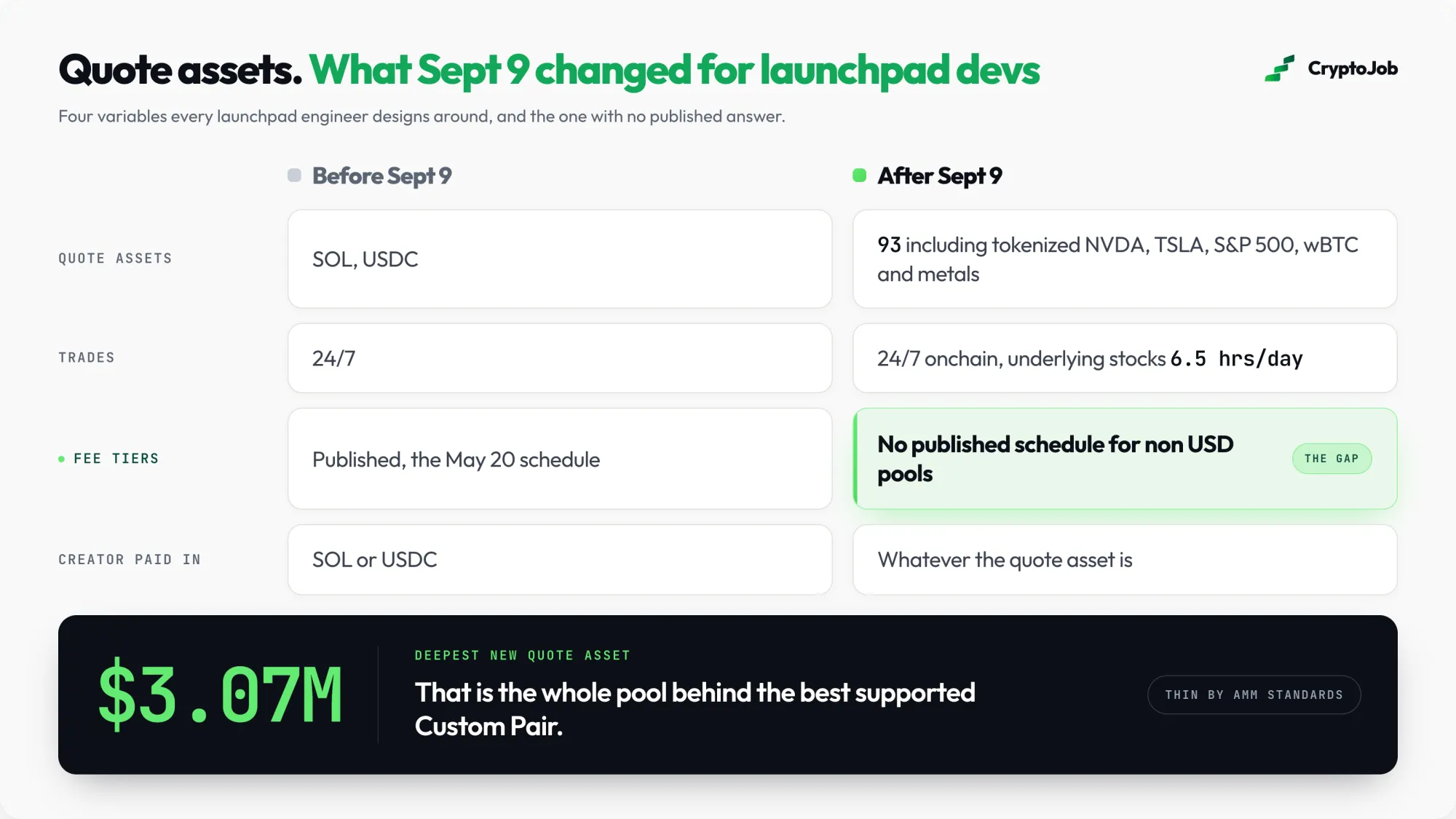
On Wednesday afternoon Pump.fun opened token launches to 93 quote assets beyond SOL and USDC, including tokenized Nvidia, Tesla and the S&P 500, with half the revenue from the new pairs routed into the PUMP buyback-and-burn contract. The deepest of the new quote assets holds $3.07 million of liquidity. I read the announcement, then I read the fee docs, and the gap between the two is what this post is about.
The product is called Custom Pairs, and it copies the trade that pushed Robinhood Chain past Solana in tokenized stock volume in July. The memecoin-on-a-stock structure that drove CASHCAT's run is now available on Pump.fun's own curve. That's where launchpad developer jobs get interesting, because the launchpad just took on a class of problem it hasn't had before. If you're a developer weighing this corner of the market, browse web3 jobs after reading; the roles I describe here are open.
1. Tuesday
It's 10am. A creator launched a coin last night paired with tokenized Nvidia. It's 40% up the bonding curve. The US market opens at 9:30 New York, which was thirty minutes ago, and Nvidia gapped down 6% on an earnings reaction. Your job this morning is to figure out what the curve thinks the coin is worth, because the curve is denominated in something whose dollar value just moved while the curve was asleep.
That's the day. Pump.fun's published fee schedule was last updated May 20 and covers only SOL and USDC pools. Graduated pools use a sliding scale keyed to market cap measured in SOL or USDC, from 1.25% down to 0.3%. There is no schedule for a pool quoted in a tokenized stock, and nothing that says how an Nvidia-denominated market cap maps onto those tiers. That's the spec someone is writing this week, at Pump.fun and at every launchpad that copies it by October. If it's you, you're a launchpad developer.
The rest of the morning is monitoring. Which pairs have depth, which are one wallet deep, which quote assets just went stale because the underlying stopped trading. Then a fee question from the finance side: creator fees on Custom Pairs are paid in the quote asset, so a coin paired with tokenized Nvidia pays its creator in tokenized Nvidia. Somebody has to decide how that gets reported. It won't be finance. It'll be you, because you're the one who knows what the contract actually emits.
2. What the stack actually is
Don't let the word "launchpad" fool you into thinking it's a web app. It's three pieces of market infrastructure with a front end on top.
| Layer | What it does in this role | How deep you need to be |
|---|---|---|
| Bonding curve program | Prices tokens from supply, mints on buy, burns on sell, tracks graduation | Could debug it at 3am |
| Graduation and migration | Moves liquidity from the curve to an AMM pool at a threshold | Shipped with it |
| AMM pool (PumpSwap, Raydium, PancakeSwap) | Where the token trades after graduation | Shipped with it |
| Quote asset handling | New in 2026: pools denominated in tokenized stocks, wBTC, metals | Nobody's deep yet, which is the opportunity |
| Fee router | Splits protocol, creator and buyback shares, now in mixed denominations | Could debug it at 3am |
| Indexer and monitoring | Tracks every pool, flags thin liquidity and stale quotes | Used it |
The language is Rust with Anchor on Solana, which is where Pump.fun lives, and Solidity on BNB Chain, where Four.meme and Flap run the same shape. The Solana side pays more, per the Solana developer guide, because there are fewer people who've shipped a program that handles real money under load.
3. Learn the curve before you learn the app
Every launchpad interview starts with the curve, so start there.
A bonding curve is a formula, enforced by a program, that sets a token's price from how many tokens exist. Buying mints and pushes the price up. Selling burns and moves it down. Pump.fun's version added an ending: at a set market cap the curve closes and the liquidity migrates to an AMM. That threshold, and the migration that follows it, is where money has historically been lost. Read the incident section before you read anything else.
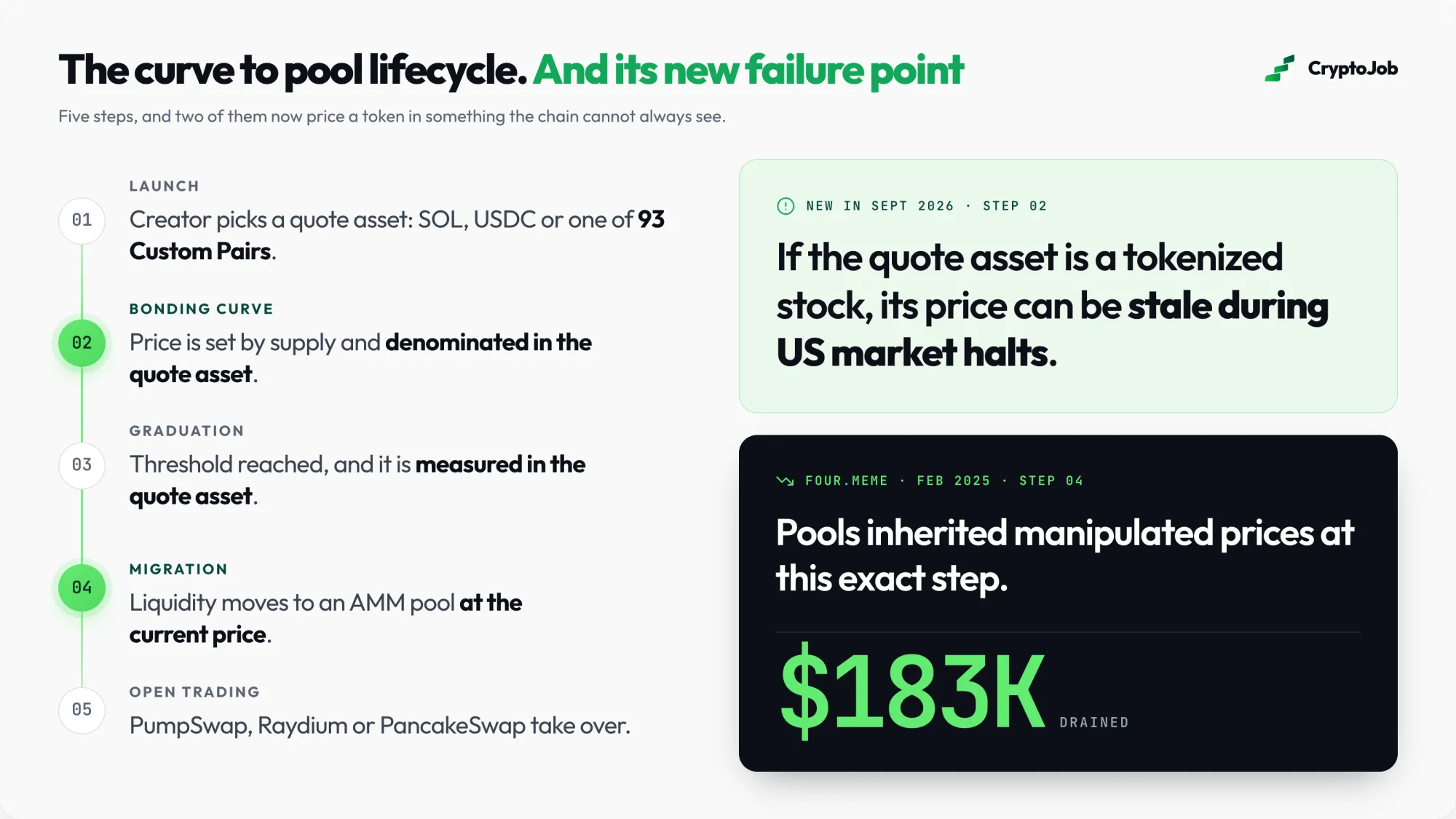
The Custom Pairs change means the formula's inputs are now denominated in an asset with its own price, its own trading hours and its own custody. If you can explain, in plain sentences, what happens to a curve quoted in tokenized Tesla during a Tesla trading halt, you're ahead of most people who'll apply for these roles this month.
4. What actually broke
Two incidents, both public, both directly relevant to the code that Custom Pairs just shipped.
May 2024, Pump.fun, about $1.9 million. An attacker used flash loans from MarginFi to exploit the migration step. When a token fills its bonding curve, Pump.fun's service account is meant to move the curve's liquidity to Raydium so the token can trade openly; throughout the attack, that service account cosigned every one of the exploiter's transactions, which led analysts to conclude a private key compromise made the flash-loan exploit possible. The lesson was not "flash loans are dangerous." The lesson was that a privileged migration account is a single point of failure and the migration step needs to be trustless or it needs to be the most defended thing you own.
February 2025, Four.meme, about $183,000. SlowMist explained that when new tokens migrated to PancakeSwap v3 and added liquidity, they automatically adopted manipulated price points, which let attackers drain pool assets. Read that again with Custom Pairs in mind. The whole attack was about the price the pool inherited at migration. Now imagine the pool is quoted in tokenized Nvidia, the migration happens at 2am New York, and the last honest Nvidia print was five hours ago. An attacker who can nudge the quote asset's on-chain price during off-hours sets the migration price for every coin graduating that night. Four.meme responded by suspending its PancakeSwap liquidity pools until a fix shipped. That's the fix the next Custom Pairs incident will need, and the engineer who's already written it is the one who gets hired.
5. The question that filters people
Here's the one I'd ask, and the one I've seen separate candidates in launchpad and AMM interviews.
"A creator launches a coin paired with a tokenized stock. The stock halts at 11am for news. Trading in the token continues on your curve. What is the token's dollar price at 11:30, who decides and what does your graduation check do if the threshold is crossed during the halt?"
A weak answer talks about oracles in general. A strong answer says three specific things. First, the curve doesn't know dollars, it knows the quote asset, so the "dollar price" is a display concern until the fee tiers depend on it, and then it's a contract concern. Second, the graduation threshold is measured in the quote asset per the current docs, so a halt doesn't stop graduation, which means the migration can happen at a stale price, which is exactly the Four.meme failure mode. Third, the fix is either a freshness check on the quote asset's reference price before migration, or a design decision to graduate on quote-asset units only and accept that dollar-denominated market caps will be wrong during halts. Either is defensible. Not having thought about it is not.
6. Build this before you apply
One project, scoped to a weekend, that puts you in the top decile of applicants for launchpad developer jobs.
Scope: a bonding curve program on Solana devnet with a configurable quote mint. Support SOL and one SPL token of your choosing as the quote asset. Implement graduation at a threshold measured in the quote asset. Then add the part nobody has: a freshness gate on migration. Before liquidity moves to a pool, check a reference price for the quote asset and refuse to migrate if it's older than a configurable window. Log why.
Stack: Rust, Anchor, the Solana test validator for local runs, a Pyth or Switchboard feed on devnet for the reference price, and a small TypeScript script that drives buys up the curve and tries to trigger migration during a simulated stale window.
What to show: the repo, a README that explains the freshness gate in three sentences, and a test that proves migration refuses when the price is stale and proceeds when it isn't. One diagram of the curve-to-pool flow. No front end.
What a reviewer looks for: whether you understood that the quote asset is the new attack surface, whether your threshold math is in quote units, and whether the test actually exercises the failure. That last one is where most portfolio projects collapse.
7. Where the roles are
The named launchpads are hiring or will be within weeks, because a product like Custom Pairs creates support load the day it ships. Pump.fun on Solana. Four.meme and Flap on BNB Chain, where MarsCoin's SPCXB-quoted pool already lives. Bonk.fun. The AMMs they graduate into, PumpSwap, Raydium and PancakeSwap, need the same skills on the receiving side.
Then the issuers. xStocks, Backpack Securities and Binance's bStocks mint the tokenized equities these pairs are quoted in, and they need engineers who understand what a launchpad does to their asset. The tokenization and RWA engineer guide covers that side, with base pay in the $200K to $270K range at the institutional issuers.
And the auditors. Every one of these designs will get reviewed, and the security auditor guide has the ranges, from $100K to $160K for entry roles to $200K to $350K for the people who find the Four.meme bug before it's a headline.
Would I take it
Yes, if the team has a written answer to the halt question and the fee tiers for non-USD pools are specced before you start. That's a team that understands what it shipped. No, if the answer is "the market will figure it out," because the market figured it out for Four.meme and it cost $183,000. Before you decide, browse web3 jobs and compare what the launchpads are posting against the issuers; the same skills price differently on the two sides.
FAQ
1. Do I need Rust for launchpad developer jobs, or is Solidity enough?
For Solana launchpads, Rust and Anchor are required. For BNB Chain launchpads like Four.meme and Flap, Solidity is enough for the curve and the pools. Most teams want you to read both, because the incidents on one chain inform the design on the other.
2. What's the difference between a bonding curve and an AMM?
A bonding curve mints and burns tokens against a formula, so supply changes with every trade and there's no counterparty pool. An AMM holds two reserves and prices trades against their ratio. Launchpads use a curve first and migrate to an AMM at a threshold, and the migration is where both of the incidents in this post happened.
3. How do you handle a quote asset that only trades during US market hours?
You either gate any dollar-dependent logic, including fee tiers and migration, on a freshness check against a reference price, or you keep all contract logic in quote-asset units and treat dollar values as display only. Pump.fun's current docs don't say which it chose, which is the first question to ask in an interview there.