Paid in Crypto? How Your Taxes Actually Work in 2026
Crypto pay is taxed twice in most countries, once as income and once at sale. The 2026 rules explained without the jargon.
TL;DR
- Paid in crypto taxes hit twice: income at receipt, gains at sale
- US brokers now file the 1099 DA form with the IRS
- Long term gains rates are 0, 15 or 20 percent after one year
- Freelancers owe quarterly estimates on crypto income
Getting paid in crypto triggers taxes twice in most countries: once as ordinary income at the moment you receive it, valued at fair market price, and again as a capital gain or loss when you eventually sell, swap or spend it. In the US the enforcement gap is closing fast, with exchanges now filing the new 1099 DA broker form directly with the IRS and per wallet basis tracking required. This guide walks through exactly how crypto pay is taxed in 2026 and the records that keep you safe when the letters go out.
One framing note before the details: this is general information, not tax advice, and a crypto literate accountant is worth every dollar once real money flows. If you are comparing offers with crypto components, browse web3 jobs and read how different employers structure pay before you negotiate.
The core mental model fits in one sentence: receipt creates income and disposal creates gains, and both get reported.

1. How is a crypto salary taxed at receipt?
As ordinary income at fair market value on the day it lands, exactly like a cash paycheck. The IRS treats staking yields and crypto received as salary identically: income at receipt based on market price.
For employees, that value flows through normal payroll: withholding applies and the amount appears on your W2 like any wages. Employers handle the mechanics, though you should confirm they actually are.
The receipt price also becomes your cost basis. Write it down per payment, because every future sale calculates gain or loss against that exact number, and reconstructing it years later is the classic nightmare.
2. What happens when you later sell or spend that crypto?
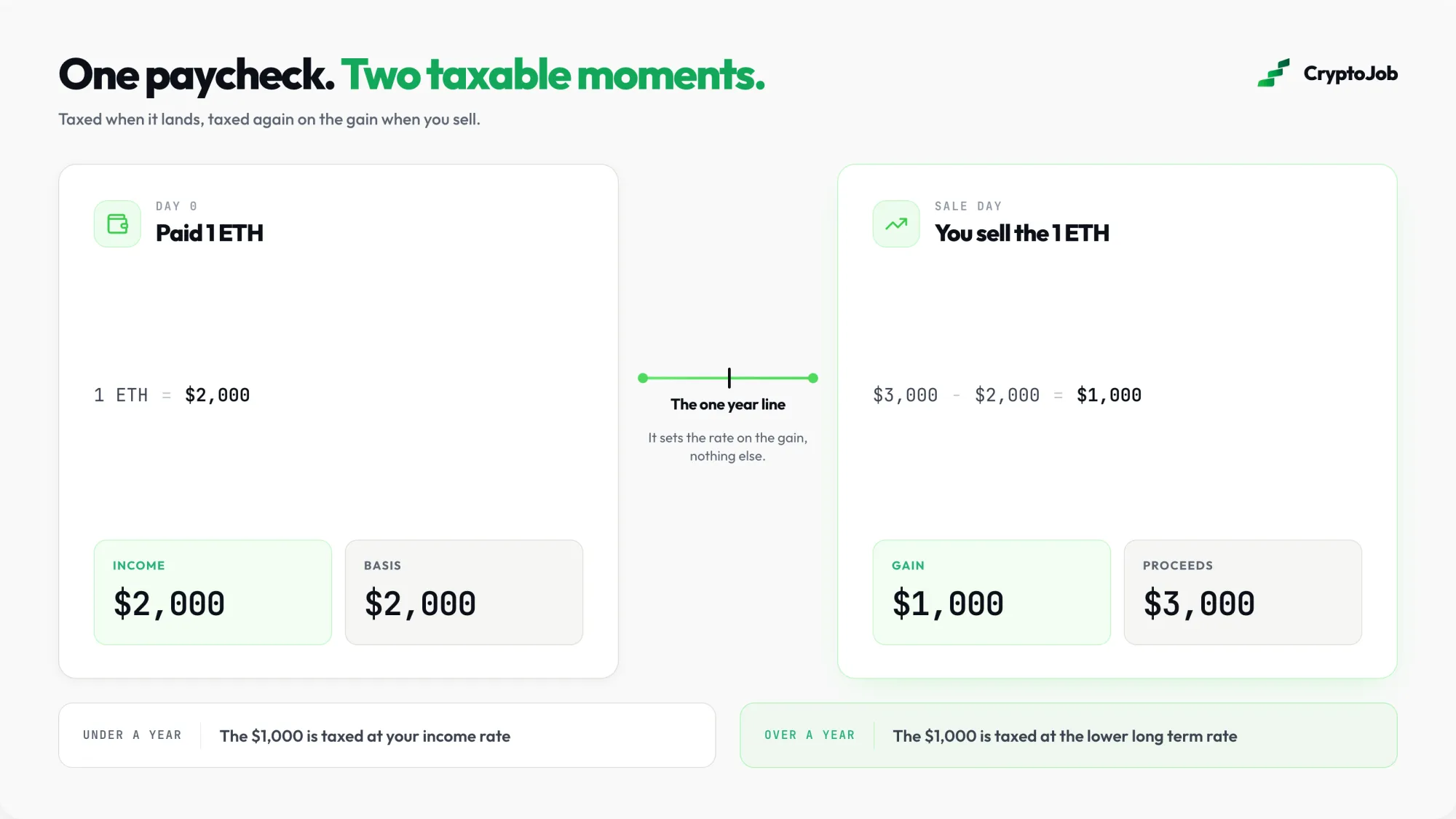
A second taxable event fires. Selling for fiat or swapping to another token both count as disposals, with your gain or loss equal to sale value minus that receipt day basis.
Holding period sets the rate in the US. Dispose within a year and short term gains stack onto ordinary income at 10 to 37 percent, hold beyond a year and long term rates of 0, 15 or 20 percent apply depending on income, which makes the one year line genuinely valuable.
A worked example makes it concrete. Say you are paid 1 ETH on a day ETH trades at $2,000: you recognize $2,000 of ordinary income that day and your basis becomes $2,000. Sell later at $3,000 and the $1,000 difference is your capital gain, taxed at your income rate inside one year and at the lower long term rate beyond it.
Losses work for you too. Crypto currently has no wash sale rule in the US, so harvesting a loss and repurchasing remains available, a quirk traditional securities do not share.
3. What changed with the new 1099 DA reporting?
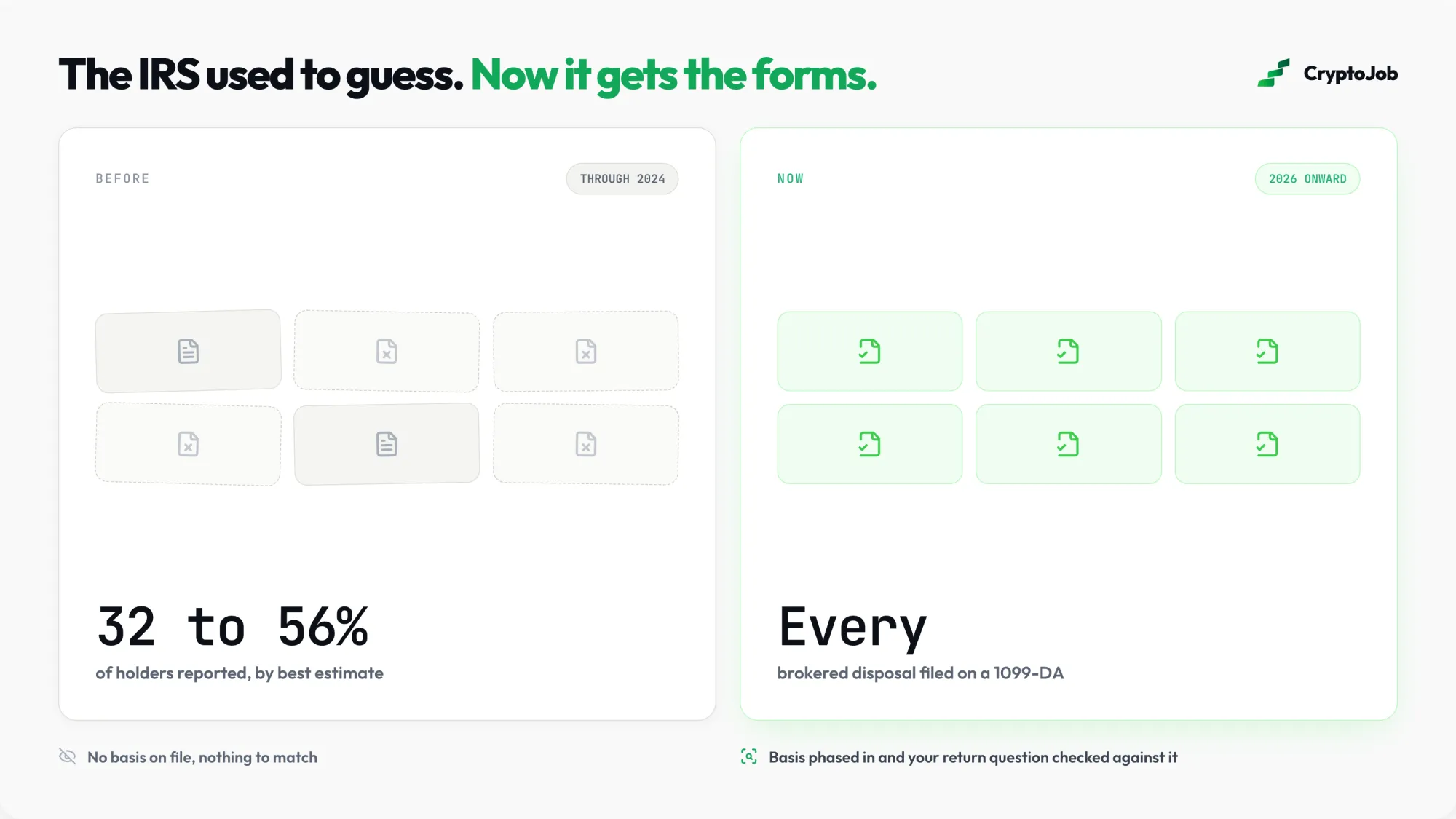
Visibility, massively. Starting with 2025 transactions, US brokers including major exchanges must report digital asset sales to the IRS on the new 1099 DA form, giving the agency broker level data comparable to stock trades for the first time.
The rollout phases in: gross proceeds reporting arrived first, with cost basis reporting for covered sales beginning for 2026 transactions and those fuller forms landing in early 2027. Early forms may therefore show what you sold without what you paid, so your own records still determine the actual tax.
The compliance gap this closes is real. Academic estimates put historical crypto reporting somewhere between 32 and 56 percent of US holders, and matching broker data to returns is exactly how the IRS shrank that gap for stocks a decade ago.
4. How do freelancers and contractors handle crypto income?
As self employment income at receipt value, reported on Schedule C in the US, with self employment tax on top of income tax. Clients may issue 1099 forms, but the obligation exists regardless of paperwork.
Quarterly estimated payments are the discipline that saves you. Crypto income arrives without withholding, so setting aside 25 to 40 percent at receipt and paying estimates on schedule prevents the April disaster that catches most first year freelancers.
Volatility adds a cruel twist: you owe income tax on receipt value even if the token later falls. Many contractors convert enough to fiat immediately to cover the tax slice, and our guide on how to get paid in crypto covers structuring payments so this stays painless.
5. What records must you actually keep?
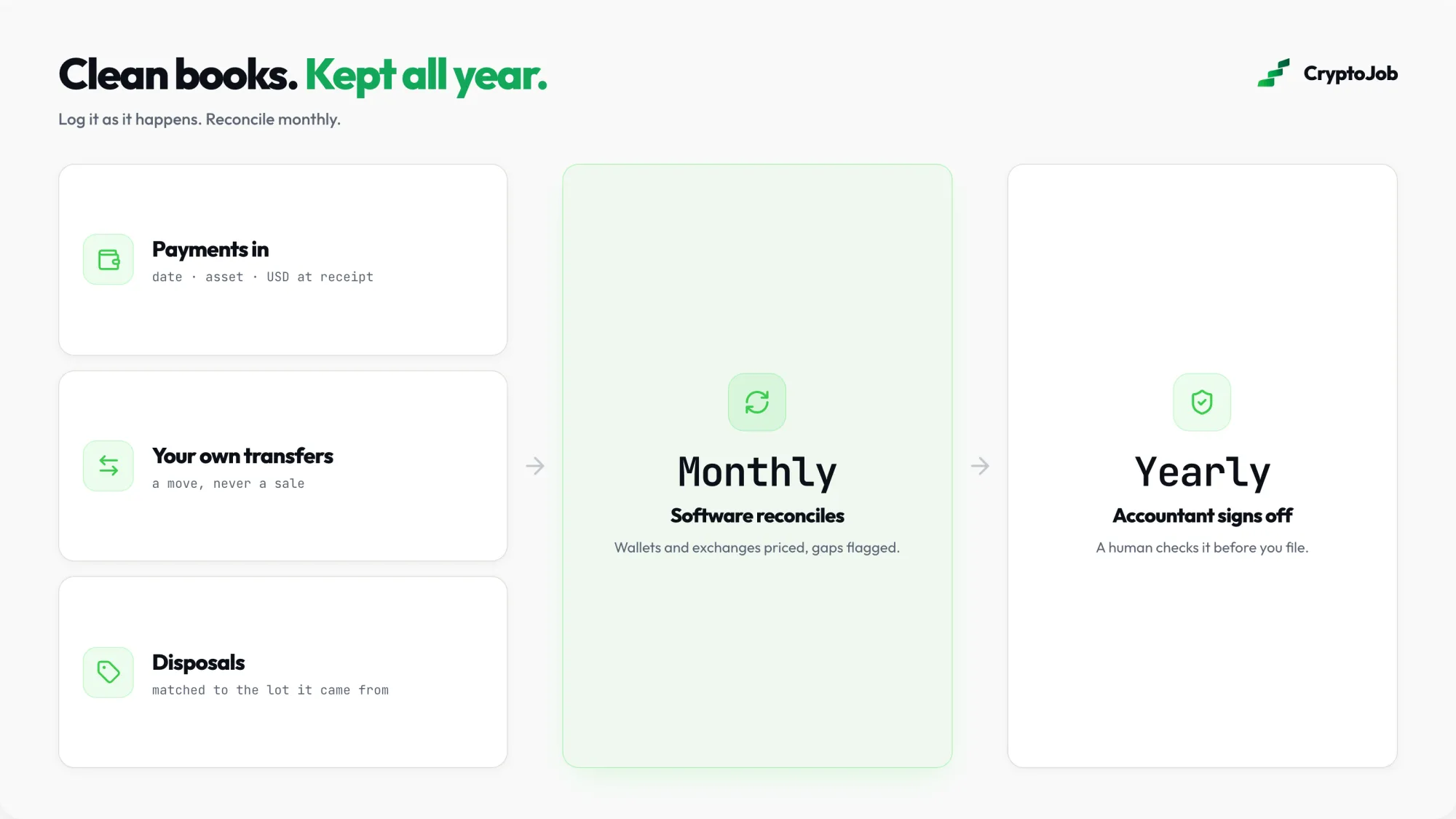
Per payment: date, asset, amount, fair market value at receipt and the wallet it landed in. Per disposal: date, proceeds, which lot you sold and the fee paid. That is the entire dataset an audit requires.
Per wallet tracking is now the rule, not a preference. US guidance requires basis tracked wallet by wallet rather than pooled across everything, which makes casual transfers between your own wallets a bookkeeping event even though they are not taxable.
Software carries the load at any real volume. Crypto tax tools ingest wallets and exchange history, then apply the rules and generate the forms, and pairing one with an accountant who has actually filed crypto returns is the standard professional setup now.

6. How do tokens and vesting complicate the picture?
Token grants generally create income as they vest, valued at the market price on each vesting date, which can generate enormous paper income in good markets. Locked or restricted tokens raise valuation questions that genuinely require professional help.
The brutal scenario is vesting high and holding into a crash: the income tax attaches to vest day value even if the token collapses afterward, a lesson an entire generation of 2021 hires learned expensively.
Elections and structures exist to manage timing in some cases, and they are decision points at signing, not at filing. Our guide to token vesting for employees walks the mechanics before you negotiate.
7. How does the picture change outside the US?
The receipt as income principle travels widely, while disposal rules diverge. Germany famously exempts gains on crypto held over a year, while other jurisdictions treat every swap as a taxable moment, so residency genuinely reshapes the math.
Zero personal income tax hubs explain part of crypto's geography: a salary in Dubai keeps its gross value, which is a core reason relocation packages keep tempting remote workers.
Wherever you sit, one rule holds: your tax residence, not your employer's location or the chain used, decides which rulebook applies, and cross border earners should get advice before the first payment rather than after the first notice.
8. What are the most common filing mistakes?
| Mistake | Why it happens | The fix |
|---|---|---|
| No receipt records | Basis reconstructed years later | Log value the day each payment lands |
| Ignoring swaps and spending | Feels like moving, is disposing | Treat every swap and purchase as a sale |
| Trusting broker forms alone | Early 1099 DA may omit basis | Keep your own lot level records |
| No quarterly estimates | Crypto pay has no withholding | Reserve a tax slice at every receipt |
9. How do employers handle crypto payroll on their side?
Properly run companies treat crypto pay as normal wages with extra plumbing: payroll calculates the fiat value at each payment and reports it on standard forms with withholding where required, often routing through specialist crypto payroll providers to handle the conversion mechanics.
That matters to you because sloppy employer handling becomes your problem at filing time. Confirm before signing how values are set, what forms you will receive and whether withholding actually happens, especially at startups improvising their first crypto payments.
Contractors carry the whole burden themselves either way, which is why the receipt log and quarterly discipline above are not optional extras but the entire system.
10. What should crypto earners do this quarter?
Build the receipt log this week, backfilled as far as your history requires, and connect a tax tool to every wallet and exchange you use. Then book one hour with a crypto experienced accountant before year end, because the questions are cheaper than the amendments.
Negotiating future pay with the tax picture in mind is the final edge: stablecoin salaries simplify everything, and token grants deserve professional review at signing. When you are weighing those offers, browse web3 jobs and compare how employers structure crypto pay across the market, and freelancers can pressure test rates against our web3 freelance guide.

FAQ
Is getting paid in stablecoins still taxable?
Yes, fully. Stablecoin pay is ordinary income at receipt like any wages, though the flat price means disposals later rarely create meaningful gains, which simplifies the second tax moment enormously.
Do I owe taxes if I never convert crypto to fiat?
On the income, yes: receipt itself is the taxable event. Gains tax waits for a disposal, and swapping tokens or spending them counts as disposing even without fiat involved.
Are transfers between my own wallets taxable?
No, moving assets you own between your own wallets is not a taxable event, though fees paid in crypto during the move can create tiny disposals and the transfer still belongs in your records.
What if I was paid in crypto in past years and never reported?
Talk to a crypto experienced tax professional about amending before broker data surfaces the gap, since voluntary correction is treated far more gently than a matching notice. This article is general information rather than advice for your situation.