The EU Pay Transparency Directive Hits Crypto: What Changes Now
Salary ranges in ads, no more salary history questions and gap reporting. How the EU directive reshapes crypto pay from June 2026.

TL;DR
- The EU pay transparency directive deadline passed on June 7, 2026
- Only Italy, Slovakia, Lithuania and Malta had full laws in force
- Where live: salary ranges in hiring, salary history questions banned
- First gender pay gap reports land in 2027 on 2026 data
The EU pay transparency directive crossed its transposition deadline on June 7, 2026, and crypto employers across Europe are now living in the messy middle: only Italy, Slovakia, Lithuania and Malta had complete national laws in force on the date, big economies including Germany, France and Spain missed it and multinationals are adopting the strictest rules everywhere rather than juggling 27 versions. This piece explains what the directive actually requires and how it already changes crypto pay conversations, even for remote and non EU workers.
For an industry that historically posted competitive salary and nothing else, the direction of travel is unambiguous: ranges in hiring and banned history questions are becoming the European default. Watch how quickly ranges spread through listings when you browse web3 jobs for EU based roles.
Here is the accurate picture, patchwork and all.

1. What does the directive actually require?
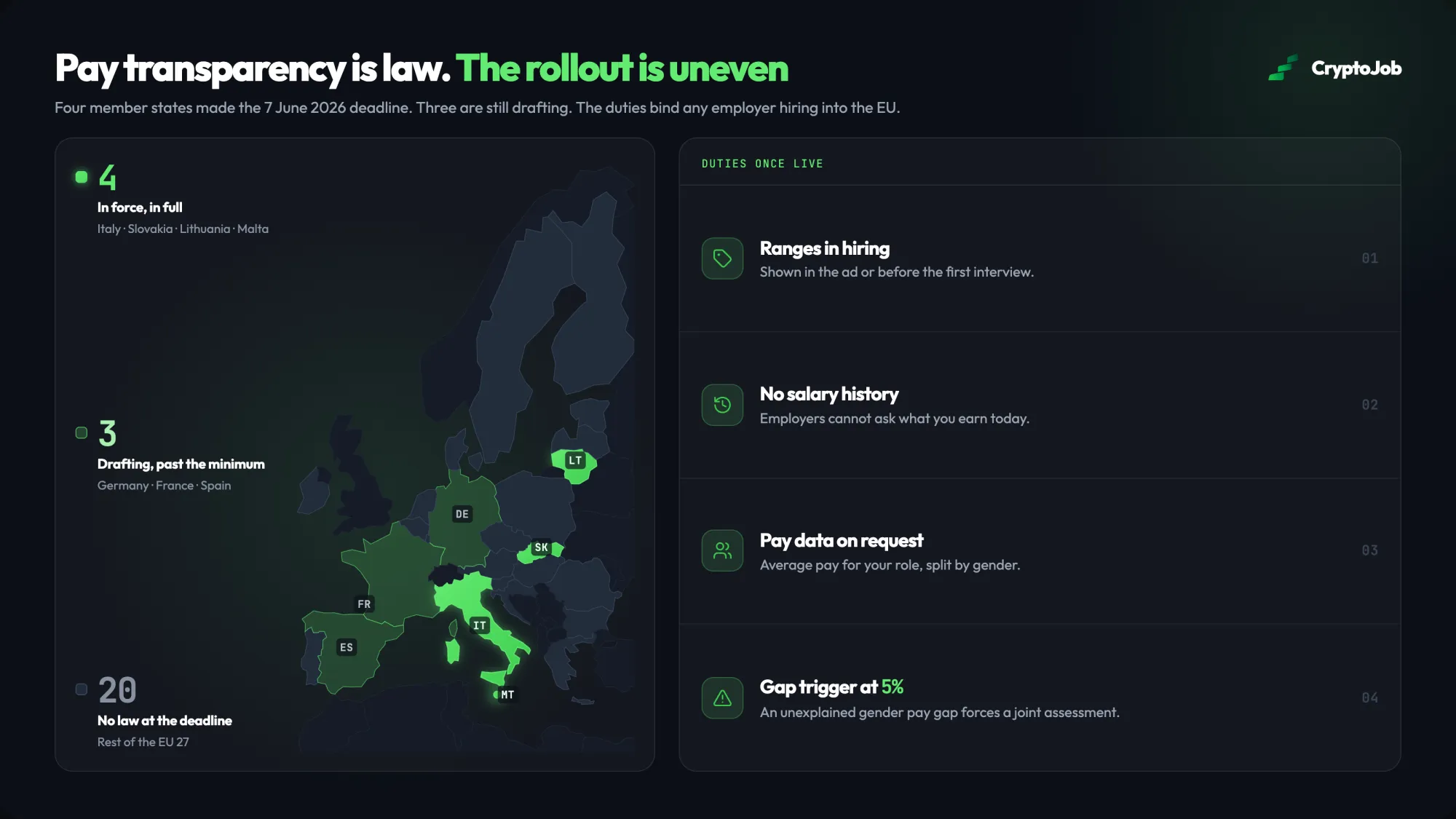
Three duties apply to employers of every size once national law is in force: disclose a starting salary or range in the job ad or before the first interview, never ask candidates about pay history and honor every worker's right to information about pay levels for their category of work.
Reporting duties scale with headcount: companies with 250 or more employees file gender pay gap reports from June 2027 covering 2026 data, the 150 to 249 tier reports every three years and the 100 to 149 tier phases in by 2031.
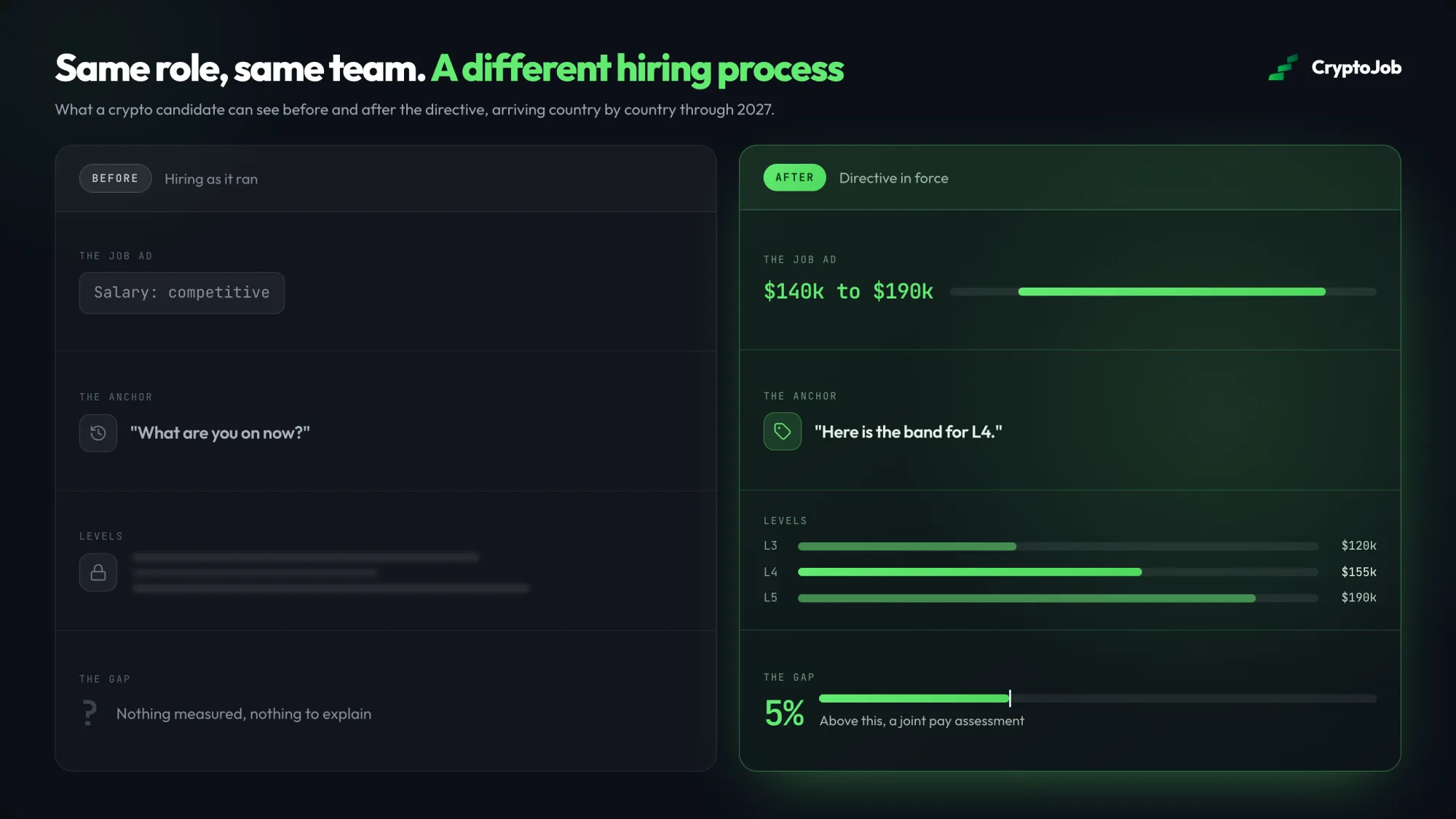
Teeth exist beyond paperwork, since an unexplained gap of 5 percent or more triggers a mandatory joint pay assessment with worker representatives, burden of proof shifts toward employers in disputes and fines plus back pay exposure make sloppy records genuinely expensive.
2. Where is the law actually in force right now?
Four countries crossed the line complete: Italy, Slovakia, Lithuania and Malta had full legislation in force at the deadline, meaning a role advertised there must already show a range and cannot probe salary history.
The heavyweights ran late. Germany, France and Spain sit closest behind, with drafts that push past the directive's minimum by requiring ranges in the advertisement itself rather than merely before interview. Others including the Netherlands remain further back, leaving roughly 20 member states with no law at the deadline, and Belgium even requested an extension and was declined.
The practical upshot for candidates is a country by country experience through 2026, while infringement pressure from Brussels pushes the laggards to finish, and trackers from major consultancies update the map monthly.
3. Why does this hit crypto employers especially hard?
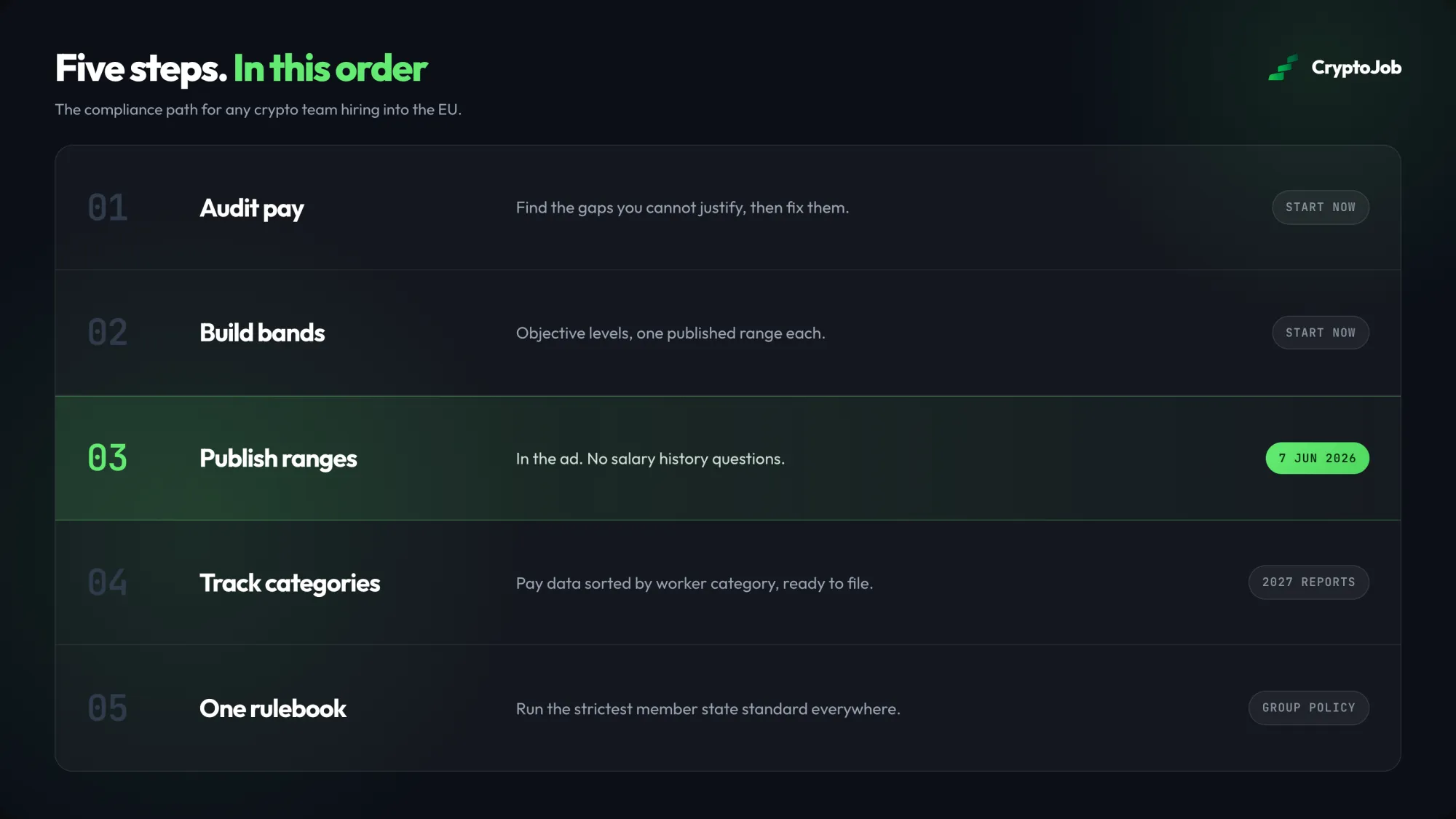
Because the industry's European footprint exploded exactly as the rules arrived. MiCA licensing pulled exchanges and issuers into entities across Ireland, France, Austria, Malta and beyond, and every one of those regulated employers now inherits transparency duties as national laws land.
Because crypto pay was built opaque: wide individual negotiation, token components that resist range framing and global bands that vary by candidate are all practices the directive was designed to expose, and equal value comparisons across hybrid packages will keep employment lawyers busy.
And because remote hiring blurs the borders, since advertising a role into a transposed market or employing through an EU entity can pull a company into scope regardless of headquarters, which is why multinational advisers recommend adopting the strictest common denominator across the group.
4. What changes for crypto job seekers in Europe?
Ranges become your starting information instead of your final discovery: in transposed markets the ad or the first conversation must reveal the band, which collapses weeks of guessing and lets you filter before investing effort.
The history ban rewires negotiation, because anchoring moves from your past pay to the posted range and the market data behind it, permanently favoring prepared candidates, and our web3 salary negotiation guide covers exactly how to work a disclosed band.
Information rights keep working after you sign, since employees can request average pay levels for their category split by gender, turning quiet suspicions of inequity into answerable questions with legal weight.
5. How are crypto employers actually responding?
The prepared ones are running pay audits now, precisely because the first reports will lock in 2026 data: consultants are openly warning that this compensation cycle is the last chance to fix gaps before they become public filings in 2027.
Structures are formalizing fast, with leveling frameworks and documented progression criteria replacing folklore pay, since every duty in the directive presumes categories and criteria exist to disclose.
And a transparency spillover is visible beyond Europe, as global crypto employers standardize ranges across all postings rather than maintain two systems, echoing what US state laws already started, which quietly exports the directive's norms to remote roles everywhere.
6. What are the tricky crypto specific questions?
Tokens are the biggest one, since ranges must represent compensation honestly while token grants defy point estimates, and early practice is trending toward disclosing cash bands plus a described equity or token layer rather than blended fantasies.
Contractor heavy structures come next, because the directive protects workers as national law defines them, and Europe's ongoing reclassification pressure means crypto's contractor workarounds may shrink exactly as transparency arrives.
Cross border comparisons round out the puzzle: a distributed team paying by local market inside one EU entity must still explain differences through objective criteria, which makes documented location frameworks the safe harbor and improvised individual deals the liability.
Enforcement carries real numbers where laws are live, with per breach fines reaching into five and six figures in early national schemes and back pay claims compounding across years, which is why compliance teams treat this as a controls project rather than a posting format change.
7. How does the timeline unfold from here?
| Date | What happens | Who feels it |
|---|---|---|
| June 7, 2026 | Transposition deadline passed, four countries fully live | Employers hiring in those markets |
| Through 2026 and 2027 | Late states finish laws under infringement pressure | Everyone hiring in the EU |
| June 2027 | First gap reports filed on 2026 data, 250 plus employees | Large exchanges and platforms |
| 2028 and beyond | Smaller tiers phase in, litigation tests equal value claims | The whole market |

8. What should you do with this shift?
Candidates should weaponize the transparency immediately: compare posted ranges against market data before every conversation, decline history questions politely where banned, log every band you are quoted and exercise information rights if internal equity looks off, with our crypto salary benchmarks supplying the reference points.
Employees inside EU entities should watch the 2027 reports, since public gap data will reshuffle employer reputations and hand retention leverage to anyone underpaid at a firm with numbers to defend.
Remote workers outside Europe should expect the spillover, because standardized global ranges are cheaper than parallel systems, and the norm the directive sets will keep leaking into every posting you read, including the ones in our remote web3 jobs guide.
9. How should you handle a banned salary history question?
Redirect without confrontation: state the range you are targeting for the role based on the posted band and market data, which answers the underlying question with the information that is actually legal and relevant.
If the interviewer presses in a transposed market, name the rule gently, since most violations are habit rather than strategy, and how a company responds to polite correction is itself useful diligence about working there.
Keep your own leverage tidy either way: never volunteer past pay, anchor on the disclosed range's upper region with evidence and remember that the burden of justifying pay structures now sits increasingly with employers, not with you.
10. Is this good or bad for crypto careers?
Good for almost everyone who is not currently overpaying on secrecy: candidates gain information and underpaid employees gain leverage, while disciplined employers gain a fairness story that recruits. The losers are improvised pay systems, and they were liabilities anyway.
Learn the rules of your market this month, calibrate against real ranges and browse web3 jobs to practice reading the new transparency before your next negotiation depends on it.

FAQ
Does the EU pay transparency directive apply to crypto companies?
Yes, wherever national transposition is in force, covering any employer with EU based workers regardless of industry, which includes MiCA licensed exchanges and their European entities.
Do salary ranges have to appear in every EU job ad now?
Only in countries with laws in force, currently four, though several pending national drafts require ranges in the advertisement itself and multinationals are standardizing early group wide.
Does the directive cover remote workers outside the EU?
Not directly, but roles advertised into transposed markets or employed through EU entities fall in scope, and global range standardization is spreading the practice well beyond the legal boundary.
When will gender pay gap data become public?
The first reports covering 2026 data are due from June 2027 for employers with 250 or more staff, with smaller tiers phasing in afterward, which is why employers are auditing pay right now.