Stand With Crypto Contacted Congress 50,000 Times in August. Someone Organized That.
The industry's side of the CLARITY fight looked organized because it was. Bex Adeyemi on the four employers behind it, the four profiles they hire, why crypto-natives lose to Hill staffers, and the one afternoon that fixes that.
TLDR
- The lobbying push behind this week's Senate vote is a job market. Trade associations, in-house policy teams at exchanges and grassroots organizations all hire for it.
- The people who get these jobs come from Capitol Hill and campaigns, not from crypto. If you're crypto-native, that's your gap and it's closable.
- Your resume needs a bill number, a member's office or a coalition name. Without one of those, you'll lose to someone whose resume has all three.
- Pay is lower than compliance at the analyst level and higher at the top, and the top is where the exchanges are.
You watched the CLARITY Act fight this month and noticed that the industry's side of it looked organized. Stand With Crypto said its supporters contacted members of Congress nearly 50,000 times in August. Advocates and community bankers took their arguments to senators' home states. Senator Lummis said the revised bill incorporated more than 114 provisions Democrats asked for. Somebody wrote those provisions, somebody counted those 50,000 contacts and somebody flew to the home states. You're wondering who they are and whether you could be one.
I've hired for crypto policy jobs twice, once at an exchange and once for a trade group's government affairs team, and both times the candidates who got the job were not who applied first. This post is about closing that gap. Before you go further, browse web3 jobs and search "policy" and "government affairs"; the postings are up and they don't look like anything else on the board.

1. Who actually employs crypto policy people?
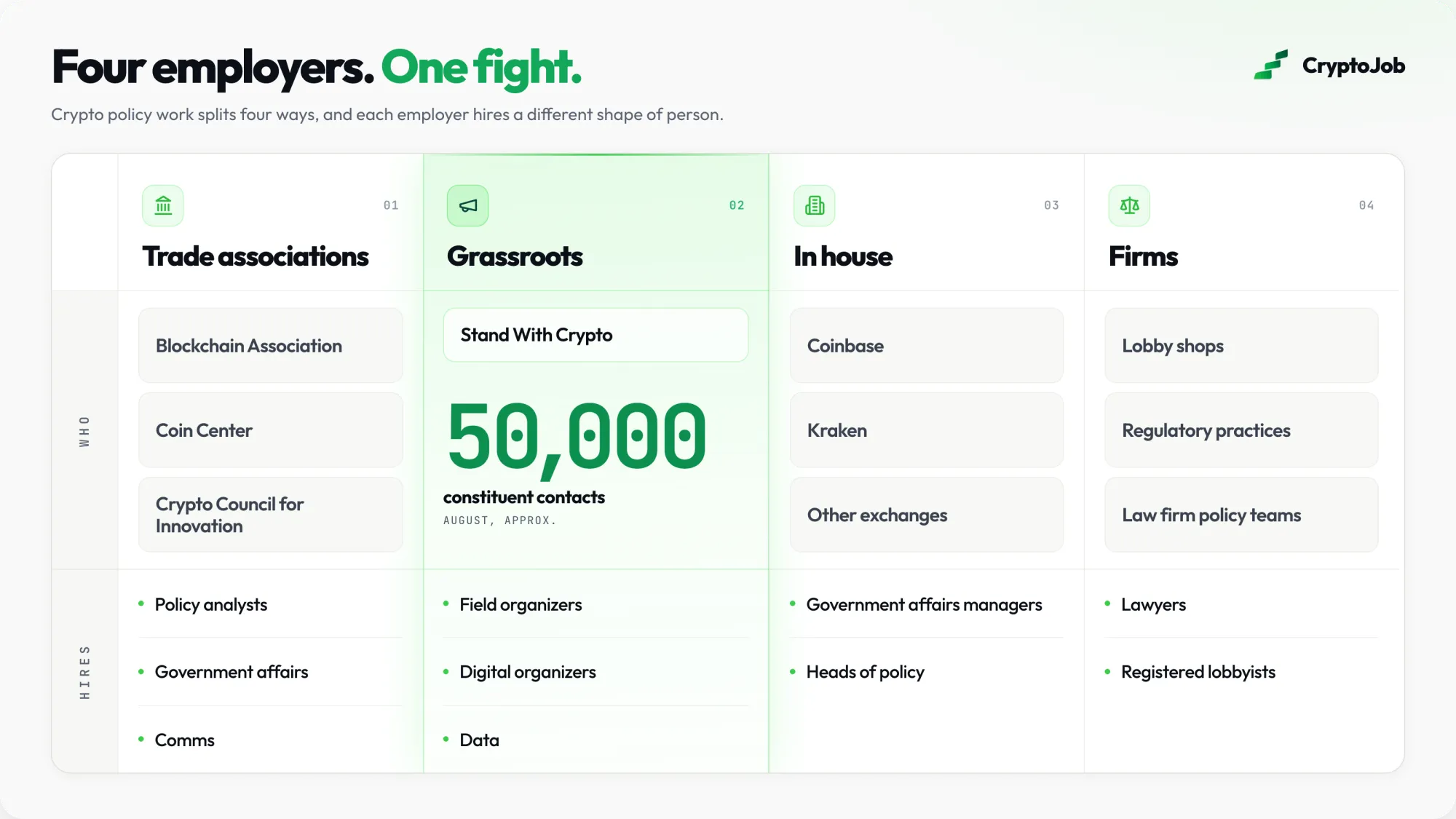
Four kinds of employer, and they hire differently.
Trade associations. The Blockchain Association, Coin Center and the Crypto Council for Innovation, among others, employ policy analysts, government affairs leads and communications staff whose whole job is Congress and the agencies. Smaller teams, mission-driven and the first stop for anyone who wants to learn the Hill side of crypto.
Grassroots organizations. Stand With Crypto is the one in the news; its August number, nearly 50,000 constituent contacts to members of Congress, is an organizing metric. Organizations like it hire the people who build those numbers: field organizers, digital organizers, data staff.
In-house policy teams. Coinbase, Kraken and the other large exchanges run government affairs functions that lobby directly, brief executives and manage the relationship with regulators. The Coinbase jobs guide on this site covers the company broadly; its policy team is the best-resourced in the industry and the hardest to get into.
Law and lobbying firms. Registered lobbyists and regulatory practices that represent crypto clients. The traditional route, and the one that pays hourly.
2. Who actually gets hired for this
Four profiles, and I'll say plainly that the first three don't come from crypto.
The Hill staffer. Legislative assistant or legislative correspondent in a member's office, ideally on a committee that touched financial services. Two to five years. This person knows how a bill moves, who the staff are and how a markup actually works. Every trade association's first call.
The campaign organizer. Field or digital organizer from a congressional or statewide campaign. Knows how to turn a mailing list into 50,000 contacts. Stand With Crypto's model is a campaign model, and the people who run it learned it on campaigns.
The agency alumnus. Two to four years at the CFTC, the SEC, Treasury or a banking regulator, then out. Reads a rulemaking the way the agency reads it. Rare and expensive.
The crypto-native who did the work. Wrote comment letters, testified at a state hearing, ran a DAO's governance response to a regulatory proposal, or organized a meeting with a member's office. Not "cares about policy." Did something with a paper trail. This is the only crypto-native profile I've seen hired, and it's the one I'd build toward if I were you.
What doesn't get hired: the person whose policy experience is a Twitter thread, and the lawyer who wants to be a lobbyist without ever having registered as one.
3. The six-second screen
Policy resumes get read by policy people, and they read them the way the Hill reads them. Three things, in six seconds.
A member's office, a committee or an agency, on line one. "Legislative Assistant, Office of Senator [name]" or "Policy Analyst, CFTC Division of Market Oversight." The institution is the credential.
A bill number. "Led the office's work on H.R. 3633" or "drafted the coalition comment letter on the stablecoin rewards provision." A bill number or a docket number proves you've worked on something that moved.
A coalition or a count. "Coordinated a 14-organization sign-on letter" or "grew the constituent-contact program from 8,000 to 50,000." Policy is a numbers game measured in members, letters and contacts, and a number on your resume tells them you know that.
What gets you rejected: "passionate about the future of digital assets," any resume that reads as an opinion, and a crypto resume with no institution on it.
| If your background is | Lead with | Your gap |
|---|---|---|
| Hill staff | Your member, your committee, one bill | Crypto fluency; read the CLARITY text and the compliance guide |
| Campaign organizing | The program you ran and the number it hit | Policy substance; pair with an analyst |
| Agency | The rule you worked on, by docket | Industry; a trade-association analyst role bridges it |
| Crypto-native | The comment letter, the hearing, the meeting | An institution; get one through a fellowship or a state hearing |

4. What does it pay?
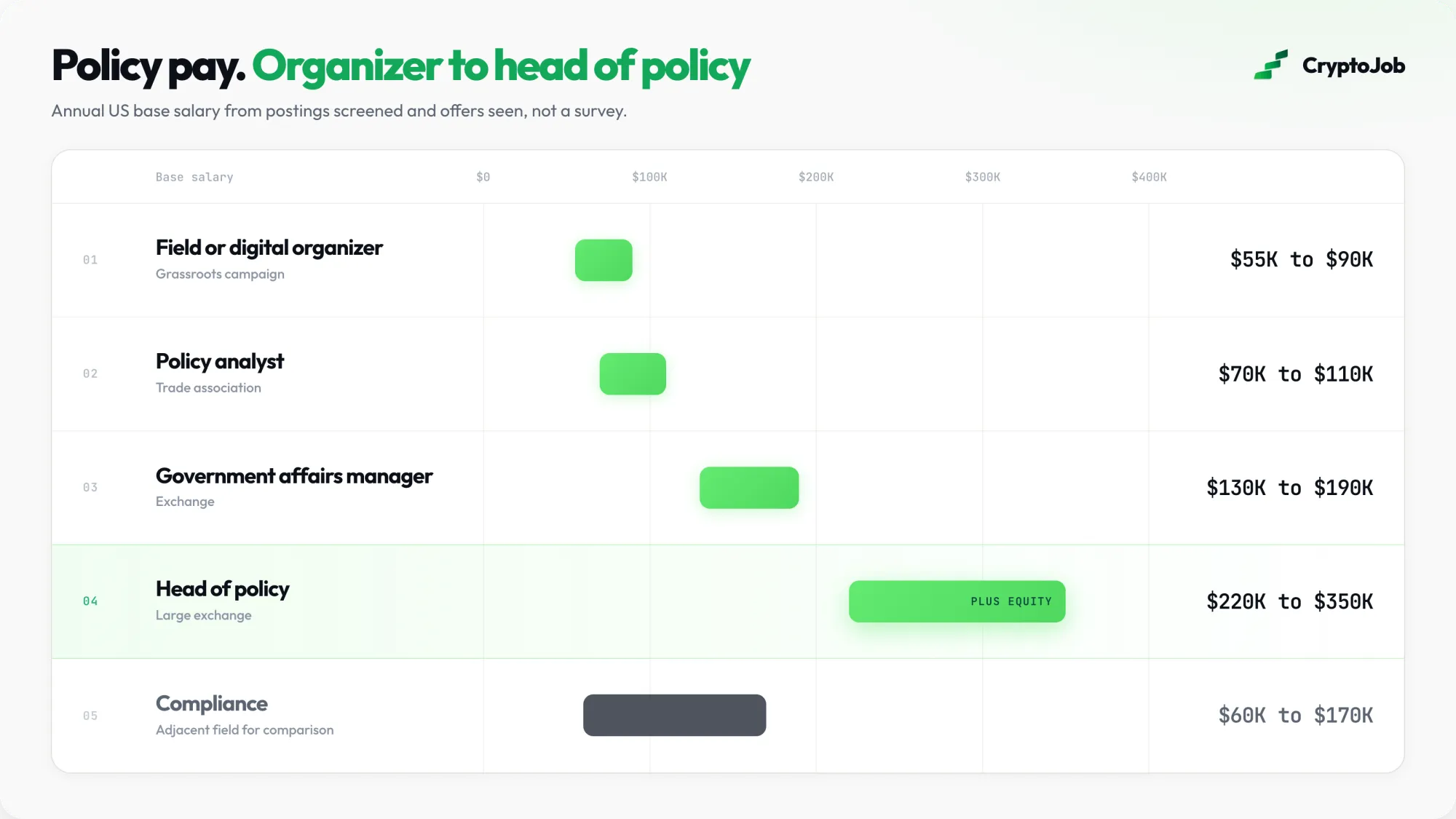
Nobody publishes policy salaries, so these are from postings I've screened and offers I've seen, and they're US figures. Policy analyst at a trade association: $70K to $110K. Government affairs manager at an exchange: $130K to $190K. Head of policy or government affairs at a large exchange: $220K to $350K plus equity, and the top of that band is real. Field and digital organizers at grassroots groups: $55K to $90K, which is campaign pay. Registered lobbyists at firms bill hourly and earn more than any of the above, and that's a different career.
For comparison, the compliance guide puts entry compliance at $60K to $95K and senior at $120K to $170K. Policy starts lower and finishes higher. The people who make the top of it moved from a trade association to an exchange, in that order.
5. Do this this week
- Put an institution on line one. If you have one, move it there. If you don't, the crypto-native path below is your only route, so start it.
- Read the reporting on the revised CLARITY Act and write, for yourself, one paragraph on the "decentralized-in-name-only" provision and one on the ethics section. Every interview this month will ask about one of them.
- If you're crypto-native, find a state-level hearing or a comment period in your jurisdiction and submit something with your name on it. That's an institution you can put on a resume, and it costs an afternoon.
- If you're Hill or campaign staff, read the non-technical careers guide so you can speak the industry's vocabulary before you're asked to.
- Follow the government affairs leads at two exchanges and one trade association on LinkedIn and X. Read what they post for a week. That's the job, in public.
- Set a CryptoJob alert for "policy," "government affairs" and "public affairs," because the titles vary and the roles don't.
6. Mistakes I see every week
Applying with an opinion instead of a record. Your cover letter argues for the CLARITY Act. The hiring manager doesn't need convincing; they need someone who can count votes. The fix: replace the argument with the bill you worked on and what happened to it.
Treating grassroots as a step down. Organizers who built the 50,000 number are the reason the trade association has leverage. The fix: if you can organize, say so with a number; it's a scarcer skill in this industry than analysis.
Skipping the trade association. Crypto-natives want the exchange job directly. In my experience the exchange hires from the trade association, almost every time. The fix: take the analyst role, do two years, then move.
Not knowing the ethics fight. The section barring officials and their spouses from issuing digital assets is largely unchanged and is the reason the bill might not get 60 votes. Candidates who can't discuss it look like tourists. The fix: know it, know it expires January 2029 and have a view on why it's stuck.
Confusing policy with compliance. Compliance implements rules that exist. Policy shapes the rules before they exist. They're different jobs for different people, and a resume built for one reads wrong for the other. The fix: pick one and write to it.
Start here
Put an institution on line one of your resume, and if you don't have one, submit one comment letter or testify at one state hearing this month so that you do; then browse web3 jobs for policy and government affairs postings and apply to the trade associations before the exchanges, because that's the order the hiring actually runs.
FAQ
Do crypto policy jobs require living in Washington?
The trade associations and in-house teams are mostly Washington-based, and the government affairs roles in particular expect you in the building. Grassroots and digital organizing roles are more often remote. If you're outside DC and want the Hill-facing roles, plan on moving.
Can I get a policy job without a law degree?
Yes. Hill staffers, organizers and most trade-association analysts don't have one. The registered-lobbyist route and the regulatory-practice route at law firms do, and those pay differently.
How do I get an "institution" on my resume if I've only worked in crypto?
State hearings, comment periods and formal meetings with a member's office all produce a paper trail with your name on it. One comment letter, submitted under your own name in a docket, is an institution. It takes an afternoon and it's the single biggest gap I see in crypto-native applicants.
Is this a stable career if the CLARITY Act fails?
The bill's fate on September 15 changes the timeline, not the demand. The industry will be lobbying on market structure, stablecoins and enforcement for years either way, and the agencies still have to write rules. Policy headcount tends to grow when bills fail, because that's when the next round of work starts.
What's the difference between government affairs and public affairs?
Government affairs is the relationship with legislators and regulators. Public affairs is the message to the public and the press. At an exchange they're separate teams; at a trade association they're often the same three people. Apply to the one that matches your record.