The CLARITY Act Just Invented a Job. Someone Has to Register Your Protocol With the CFTC.
The 630-page revised CLARITY Act says any trading protocol a person or group can "control or materially alter" has to register with the CFTC. That's a job nobody has held. Bex Adeyemi on the four profiles that will get it, the six-second screen, and what to do this week.

TLDR
- The revised CLARITY Act says any trading protocol a person or group can "control or materially alter" has to register with the CFTC. That's a job, and almost nobody has done it before.
- If you've worked in exchange compliance, you're closer to this role than the DeFi people are, and they'll be surprised to hear it.
- The first hires will be at protocols with a multisig and a foundation, because those are the ones that obviously fail the decentralization test.
- Your resume needs one regulator's name on it. If it doesn't have one, that's the gap to close this month, and I'll tell you how.
The Senate voted on the CLARITY Act last week and fell short, 49 to 50 on cloture against the 60 it needed, so the 630 pages go back to negotiation. The provision this post is about survives every version of the bill. You're a compliance analyst at a protocol with a five-of-nine multisig, and your CEO forwarded you the 630-page revised text with a single question: does "materially alter" mean us? You don't know. Nobody does yet, because the bill directs the CFTC and Treasury to write the rules that define it. What you do know is that someone at your company is about to own that answer, and crypto regulatory affairs jobs are about to get posted for the first time in this industry's history.
I've watched exchanges build compliance functions from one person to forty. This is that moment for protocols, and the people who get the first seats will be the ones who understood what the seat is before the posting went up. If you want to see who's staffing early, browse web3 jobs after this; the postings will look like compliance roles with a new word in the title.

1. What does the bill actually say my protocol has to do?
Here's what's in the text, from the reporting on the September 10 draft, and you'll want these facts in front of you before any interview.
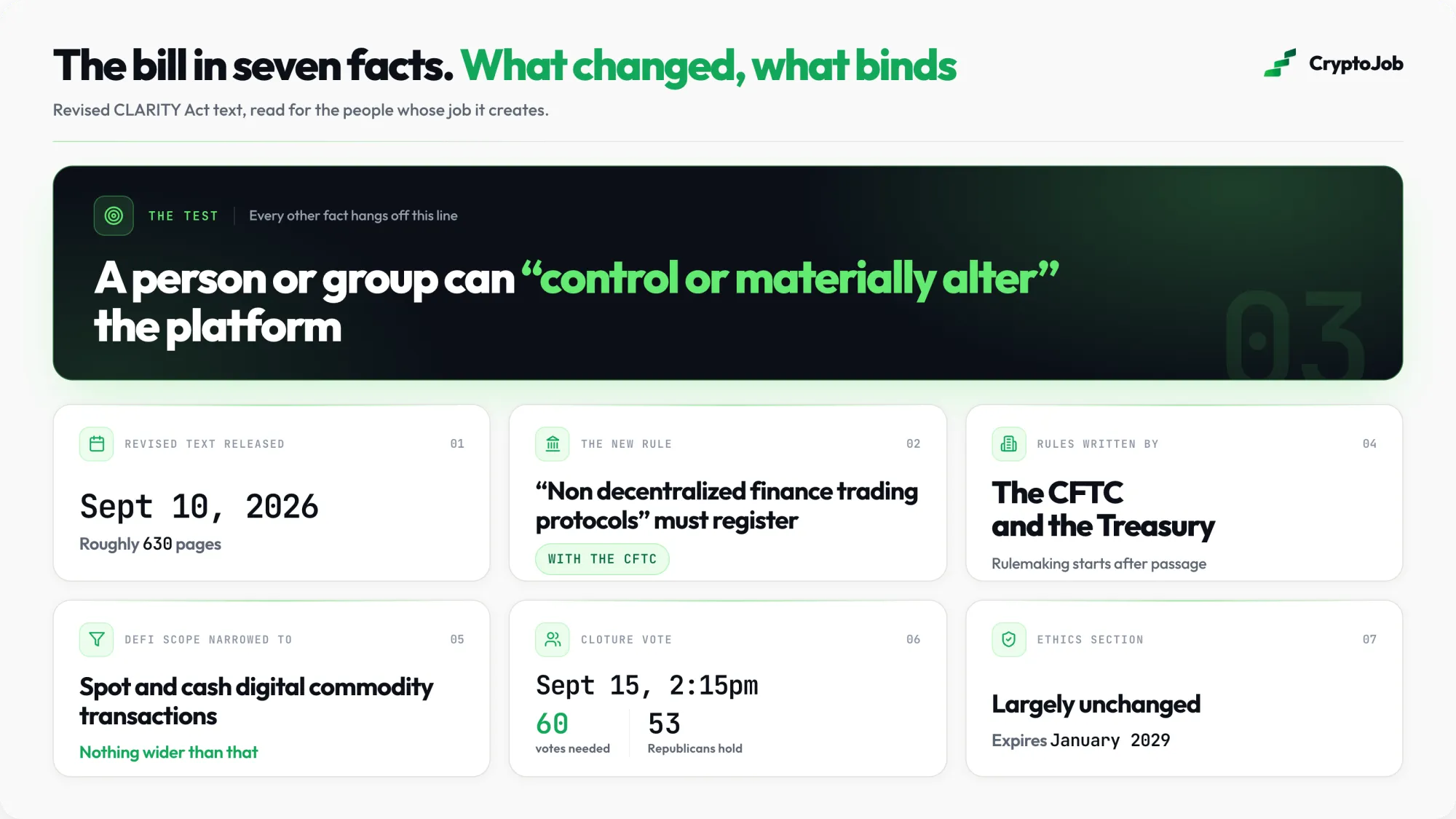
Senate Republicans, led by Senator Cynthia Lummis, released a roughly 630-page revised CLARITY Act on September 10. The most significant change targets what the bill calls "non-decentralized finance trading protocols," and what Lummis called "decentralized-in-name-only DeFi protocols" on X: entities where a person or group can control or materially alter how a supposedly decentralized platform actually runs. Those would be required to register with the Commodity Futures Trading Commission, and the bill directs the CFTC and Treasury to write the detailed rules.
The DeFi provisions were narrowed to cover only spot and cash digital commodity transactions, a change Lummis said was in response to tribal government concerns about prediction markets. The text incorporates more than 114 provisions requested by Democrats, including a felony bar on fraudsters and $150 million for the CFTC. The ethics section, which bars officials and their spouses from issuing digital assets, stays largely unchanged and expires in January 2029. The September 15 cloture vote needed 60 senators and got 49, with 50 against, and Senator Thom Tillis entered a motion to reconsider. The SEC has said it will proceed with its own crypto asset rulemaking either way, with comments open until October 20.
So the job, in one sentence: figure out whether your protocol meets the decentralization standard, and if it doesn't, get it registered with a regulator that's still writing the form.
2. Who actually gets hired for this
I've screened for the closest existing roles, exchange compliance and market-integrity, for seven years, and I've seen four profiles land jobs like this one. The DeFi-native person who reads every governance forum is not on the list, and that surprises people.
The exchange compliance escapee. Three to six years at a licensed exchange, in a team that's dealt with a regulator directly. This person knows what a registration package looks like, what a regulator asks in the first meeting and how long "we'll get back to you" actually takes. They're the first hire at most protocols, and they're the profile I'd bet on.
The former regulator. Two to five years at the CFTC, FINRA, the SEC or a state regulator, then out. They can read "control or materially alter" and tell you how the agency will interpret it before the rule exists, because they've watched it interpret similar language. Rare, expensive and worth it for the first six months.
The TradFi registration specialist. Someone who's registered a swap dealer, a commodity pool operator or a broker-dealer. Never touched crypto. Knows the CFTC's forms by number. This person plus a DeFi ops lead is a complete team; alone, neither is.
The protocol operations lead who documented everything. Ran ops at a protocol with a foundation and a multisig, and, unusually, wrote down who could do what. That documentation is the first thing a registration needs, and the person who made it is the person who gets to keep it.
What doesn't get hired: a lawyer who wants to bill for it rather than own it, and a governance enthusiast whose evidence of decentralization is a forum post.
3. The six-second screen
At a protocol, your resume lands with a founder or a head of ops, not a recruiter. Here's what they see in six seconds, and what they need to see.
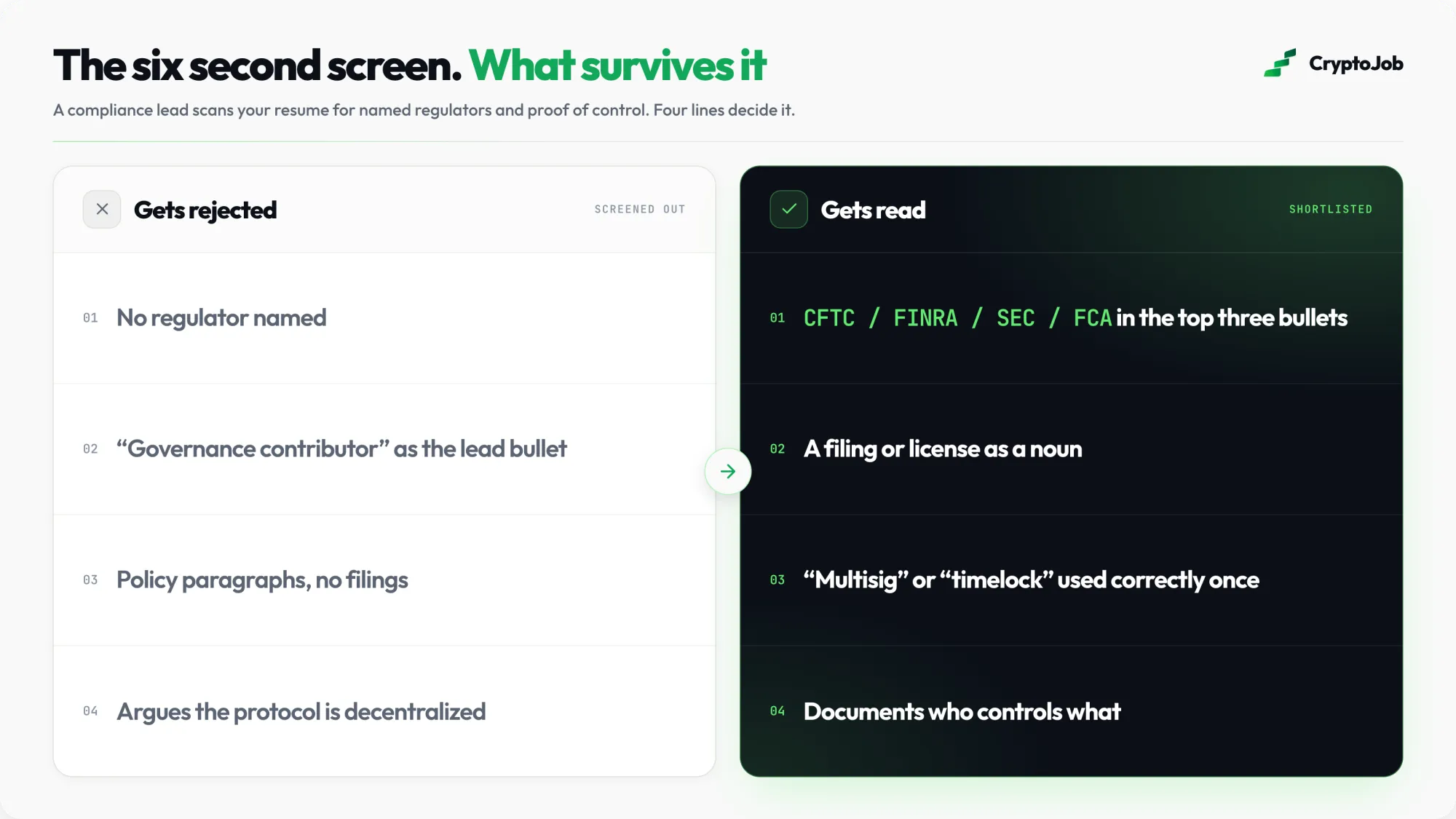
A regulator's name in the top three bullets. CFTC, FINRA, SEC, MAS, FCA, VARA. One of them, spelled out, attached to something you did. "Managed a FINRA examination" beats a paragraph about your compliance philosophy. No regulator's name on the page means you're a compliance person who's never met one, and for this role that's disqualifying.
A registration or a license, as a noun. "Prepared the MSB registration," "maintained the VASP license," "filed the Form ADV." The noun proves you've done the paperwork that this job is entirely made of.
One line that shows you understand protocols. Multisig, governance, upgrade keys, timelock. One of those words, used correctly, in a bullet about something you did. It tells them you won't need the decentralization standard explained to you.
What gets you rejected: a resume that's all policy and no filings, and one that's all DeFi and no regulator.
| If your background is | Lead with | Your gap |
|---|---|---|
| Exchange compliance | The regulator you dealt with and the outcome | Protocol vocabulary; learn what a timelock is this week |
| Former regulator | The rule you enforced and the firms you examined | Industry experience; a six-month protocol contract fixes it |
| TradFi registrations | The forms you've filed, by name | Crypto entirely; pair with a DeFi ops lead |
| Protocol ops | The control documentation you wrote | A regulator; get one through a filing, even a small one |

4. What does it pay, and who's paying?
Nobody has posted "Head of CFTC Registration" yet, so the ranges come from the closest roles that exist, using the compliance guide on this site: $85K to $130K for mid-level compliance analysts, $120K to $170K for senior, and $250K to $350K and up for a chief compliance officer at an exchange. In my experience the first regulatory affairs hires at protocols land at the top of the senior band, with tokens on top, because the role has no bench and the company has no choice.
Who's paying, in the order I expect postings: protocols with a foundation, a multisig and a treasury, because they obviously fail the test and have the money; the exchanges that also run on-chain products, because they've got compliance teams that need a DeFi arm; and the law firms and consultancies that will sell registration as a service to everyone smaller. The exchange jobs guide covers the second group.
5. Do this this week
- Put a regulator's name in your top three bullets. If you don't have one, find the smallest filing you've ever touched and name the body it went to.
- Read the CLARITY Act summary from The Block or Decrypt, then read the section on "non-decentralized finance trading protocols" in the actual text. Twenty minutes. You'll be one of very few candidates who has.
- Write one paragraph, for yourself, on whether a protocol with a five-of-nine multisig and a two-day timelock "materially" controls its platform. There's no right answer yet. Having an answer is the point.
- Learn four words if you don't know them: multisig, timelock, upgrade key, governance quorum. They'll be in every interview.
- Set a CryptoJob alert for "regulatory affairs" and "registration," because the first postings will use those words before anyone agrees on a title.
- If you're a former regulator, message three protocol founders this week. Not to apply. To ask what they think "materially alter" means. That conversation is the interview.
6. Mistakes I see every week
Applying as a DeFi person to a regulatory role. Your resume says "governance contributor" and "DAO delegate." The founder reading it needs someone who's met the CFTC. The fix: lead with any filing, license or examination you've ever been near, then the DeFi.
Waiting for the rule. The CFTC and Treasury have to write the rules, and that takes time. Candidates think the job starts when the rule lands. The job starts now, because the documentation of who controls what has to exist before any form does. The fix: apply before the posting says "registration," while it still says "compliance."
Treating "decentralized" as a defense. In interviews I've seen people argue the protocol is decentralized enough not to need this. That's not the job. The job is to document the facts and let the standard fall where it falls. The fix: bring the facts, not the argument.
Pricing yourself against compliance analysts. This role has no bench. The fix: ask for the senior band plus tokens, and get the scope in writing, because "regulatory affairs" at a 30-person protocol means everything.
Ignoring the ethics section. It's largely unchanged, it bars officials and their spouses from issuing digital assets, and it's the reason the bill fell short on the 15th; the vote failed over that language, not over the market structure framework. If you can't discuss it, you look like you skimmed. The fix: know it exists, know it expires in January 2029 and know the Justice Department enforces it.

Start here
Open your resume, find a regulator's name for the top three bullets, and if there isn't one, that's the only thing to fix before you apply to any crypto regulatory affairs jobs; then browse web3 jobs and look at the compliance postings from protocols, not exchanges, because that's where the new title will appear first.
FAQ
Does the CLARITY Act apply to my protocol if it's on a testnet?
The registration requirement in the revised draft targets trading protocols where a person or group can control or materially alter the platform. Whether a testnet counts depends on rules the CFTC and Treasury haven't written yet. The honest answer is that nobody knows, and the honest hire is the one who documents your control structure now regardless.
Do I need a law degree for crypto regulatory affairs jobs?
No, and in my experience the first hires usually don't have one. Exchange compliance, prior regulator experience or TradFi registration work all qualify. The law firms will hire lawyers; the protocols will hire people who've filed things.
The vote failed on September 15. Does the job still exist?
Yes. The "decentralized-in-name-only" provision has survived every revision of the bill and reflects a position both parties have signed onto. Cloture failed 49 to 50, a motion to reconsider is pending, and the SEC and CFTC are writing rules with or without the statute, so the timeline stretched and the requirement didn't go away. I'd apply on the same schedule.
How is this different from an exchange compliance job?
An exchange registers a company. A protocol has to first establish what the company even is: who holds the keys, who can upgrade the contracts, who decides. That documentation step is new, and it's why protocol ops people with good records are on the hire list.
Should I hold off applying until the rules are written?
No. The rules define the form. The facts about who controls your protocol exist today, and the person who documents them first is the person the CFTC talks to. That's the seat.