$CASHCAT Beat Robinhood's Own Product. The Jobs Followed.
Robinhood built a chain for tokenized stocks and a cartoon cat took it over. The token made a few wallets rich; the chain created a hiring wave.

TLDR
- Robinhood Chain launched July 1, 2026 for tokenized stocks. A cat memecoin dominated
- CASHCAT peaked near $156M, briefly 12x every tokenized asset on the chain
- Noxa earned an estimated $12M in fees, then shut down within twelve days
- Blockchain infrastructure jobs sit with the chain, not the token
- Infrastructure roles pay roughly $110k to $260k
Robinhood built a blockchain for Wall Street. A cartoon cat won the opening bell.
Robinhood Chain went live on July 1, 2026 as a permissionless Ethereum layer 2 built for tokenized real-world assets. Within two weeks it was one of crypto's busiest new networks, holding roughly $312 million and processing 3.6 million daily transactions. Tokenized real-world assets, the entire reason the chain exists, accounted for only about $12.8 million of value and roughly 4% of activity.
The rest was memecoins. CASHCAT, named after the working title Vlad Tenev and Baiju Bhatt used before they settled on Robinhood, reached a market cap near $156 million. Its own website describes it as fan fiction with a ticker.
Here's why that matters to your career rather than your portfolio. The token minted a handful of anonymous wallets. The chain created a hiring wave.
org) across chains, launchpads and DeFi protocols today.
1. Why do blockchain infrastructure jobs outlast the tokens on top of them?
Look at what happened to each layer.
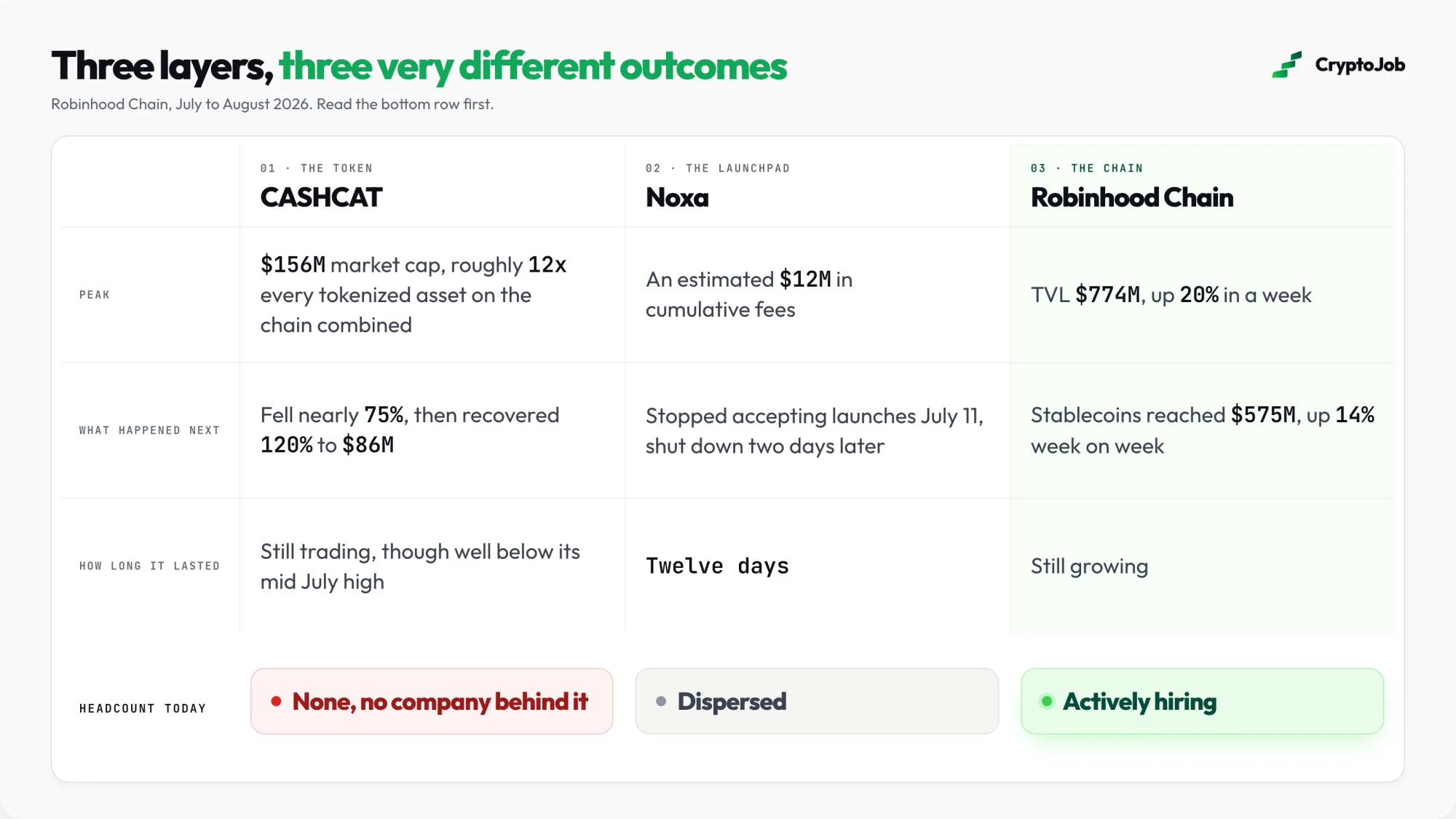
The token layer is brutal. CASHCAT jumped roughly 4,000% in a week during July, went from a $156 million peak to losing nearly three-quarters of its value, then recovered 120% in a week in early August to an $86 million cap. That is still well below its mid-July high of roughly 22 cents.
The launchpad layer is worse. Noxa, which drove the entire launch boom, earned an estimated $12 million in cumulative fees, stopped accepting new launches on July 11 at the exact moment CASHCAT hit peak volume, and went dark two days later, citing low-quality tokens flooding the platform.
The chain layer kept growing through all of it. Total value locked reached $774 million, up 20% in seven days, with lending at 43% and asset management at 41.5%. Two protocols hold nearly three-quarters of it: Morpho at $332 million, the lending market behind Robinhood's own onchain earn product, and Ethena at $236 million.
Morpho and Ethena have employees. CASHCAT does not.
2. What blockchain infrastructure jobs does a new chain create?
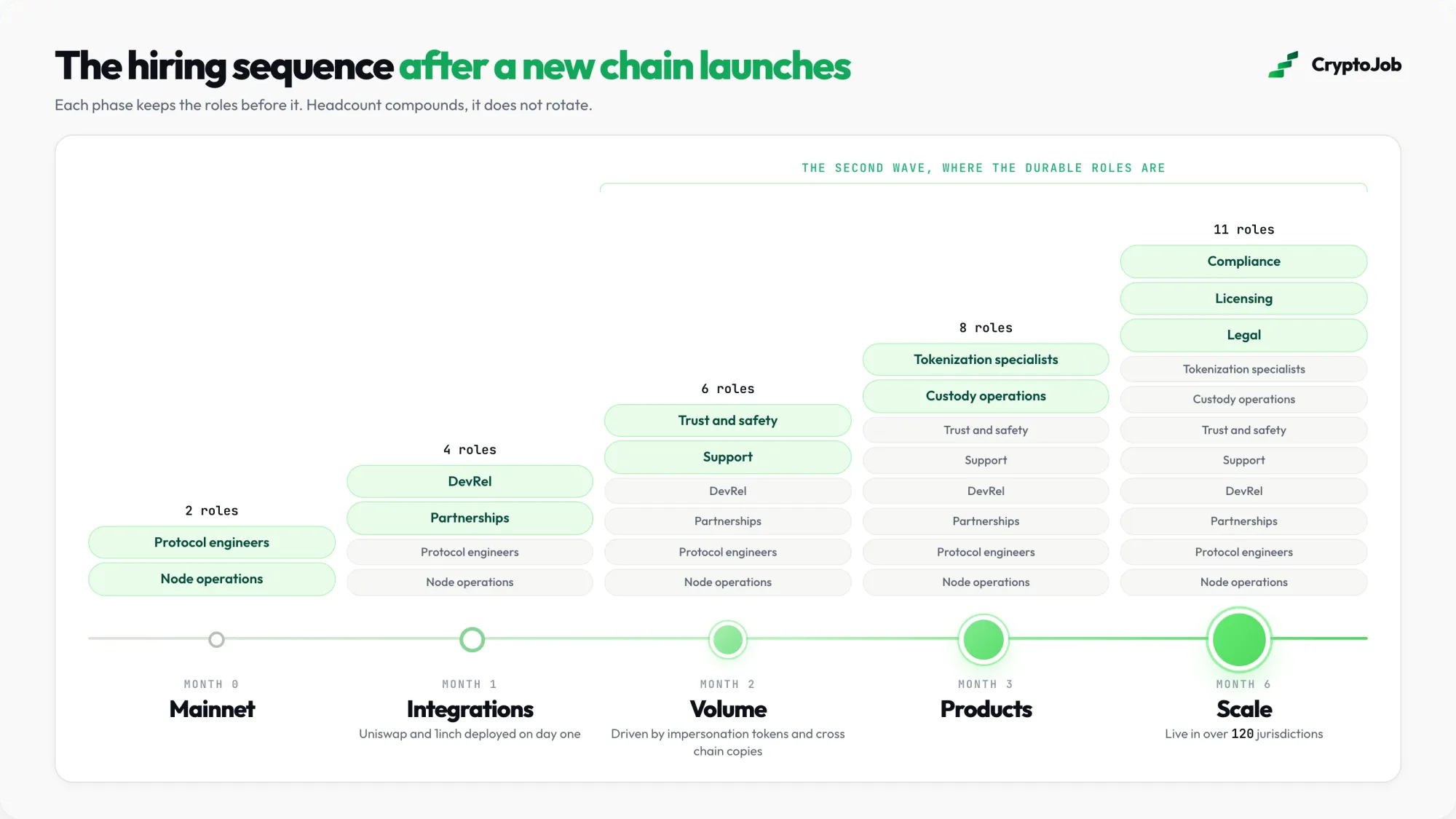
A new layer 2 generates demand across a predictable set of functions, and they don't all appear at once.
Protocol engineers come first. These are the people building sequencers, bridges and node infrastructure. Deepest technical requirement, highest pay.
DevRel and integrations arrive next. When a chain launches, wallets, analytics platforms, exchanges and launchpads all need to integrate it. That is somebody's full-time job on both sides.
Tokenization and RWA specialists are the chain's stated purpose. Robinhood's flagship Stock Tokens product tracks over 200 US stocks and ETFs across more than 120 jurisdictions, excluding US users. That requires legal, custody, settlement and operations staff, not just engineers.
Compliance and licensing scales with jurisdictions. A product live in 120+ countries needs people who understand each of them.
Trust and safety is the reactive one. Fake accounts and cross-chain copies of CASHCAT appeared quickly, and holders were urged to verify contract addresses before buying. Somebody handles that queue.
3. What do crypto exchange jobs and chain roles pay?
| Role | Typical range (USD) | Where demand comes from |
|---|---|---|
| Protocol / L2 engineer | $160k to $260k | Chain launch and scaling |
| DevRel engineer | $130k to $190k | Ecosystem integrations |
| Tokenization / RWA specialist | $120k to $200k | Stock tokens, custody, settlement |
| Compliance / licensing | $110k to $190k | Multi-jurisdiction rollout |
| Trust and safety analyst | $85k to $140k | Scam tokens, impersonation |
| Liquidity / DeFi analyst | $110k to $180k | Lending and asset management protocols |
Ranges vary by region and company stage. Established brokerages pay conventional salaries with equity. Protocol-native teams weight more heavily toward tokens.
4. Are tokenization jobs actually growing, or is it hype?
The honest read from Robinhood Chain is mixed, and worth knowing before you build a career on it.
The bull case is real. At one point a dozen tokenized equities were each generating more than $500,000 in daily volume, with GameStop alone reaching $26 million. That is genuine product usage, not speculation.
The bear case is also real. RWAs were about 4% of early activity while memecoins dominated. Robinhood subsidized gas fees through roughly the end of September, and the true test of sustained usage arrives once users cover their own transaction costs.
What this means practically is that tokenization roles are growing, but they're concentrated at regulated institutions rather than crypto-native startups. If you're targeting this lane, a background in custody, settlement or securities operations is worth more than Solidity.
5. Should you follow the volume or the fees?
This is the single most useful career question in crypto, and Robinhood Chain answers it cleanly.
Memecoin traders are mercenary by construction. They move to wherever activity is and are loyal to no chain, which means a chain's memecoin users may have no overlap at all with the users it actually wants. When a flashier chain offers faster returns, the volume leaves.
Fees are stickier than volume. Lending and asset management make up 84.5% of Robinhood Chain's TVL. Those protocols earn whether or not anyone is trading cat tokens.
Apply that to your job search directly. A role paid out of protocol fees, exchange spreads or SaaS revenue survives a drawdown. A role paid out of launch hype does not, as the Noxa team discovered in July.
6. How do you evaluate a new chain as an employer?
Robinhood Chain gives you a checklist, because the warning signs and the good signs both showed up inside two months.
Check what funds the payroll. Robinhood is a public brokerage with revenue independent of the chain. Noxa was funded entirely by launch fees from a boom, which is why it lasted twelve days. Ask any prospective employer where salaries come from when volume drops 70%.
Check whether usage is subsidized. Robinhood covered gas fees for the first 90 days, running through roughly the end of September. Subsidized activity is not proven demand. If you join during a subsidy window, know when it ends and what management expects to happen.
Check the gap between stated purpose and actual usage. The chain was built for tokenized equities and got memecoins. That gap is not automatically bad, since speculation bootstraps liquidity and a dozen tokenized equities were each doing over $500,000 in daily volume. But it tells you which teams will be resourced and which will be defending headcount.
Check integration depth. Uniswap and 1inch deployed on day one. When serious protocols integrate immediately, the infrastructure work is real. When only launchpads show up, the chain is a casino with a roadmap.
7. What does the hiring cycle look like after the hype fades?
Token deployments across the chain's launchpads fell from roughly 35,000 a day in mid-July to about 10,000. That is a 70% decline in the headline activity metric.
Hiring did not fall 70%, because the two are only loosely connected.
Deposits kept climbing through the entire cooldown, with total value locked reaching $774 million and stablecoins on the chain totaling $575 million, up 14% week on week. Lending and asset management now account for 84.5% of that.
Those protocols hire risk analysts, integrations engineers and compliance staff. Those roles barely existed during the launch frenzy and become essential afterward. The frenzy hires marketers and community managers.
The consolidation hires operators.
If you are timing an entry into a new ecosystem, the second wave is usually the better one. There is less competition for roles and more durable funding. People who join at that stage tend to still be there a year later.
8. Where are these roles right now?
The competitive landscape on Robinhood Chain alone includes hood.fun, PONS, Uniswap Labs' Pools.trade, and CASHCAT's own launchpad, launched in August. Every one of them needs engineers, and the surviving ones need compliance staff.
Beyond that, every major L2 launch in the next year repeats this exact hiring sequence. You can browse web3 jobs across infrastructure, protocol, tokenization and compliance roles to see who is hiring at each layer.
FAQ
What are blockchain infrastructure jobs?
Roles that build and operate the chain itself rather than applications on top. That covers protocol engineering, node operations, DevRel, bridges and sequencers. They're funded by protocol revenue rather than token appreciation.
Do I need to know Solidity for tokenization jobs?
Often no. Tokenization work at regulated firms leans heavily on custody, settlement, securities law and operations. Engineering matters, but domain knowledge from traditional finance is frequently the scarcer skill.
Why did the Noxa launchpad shut down?
Noxa stopped accepting new token launches on July 11, 2026 and went dark two days later, citing concerns about low-quality tokens flooding the platform, after earning an estimated $12 million in cumulative fees.
Are crypto exchange jobs more stable than protocol jobs?
Generally yes. Exchanges earn fees on trading volume in both directions, which insulates headcount from price. Protocol teams funded by treasuries are more exposed to token value.
Is CASHCAT affiliated with Robinhood?
No. CASHCAT is a community token with no official affiliation with Robinhood Markets, and its own site states this. The name references the working title Robinhood used before 2010.