Blockchain Infrastructure Jobs: Nodes, Validators and DevOps
Someone has to keep the chains alive. What node, validator and platform engineers earn and the employers behind the infrastructure.
TL;DR
- Blockchain infrastructure jobs pay $99K to $200K plus for most engineers
- Indeed posting data averages blockchain engineers near $169K
- Validators and RPC providers hire SRE and DevOps talent constantly
- Traditional infrastructure skills transfer with 2 to 3 months of chain specifics
Blockchain infrastructure jobs keep the chains alive: running validators, operating RPC fleets, maintaining indexers and carrying the pagers when networks misbehave. Indeed posting data averages blockchain engineers at $169K with a range from about $100K to $289K, ZipRecruiter's broader sample centers near $116K and senior reliability leads at validator firms advertise aggressively through 2026. This guide maps the employers, the pay by role and the fastest route in for traditional infrastructure engineers.
The appeal is straightforward: this is the least speculative engineering in crypto, because every wallet and dApp pays for uptime regardless of market mood. See what is open today when you browse web3 jobs filtered for infrastructure and DevOps.
And the entry secret is equally simple: Kubernetes and on call scars matter more here than Solidity ever will.
1. What counts as blockchain infrastructure work?
Four layers define the field. Node and validator operations keep consensus participation healthy across dozens of networks, RPC and API platforms serve billions of requests to applications, indexing and data infrastructure turn raw chains into queryable systems and platform engineering wraps it all in deployment, monitoring and security.
Listings read like serious systems work because they are. Current roles ask for managing blockchain nodes for maximum uptime, Prometheus based metrics tooling, incident response design and multi cloud orchestration across AWS and bare metal.
The distinguishing pressure is money on the line every second. A missed attestation costs stake, a degraded RPC endpoint breaks live applications and slashing turns operational mistakes into direct financial loss.
2. What do blockchain infrastructure jobs pay in 2026?
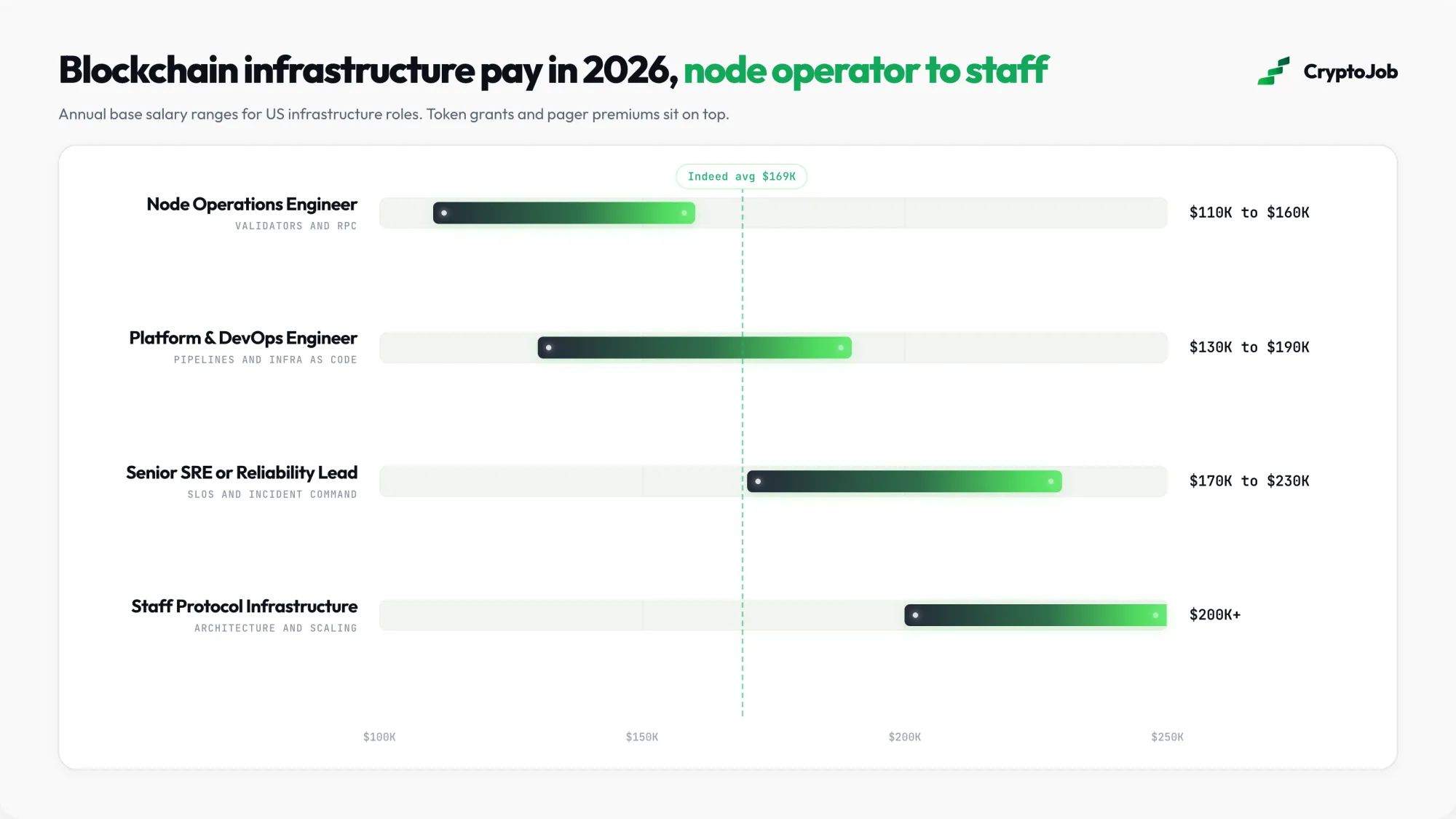
Aggregates set the frame: Indeed's posting based average sits at $169,521 for blockchain engineers with a $99.6K to $288.6K spread, ZipRecruiter's wider sample averages $115.9K and web3.career shows blockchain developers averaging $150K. Infrastructure specialists cluster in the upper half of those blends.
By role, node operations engineers typically land $110K to $160K in US adjacent markets, while platform and DevOps engineers sit at $130K to $190K. Senior SRE and reliability leads reach $170K to $230K, with staff level protocol infrastructure work above that, with token grants layered on at network companies.
Two premiums stand out. Go and Rust systems depth prices at the top of the curve per 2026 recruiter guides, and anything touching zero knowledge proving infrastructure breaks the bands entirely because the qualified pool is tiny.
3. Which companies hire infrastructure engineers?
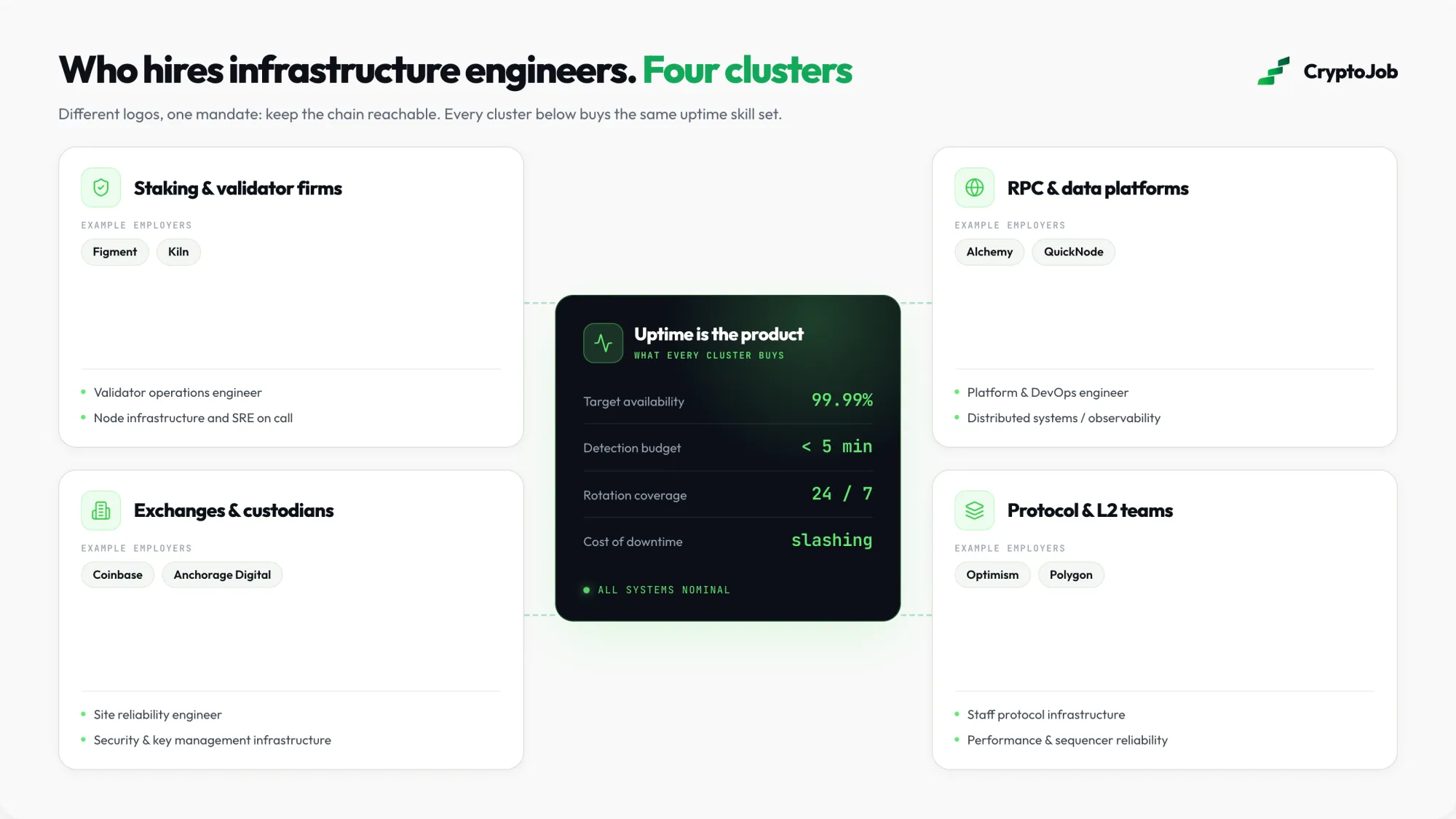
Staking and validator firms are the purest employers: Figment, Kiln, Chorus One, P2P and peers run validators across dozens of networks and hire operations engineers continuously. Newer institutional entrants advertise senior SRE leadership roles to own validator reliability single handedly before building teams.
RPC and developer platforms form the second tier, with Alchemy, QuickNode, Infura and network specific providers operating some of the highest traffic API fleets in software. Data and indexing companies sit beside them.
Then come the everyone elses: exchanges running internal node fleets, custodians requiring bank grade reliability, L2 teams operating sequencers and provers and protocol foundations funding client infrastructure. The protocol layer itself is mapped in our blockchain protocol engineer guide.
4. What skills actually get you hired?
The core stack is boring and beautiful: Linux depth, Kubernetes and container orchestration, Terraform style infrastructure as code, Prometheus and Grafana observability and real incident management experience. Every serious listing repeats this list.
Security instincts thread through everything, from key handling on validator hosts to supply chain hygiene on node images, and candidates who mention hardening practices unprompted consistently rate higher in these loops.
Chain specifics layer on top: running an Ethereum client pair, operating a Solana validator, understanding slashing conditions and knowing why archive nodes eat disks. A month of hands on operation teaches what no documentation conveys.
Programming expectations skew systems: Go for most client and tooling work, with Rust for the performance frontier and Bash for the glue. Our breakdown of Rust developer jobs in crypto covers where that language premium leads.
5. How do you break in from traditional DevOps or SRE?
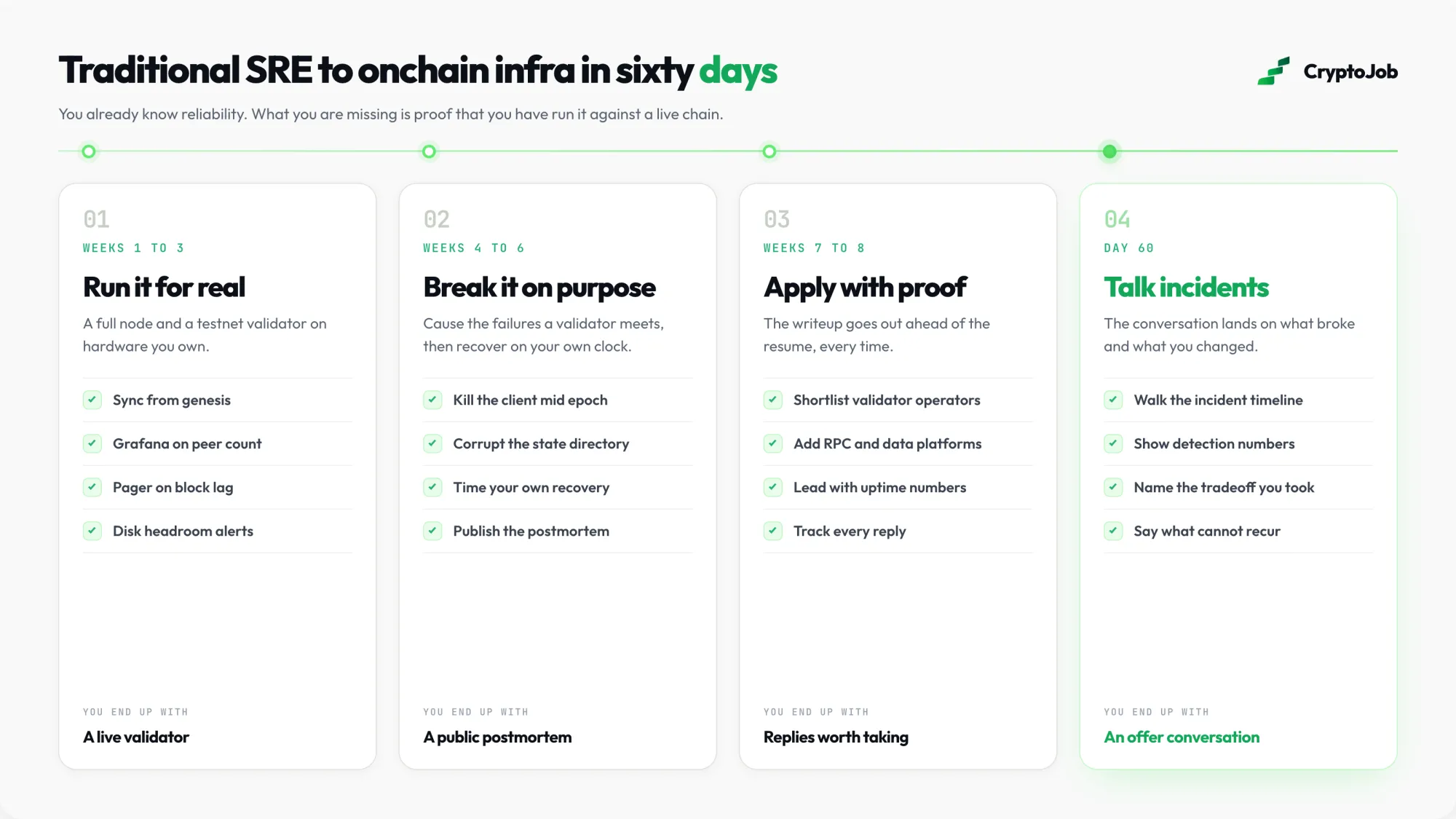
Run something real first. Spin up a testnet validator on two networks and document the incidents you caused and fixed, because that writeup is the interview.
Translate your scars explicitly. On call leadership, postmortem culture, capacity planning and security hardening from any serious environment map directly, and hiring managers at validator firms say traditional reliability backgrounds convert fast.
Then target the tier matching your seniority: platform roles at RPC providers for mid level engineers, reliability leadership at growing validators for seniors and protocol adjacent infrastructure once you have one crypto role banked. General engineering market context lives in our blockchain developer jobs guide.
Credentials play a modest supporting role here, unusually for crypto. Kubernetes certifications and cloud architect badges pass procurement style screens at institution facing operators, though every hiring manager weighs a documented incident history above all of them.
Cost engineering is the quiet bonus skill. Node fleets burn serious cloud and bare metal budgets, and engineers who can cut infrastructure spend while holding uptime become instantly visible to founders, which makes one optimization story worth carrying into every interview.
6. What is the on call reality like?
Honest answer: chains never close. Coverage rotations are global, upgrade windows land at odd hours and volatile markets multiply traffic exactly when everything is most fragile.
Mature firms compensate with real structure: follow the sun rotations, paid on call, blameless postmortems and error budgets that gate feature pressure. The targets themselves are unforgiving, with availability goals around 99.99 percent, detection budgets under five minutes and rotations that genuinely cover every hour of the week. Interview for these practices explicitly, because their absence predicts burnout.
The reward for the pager is leverage. Infrastructure people at these firms hold outsized influence and unusually durable employment, since nobody cuts the team that keeps the stake safe.
7. How do the infrastructure paths compare?
| Path | Typical 2026 pay | Entry difficulty | Stability profile |
|---|---|---|---|
| Validator and staking ops | $130K to $200K plus tokens | Medium, ops proof required | High, stake needs uptime |
| RPC and developer platforms | $140K to $220K | Medium, high scale systems | High, usage based revenue |
| Exchange and custodian infra | $140K to $230K | Medium, security heavy | Highest, regulated demand |
| Protocol and L2 infrastructure | $180K plus, tokens heavy | High, systems depth | Tracks network success |
8. Where is the field heading through 2027?
Institutionalization is the arc. Bank charters and enterprise chains are importing formal reliability standards, which means more roles written for people with change management and audit experience rather than fewer.
New networks keep resetting demand. Every serious L1 and L2 launch, including the payment chains arriving from fintech giants, needs validator sets and RPC coverage on day one, and operators who span ecosystems capture each wave.
AI absorbs toil, not accountability. Automated remediation is spreading through runbooks, yet someone still signs for the stake and faces the postmortem, and that someone is this career.
9. What does a validator firm interview loop look like?
Screens open with your incident history, because these firms hire on scars: expect to walk one real outage end to end, from detection through remediation to the postmortem changes, with follow ups probing what you would do differently.
Technical rounds mix systems depth with chain specifics. A typical loop includes a Kubernetes or Linux deep dive, a monitoring design exercise around a validator fleet and scenario questions like diagnosing missed attestations or planning a client upgrade across hundreds of nodes.
Practical stages increasingly replace whiteboards: a takehome standing up a monitored node or a live session debugging a deliberately broken environment while narrating your process. Your personal validator project pays off directly here.
Final conversations test operational maturity: how you run on call handoffs and when you would page a founder at 3am. Firms selling uptime to institutions hire people who answer those calmly.
10. Should infrastructure be your route into crypto?
If you already run serious systems, it is the highest probability route that exists. The skills transfer with minimal translation, the pay clears most alternatives and the work stays valuable through every market cycle.
Start the sixty day node project this week, write the postmortem nobody else will and browse web3 jobs for the validator and platform openings your writeup will unlock.
FAQ
Do blockchain infrastructure jobs require Solidity?
No. This field runs on systems skills: Linux, Kubernetes, Go or Rust and observability tooling. Smart contract languages are a different career lane entirely.
Are blockchain infrastructure jobs remote?
Mostly yes, with global on call rotations replacing office requirements. Some custodian and exchange roles require onsite presence for controlled environments and key ceremonies.
What is the easiest first infrastructure role to land?
Node operations at a staking firm or platform engineering at an RPC provider, entered with a documented personal validator project and traditional on call experience.
Is running my own validator enough to get hired?
A well documented one is the strongest possible portfolio piece, especially with real monitoring and an incident writeup. Pair it with production reliability history and interviews become conversations between peers.