Crypto ETF Jobs: Operations, Custody and Market Making Roles
Crypto ETF roles are fund operations jobs with digital assets underneath. Here is what each function does and why ETF experience beats crypto tenure.

TL;DR
- Crypto ETF jobs sit in fund operations, not crypto engineering.
- Senior digital asset roles at issuers reach $270,000 base.
- ETF operations, custody and market making are the core functions.
- Fund administration experience beats crypto tenure here.
Crypto ETF jobs are among the least understood roles in the industry, largely because most people looking for crypto work assume they involve crypto skills. Mostly they do not.
These are fund operations roles that happen to have digital assets as the underlying. The people getting hired come from ETF operations, fund accounting and custody backgrounds and senior digital asset positions at the issuers running these products have been advertised at up to $270,000 base before bonus.
To compare these against crypto native openings, browse web3 jobs.

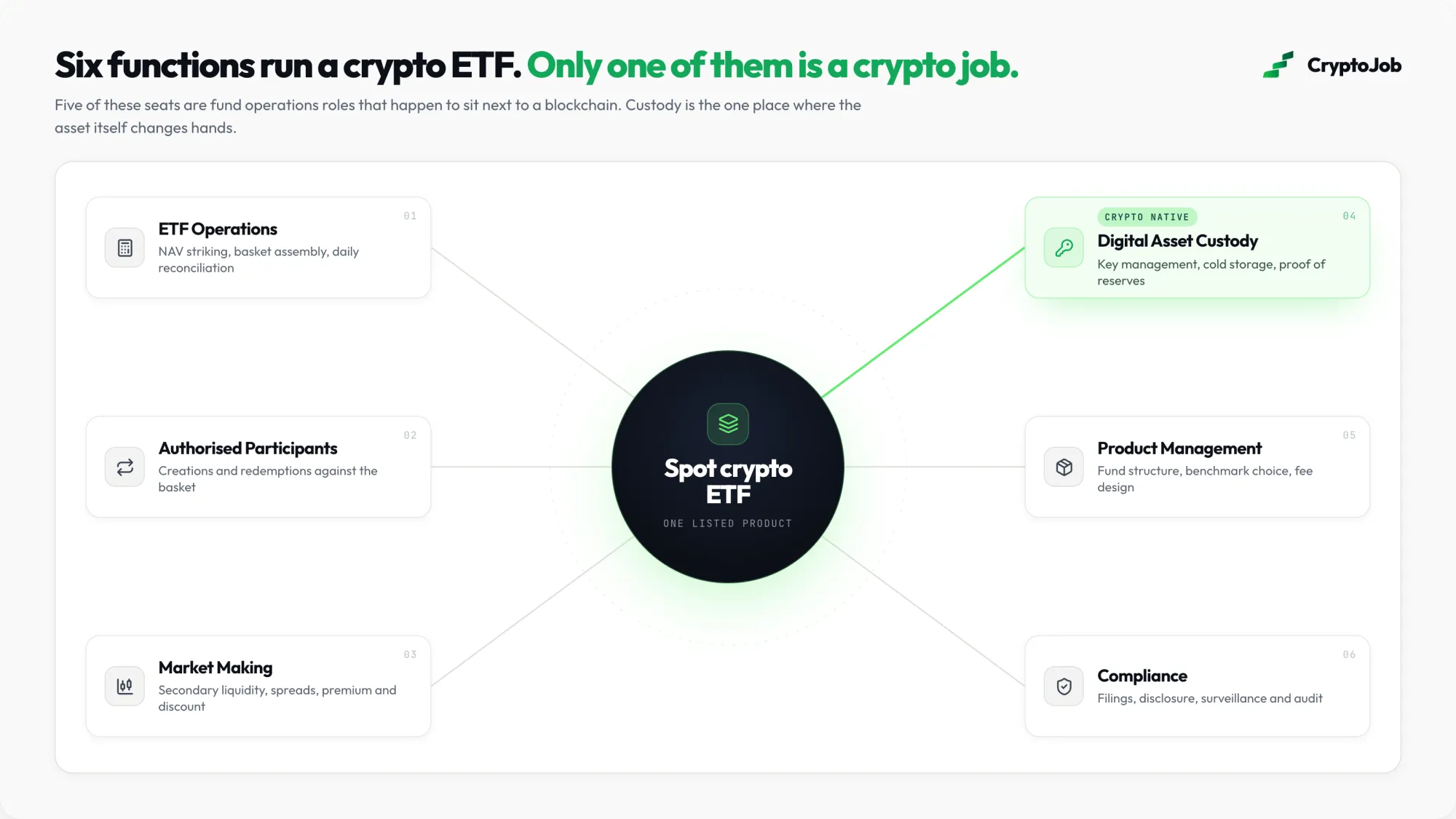
1. What functions actually exist around a crypto ETF?
An exchange traded fund holding digital assets requires the same machinery as any other ETF, plus a custody problem that conventional funds do not have.
| Function | What the role does | Where candidates come from |
|---|---|---|
| ETF operations | Creation and redemption baskets, daily NAV, reconciliation | Fund operations, ETF admin |
| Authorised participant desk | Executes creations and redemptions, manages inventory | Institutional trading |
| Market making | Provides secondary market liquidity, manages basis risk | Quantitative trading |
| Digital asset custody | Key management, cold storage procedure, insurance | Security engineering, custody ops |
| Product management | Structure, fee design, competitive positioning | Asset management product |
| Regulatory and compliance | Filings, disclosure, ongoing supervision | Securities compliance |
Only one row on that table involves anything a crypto native candidate would recognise as their specialism, and even custody looks different inside a regulated fund structure than it does at a protocol.
2. Why does fund experience beat crypto experience here?
Because the failure modes are operational and regulatory rather than technical.
A crypto ETF does not break because someone wrote a bad smart contract. It breaks because a NAV is struck incorrectly, a creation basket fails to settle or a disclosure obligation is missed. Those are problems that fund operations people have spent careers preventing.
This mirrors the broader pattern across institutional crypto. Firms building in this space are largely seeking finance professionals with blockchain knowledge rather than blockchain people with finance curiosity, and more than 60% of Fortune 500 financial firms now run formal blockchain divisions doing exactly that hiring.
3. What do crypto ETF roles pay?
Compensation follows asset management norms rather than crypto ones: meaning solid base salaries, cash bonuses and no token component whatsoever.
Advertised institutional digital asset roles give a useful reference range. A director of digital assets at a major asset manager was listed at up to $270,000 before bonus. Senior engineering roles supporting digital asset platforms have appeared at up to $255,000 and $200,000 depending on the firm.
Operations and analyst roles sit meaningfully below those figures, as they would in any fund business. The compensation ladder is conventional and predictable, which is either the appeal or the drawback depending on what you want.
4. How do you move into crypto ETF work?
4.1 From traditional fund operations
You are already most of the way there, and you likely underestimate that. What you need is credible digital asset literacy, not technical depth.
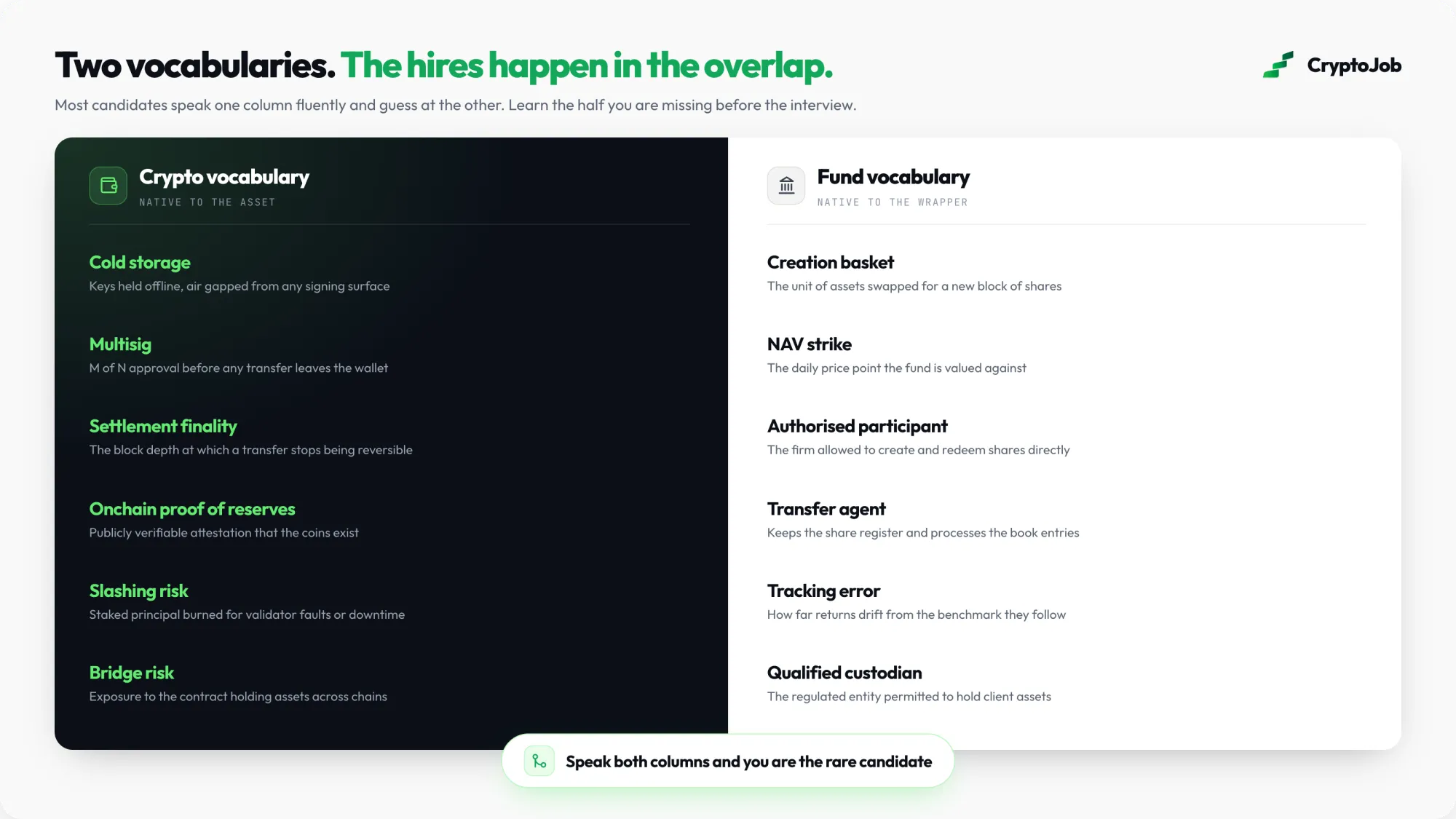
Understand how custody actually works for a fund holding digital assets, why settlement finality differs from conventional securities and what a qualified custodian arrangement looks like in this context. That is a few weeks of focused reading, not a career change.
4.2 From crypto
Your gap is the fund machinery, and it is genuinely substantial. Terms like creation basket, NAV strike, authorised participant and transfer agent will appear in your first interview.
Learn what an ETF actually is at a mechanical level, how shares come into existence, who is allowed to create them and why the arbitrage between price and NAV matters. Without that, technical crypto knowledge does not help you.
4.3 From neither
Operations and analyst roles are the realistic entry point. They are less contested than the senior positions and provide exactly the institutional grounding needed to move up.
5. Is this a good career bet?
It has a distinctly different risk profile from crypto native work, and that cuts both ways.
The stability is real. These roles sit inside asset managers and banks whose revenue comes overwhelmingly from elsewhere, which insulates them from crypto market cycles in a way no protocol job can match. Through a year in which more than 7,000 crypto roles were cut, institutional digital asset teams continued hiring.
The trade off is ceiling and pace. There is no token allocation that might change your life, decisions move through committees and the culture will feel slow if you are used to shipping weekly.
It suits people who want exposure to the technology without exposure to the volatility. It frustrates people who came to crypto for the volatility.

Frequently asked questions
Do crypto ETF jobs require crypto experience?
Usually not. Most functions are fund operations roles, and issuers typically prioritise ETF, fund accounting or custody experience with digital asset knowledge treated as trainable.
What do crypto ETF roles pay?
Senior digital asset positions at issuers have been advertised up to $270,000 base before bonus. Operations and analyst roles sit considerably lower, following conventional asset management bands.
Which role is the best entry point?
ETF operations or fund analyst positions. They are less contested than senior roles and build the institutional grounding needed to progress.
Do these roles pay in tokens?
No. Compensation is cash base plus conventional bonus, and sometimes company equity. Token grants are a crypto native practice that does not extend to regulated fund businesses.
Are crypto ETF jobs remote?
Less often than crypto native roles. Many sit inside regulated entities with location and supervision requirements, so hybrid arrangements are the norm.
Where to go from here
Crypto ETF work is one of the clearest examples of a broader truth about institutional crypto: the scarce skill is rarely blockchain knowledge. It is knowing how regulated financial products actually operate.
If you have that background already, you are closer to these roles than you think. Browse web3 jobs to see what is currently open.