Gate Just Built Its Own Trenches. Every Exchange Is Becoming a Launchpad.
A flat 0.5% fee, a gas waiver, a KOL leaderboard and Hunter Biden's token in the first batch. Gate's Trenches is the other answer to the question Binance answered with a Seed Tag, and it changes who exchanges hire.

TLDR
Gate shipped Trenches, a meme trading venue inside the exchange, and listed LAPTOP in week one.
Binance added stages and a Seed Tag. Gate removed them and charged a flat 0.5%.
The listings desk is becoming a product team. That's who gets hired next.
Gate's announcement went out in the first week of September. Trenches, it said, is "a new all-in-one onchain trading product" built around the "meme social-trading ecosystem," with a flat 0.5% fee on both buy and sell, a limited-time gas fee waiver for Robinhood Chain assets, and community tools named Callout Leaderboard, KOL Leaderboard and Active Account Showcase. The platform supports more than a dozen chains, per Metaverse Post: Solana, Ethereum, BSC, Base, Sui, Arbitrum, Polygon, Robinhood Chain and Gate's own Gate Layer among them.
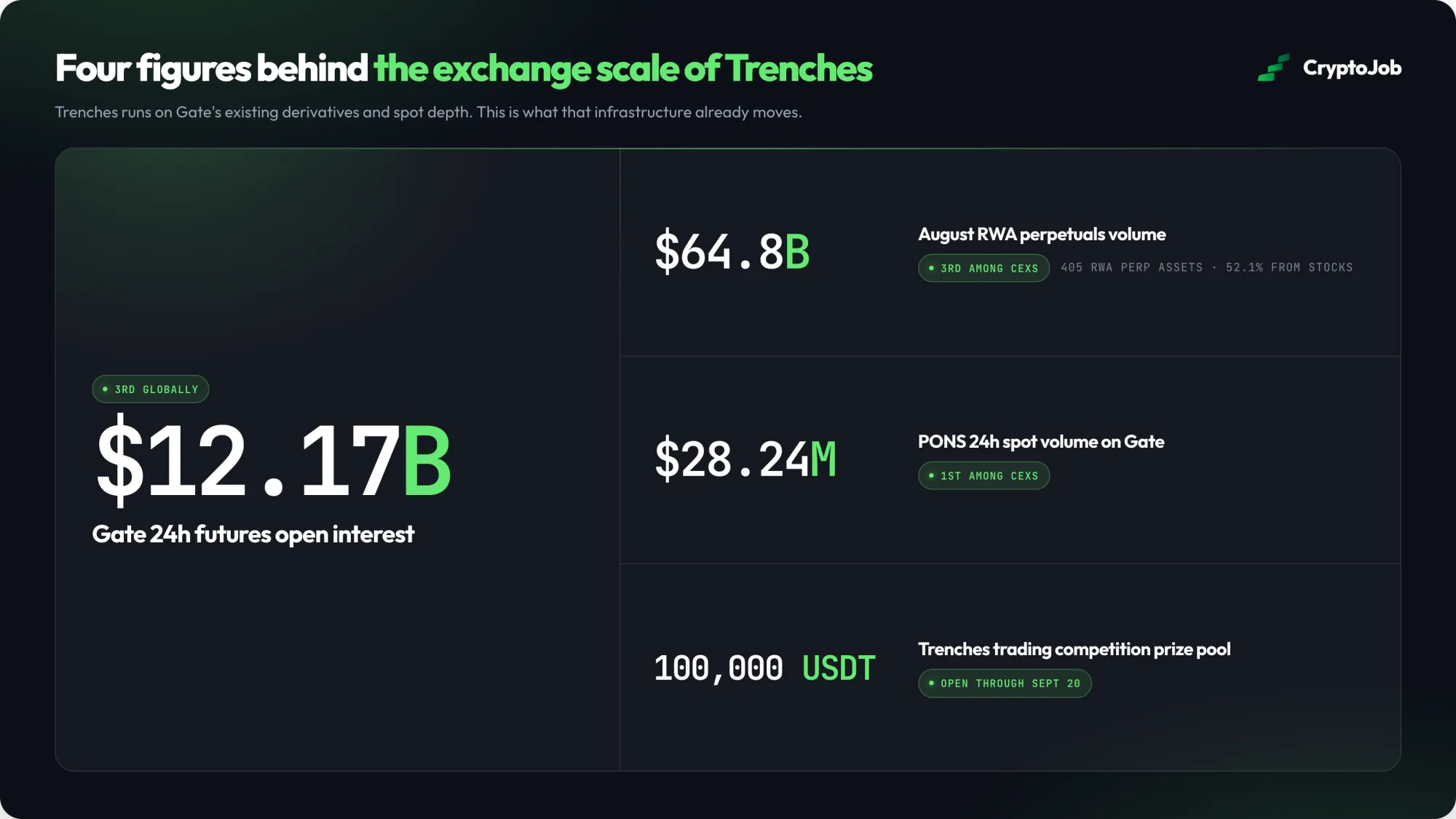
Its first listed tokens included 4Stock, FATPANDA and build, then LAPTOP, VC and Pumpcat, then MANY, FLYBRAIN and MARIO on September 11. MANY, a token whose narrative is routing AI models through a crypto-native API, rose more than 700% on roughly $224,000 of liquidity and a market cap near $4.1 million. A Robinhood Chain trading competition on Trenches runs through September 20 with a 100,000 USDT prize pool split across five tracks tied to volume, referrals and daily check-ins.
None of that is a listing. It's a product, and the crypto exchange product jobs behind it are the story. Anyone considering that side can browse web3 jobs once they've seen what the product is.
1. What Gate built, and what it's built on
Trenches is an aggregator with an exchange wrapped around it. A user trades on-chain tokens across a dozen chains from inside the Gate app, without moving between wallets and DEXs, and pays Gate a flat half a percent for the convenience. The social layer, leaderboards ranking callouts and KOLs, is the part that makes it a product rather than a router.
It sits on top of an exchange that is, per DefiLlama data cited by Metaverse Post, third globally by futures open interest at about $12.17 billion, behind Binance and Bybit. Gate ranked third among centralized exchanges in August RWA perpetuals volume at $64.8 billion, listed 405 RWA perpetual assets, more than any tracked platform, and drew 52.1% of that volume from tokenized stocks. On the meme side, PONS, the token of Robinhood Chain's launch platform, recorded $28.24 million in 24-hour spot volume on Gate, first among centralized exchanges per CoinGecko, while that launch platform's daily volume hit a record $756 million.
So Gate is not building Trenches from nothing. It's building it on a derivatives book, a tokenized-stock franchise and a Robinhood Chain relationship, and pointing all three at the retail meme trade.
2. What happened at Binance the week before
The context is the MarsCoin listing, which I wrote about last week from inside Binance's funnel: Alpha for observation, futures for risk, spot with a Seed Tag. That's an exchange listing desk adapting to memecoins by adding stages. Trenches is the other answer: skip the stages, put the on-chain market inside the app, and charge for access.
The two models will coexist, and the difference is a hiring difference. Binance's approach staffs research, risk and compliance. Gate's approach staffs product, growth and community. Both need market surveillance, because a KOL leaderboard is a manipulation vector with a scoreboard.
3. How it works inside
An exchange product like Trenches is four teams, and the exchange jobs guide on this site has the bands for the ones that already exist.
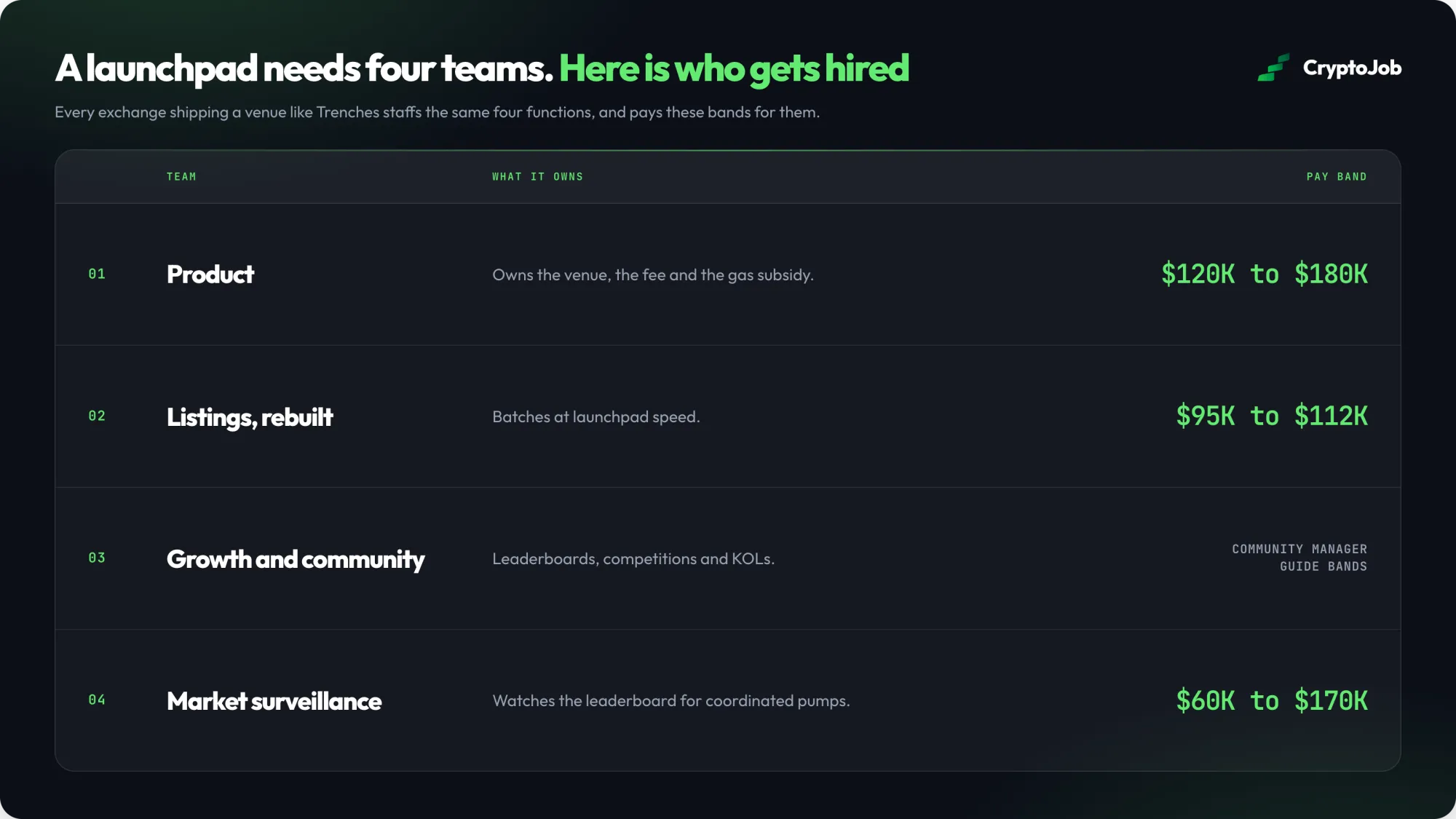
Product. Someone owned the decision that Trenches would be one screen for a dozen chains with a flat fee, and someone owns the gas-waiver economics, which are a subsidy with an end date. That's a product manager with a P&L, and the exchange guide puts product roles at $120K to $180K, with the senior end higher at the largest venues.
Listings, rebuilt. The batches of initial tokens, 4Stock and FATPANDA, then LAPTOP, then MANY, are listing decisions made at launchpad speed. The listings analyst bands, $95K to $112K entry, still apply; the cadence doesn't.
Growth and community. The Callout Leaderboard, the KOL Leaderboard and the 100,000 USDT competition are growth mechanics, and they need people who've run them. The community manager guide covers the role; at an exchange it's a team with a budget.
Market surveillance. A leaderboard that ranks callouts by performance is a leaderboard that rewards coordinated pumps. The surveillance function that watches Gate's $12 billion derivatives book now has to watch a meme venue with $224,000 pools. That's the compliance-side hire, and the compliance guide puts it at $60K to $95K entry and $120K to $170K senior.
What the four teams have in common is that none of them existed at an exchange in this form five years ago. A listings desk reviewed whitepapers. A product team built the trading interface. Now the trading interface is the listing, the whitepaper is a leaderboard, and the surveillance function has to watch both at once. That's the job description change underneath the product launch, and it's why the exchange guide's bands are a floor for the people who've shipped one of these rather than a ceiling.
4. What people who work there say
Gate hasn't put product staff on the record about Trenches, and the coverage is announcement-driven, so the sourcing is the exchange's own language and the trade press that relayed it.
Trenches "amplifies the social side of meme trading and taps into the value of meme-trading communities." Gate announcement, September 2026
The platform is designed "to eliminate the friction of moving between wallets and DEXs" and to "combine the accessibility of centralized exchanges with the functionality of on-chain markets." Metaverse Post, describing the launch
Read those together and you have the product thesis in two lines: the exchange wants to be where meme trading happens, and it wants the social layer, the KOLs and the callouts, inside its walls. That's a community product with an exchange's balance sheet behind it. It's also the thing Binance Alpha, Bybit's on-chain products and Robinhood Chain's launch platform are all circling from different directions.
5. The pattern, in three exchanges
Binance listed MarsCoin after running it through Alpha and futures, and put a Seed Tag and a quiz on it. Gate built Trenches and listed LAPTOP in its first week. Robinhood Chain's launch platform did $756 million in a day, and its token traded most on Gate. Three exchanges, three approaches, one direction: the launchpad layer that Pump.fun and its copies built over two years is being absorbed into the exchanges, where the fees are.
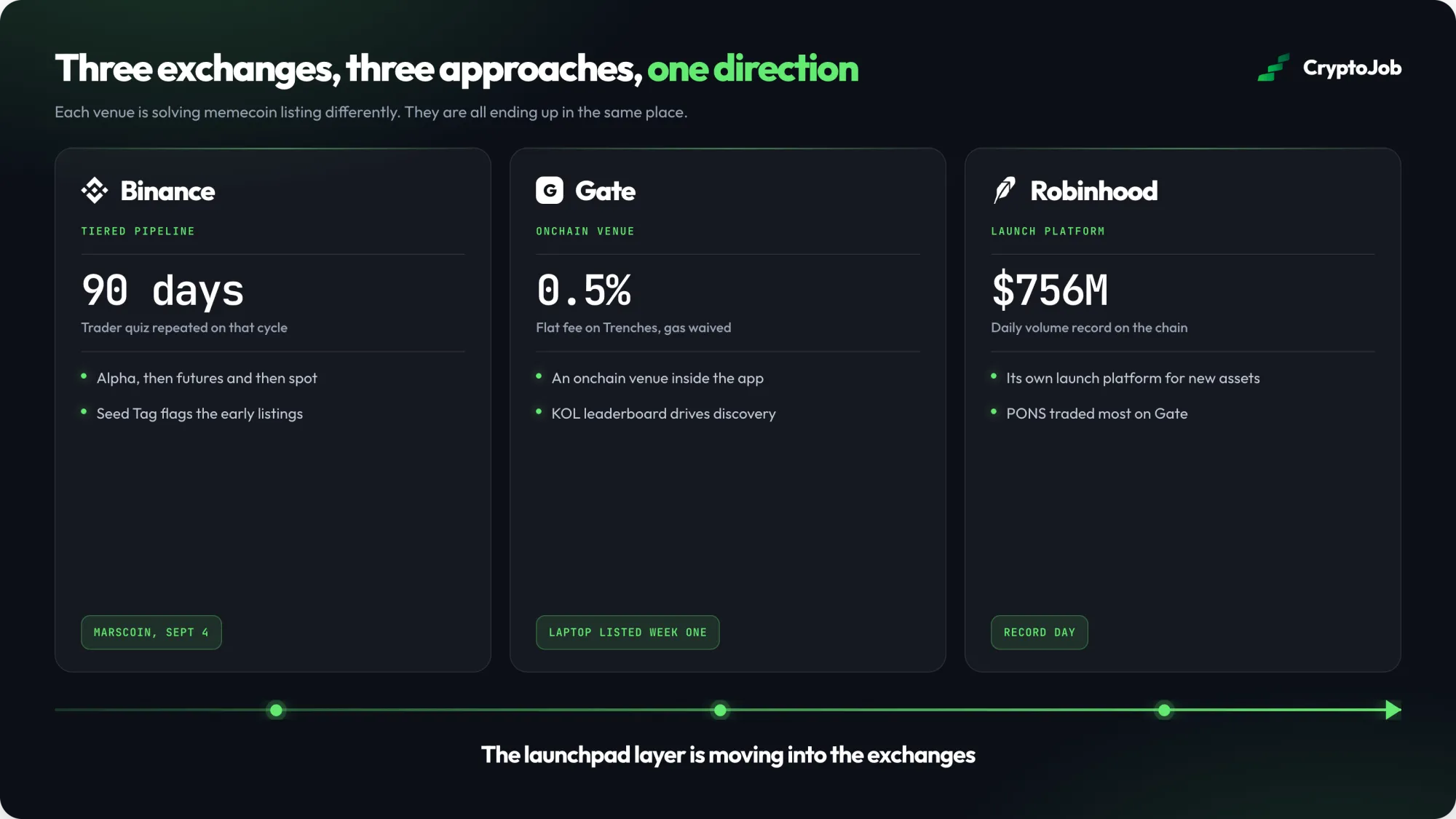
For someone looking at crypto exchange product jobs, that's the read. The listings desk of 2024 is becoming the product team of 2026, and the skills that get hired are the ones that ship a venue, run a leaderboard and price a gas subsidy, not the ones that review a whitepaper.
The timing matters for anyone applying. Trenches launched in the first week of September and was listing tokens by the 11th, which is a product built and shipped inside a quarter. Exchanges staff that kind of launch with contractors and internal transfers first and post the permanent roles after, once the venue has volume to justify them. The postings for the product, growth and surveillance seats behind Trenches will surface in October, and the people who get them will be the ones who can talk about the launch as if they'd watched it from inside.
The verdict
Trenches is the exchange business model for the next cycle: own the on-chain meme trade, charge a flat fee and make the social layer a feature. It's right for a product person who wants a P&L, a growth person who's run a leaderboard and a surveillance person who can watch a $224,000 pool as carefully as a $12 billion book; it's wrong for a listings analyst who liked the whitepapers. If that's the seat you want, browse web3 jobs and search "product" at the exchanges, because that's where the launchpad jobs are being posted.
FAQ
What is Gate Trenches?
An on-chain trading product inside the Gate app that lets users trade meme and micro-cap tokens across more than a dozen chains without moving between wallets and DEXs. It charges a flat 0.5% fee on buys and sells, currently waives gas on Robinhood Chain assets, and includes Callout and KOL leaderboards.
How is Trenches different from Binance Alpha?
Alpha is an early-access surface for tokens Binance wants to observe before deciding on futures or spot listings, with staged risk labels like the Seed Tag. Trenches is a trading venue: the token is tradable inside Gate immediately, on-chain, with a fee. One adds stages; the other removes them.
Which tokens were listed on Trenches first?
Initial batches included 4Stock, FATPANDA and build, then LAPTOP, VC and Pumpcat, then MANY, FLYBRAIN and MARIO on September 11, per Gate's announcements. MANY rose more than 700% on about $224,000 of liquidity.