Liquid Lost $320M to a Bug That Was Already Patched. The Jobs in the Gap.
The biggest hack of 2026 came through a bug whose fix was already visible in the open-source repo. Tiago Sousa on the six hours that decide a sidechain incident, the monitor that would have caught it, and the crypto incident response jobs it created.

TLDR
- Role: the people who detect, contain and recover from a live exploit, at the protocol, at the exchanges that integrate it, and at the firms that trace the money
- Stack: Bitcoin and Elements internals, node operations under pressure, on-chain forensics tooling, a comms channel that works when the network doesn't
- Pay: $130K to $200K mid-level and $180K to $280K senior for crypto incident response jobs, using the security bands from the auditor guide; exchange security teams pay at the top of that
- The filter: "A fix lands in the public repo at 14:00. Not every federation node has upgraded. What are your next six hours?"
- Verdict: yes, if the team has a written disclosure and rollout policy. No, if "it's open source" is the security plan.
On September 6, roughly 4,000 of the 4,200 BTC in Liquid Network's federation wallet left in a single peg-out, about $320 million at the time. Nobody stole a key. A bug in Elements, the open-source software that powers the sidechain, let unbacked L-BTC be created and then redeemed for real bitcoin through SideSwap's peg-out authorization key, which Blockstream says was never compromised. That's the whole incident in two sentences, and it's the biggest crypto theft of 2026.
I want to talk about the gap. Halborn's writeup makes a point the headlines skipped: the vulnerability had been identified and patched within the Elements codebase, which made it publicly visible, before every node was running the patched version. Somebody read a diff, understood what it fixed and used the window. The crypto incident response jobs in this post exist because that window will always exist. If you want to see who's staffing for it, browse web3 jobs after you've read what the work actually is.

1. Tuesday
It's a Sunday, actually, because that's when these happen. You're on the security rotation at an exchange that lists L-BTC. At some point in the afternoon a monitoring alert fires: a peg-out from the Liquid federation wallet that's roughly 95% of the reserve. That number is wrong in a way that can only mean one thing.
Your next hour is the job. You pause L-BTC deposits and withdrawals before you know why, because "why" can wait and "how much" can't. You check whether your own hot wallet touched the sidechain in the last 24 hours. You open a channel to Blockstream, who by now have posted that "purported white-hat hackers" withdrew about 4,000 BTC and that Liquid wallets will be impacted. You brief your compliance desk, because TRM and Chainalysis will have labeled the attacker addresses within a day and you'll need to know if any of that flow touches you.
That's a normal Sunday for crypto incident response jobs. The exchanges that paused L-BTC within hours had someone doing exactly that. The ones that found out from Twitter didn't.
2. What the stack actually is
Incident response at a protocol and at an exchange are the same discipline with different tools. Here's the shape.
| Layer | What it does in this role | How deep you need to be |
|---|---|---|
| Reserve and peg monitoring | Alerts when reserve movements or peg-out volume exceed thresholds | Could debug it at 3am |
| Node operations | Disable bridge nodes, halt block production, coordinate an upgrade across a federation | Shipped with it |
| Protocol internals | Read Elements or Bitcoin Core well enough to understand a patch you didn't write | Could debug it at 3am |
| Forensics tooling | Trace peg-outs to mainchain addresses, cluster, label | Used it |
| Signed communications | Reach an attacker on-chain with a signed message, publish a notice users can verify | Shipped with it |
| Exchange integration | Pause a listed asset without pausing the exchange | Shipped with it |
Blockstream's own sequence on September 6 hits every row: detect, disable bridge nodes, pause the network, patch, contact the attackers on-chain with a signed message, coordinate the return. The infrastructure guide covers the node-operations layer in depth; the difference here is doing it while $320 million is in motion.
3. Read the peg before you read the exploit
A federated sidechain holds real bitcoin in a multi-party wallet and issues a token, L-BTC, that's supposed to be backed one to one. Pegging in locks BTC and mints L-BTC. Pegging out burns L-BTC and releases BTC. The whole security model rests on one invariant: no L-BTC exists that isn't backed.
The Elements bug broke that invariant. TRM's summary is the cleanest: the flaw let the attackers forge the asset itself, which is different from every prior bridge theft, where the failure was stolen validator keys, a flawed bridge contract or forged signatures. Forged L-BTC looked valid to the sidechain, went through a legitimate peg-out and came out as real bitcoin.
Understand that sequence and you understand why the peg-out authorization key being uncompromised is both true and beside the point. The key did its job. It released bitcoin against L-BTC that the network had accepted. The bug was upstream of the key.
4. What actually broke
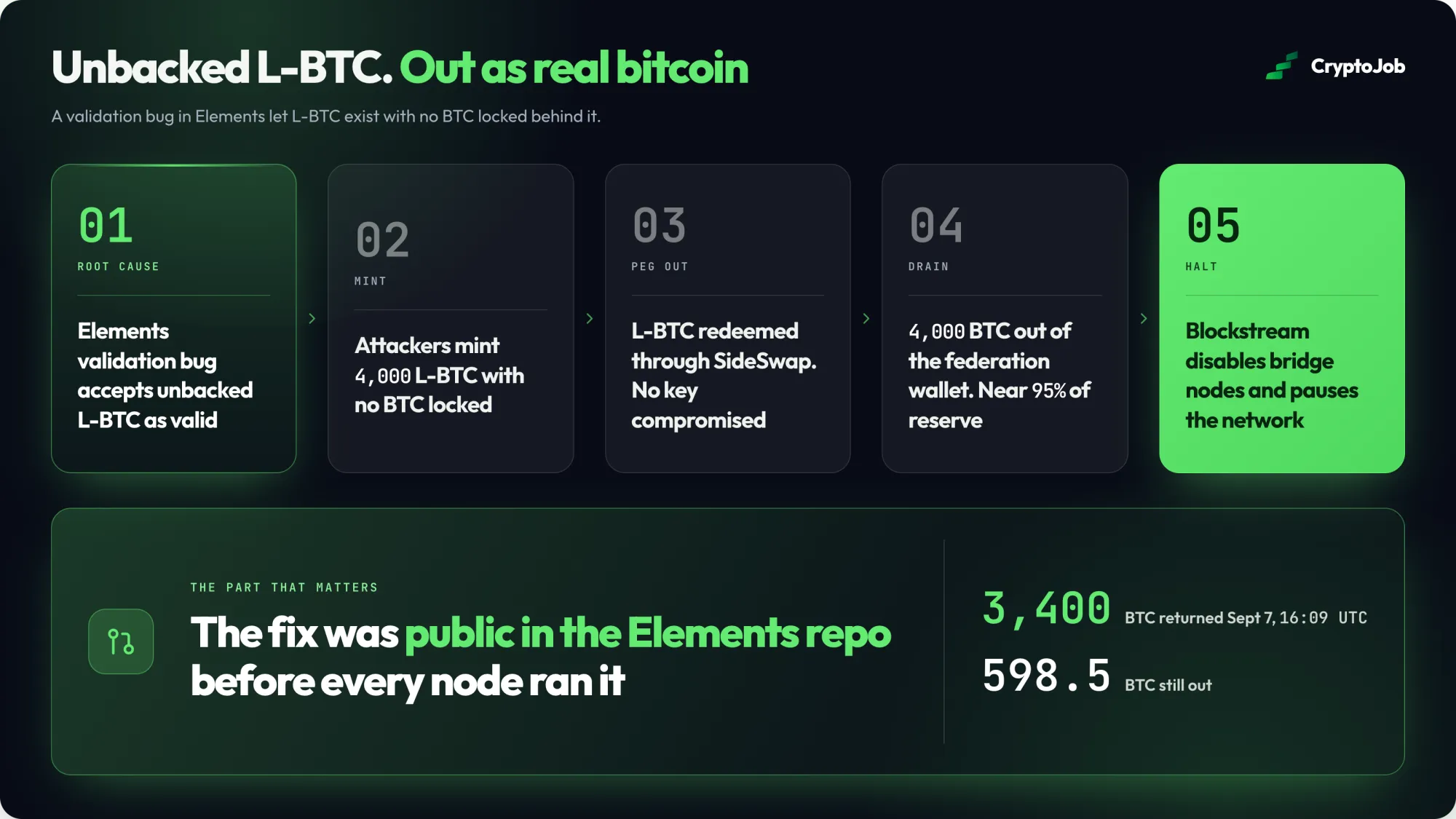
September 6, 2026, Liquid Network, about $320 million. Per Blockstream's incident notice, the attackers withdrew about 4,000 BTC from the federation wallet via SideSwap's Peg-out Authorization Key, which "was not compromised, nor were any others." The mechanism, per Halborn and TRM, was a validation bug in Elements that accepted unbacked L-BTC as valid. Blockstream disabled the affected nodes and halted block production until the patch was applied network-wide. Exchanges paused L-BTC deposits and withdrawals. The next day, at 16:09 UTC, 3,400 BTC came back to a federation address. About 598.5 BTC, roughly $47 million, has not.
Three lessons, in order of how much they'll matter to your interview.
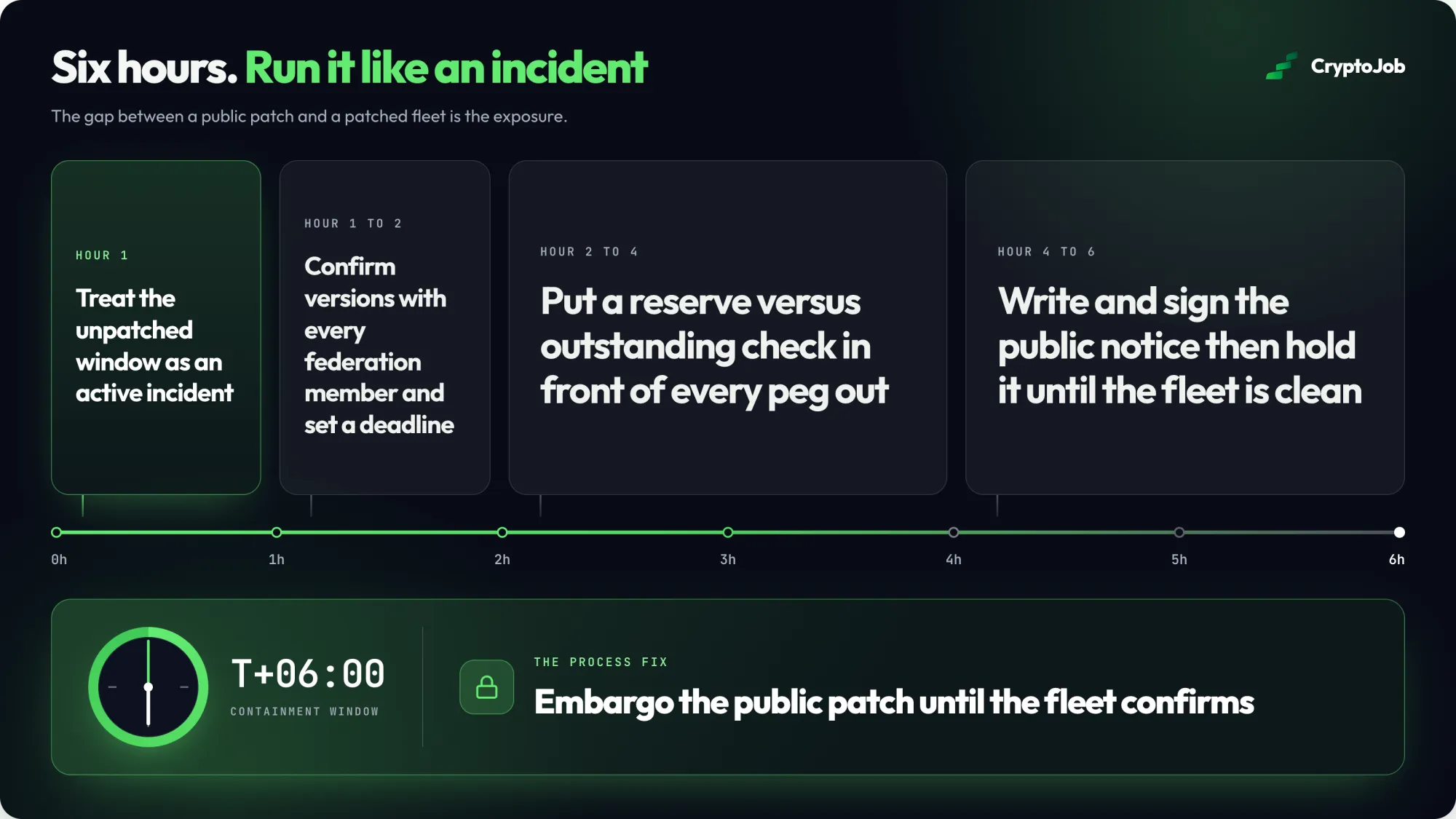
First, the disclosure window. Halborn frames this as supply-chain risk for open-source codebases: the fix was visible before the fleet was patched. The mitigation isn't secrecy, it's staged rollout with the fix embargoed until federation members confirm they're running it, which is a process, and a process is a hire.
Second, the invariant check. A monitor that compares L-BTC outstanding to BTC in reserve, continuously, catches an unbacked mint before it's redeemed. Per TRM, after the return there were about 3,597 BTC in the identified reserve against an estimated 4,200 L-BTC outstanding, roughly 86% backing. That number should have been an alert, not a post-incident calculation.
Third, the containment reflex. Blockstream paused the network within hours. The exchanges that did the same limited their exposure. The ones that waited for certainty had certainty delivered to them by the attacker's transactions.
5. The question that filters people
Here's the one I'd ask for any crypto incident response role this month.
"A fix for a validation bug lands in a public repo at 14:00. You know that not every federation node has upgraded, and you can see the diff. Walk me through your next six hours."
A weak answer talks about "monitoring the situation." A strong answer has a clock in it. Hour one: assume the diff is being read by someone hostile and treat the unpatched window as an active incident, not a pending upgrade. Hours one to two: contact every federation member with a specific version to confirm and a deadline, and prepare to pause peg-outs if the deadline slips. Hours two to four: put a reserve-versus-outstanding check in front of the peg-out path, even a crude one, so an unbacked redemption fails closed. Hours four to six: write the notice you'll publish if it goes wrong, sign it and hold it. The candidate who says "we'd also ask the maintainers to delay publishing the fix next time" gets the offer, because that's the process fix and it costs nothing.
6. Build this before you apply
One weekend project that proves you understand the invariant.
Scope: a peg monitor for a federated sidechain. Run an Elements node against Liquid testnet or a local regtest federation. Continuously compute L-BTC outstanding and BTC held in the federation address. Alert on three conditions: outstanding exceeds reserve, a single peg-out exceeds a configurable fraction of reserve, and peg-out volume over a rolling hour exceeds a threshold. Log every alert with the block height and the transaction.
Stack: Elements, Bitcoin Core, Python or Rust for the monitor, any alerting sink. No dashboard.
What to show: the repo, a README that states the invariant in one sentence, and a replay against the September 6 block range if you can obtain it, showing the alert firing at the peg-out. If you can't get the real data, simulate a 95% peg-out on regtest and show the alert.
What a reviewer looks for: whether you understood that reserve versus outstanding is the number that matters, whether your thresholds are in reserve units rather than dollars, and whether the alert would actually have fired on September 6. Everything else is decoration.
7. Where the roles are
Three kinds of employer are staffing this right now.
The protocol side: Blockstream itself, and every federation or bridge that watched this happen and audited its own peg-out path this week. The infrastructure guide has the node-operations bands.
The exchange side: every venue that lists L-BTC or any other wrapped asset. The security and market-operations teams that paused within hours are the ones that had a rotation. The Bitcoin jobs guide covers the Bitcoin-native employers, and Liquid's federation members are drawn from that list.
The forensics side: TRM labeled the attackers' addresses within a day and is still tracking the $47 million. Chainalysis published its breakdown on September 9. Those firms hire investigators and engineers, and the exchange compliance desks that consume their labels hire the people who act on them.

Would I take it
Yes, at any of the three, if the team can show me a written disclosure policy, a staged rollout procedure and a monitor that checks reserve against outstanding. That's a team that learned something on September 6. No, if the security plan is "the code is open source and people review it," because the Elements fix was open source and reviewed, and that's exactly how the attackers found it. Before you decide, browse web3 jobs and compare what the exchanges and the forensics firms are posting; the same skills price differently on the two sides.
FAQ
1. Is the Liquid Network still paused?
As of the most recent reporting, yes. Blockstream halted block production on September 6 and, as of September 8, exchanges had not resumed L-BTC trading. Holders can't peg out until it resumes.
2. What's the difference between the Liquid hack and a bridge hack like Ronin or Wormhole?
Those came from stolen validator keys, a flawed bridge contract or forged signatures. Liquid's came from a validation bug that let the attackers forge the asset itself, so no key was compromised. TRM draws that distinction and it's the right one; the defense is different.
3. Do crypto incident response jobs require being on call?
Yes. The Liquid withdrawal happened on a Sunday and the return landed at 16:09 UTC on a Monday. Every role in this post assumes a rotation, and the pay reflects it.