Real Yields Rose, Bitcoin Fell 5%, the Fed Split 9-3. What That Did to Crypto Hiring Last Time.
Price leads hiring by about a quarter, in both directions. This week's yield shock is seven days old. Karin Holm separates the numbers that describe the market from the ones that describe the mood, and reads the 2022 lag into the September 2026 postings.

TLDR
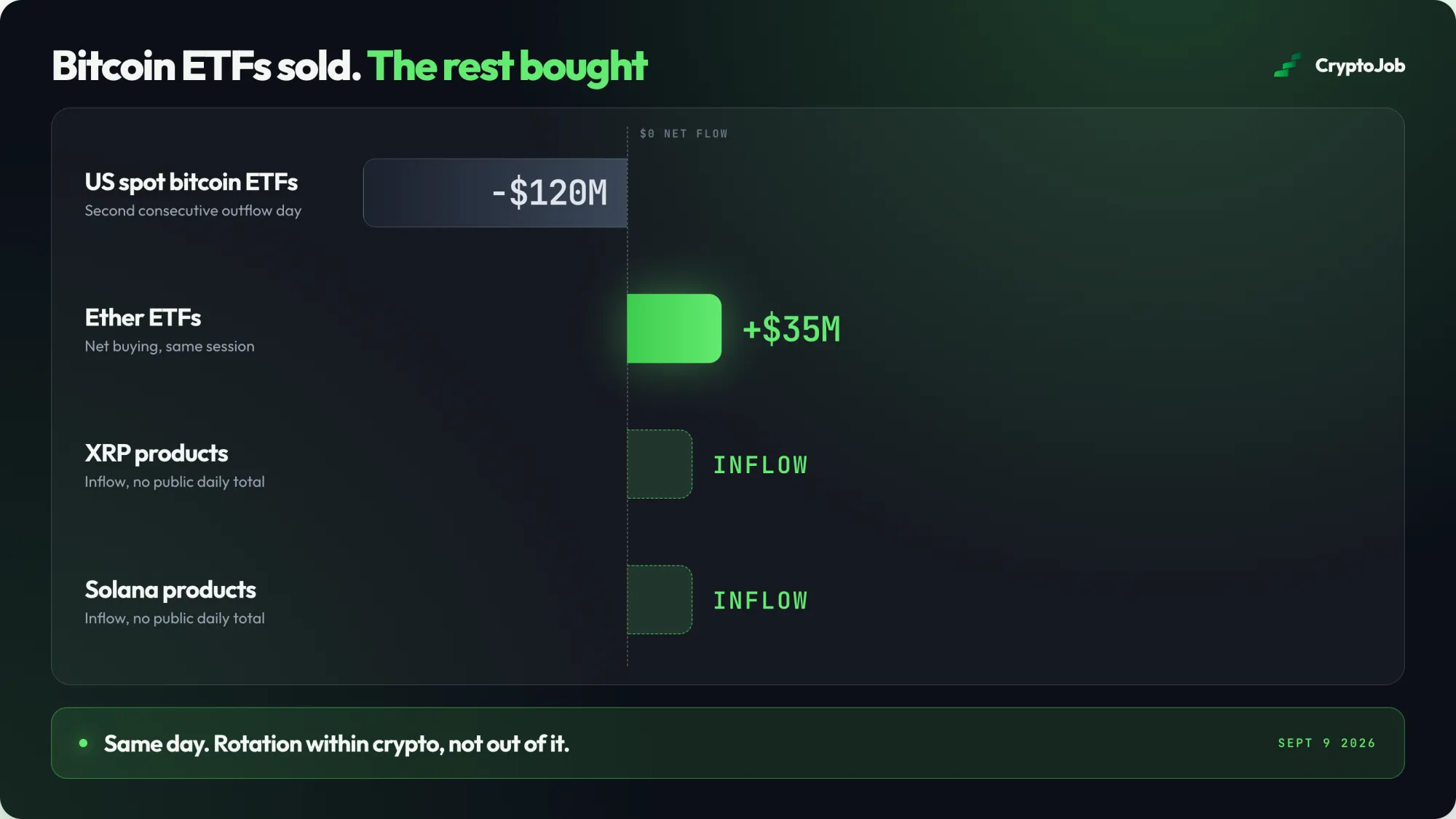
- $120 million. Net outflow from US spot bitcoin ETFs on Wednesday, September 9, double Tuesday's, per CoinDesk's market report, on the same day ether, XRP and Solana products took inflows.
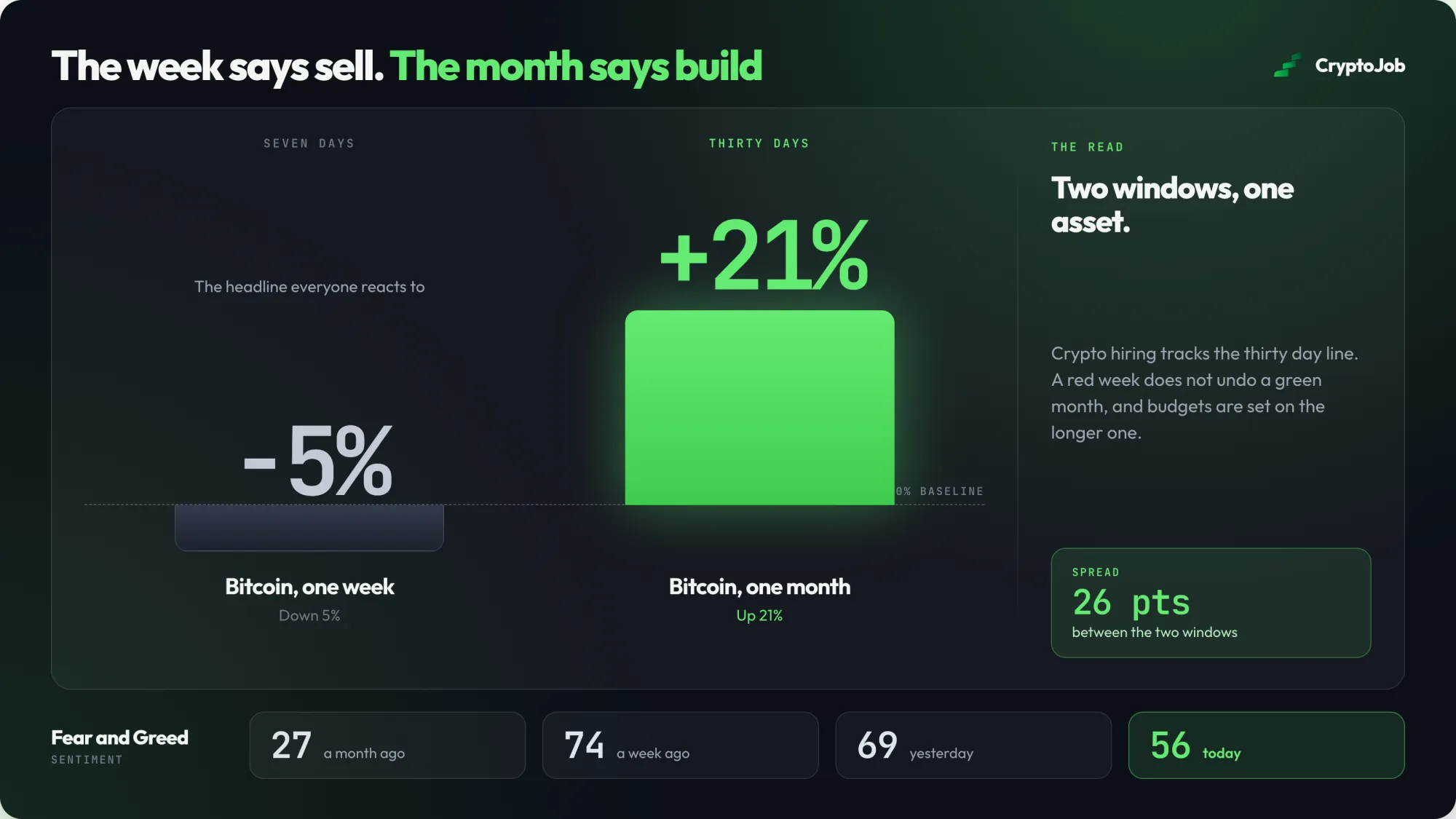
- 5%. Bitcoin's weekly decline to a print below $77,000 after Thursday's PPI, while still up 21% on the month. The crypto job market September 2026 read starts with that pair, not with either number alone.
- 9-3. The Fed's split on rate direction this month, which is the macro input the rest of this post is about.
Five percent down on the week, 21% up on the month. Both are Bitcoin as of Friday morning, September 11, per CoinDesk, and the second number is the one nobody is posting. The first comes from a Thursday drop of nearly 2% after hot producer-price data, into a range of $77,100 to $77,250. The mechanism CoinDesk describes is the standard one: rising real yields make government bonds more competitive against a non-yielding asset and raise the cost of carrying leverage.
We will do two things with that. First, separate the numbers that describe the market from the numbers that describe sentiment about it. Second, look at what a comparable macro turn did to crypto hiring the last time, so that anyone reading job postings this month knows how long the lag is. This is the first of a monthly read; the method note at the end says how it will be repeated. Anyone weighing a move can browse web3 jobs with the lag in mind.

1. The week, in the numbers that were actually recorded
Global crypto market capitalization stood at $2.7 trillion on September 11 at 01:30 UTC, down 1.9% over 24 hours, on $88.4 billion of volume, per CoinGecko data cited by CoinGabbar. Bitcoin dominance was 57.2%, ether 11.1%. The CoinDesk 20 fell 3% on Thursday, underperforming bitcoin, and 95 of the CoinDesk 100 closed red.
The Fear and Greed Index read 56 on September 11, in the Greed band. It was 69 the day before and 74 a week earlier. A month earlier it read 27, Fear. So sentiment fell 18 points in a week and rose 29 points in a month, which is the same shape as the price.
ETF flows split. US spot bitcoin ETFs saw $120 million of outflows on Wednesday, their second consecutive outflow day, while ether products attracted nearly $35 million and XRP and Solana products also took inflows, per CoinDesk and CoinStats. That is rotation within crypto, recorded on the same day, and it matters for the hiring read below.
2. The number everyone quotes and the number that holds up
| The number everyone quotes | The number that holds up |
|---|---|
| "Bitcoin crashed." | Down about 5% on the week to just under $77,000. Up about 21% on the month. Both from CoinDesk on September 11. |
| "Money is leaving crypto." | $120 million left US spot bitcoin ETFs on Wednesday. Ether, XRP and Solana products took inflows the same day. Money moved within crypto. |
| "Sentiment collapsed." | Fear and Greed at 56, still Greed, down from 74 a week earlier and up from 27 a month earlier. |
| "The Fed is hiking." | The Fed split 9-3 on direction, per CryptoTicker's summary; rate-hike pricing rose on energy-driven inflation fears, per ICRYPEX. A split is not a decision. |
| "Altcoins are dead." | 95 of the CoinDesk 100 closed red on Thursday. On September 10, the largest 24-hour gainers by category were restaking and liquid restaking governance tokens. Breadth was bad; it was not uniform. |
The right column is what a hiring manager at an exchange or a fund actually sees. The left column is what a candidate reads on the way to the interview.
3. What a macro turn did to hiring last time
The comparable episode is 2022, when real yields rose sharply through the first half of the year and crypto prices fell with them. The hiring response came with a lag, and the lag is the useful number.
The documented marker is Coinbase, which announced in June 2022 that it would cut about 18% of its workforce, roughly 1,100 people, citing the downturn and its own over-hiring. The yield shock began in the first quarter. The headcount response came in the second. That is roughly one quarter from macro turn to announced cuts at the largest public company in the industry, and smaller firms moved on a similar or shorter clock.
The recovery lag ran the other way. CryptoJob's own job market report records postings down about 80% year over year in January 2026 against the prior cycle's baseline, with more than 5,000 cuts in the preceding period and the AI share of postings roughly doubling. Postings fell long after prices did and recovered long after prices did. Price is a leading indicator for hiring with a lag measured in quarters, in both directions.
So the question for September 2026 is not whether a 5% week matters. It is whether the yield move persists for a quarter. If it does, the hiring effect arrives around December. If it reverses, the effect never arrives, and the month-over-month price gain is the number that ends up describing the labor market.
4. Which roles move with the macro, and which don't
Hiring in this industry is not one market. The job market report separates growing and shrinking roles, and the macro read sharpens the split.
| Function | Sensitivity to a yield-driven price drop | Why |
|---|---|---|
| Trading desks, market making | High | Revenue is volume and volatility; volume fell with price this week, per the CoinDesk 100 breadth |
| Listings, growth, marketing | High | Budget follows revenue with a one-quarter lag |
| ETF issuers, product | Mixed | Bitcoin product outflows, ether and Solana inflows on the same day; the ETF jobs guide covers the desks now hiring for altcoin products |
| Security, incident response | Low | The Liquid Network lost $320 million on September 6 regardless of the tape, and the response was staffed regardless of it |
| Compliance, regulatory affairs | Low, rising | The CLARITY Act's September 15 vote sets headcount independent of price |
| Infrastructure, protocol engineering | Low | Roadmaps are set in tokens and quarters, not weeks |
For a candidate, the table says one thing: if the yield move persists, the top two rows contract first and the bottom three don't, and the quant and trading guide is the one to read with the most caution this quarter.
5. The rotation is a hiring signal
The ETF split, $120 million out of bitcoin products and inflows into ether, XRP and Solana products on September 9, is small in dollars and large as a signal. Issuers staff product and operations desks by asset. A week in which bitcoin products leak and altcoin products fill is a week in which the altcoin desks justify their headcount, and the ETF jobs guide describes exactly those roles.
One day is not a trend. Two consecutive outflow days for bitcoin products, against inflows elsewhere, is a pattern worth watching for a month, which is the interval this read will use.
6. What the data doesn't say
- It does not say a hiring contraction is coming. It says that if the yield move persists for a quarter, the 2022 pattern suggests one, and the yield move is a week old.
- It does not say which companies would cut. The 2022 marker is one public company. Private firms don't publish.
- It does not say the ETF rotation will continue. It is two days of bitcoin outflows and one day of altcoin inflows.
- It does not say the Fed will hike. A 9-3 split is a disagreement, and the CPI print on September 11 arrived after the figures in this post were recorded.
- It does not say postings have moved yet. We measured none this week. That is the point: the lag means September's postings describe June's market.

Method and sources
Price, weekly and monthly change, the CoinDesk 20 and CoinDesk 100 breadth, and ETF flow figures are from CoinDesk's Global Market Report for September 11, 2026, as republished by ICRYPEX, and from CoinStats' September 11 update. Market capitalization, volume, dominance and Fear and Greed readings are CoinGecko data as cited by CoinGabbar on September 11 at 01:30 UTC. The Fed split is from CryptoTicker's weekly summary and the rate-hike pricing from ICRYPEX. The 2022 Coinbase reduction is from the company's own June 2022 announcement, widely reported at the time. The January 2026 posting and layoff figures are from CryptoJob's published job market report, linked above, which draws on public job boards and layoff trackers. We did not measure postings this week and we do not claim to; the lag argument is drawn from the 2022 sequence, one cycle, and should be weighted accordingly. This read will repeat monthly, on the last business day, using the same sources and the same table, so that the numbers can be compared rather than re-described. Readers can browse web3 jobs to see current postings directly.

Two questions I get asked
1. Should I wait to apply until the market recovers?
The lag runs both ways. Postings this month reflect decisions made in June, when the market was rising, so September is a better month to apply than the price suggests. If the yield move persists, the postings that reflect it arrive around December. Applying now means applying into the earlier decision, not the later one.
2. Which crypto roles are safest if a contraction does come?
By the 2022 pattern and the table above, security, compliance and infrastructure roles, because their budgets are set by incidents, regulation and roadmaps rather than by weekly volume. The Liquid response and the CLARITY vote both happened this week and neither cared what bitcoin did. Trading and growth roles carry the macro risk, and their pay reflects it in good quarters.