Crypto Legal Jobs: The Hardest Hire in Web3 Pays Accordingly
Regulation multiplied faster than lawyers who understand it. What crypto counsel earns and where the openings concentrate.

TL;DR
- Crypto legal jobs remain among the hardest hires in the industry
- Indeed lists over 600 counsel and attorney openings touching digital assets
- Remote crypto lawyers average about $100K, senior counsel far more
- MiCA, US stablecoin law and IPO filings drive the 2026 demand
Crypto legal jobs sit at the top of every hard to fill list in 2026, because regulation multiplied faster than lawyers who understand it. Indeed alone shows roughly 380 general counsel openings and another 257 attorney roles touching digital assets, ZipRecruiter puts the average remote crypto lawyer near $100K and senior counsel at funded companies negotiate multiples of that. This guide maps who is hiring, what each level pays and how attorneys actually transition in.
The demand spans two worlds now: crypto native companies building legal functions and traditional giants like Visa, Mastercard, PayPal and JPMorgan hiring digital asset counsel internally. You can browse web3 jobs with a legal filter to watch both streams in real time.
One framing matters before the details: this is a seller's market for the right profile, and employers know it.

1. Why are crypto legal jobs so hard to fill?
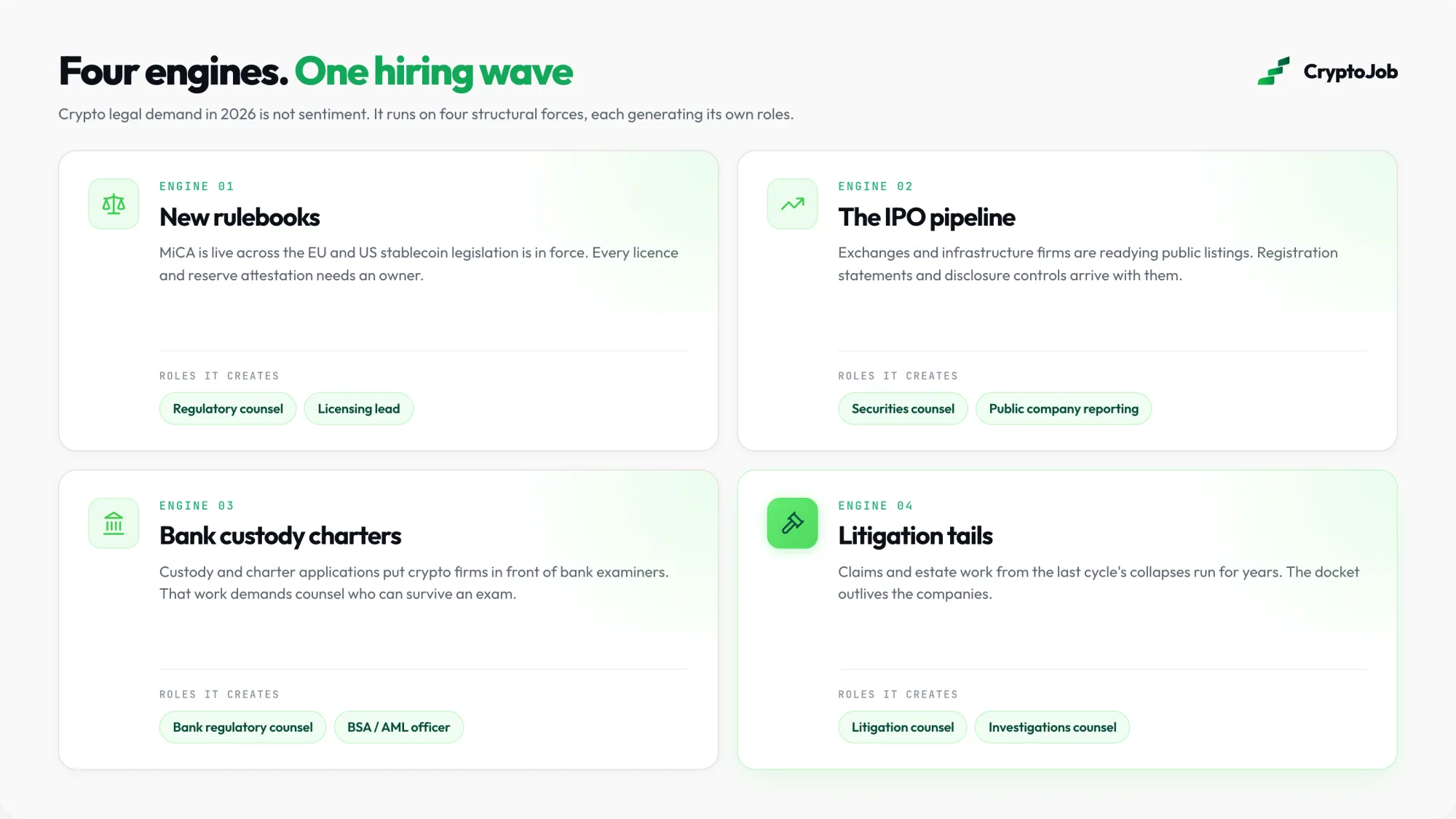
The rulebooks arrived all at once. MiCA now governs the EU and the US passed federal stablecoin legislation, while market structure keeps evolving through agency guidance, so every serious company suddenly needs counsel who can operate across regimes.
The qualified pool stayed tiny. A credible crypto lawyer needs securities or financial regulatory grounding plus genuine product understanding, and only a few years of law school classes and firm practice groups have produced that combination at scale.
Then the IPO wave stacked demand higher. Exchanges and infrastructure companies preparing public listings need securities counsel and disclosure specialists immediately, in exactly the years when custody charters and licensing sprints already stretched every legal team thin.
2. What do crypto legal jobs actually pay?
Aggregated data anchors the floor: ZipRecruiter shows remote crypto lawyers averaging $100,626 with most between $79K and $103K, and blockchain lawyer listings spanning $84K up to $500K at the extremes. Those averages blend contract roles and junior positions, so read them as the entry band rather than the market.
In house reality runs higher. Product and regulatory counsel at funded crypto companies commonly land between $180K and $300K base with equity. Senior and lead counsel carrying multi jurisdiction scope typically sit at $250K to $400K, and general counsel at significant firms negotiate $300K to $500K plus meaningful ownership, with all figures varying by stage and city.
Law firm partners built entire practices on the niche too. Digital asset groups at major firms bill premium rates, which sets a competitive floor for what companies must pay to pull talent inside.
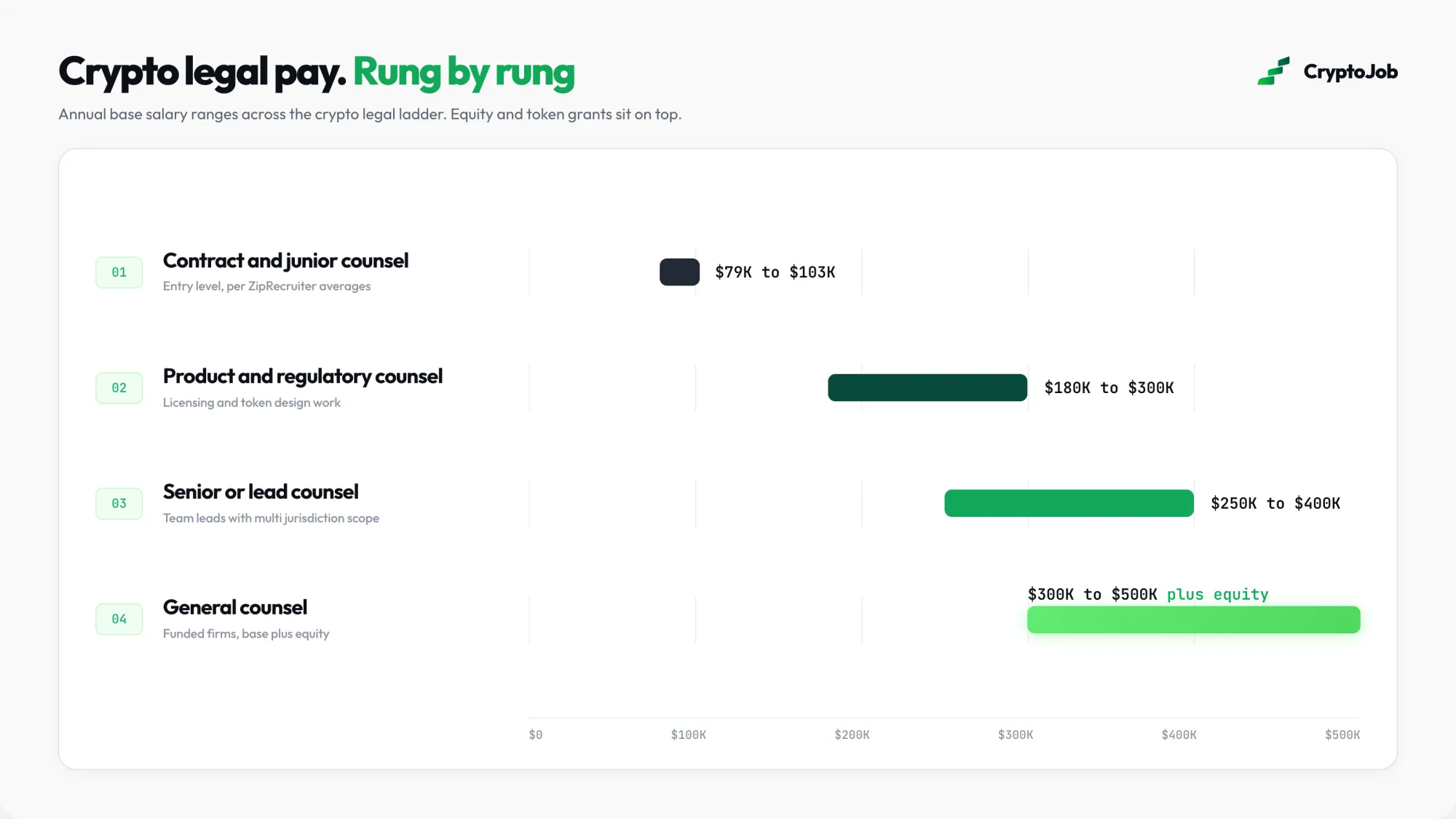
Contract and junior counsel sit at the bottom of that ladder, where ZipRecruiter averages put most roles between $79K and $103K. The jump to product counsel is the steepest step on the ladder, and it is bought with regime fluency rather than years served.
3. Which employers are hiring crypto lawyers in 2026?
Crypto native companies lead on volume: exchanges, stablecoin issuers, custodians and prediction market platforms all run standing legal openings, with prediction market roles explicitly asking for CFTC and SEC regulated product experience. Companies approaching listings add securities and governance counsel on top.
Traditional finance is the second stream and it is enormous. Listings from Visa, Mastercard, PayPal and JPMorgan seek payments and digital asset counsel, and banks entering custody under new charters need lawyers who can face examiners.
Law firms and litigation shops round it out. Crypto disputes and bankruptcy tails from past collapses keep litigation teams recruiting, while regulatory practices advise everyone else on the same rulebooks.
4. What specialties command the biggest premiums?
Licensing and market structure lead. Lawyers who have actually obtained money transmitter licenses, VARA approvals, MiCA authorizations or CFTC registrations carry proof that cannot be faked, and companies pay for the scar tissue.
Securities and capital markets follow closely, powered by the IPO pipeline and token distribution questions that never fully resolve. Stablecoin and payments law became its own specialty the moment federal legislation passed, with issuers and fintech giants competing for the same few experts.
Sanctions and investigations work completes the premium tier, since enforcement never sleeps even when policy softens. Our guide to crypto compliance and AML jobs covers the adjacent nonlawyer track that works alongside these teams.
5. How do lawyers transition into crypto without prior experience?
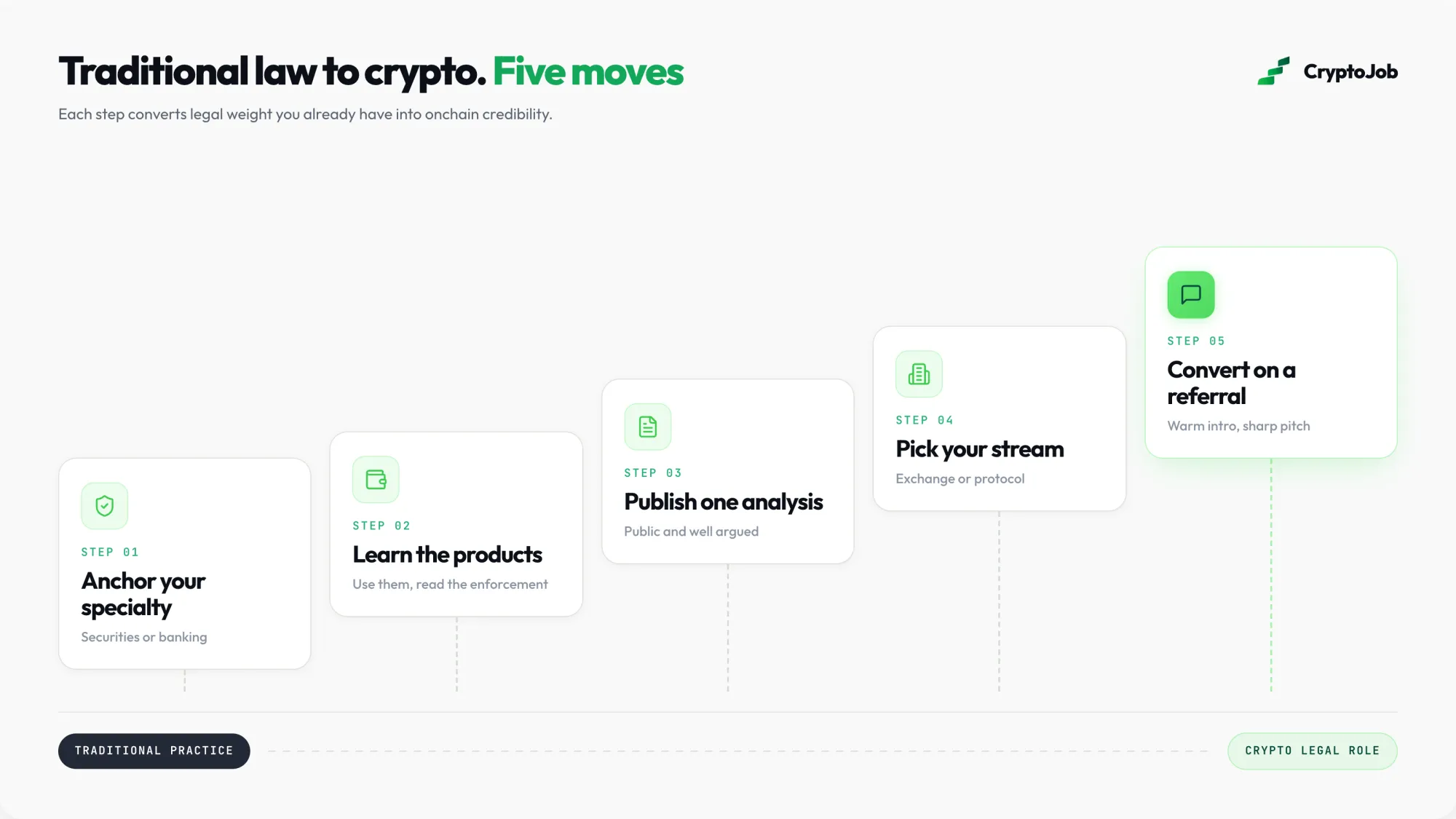
Lead with your regulated foundation. Firms hire securities, banking, payments and funds lawyers and teach them tokens far more readily than the reverse, so frame your practice history around the regime overlap rather than apologizing for missing crypto years.
Close the product gap deliberately. Use the products, read a few landmark enforcement actions and settlement orders and follow the policy debate closely enough to hold an informed opinion, because interviews probe for genuine engagement within minutes.
Then write one thing publicly. A clear memo style analysis of a live legal question, published on LinkedIn or a personal site, functions as both proof and networking, and hiring managers in this niche genuinely read them.
Geography widens the map further. Dubai, Singapore and the EU's licensing hubs all run their own counsel shortages under VARA, MAS and MiCA regimes, and lawyers willing to relocate or cover those time zones remotely find even thinner competition than the US market offers.
6. What does day to day crypto legal work look like?
Product counseling dominates in house life. Lawyers sit with engineering and product teams through launch cycles, resolving novel questions about custody flows and marketing claims before anything ships, exactly as current New York listings describe.
Regulatory management runs in parallel: license maintenance, examiner correspondence, policy monitoring across jurisdictions and coordinating external counsel without letting costs explode. The multi jurisdiction juggling is constant, with one current listing asking for comfort across US, UAE and EU frameworks simultaneously.
The pace is the culture shock. Crypto legal teams operate at product speed with high ambiguity, which thrills lawyers who want a seat in the business and exhausts those who prefer settled precedent.
7. How do the main crypto legal paths compare?
| Path | Typical 2026 pay | Best entry background | Demand driver |
|---|---|---|---|
| Crypto native in house | $180K to $500K plus equity | Securities, fintech, payments law | IPOs, licensing, product launches |
| TradFi digital asset counsel | $170K to $350K | Banking and payments practice | Custody charters, stablecoins |
| Law firm practice group | Market firm scale | Litigation or regulatory associates | Disputes and advisory volume |
| Contract and fractional | $79K to $150K equivalents | Any licensed background | Startups avoiding full time cost |

8. What should you ask before accepting a crypto legal role?
Ask who owns risk decisions when legal says no. The answer reveals whether counsel is a partner or a rubber stamp, which predicts both your influence and your professional exposure.
Ask about the regulatory calendar you would inherit: pending licenses and any enforcement history. Walking into a live matter unknowingly is the classic mistake in this niche.
And ask how the company handled its last hard call between growth and compliance. Every serious crypto business has one, and the story they tell is the culture you would join. Salary specifics for the broader market live in our crypto salary benchmarks guide.
9. What roles sit beside crypto counsel for nonlawyers?
Legal operations is the widest adjacent door: matter management, external counsel budgets, contract systems and licensing project coordination all hire process minded professionals without bar cards, and crypto legal teams building fast need them early.
Policy and regulatory affairs runs parallel, translating between lawyers and product teams, while licensing program managers own the application grind across jurisdictions. Both roles reward the same regime fluency this article describes, minus the JD.
Paralegals with securities or funds experience are genuinely scarce in the niche too, and banks building digital asset desks hire the entire supporting cast alongside counsel, a stream mapped in our guide to digital asset jobs at banks.
For all of these, the entry move mirrors the lawyer's: pick one regime and show written evidence of the fluency, because legal teams hire support staff on precision signals above all else.
10. Is crypto law a durable career bet?
As durable as they come in this industry. Regulation only accumulates, every product category eventually needs counsel and the skills transfer back to fintech and banking if you ever want out.
Move while the scarcity premium holds. Target the stream that matches your background, publish your first analysis this month and browse web3 jobs to shortlist the legal openings worth your specificity.
FAQ
Do crypto legal jobs require prior crypto experience?
Usually no. Employers consistently hire from securities and banking practices and train the crypto layer, though demonstrated product fluency and genuine interest separate offers from rejections.
Can paralegals and compliance professionals enter this niche?
Yes. Legal operations, licensing coordination and regulatory analyst roles hire nonlawyers with strong process skills, and they often pay above equivalent TradFi positions.
Are crypto legal jobs remote?
Many are, especially at crypto native companies, though IPO preparation and examiner facing roles increasingly anchor to US time zones or hub offices.
What is the fastest growing crypto legal specialty?
Stablecoin and payments law, driven by federal legislation and fintech giants entering the market, with securities counsel for the IPO pipeline close behind.