Crypto Risk Management Jobs: The Quiet Winners of Every Crisis
Every blowup created risk jobs. What market, counterparty and DeFi risk roles pay and the backgrounds that transfer straight in.

TL;DR
- Crypto risk management jobs span market, counterparty, operational and protocol risk
- ZipRecruiter lists 449 roles in the niche paying $72K to $550K
- Fidelity posts digital asset risk managers at $80K to $153K base
- Every crisis since 2022 expanded this function permanently
Crypto risk management jobs are what every blowup leaves behind: after each exchange collapse, lending implosion and protocol exploit, the survivors hired risk people, and the discipline is now a permanent career track. ZipRecruiter shows 449 openings in the niche spanning $72K to $550K, Fidelity posts digital asset risk managers at $80K to $153K base and strategic platform roles at institutions reach $185K to $400K. This guide maps the four risk families, what each pays and the backgrounds that transfer straight in.
The quiet appeal: risk hiring is countercyclical, expanding precisely when everything else contracts, because losses fund the case for the function. Watch the live demand anytime when you browse web3 jobs with a risk filter.
And unlike most crypto roles, this one imports decades of TradFi methodology almost unchanged.

1. What do crypto risk management jobs actually cover?
Four families define the field. Market risk sizes exposure to price moves across trading books and treasuries, counterparty and credit risk decides who the firm can safely face and on what collateral, operational risk hardens the processes and people layer and protocol or smart contract risk assesses the code and economic design money sits inside.
Current listings show the spread vividly: market maker roles assessing posted collateral quality and token volatility, bank roles running enterprise risk frameworks and fintech scorecards and platform roles designing controls that reconcile onchain data with financial records.
The unifying job is the same everywhere: quantify what can go wrong, set limits before it does and hold the authority to say no when it matters.
2. What is a realistic crypto risk management salary?
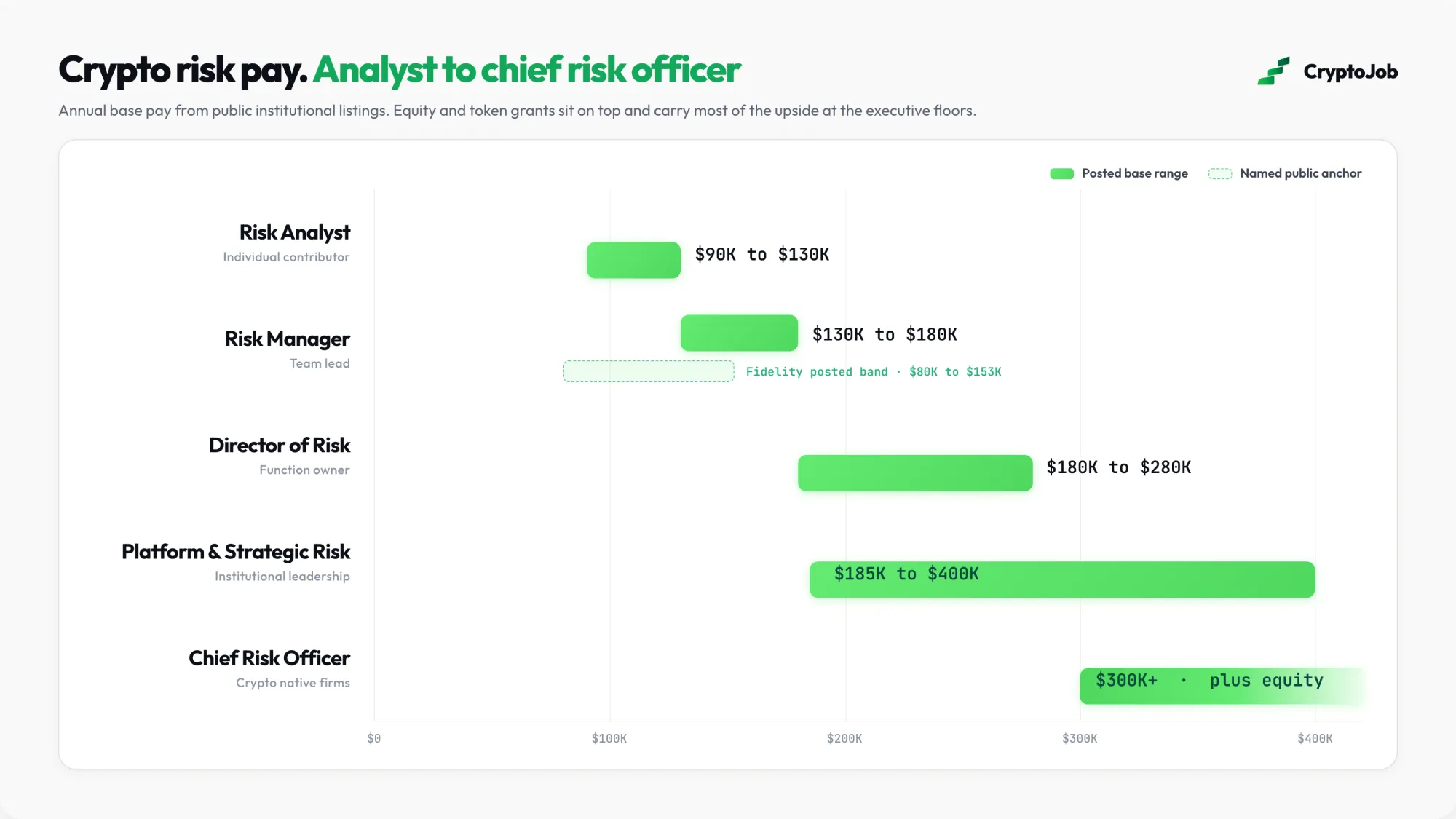
The public anchors are unusually concrete. Fidelity's digital assets risk manager band runs $80K to $153K base, ZipRecruiter's 449 role sample spans $72K to $550K and an institutional platform leadership listing posts $185K to $400K.
By level, analysts typically land $90K to $130K, managers $130K to $180K, directors $180K to $280K and chief risk officers at exchanges and custodians negotiate well past $300K with equity, varying by firm type and city as always.
DeFi risk specialists price their own curve. Firms like Gauntlet and Chaos Labs built businesses on parameter and protocol risk, and quantitative researchers there compete on quant compensation rather than corporate risk bands.
3. Who hires crypto risk professionals in 2026?
Exchanges and trading platforms lead, running market and credit risk desks that listings from majors like Crypto.com make visible, including new roles applying AI to risk workflows. Market makers and lenders hire the collateral and margin specialists their business models depend on.
Institutions form the fastest growing stream: Fidelity's digital asset risk postings, bank ERM teams onboarding crypto exposure and custodians whose charters require formal risk functions all recruit continuously, often preferring examination fluent candidates from banking.
The DeFi risk industry rounds it out, from protocol risk vendors through insurance and security firms, hiring quants and researchers who model liquidations and economic attacks. The exchange lane specifically pairs well with our guide on getting a job at a crypto exchange.
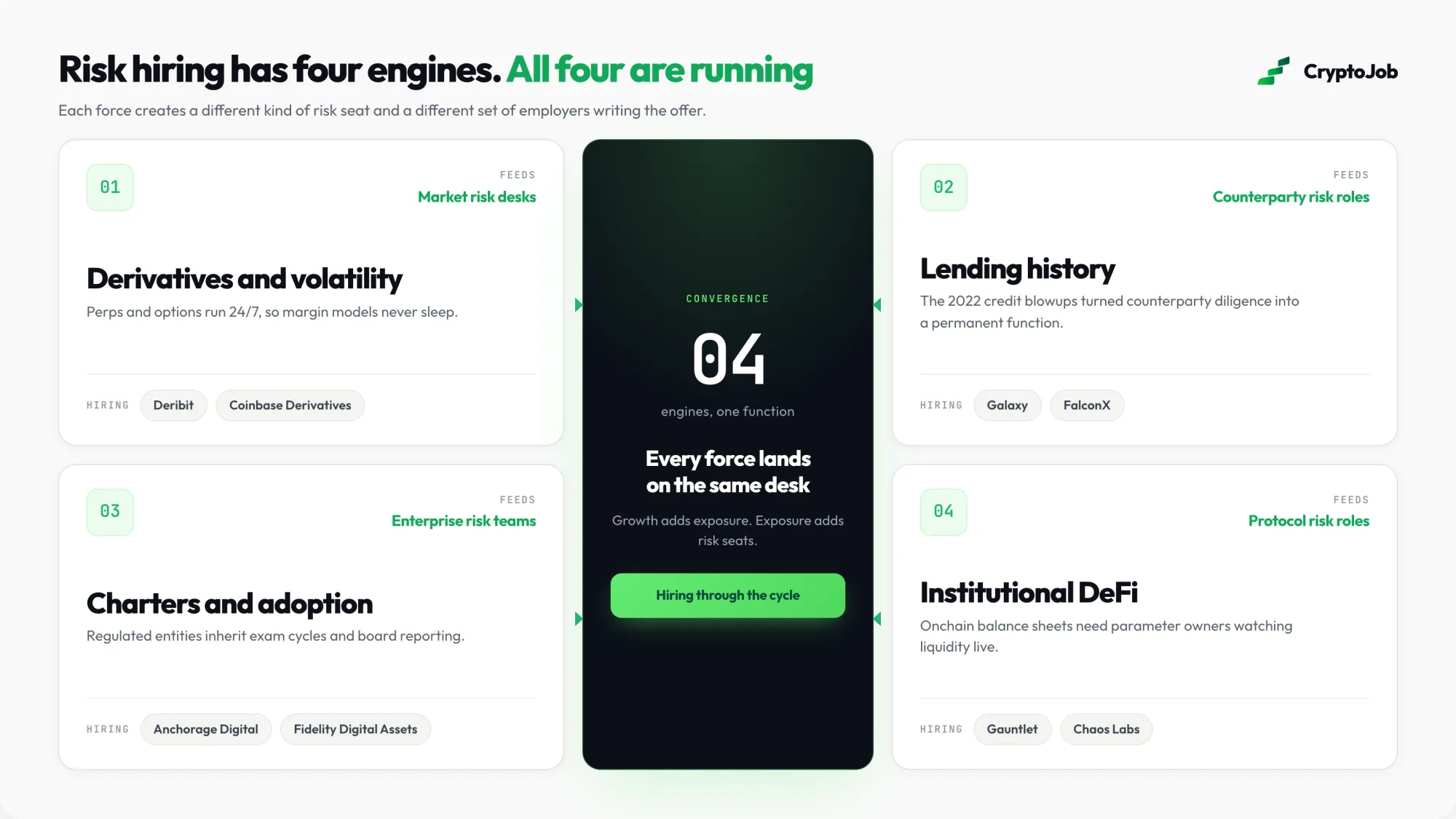
Two employer names worth watching on the trading side are the derivatives venues and the prime brokers, since perpetual futures books and lending desks generate the most continuous exposure in the industry. Those desks staff risk before they staff almost anything else.
4. Which risk specialty should you target?
Counterparty and credit risk carries the deepest scar premium. The lending collapses of past cycles made credit officers who can size and document counterparty exposure genuinely scarce, and market makers now advertise for exactly that background from credit trading and structured products.
Market risk suits quants who want breadth: volatility that dwarfs equities and around the clock books make the modeling genuinely interesting, and the skill set overlaps our crypto quant and trading jobs guide.
Protocol risk is the frontier lane for the technically fluent, while operational and enterprise risk offers the widest door for bank professionals, since control libraries and risk appetite statements transfer almost word for word.
5. How do you transition in from traditional risk?
Translate your framework first. Enterprise risk, model validation, credit committees and regulatory examination experience map directly onto what chartered crypto firms are building right now, so lead applications with the frameworks you have owned rather than crypto enthusiasm.
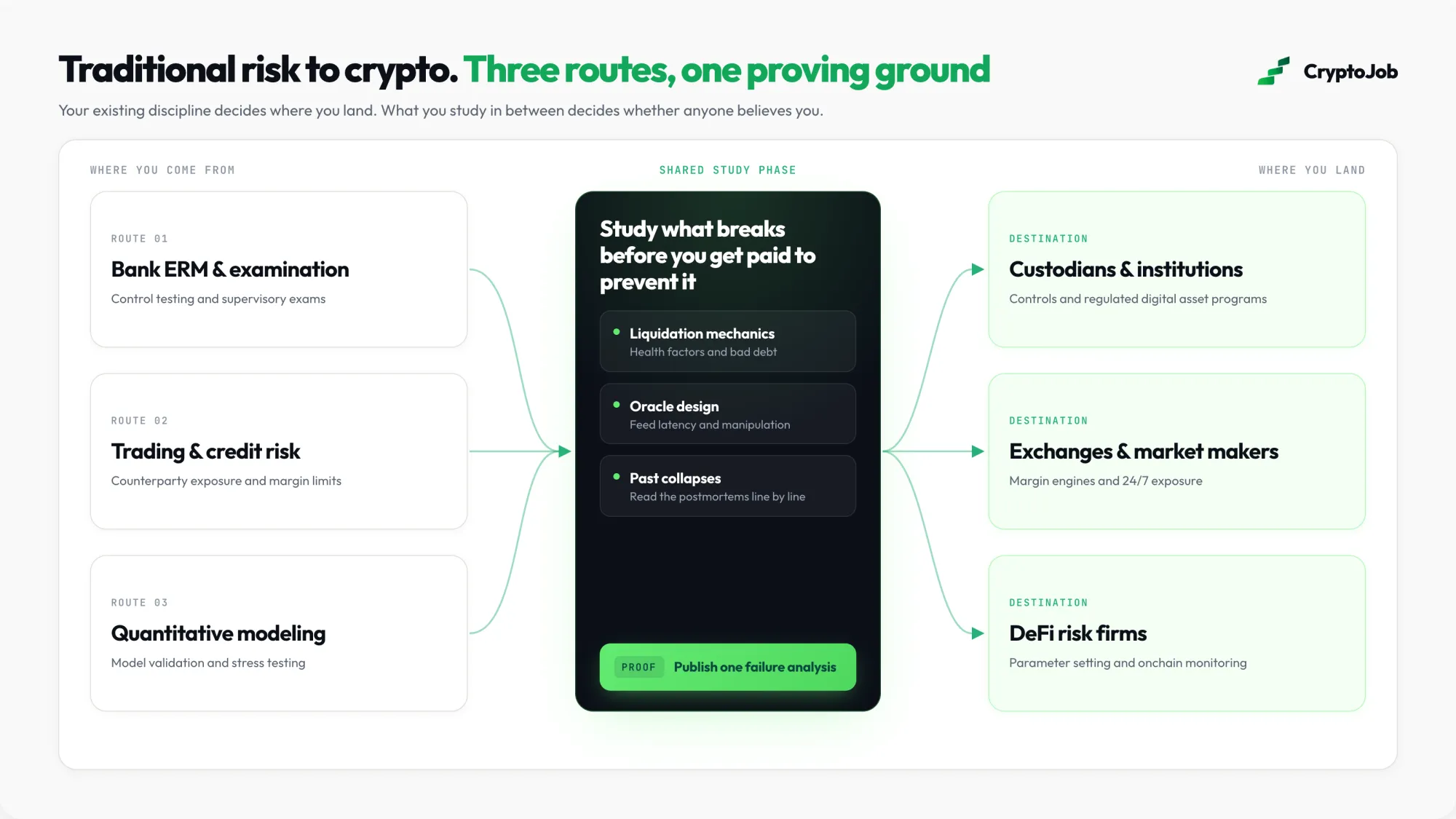
Close the asset gap with deliberate study: how liquidations cascade, how oracle prices can be manipulated, what collateral quality means when the collateral is a token and how past collapses actually propagated. Writing one postmortem style analysis of a historical failure demonstrates the exact judgment interviews test.
Then pick the entry stream by your background: bank risk people toward custodians and institutions, trading risk people toward exchanges and market makers, quants toward DeFi risk firms. Compliance adjacent candidates should also read our crypto compliance and AML guide, since the functions hire side by side.
6. What does the day to day work feel like?
Limits, reviews and escalations set the rhythm: daily exposure reporting, new asset and counterparty assessments, incident postmortems and the recurring meetings where risk argues with growth. The job is institutionalized skepticism with a dashboard.
Crisis weeks are the exam. When markets gap or a protocol breaks, risk teams run the playbooks they wrote in calm months, and the July 2026 wallet exploit that drained over 1,000 wallets within an hour is exactly the scenario these teams rehearse against.
Influence is the compensation beyond salary. Risk officers at serious firms hold veto authority over listings and counterparties, which is organizational power most functions never touch.
7. How do the four risk families compare?
| Family | Typical 2026 pay | Best background | Demand driver |
|---|---|---|---|
| Market risk | $110K to $250K | Trading risk, quant modeling | Derivatives growth, volatility |
| Counterparty and credit | $120K to $280K | Credit trading, structured products | Lending scars, prime services |
| Operational and enterprise | $90K to $200K | Bank ERM, audit, examinations | Charters and institutional entry |
| Protocol and DeFi risk | $130K to $300K plus | Quant research, smart contract fluency | Institutional DeFi adoption |

The working toolstack rewards naming too: Python for exposure analytics, familiar risk measures adapted to around the clock markets, dashboarding for limit monitoring and increasingly the onchain data platforms that let risk teams watch protocol health directly. Two named tools plus one modeling story covers most technical screens.
8. Where is crypto risk heading through 2027?
Institutional rigor is the arc. As charters and bank adoption pull crypto into regulated frames, risk functions inherit formal expectations: documented appetite statements and validated models, which multiplies roles written for experienced professionals.
AI is joining the desk as tooling, with exchanges already posting leadership roles for AI innovation in risk management. The pattern matches the rest of the industry: automation handles monitoring volume while accountable humans own thresholds and decisions.
And institutional DeFi is the growth frontier, since allocators entering onchain yield need risk professionals who can evaluate protocols with institutional rigor, a demand 2026 hiring commentary calls out explicitly.
9. How do you build risk judgment without a risk title?
Write failure analyses on your own authority. Pick two historical collapses and publish structured postmortems reconstructing the exposure chains from public reporting, because demonstrated forensic thinking is the portfolio this field respects.
Practice limit setting on paper: define how you would size counterparty exposure to a mid tier exchange or set collateral haircuts for a volatile token, state your assumptions and stress them. Interviewers ask exactly these hypotheticals, and rehearsed frameworks show.
Adjacent roles build the muscle too. Treasury work, trading operations, audit and even senior support fraud queues all generate risk decisions daily, and framing that experience in risk language converts it into candidacy.
The meta skill is documented skepticism: a trail of written, dated judgments about what could go wrong, some proven right. Start the trail now and the title follows it.
10. Is risk the smart contrarian bet in crypto?
It might be the smartest one available: countercyclical demand, transferable methodology, real authority and salaries that public listings already verify. The industry has finally accepted that risk teams are cheaper than the alternative.
Write your failure postmortem this month, aim it at the stream matching your background and browse web3 jobs for the risk seats your framework experience already qualifies you to hold.

FAQ
Do crypto risk jobs require crypto experience?
Often no. Institutions and custodians actively prefer examination tested risk professionals from banking, and exchanges hire credit and market risk people from trading firms, teaching the asset layer internally.
Which certifications help for crypto risk management?
FRM and similar risk credentials pass institutional screens and pair well with demonstrated crypto study, while DeFi risk firms weight quantitative work samples far above any certificate.
Are crypto risk management jobs remote?
Mixed. Analytical and DeFi risk roles frequently list remote, while exchange desks and institution facing positions increasingly anchor to hubs for crisis coordination.
Is risk management safe from crypto downturns?
Safer than most functions, because downturns are precisely when risk teams get funded and empowered. Every major collapse in industry history expanded this discipline rather than shrinking it.