The Great Crypto Talent Exodus: Where Web3 Workers Actually Went
The layoffs were loud, the destinations quiet. Tracking where crypto talent landed and which niches are pulling people back.

TL;DR
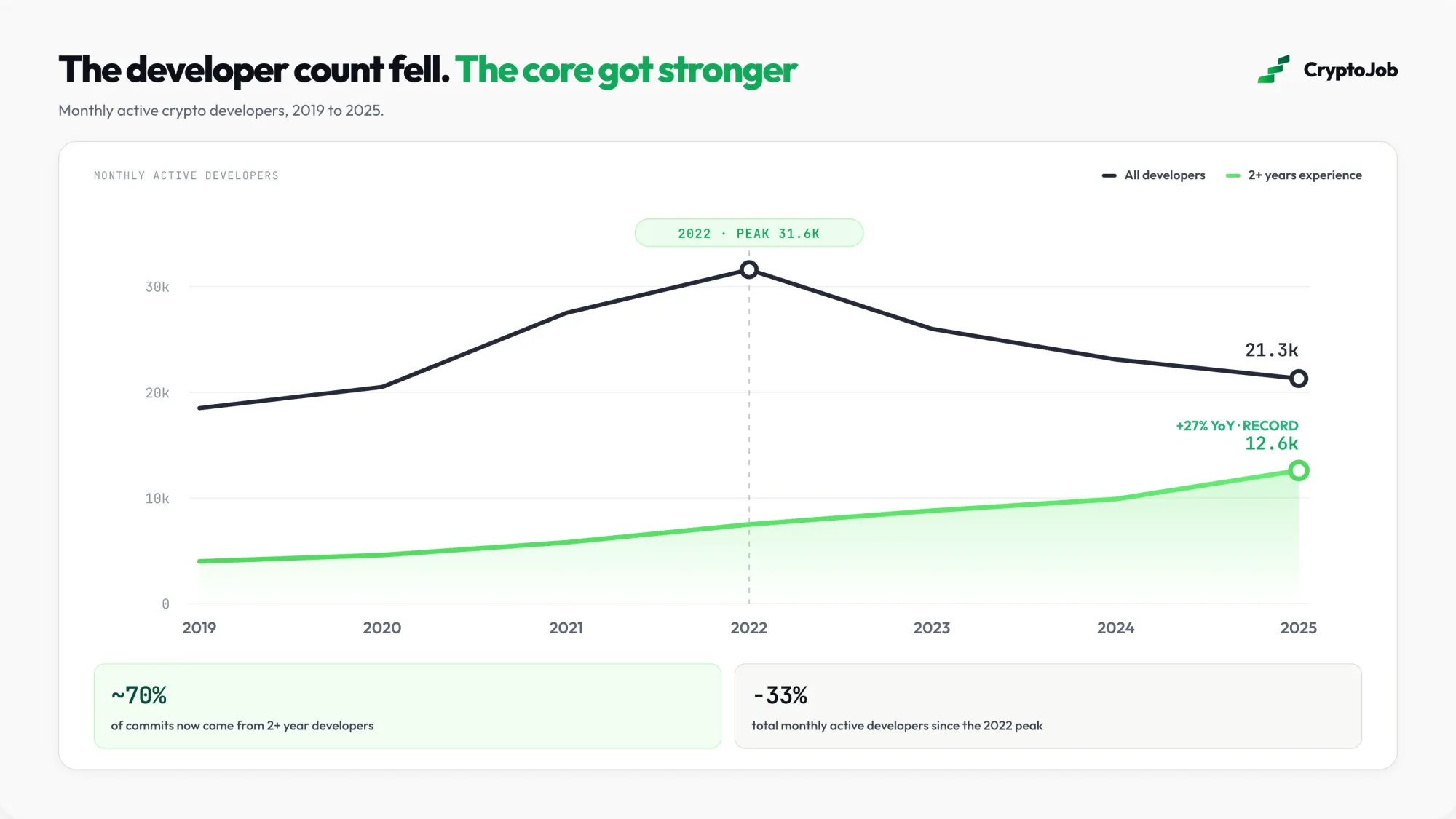
- The crypto talent exodus is real: monthly active developers fell from over 30,000 to the low 20,000s
- AI absorbed the most, with 1.3M new AI jobs created globally
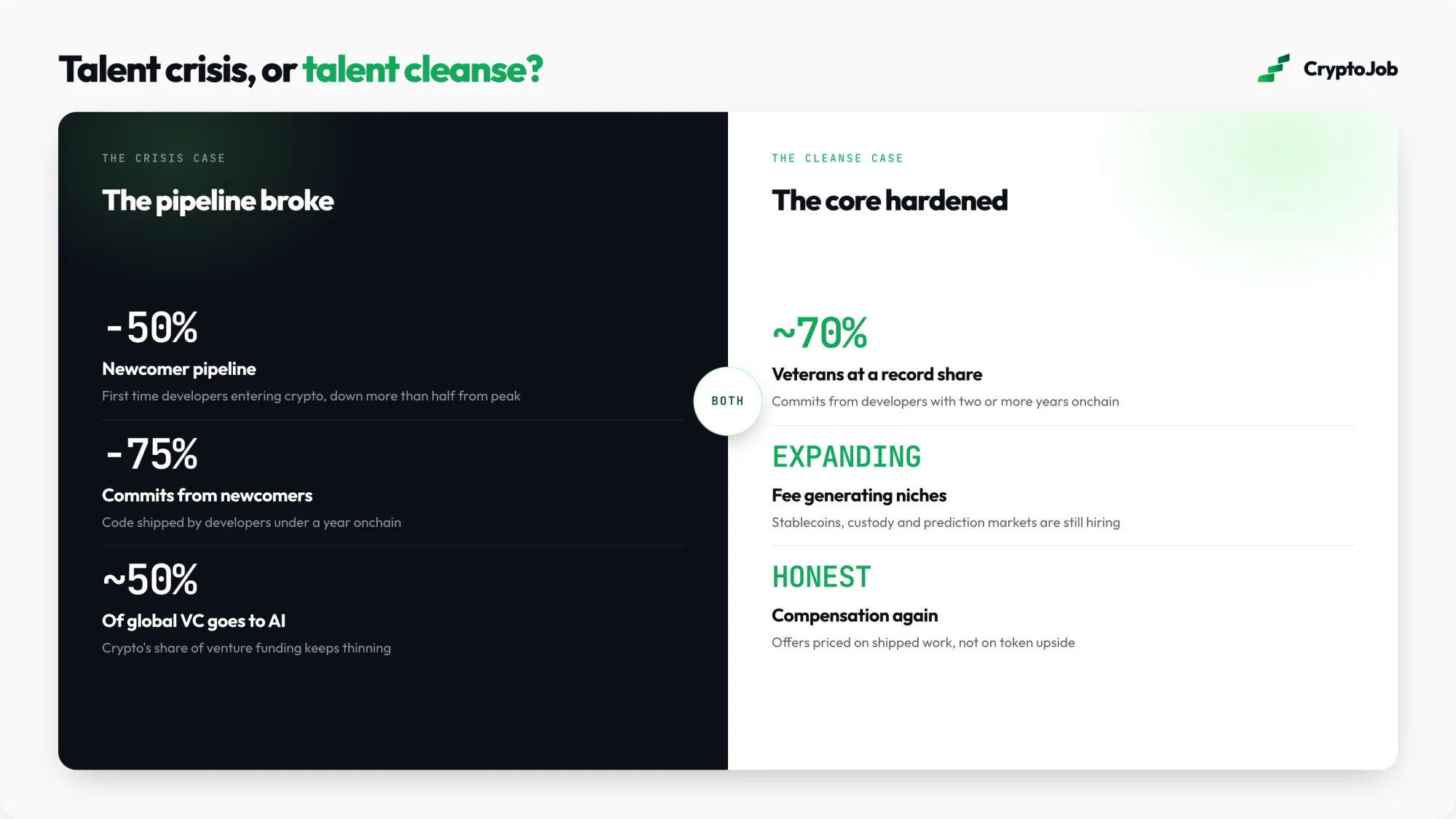
- Veterans stayed, newcomers under 1 year fell more than 50 percent
- Custody, stablecoins and prediction markets are pulling people back
The crypto talent exodus stopped being anecdote and became data in 2026: Electric Capital's tracking shows monthly active developers down from a 2022 peak above 30,000 to the low 20,000s, CoinDesk reported weekly code commits falling about 75 percent since early 2025 and a parade of senior names publicly switched domains. This piece maps where the people actually went and which corners of crypto are hiring them back.
The destinations matter more than the departure headlines, because they reveal which skills transferred and which niches now compete for returning talent. If you are weighing your own move in either direction, browse web3 jobs first to see what the staying market actually offers in 2026.
One finding upfront reframes everything: this was a newcomer exodus far more than a veteran one.

1. How big is the crypto talent exodus really?
Measured by developers, substantial: from a 2022 peak near 31,600 monthly active builders to roughly 21,300 by 2025, a decline of about a third, with estimates holding near the low 20,000s into 2026 depending on methodology. Commit activity fell even harder as part time contributors vanished, with code shipped by developers under a year onchain down roughly 75 percent.
Measured by composition, it inverts. Developers with two or more years of experience reached a record 12,600, growing about 27 percent year over year and now producing roughly 70 percent of all commits, while contributors under one year declined by more than half.
So the honest description is talent deleveraging: the speculative hiring wave of 2021 and 2022 washed out while the core compounded, so headcount shrank as average expertise rose.
2. Where did the leavers actually go?
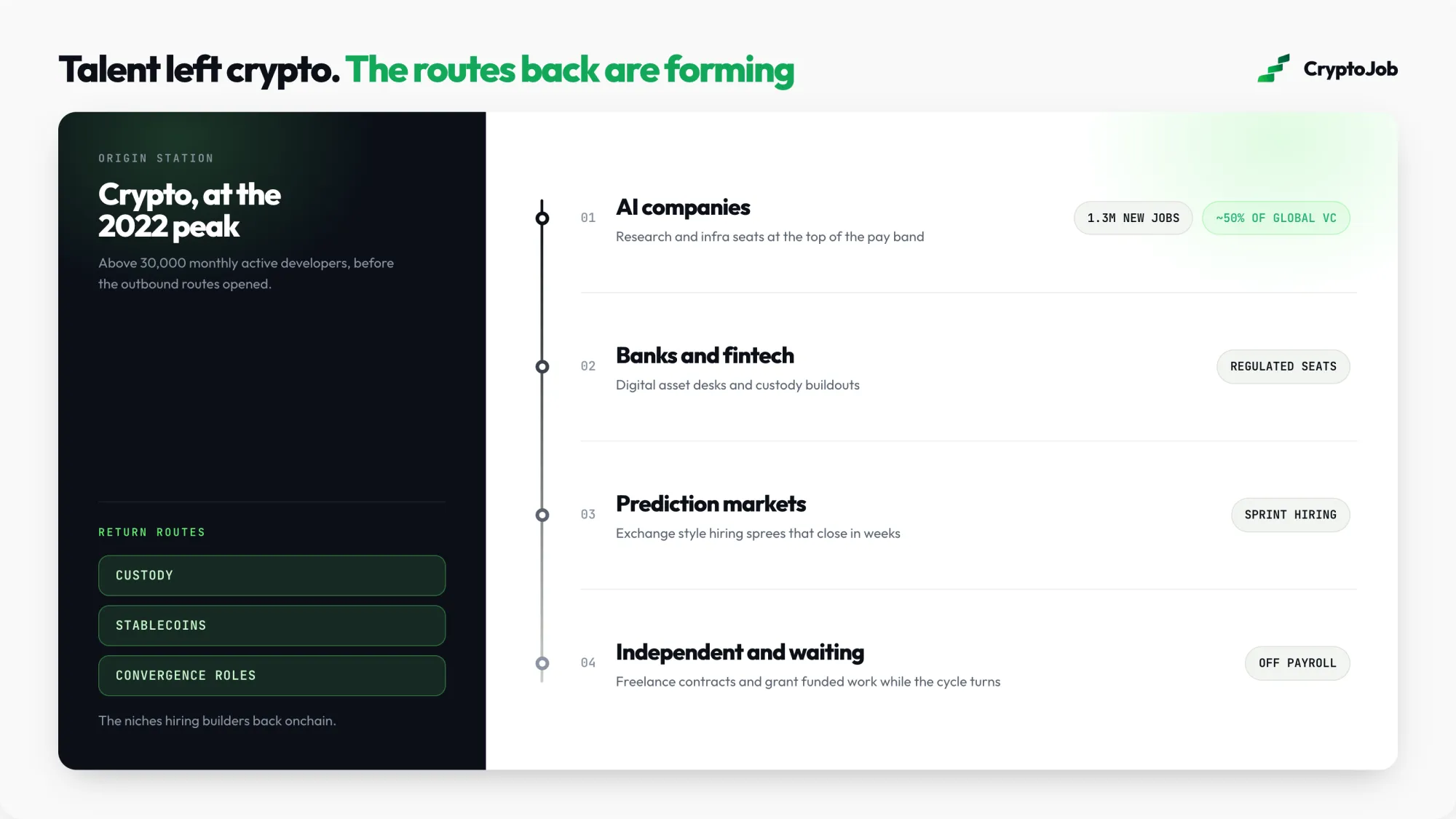
AI took the largest share by every available signal. LinkedIn documented 1.3 million new AI jobs created globally between 2023 and 2025, AI engineer roles grew thirteen times over and high profile moves made the pattern visible, from the creator of the Move language joining Anthropic in August 2026 to an OpenSea founder building a leading AI routing startup.
Recruiters describe the same gravity from their side, with crypto resumes now common in AI hiring pipelines and interviewers treating protocol experience as evidence of shipping under adversarial conditions.
Money explains the pull. AI captured $211 billion of 2025 venture funding per Crunchbase, roughly half of everything deployed, while crypto raised about $19.7 billion per PitchBook, and in the first half of 2026 two AI labs alone absorbed over 40 percent of a $510 billion global VC total.
The rest scattered across finance and fintech, where banks built digital asset desks, into prediction market startups staffing like exchanges and into independent work, with a meaningful group simply waiting out the cycle.
3. Who stayed, and why?
The accountable and the convinced. Compliance officers and infrastructure operators kept their seats because regulated, revenue producing crypto businesses never stopped needing them, and hiring reports through 2026 still rank legal and compliance among the hardest roles to fill.
Economically rational veterans stayed too. Established builders concentrated in ecosystems with real users and fee revenue, notably Bitcoin, Ethereum and Solana, where senior scarcity pushed compensation up even as junior doors closed.
And mission holders stayed on principle. The industry's core thesis around user owned systems did not weaken because funding rotated, and investors framing 2026 around sovereignty infrastructure kept capital flowing to conviction teams.
4. Which crypto niches are pulling talent back?
Prediction markets recruit loudest, with the leading platforms planning aggressive headcount growth and poaching from trading firms and exchanges at premium pay. Institutional custody follows, riding charters and more than $20 billion in tokenized fund assets.
Stablecoin and payments teams form the third magnet, since regulatory clarity turned them into the industry's steadiest business line, and our guide to stablecoin jobs tracks that hiring in detail.
The convergence layer completes the circle: agent payments and hybrid analyst roles let people hold both bets at once, covered in our AI and crypto jobs guide.
5. What does the exodus mean for compensation?
A barbell formed. Senior crypto specialists command more because fewer exist, while the junior oversupply from layoffs and career switchers keeps entry offers flat, mirroring the application pile ups documented across 2026.
AI set a new reference price. When labs pay research engineers multiples of crypto norms, crypto employers competing for overlapping skills, meaning Rust and applied cryptography, either raise offers or lose the argument, and several infrastructure teams quietly raised.
Token compensation lost its magic in the standoff. With fewer credible launches, candidates price offers on cash and equity first, completing a normalization the industry resisted for years.
6. How did previous cycles compare?
| Cycle moment | Developer trend | Where talent went | What pulled it back |
|---|---|---|---|
| 2018 to 2019 winter | Growth slowed, base held | Big tech and fintech | DeFi summer 2020 |
| 2022 crash | Grew 5 percent despite prices falling 70 percent | Mostly stayed | Institutional wave |
| 2025 to 2026 exodus | Total down, veterans at record high | AI above all | Custody, stablecoins, predictions so far |

The pattern across cycles is consistent: core builders persist, tourists rotate to whatever is hottest and each recovery has been led by a business line nobody staffed for in advance.
7. Is the exodus a crisis or a cleanse?
Both, honestly. Losing newcomer pipelines threatens the industry's future bench, university interest follows funding and a field producing 70 percent of its output from veterans is compounding expertise while aging its base.
Yet quality signals improved everywhere. Surviving teams ship with smaller headcount, security culture strengthened after painful incidents and the businesses left standing generate real fees rather than narrative.
For individuals the reading is simpler: scarcity is opportunity. Every veteran who left for AI made the remaining specialists more valuable, and every unfashionable niche that kept hiring became the contrarian bet. The layoff ledger behind all of it lives in our crypto layoffs 2026 breakdown.
8. What happened to the nontechnical talent?
Marketing, community and business development absorbed the deepest cuts because their headcount scaled with the 2021 boom fastest. When budgets contracted, entire growth teams disappeared in single announcements, and those professionals dispersed widest.
Their destinations skew consumer tech and fintech, where growth skills translate directly, plus the AI startup wave that needed exactly the community and content muscle crypto had trained. A meaningful group went independent, running fractional marketing for several protocols at once instead of one salary.
Geography shifted alongside the functions. US teams absorbed a disproportionate share of the cuts while hubs like Dubai, Singapore and parts of Europe kept hiring under clearer rules, so part of the exodus was really a relocation of where crypto work happens.
The return path for this group runs through the regulated niches too. Stablecoin firms and custodians both market to institutions and mainstream users now, and they are hiring the storytellers who can do it credibly.
9. What would actually reverse the exodus?
A new business line with real revenue, if history repeats. DeFi summer recalled the 2019 leavers and the institutional wave recalled the 2022 doubters, so watch the current candidates: agent payments and tokenized funds.
Distribution events matter psychologically. Major token launches and the crypto IPO pipeline through 2026 put wealth creation stories back in circulation, and nothing recruits like a former colleague's liquidity event.
Talent follows tooling as well. As AI assistants shrink team sizes needed to ship, small crypto teams can attempt what once took fifty people, which quietly lowers the barrier for veterans to return as founders rather than employees.
10. What should you do with this information?
If you left, keep the door ajar: your crypto specific knowledge appreciates while you are gone, and the returning routes through custody, payments and convergence roles pay for it. If you stayed, name your scarcity explicitly in negotiations, because employers now know exactly what replacing you costs.
If you are entering now, you face less glamour and less competition simultaneously, the classic contrarian setup. Pick a fee generating niche, then build proof in public and browse web3 jobs for the teams hiring against the tide.

FAQ
Did crypto really lose half its developers?
Total monthly active developers fell substantially from the 2022 peak, with some methodologies showing declines near half. The drop concentrated among contributors with under one year of experience, while veteran builders hit record highs.
Is everyone leaving crypto for AI?
No, but AI is the single largest destination by funding and job creation, and several prominent builders made the switch publicly. Regulated crypto niches kept hiring throughout.
Will the talent come back?
History says yes, tied to a new business line rather than prices alone. Custody, stablecoin payments and prediction markets are already re recruiting experienced operators in 2026.
Does the exodus make it easier or harder to get hired?
Easier at the senior and specialist level, where scarcity grew, and unchanged to harder at the junior level, where laid off talent and career switchers still crowd popular openings.