Crypto vs AI Careers in 2026: The Talent War Nobody's Winning
AI pays more at the top, crypto pays faster at the edges. A straight comparison of the two hottest career tracks in tech.

TL;DR
- Crypto vs AI careers in 2026: AI wins on openings and top pay
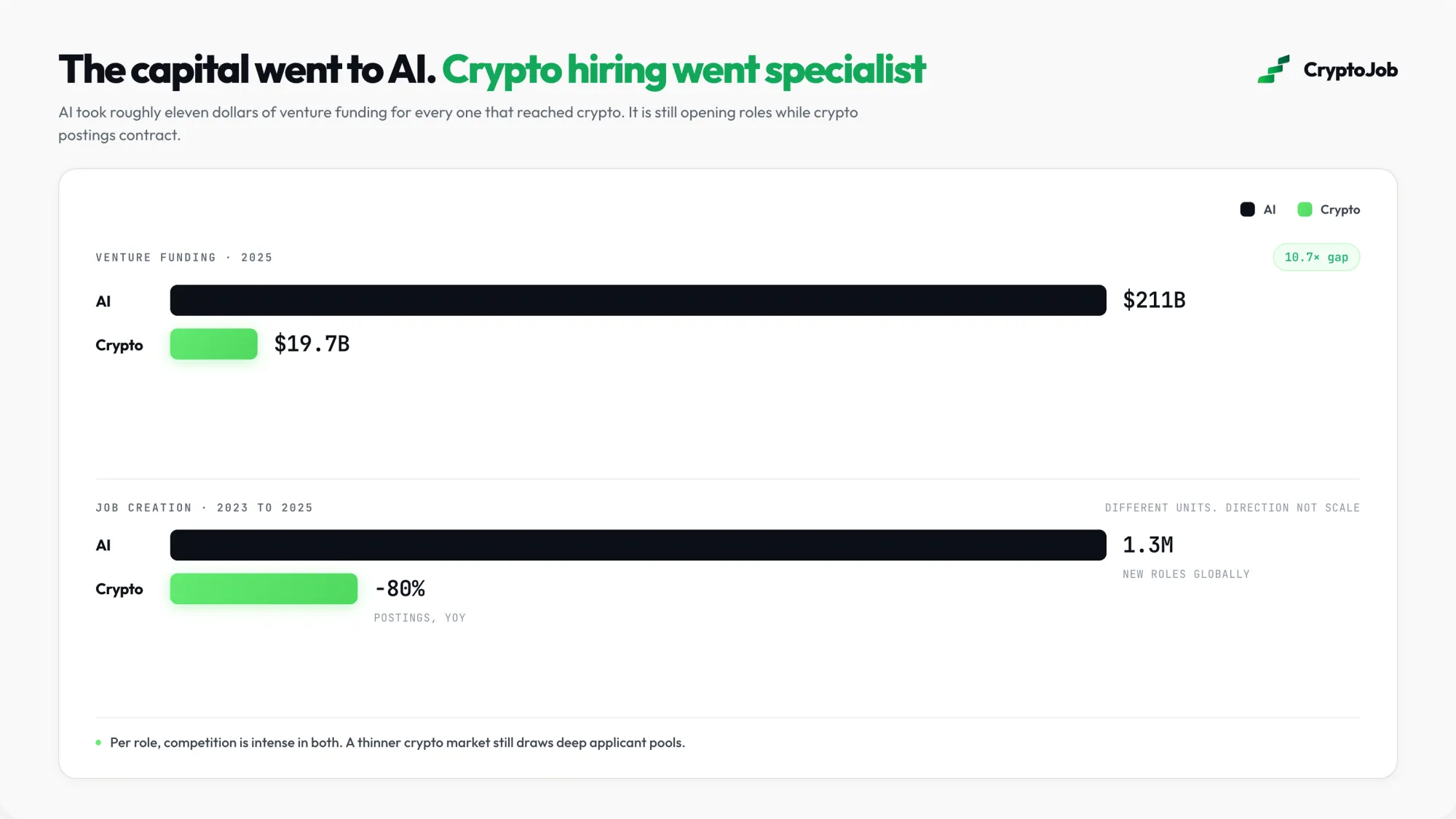
- AI drew $211B in 2025 funding, crypto about $19.7B
- Crypto wins on entry speed and specialist scarcity
- Convergence roles bridging both markets hedge the entire bet
Comparing crypto vs AI careers in 2026 produces an uncomfortable scoreboard: AI captured $211 billion in venture funding in 2025 against crypto's roughly $19.7 billion per PitchBook, generated 1.3 million new jobs globally per LinkedIn and pays its top researchers multiples of crypto norms. Yet crypto still wins specific fights, from entry speed to remote flexibility to specialist scarcity. This piece compares the two honestly, factor by factor, and shows where the smartest careers refuse to choose.
Both markets share skill DNA, from distributed systems to Rust to applied math, which is why the comparison matters even after you pick. Check the crypto side of the ledger anytime by taking a minute to browse web3 jobs and reading what current listings actually demand.
Neither track is a safe default anymore, so the useful question is which risks fit you.
1. Which pays more, crypto or AI?
At the peak, AI without contest. Research engineers and scientists at the leading labs command packages crypto rarely matches, and the funding gap, with two labs alone taking over 40 percent of the $510 billion global VC total in the first half of 2026, sustains those numbers.
At the median, closer than people assume. Senior crypto engineers typically earn $150K to $250K, with security and ZK specialists above that. Scarce compliance and institutional roles rose through 2026, while the AI market's median settled as bootcamp supply arrived.
At the specialist edge, crypto sometimes wins. When a custody firm, exchange or prediction market needs someone who genuinely understands both keys and regulation, they bid against a tiny pool, and scarcity beats sector averages every time. Our highest paying web3 jobs guide maps those pockets.
One number worth holding onto when you compare the two markets: the funding gap ran roughly eleven to one in 2025. That ratio explains the pay ceiling on the AI side far better than any single job posting does.
2. Which has more open jobs in 2026?
AI, by an order of magnitude. LinkedIn's tracking shows AI engineer roles growing thirteen times over recent years and forward deployed engineering exploding, while crypto postings fell roughly 80 percent year over year into early 2026.
But raw counts mislead on odds. Popular AI roles now drown in applicants just as famous crypto roles collect up to 450 applications, and hiring managers in both markets report the same pattern: floods at the brands, droughts in the specialties.
Openings also differ in shape. AI hiring concentrates in a handful of labs and a startup wave, while crypto hiring spreads thinner across exchanges, infrastructure, regulated finance and global startups, which changes what a search actually feels like.
3. Which career is more stable?
Neither, in the way people hope. Crypto cycles are famous, with layoff waves tracking prices, while AI carries its own correction risk after historic capital concentration, and 2026 already delivered high profile burn rate anxieties across the startup layer.
Within each field, stability lives in the same place: regulated, revenue attached functions. Crypto compliance, custody and exchange infrastructure kept hiring through the worst of the downturn, exactly as enterprise AI deployment roles look sturdier than research moonshots.
Judged as employers of record, mature crypto companies now resemble fintech, with public listings and audited revenue, while much of AI remains pre revenue at extraordinary valuations. Stability is a role property more than a sector property.
4. Which is easier to break into?
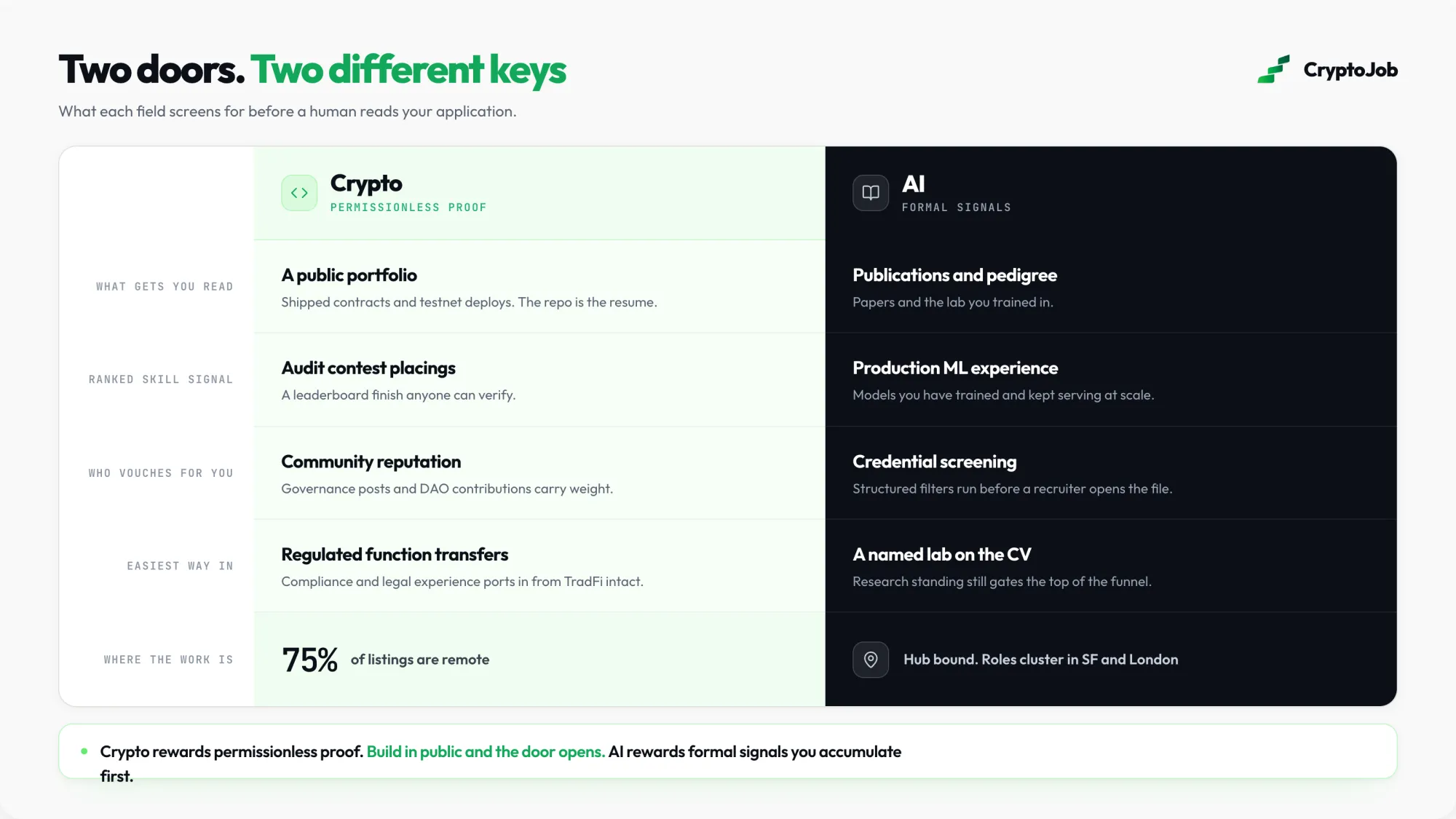
Crypto, clearly, and it is not close. Permissionless proof still works: shipped contracts, audit contest placements, public analysis and community reputation convert outsiders into hires without credentials, a door AI mostly lacks.
AI entry increasingly demands formal signals. Research roles filter on publications and pedigree, engineering roles on production ML experience, and the credential arms race intensified as applicant floods arrived.
The asymmetry compounds for career switchers: a finance, legal or operations professional can enter crypto through the regulated lane in months, while equivalent AI entry points remain scarce outside sales and operations at the biggest firms. The transferable route is mapped in our guide on moving from big tech to crypto.
5. How do the two careers compare factor by factor?
| Factor | Crypto in 2026 | AI in 2026 |
|---|---|---|
| Top end pay | $250K to $500K specialists | Lab packages far higher |
| Openings volume | Down about 80 percent from peak | 1.3M new roles created |
| Entry without credentials | Strong via public proof | Weak outside operations |
| Remote flexibility | About 75 percent of listings | Hub concentrated |
| Cycle risk | Proven and survivable | Untested correction ahead |
| Skill overlap | Rust, distributed systems, security and applied math transfer both ways | |
6. What are the convergence roles that refuse to choose?
Agent infrastructure leads the category: wallets, payment rails, identity and spending limits for autonomous AI agents, which investors including Electric Capital framed as a defining 2026 opportunity while legal frameworks race to catch up.
Inside companies, hybrid demand is explicit. Exchanges and institutions increasingly hire people who understand both onchain incentives and model behavior, per 2026 hiring commentary, spanning AI risk analysts and data engineers feeding models with onchain data.
These roles hedge the macro bet elegantly: if AI booms, agents need payment rails, and if crypto rallies, AI tooling makes its teams faster. The full landscape lives in our AI and crypto jobs guide.
7. How should you actually decide?
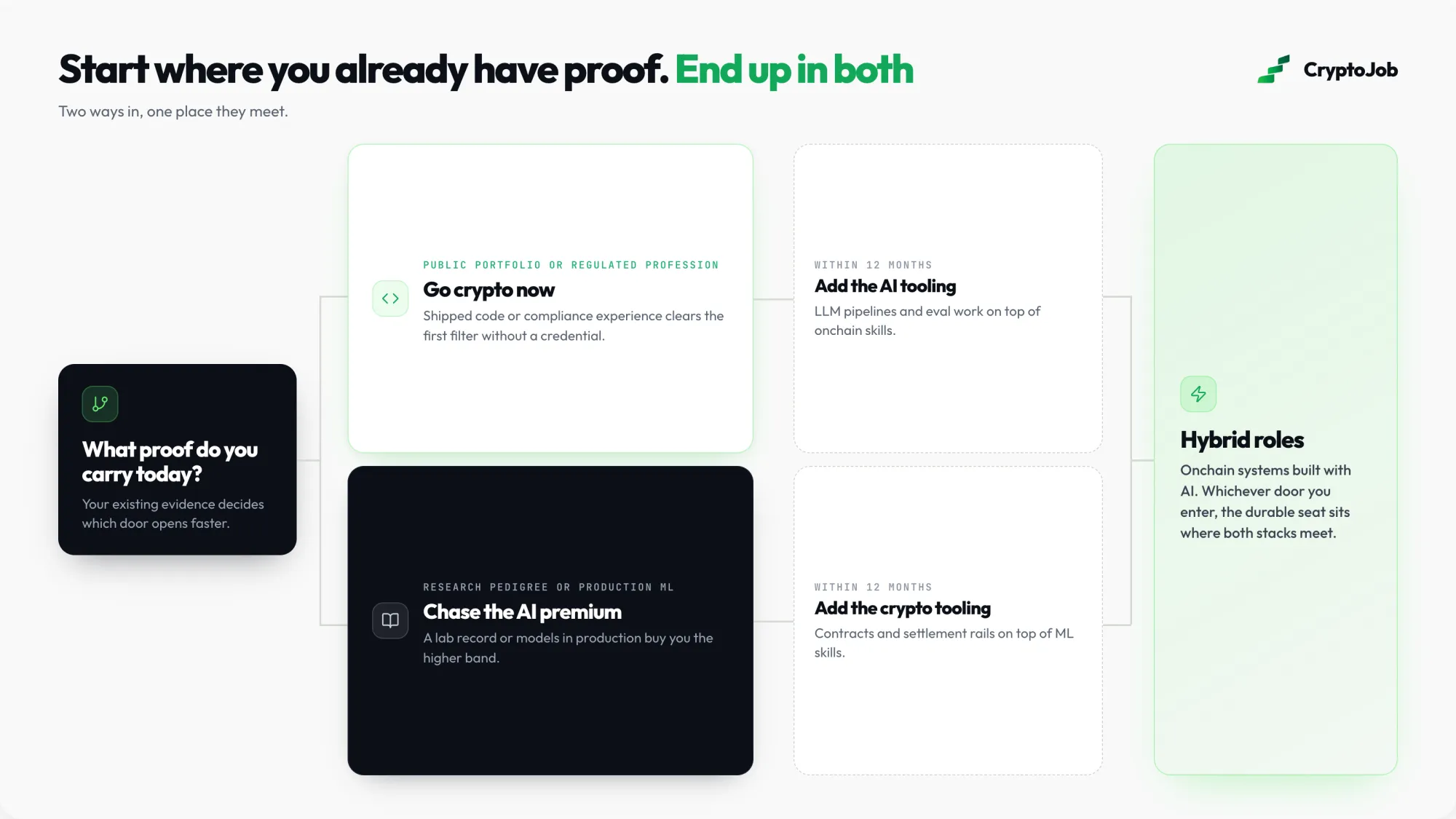
Decide on entry mechanics first. If you can win through public proof and want remote work now, crypto's door is simply more open, while a research pedigree or production ML background argues for cashing it in AI while premiums last.
Decide on risk appetite second. Crypto's volatility is known and priced, AI's correction is hypothetical and unpriced, and your tolerance for each differs from your neighbor's.
Then refuse purity. Learn AI tooling inside a crypto role or bring crypto payments knowledge into an AI team, because the overlap skills appreciate under every scenario and the people holding both vocabularies are the scarcest hires in either market.
8. What do the hybrid roles actually pay?
A premium over their single field equivalents, because two vocabularies in one head is rare. Engineers building agent payment infrastructure or onchain data pipelines for models commonly price 10 to 25 percent above comparable pure crypto roles, and hybrid analyst and risk seats at exchanges post similar spreads.
The premium is scarcity math, not magic. When a listing requires production experience with both wallets and model behavior, the qualified pool collapses to a handful of people, and small pools set their own prices.
Expect the spread to persist for years. Both fields are growing their overlap faster than universities or bootcamps can supply it, which is precisely the window individual career moves exploit.
9. How do you become bilingual within twelve months?
From the crypto side, ship one AI integration this quarter: an agent that reads onchain data or a model assisted audit workflow inside your current role. Write about what broke, because the debugging story is the credential.
From the AI side, transact for a month before touching a job listing. Run a wallet, use two DeFi protocols, follow one regulatory thread and then build a small tool that connects a model to a chain, which teaches the constraints no course covers.
Either direction, spend the second half of the year in public: one open repo and one contribution to a convergence project. Twelve months of visible overlap work puts you in that tiny qualified pool while both markets are still bidding.
10. What is the verdict nobody wants to hear?
The talent war has no winner because the fronts keep merging. AI is absorbing crypto's builders while depending on crypto's rails for its agent future, and crypto is losing headcount while gaining the leverage of every AI tool its remaining teams adopt.
So position at the seam. Pick the field whose entry door you can actually open this quarter, then spend a year becoming bilingual so the convergence pays you from both directions. The crypto side of that plan starts when you browse web3 jobs and shortlist the teams already hiring for hybrid skills.
FAQ
Should I switch from crypto to AI in 2026?
Only with an entry advantage such as ML experience or research credentials, since AI's popular roles now flood with applicants too. Otherwise, adding AI fluency inside a crypto role captures much of the upside at none of the switching cost.
Do AI jobs really pay more than crypto jobs?
At the elite research tier, substantially. Across typical engineering and specialist roles the gap narrows, and scarce crypto functions like security and ZK held or raised pay through 2026.
Which is better for someone with no experience?
Crypto, because public proof substitutes for credentials and remote entry roles exist. AI entry without formal signals concentrates in operations and sales seats at a handful of companies.
What skills work in both crypto and AI?
Rust and systems programming, distributed infrastructure, security engineering, data pipelines and applied math transfer cleanly, and professionals holding them can genuinely arbitrage between the two markets.