Crypto Jobs at PayPal, Stripe and Robinhood: The Fintech Route Into Web3
Stablecoins, tokenized stocks and a new blockchain. Why the fintech giants became real crypto employers and how to join them.

TL;DR
- Fintech crypto jobs exploded as PayPal, Stripe and Robinhood built real teams
- PYUSD grew 600 percent to $3.6B in circulation during 2025
- Stripe is launching Tempo, its own layer 1, after the $1.1B Bridge deal
- These roles pay fintech scale salaries with public company stability
Fintech crypto jobs became a serious career category the year the giants stopped experimenting: PayPal's PYUSD stablecoin grew 600 percent to $3.6 billion in circulation during 2025 per DefiLlama, Stripe bought Bridge for $1.1 billion and is launching its own Tempo blockchain and Robinhood shipped tokenized stocks across Europe alongside its own chain. This guide covers what each giant is building, which roles they hire and why the fintech route into web3 might be the smartest one available.
The pitch is unusual in crypto: frontier products with public company pay and stability. Compare these openings against crypto native alternatives anytime when you browse web3 jobs.
And the timing is loud, with one industry executive telling DL News that 2026 is going to be massive for exactly this corner of the market.
1. Why did fintech giants become real crypto employers?
Stablecoin legislation removed the excuse. Once US federal rules landed, payments companies could build on public rails without regulatory vertigo, and every major player moved from pilots to product lines within quarters.
The economics finally demanded it. Stablecoins settle around the clock at low cost and agent driven commerce needs programmable money, so the giants are defending their core businesses by absorbing crypto rather than watching it.
The talent implication is direct: these companies are hiring blockchain engineers, product managers, counsel and compliance leads at fintech scale, often faster than crypto native firms in the same quarters.
2. What is happening inside each giant right now?
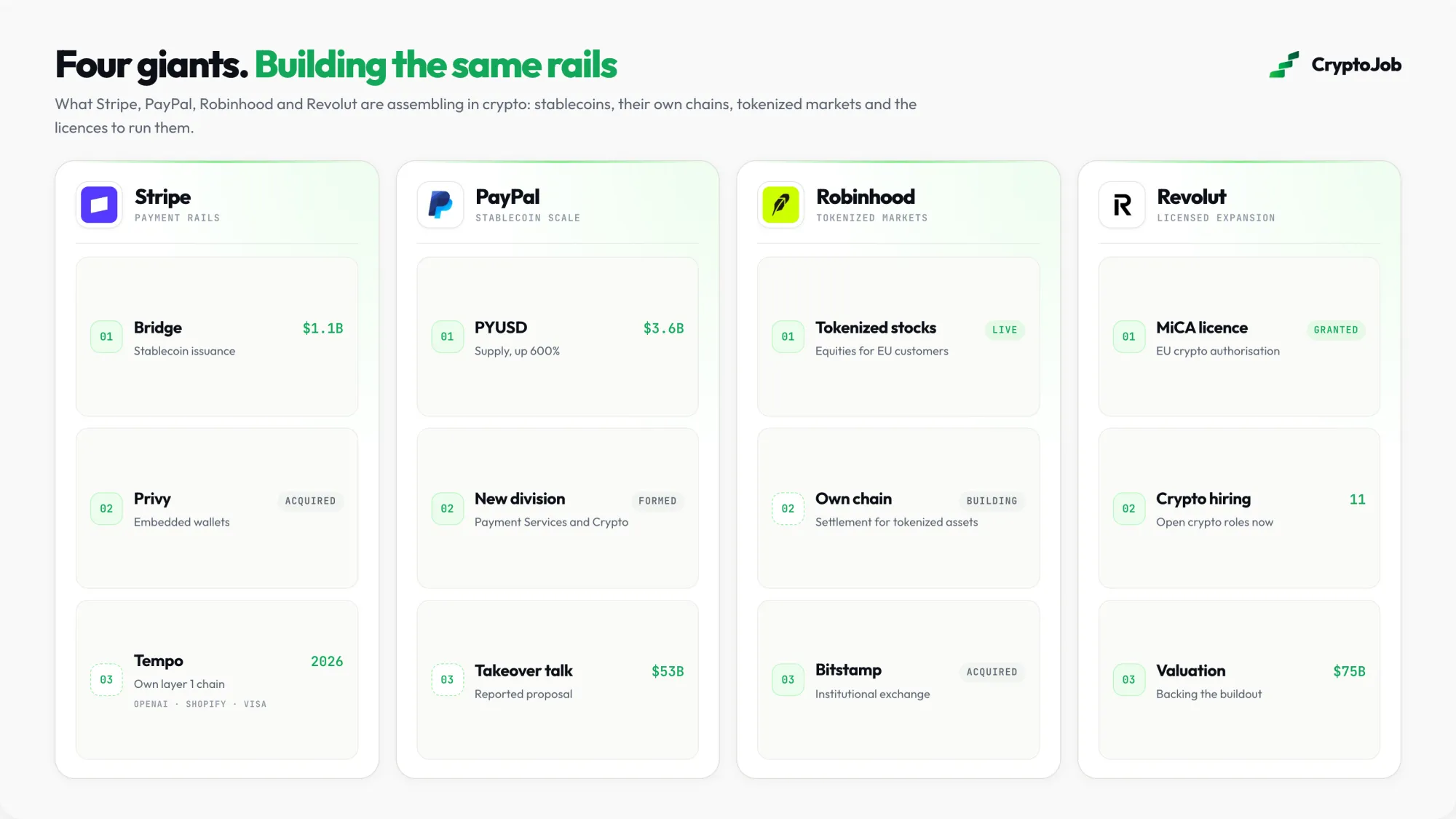
Stripe assembled the most aggressive stack: the $1.1 billion Bridge acquisition for stablecoin orchestration, the Privy wallet deal and Tempo, a payments focused layer 1 built with Paradigm that ran a public testnet in December with mainnet expected during 2026. Design partners have included OpenAI, Shopify and Visa, and an advisory unit launched in April 2026 to push stablecoin adoption.
PayPal doubled down on PYUSD and reorganized around it, unifying processing and crypto into a single Payment Services and Crypto division per its own filings. The stablecoin's 600 percent growth made it a top ten player, and a reported $53 billion acquisition proposal from Stripe and Advent in mid 2026 put the whole picture in play, though nothing had closed as of this writing.
Robinhood turned crypto into a growth engine: tokenized shares across Europe, its own Arbitrum based chain in development, the Bitstamp exchange acquisition and event contracts. Revolut belongs in the same sentence, running 11 open crypto roles from investigators to product marketers after securing its MiCA license at a $75 billion valuation.
3. Which crypto roles do these companies hire?
Engineering leads the volume: blockchain and protocol engineers for Tempo and Robinhood's chain, integration engineers wiring stablecoins through existing rails and infrastructure teams running nodes inside corporate environments. These postings often ask for EVM experience plus large scale payments systems, a rare combination that favors career switchers from either side.
Product and compliance form the second wave. Every stablecoin flow needs product managers who understand both checkout and chains, counsel fluent in the new federal rules, licensing teams for each market entered and reserve reporting owners, which is why PayPal and peers appear constantly in digital asset counsel listings.
Partnerships and risk round it out, from merchant adoption teams for stablecoin payments to fraud specialists who understand onchain investigation. The stablecoin specific landscape is mapped in our stablecoin jobs guide.
One detail worth checking before you apply: the crypto unit's reporting line. Teams that report into payments leadership tend to ship on the core roadmap, while teams parked under innovation budgets move faster and get reorganized more often.
4. What do fintech crypto jobs pay?
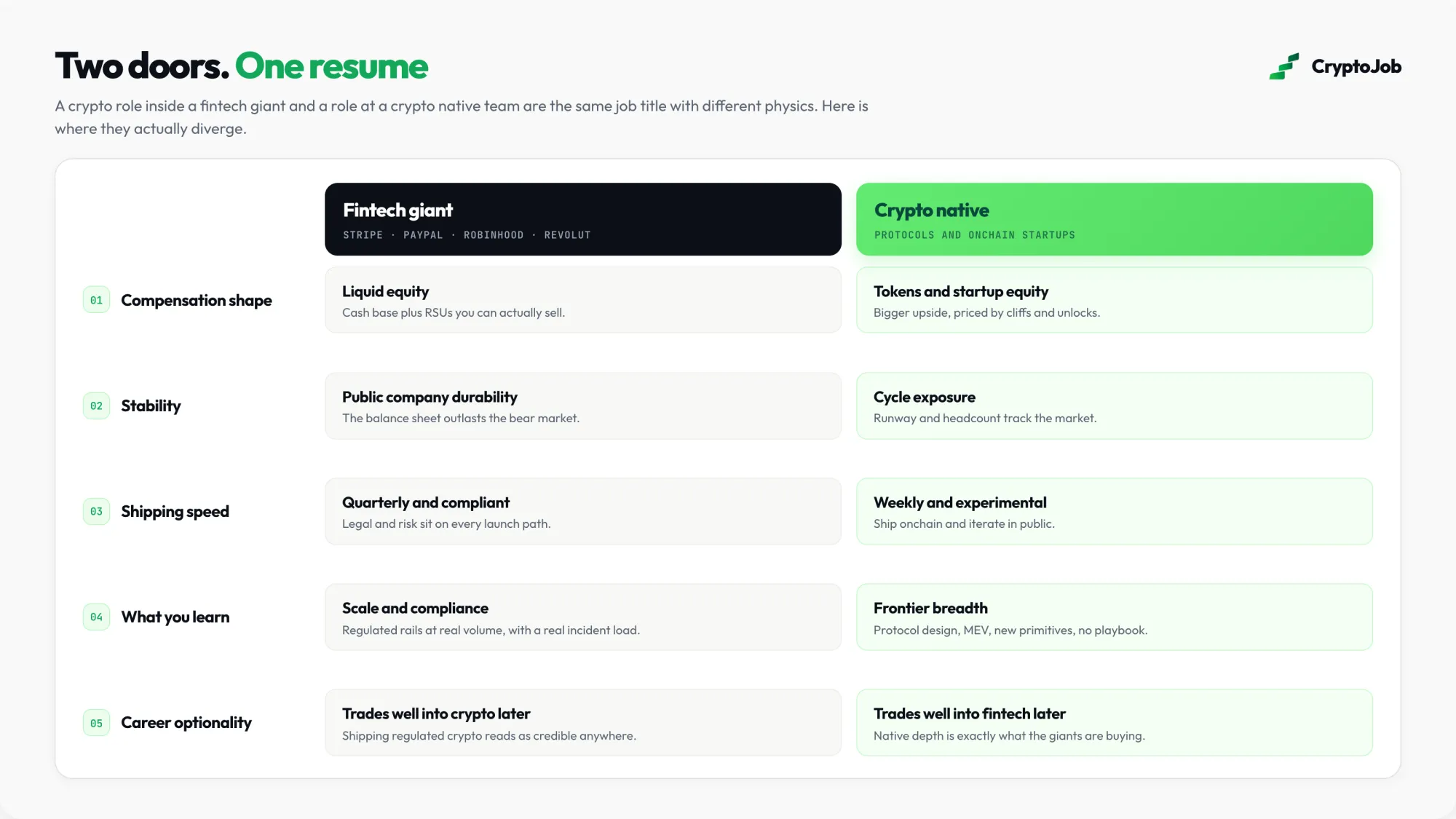
Fintech scale, which is the point. Senior engineers at these companies typically land $180K to $280K base plus equity in the US, product managers $160K to $240K, counsel $200K to $350K and compliance leads $150K to $250K, varying by level and location as always.
The equity is liquid or near it: public stock at PayPal and Robinhood, late stage shares at Stripe and Revolut. That single difference removes the valuation roulette that defines crypto native offers.
The tradeoff is honest too. No token upside and a slower shipping culture than startups, with crypto teams living inside larger corporate priorities, which occasionally reorganize around them.
5. How does the fintech route compare with crypto native jobs?
Stability versus upside is the core trade. The giants offer brand and durable employment, while crypto native firms offer speed and the small chance of a defining token or IPO event.
Skill building differs subtly: fintech crypto teams teach you to ship compliant products at massive scale, crypto native teams teach you the frontier faster. Both credentials trade well, in opposite directions.
Many careers now sequence them deliberately, entering through a giant for the resume line and stability, then arbitraging into crypto native seniority or the reverse when a startup exit lands. The transition mechanics mirror our guide on moving from big tech to crypto.
6. How do you get hired at a fintech giant's crypto team?
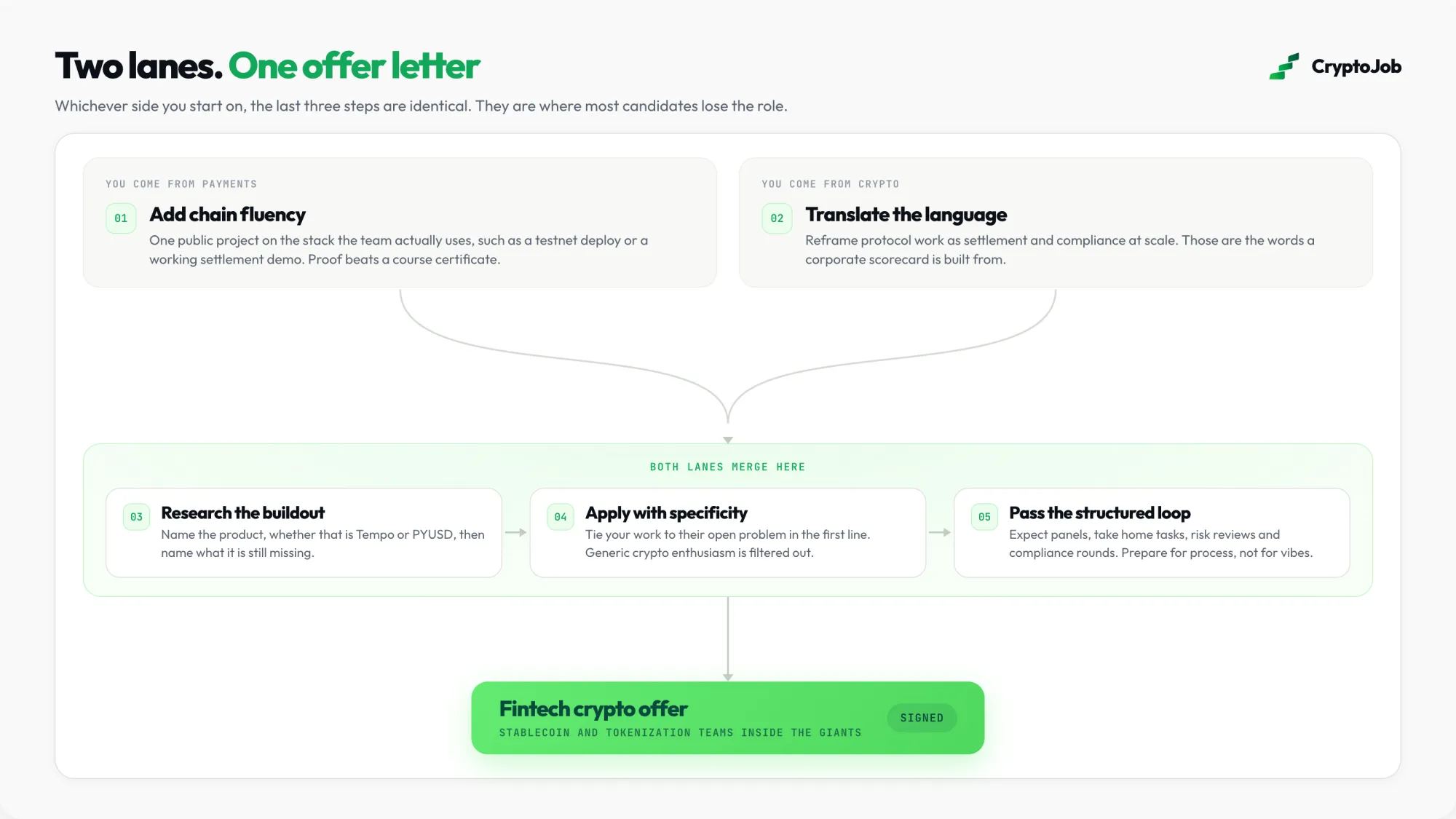
Lead with whichever half you already own. Payments engineers should demonstrate chain fluency through a small public project on the relevant stack, while crypto natives should translate their work into payments language: settlement, disputes, compliance and uptime.
Study the specific buildout before applying. Referencing Tempo's design constraints, PYUSD's distribution strategy or Robinhood's tokenization mechanics signals seriousness that generic crypto enthusiasm never does, and these teams are small enough that specificity reaches decision makers.
Expect structured processes: recruiter screen, domain deep dives, system design or case rounds and cross functional panels. These are classic corporate loops with crypto content, so standard interview discipline applies alongside the domain prep.
7. How do the four giants compare as crypto employers?
| Company | Crypto center of gravity | 2026 hiring lean | Watch item |
|---|---|---|---|
| Stripe | Bridge plus the Tempo chain | Protocol, infra, stablecoin product | Tempo mainnet timing |
| PayPal | PYUSD and payments integration | Product, counsel, compliance | The reported acquisition outcome |
| Robinhood | Tokenized assets and its chain | Engineering, brokerage crossover | EU tokenization expansion |
| Revolut | MiCA licensed exchange growth | Investigators, marketing, product | Team expansion pace |
Preparation timelines run longer than crypto startups too, with multi week processes and structured panels the norm, so run these applications in parallel with faster moving options rather than sequentially.
8. What risks should candidates price in?
Strategy can reorganize above you. The reported PayPal acquisition saga shows how quickly ownership questions can reshape a crypto division, and private equity involvement historically optimizes cash flow over experiments.
Crypto teams inside giants also compete internally for resources, so ask in interviews who sponsors the unit at the executive level and what shipped in the last two quarters. Concrete answers exist at all four companies right now, which is itself the reassuring signal.
Finally, expect your crypto instincts to meet process. People who need weekly mainnet deploys to feel alive should weight the crypto native column more heavily.
9. Which adjacent employers ride the same wave?
Block sits closest, building bitcoin products across its ecosystem and even appearing as a reported equity contributor in the PayPal bid saga, while Visa and Mastercard run digital asset teams that show up constantly in counsel and product listings.
Banks form the institutional flank, standing up custody and tokenization desks under fresh charters, and they hire the same blend of payments professionals with chain fluency, mapped in our guide to digital asset jobs at banks.
Then come the infrastructure vendors the giants build on: stablecoin orchestration platforms and compliance tooling firms, all of which expand headcount every time a fintech announces a crypto product.
The career implication is a genuine ecosystem rather than three companies: skills proven at any node trade across all of them, which makes the fintech crypto lane deeper than its headlines suggest.
10. Is the fintech route right for you?
If you want crypto's frontier with a salary your family understands, yes. These teams are shipping the products most likely to onboard the next billion users, and they pay properly while doing it.
Pick the giant whose buildout matches your skills, produce one specific artifact against it and browse web3 jobs to line up crypto native alternatives so you negotiate from choice.
FAQ
Do PayPal, Stripe and Robinhood pay in crypto?
No, compensation is standard fiat salary plus equity. The crypto is the product, not the paycheck, which many candidates count as a feature.
Do I need crypto experience for these roles?
Not always. Engineering and product roles frequently hire strong payments people and teach the chain layer, though a small public crypto project accelerates every conversation.
Are fintech crypto jobs safer than exchange jobs?
Generally yes on employment durability, since diversified public companies absorb crypto winters better. The tradeoff is strategy risk, where reorganizations can reshape or shrink crypto teams.
Which giant is hiring crypto roles fastest in 2026?
Stripe's Tempo buildout and Robinhood's tokenization push show the most engineering velocity, while PayPal leans product and counsel and Revolut lists the broadest mix of open crypto roles.