How to Hire a Solidity Developer Without Getting Burned
Solidity code cannot be patched after deployment. Here is how to assess candidates properly, what to budget and the mistakes that cost teams money.

TL;DR
- Hire a Solidity developer on shipped code, not interviews.
- Budget $100K to $250K base; senior DeFi engineers clear $200K.
- "Blockchain developer" describes two wildly different hires.
- Never let the same person write and audit the contracts.
Hiring a Solidity developer is unusually high stakes because the output cannot be patched. Ship a bug to a public chain and it is immutable, reachable by anyone and sitting next to your users' money.
The good news is that this is one of the easiest engineering disciplines to assess honestly, because the work is public. The bad news is that most teams assess it the way they assess web2 hires, and that does not work.
Budget expectations first: Solidity developers command $100,000 to $250,000 base, with the median near $150,000. Senior engineers at established DeFi protocols clear $200,000 before any token component. If you want to see live market rates, browse web3 jobs.
1. What kind of Solidity developer do you actually need?
Start here, because the single most expensive hiring mistake is treating one job title as one job.
One resume reading "blockchain developer" belongs to someone who connected a wallet interface to an existing chain. The next belongs to an engineer holding hundreds of millions in locked value inside code that cannot be amended after deployment.
Same two words. Completely different hire, completely different price.
| If you need | Look for | Rough band |
|---|---|---|
| dApp integration, wallet flows | Strong frontend plus ethers/viem fluency | $100K to $150K |
| Standard contracts, tokens, NFTs | Solid Solidity, testing discipline | $130K to $180K |
| Novel DeFi mechanisms | Protocol design, economic reasoning | $180K to $250K+ |
| Code holding significant value | Security first engineer with audit exposure | $200K+ and worth it |
Write down which row you are hiring for before you open the search. Teams that skip this step reliably interview candidates from all four rows and cannot explain why the process feels incoherent.
2. How do you assess a Solidity developer properly?
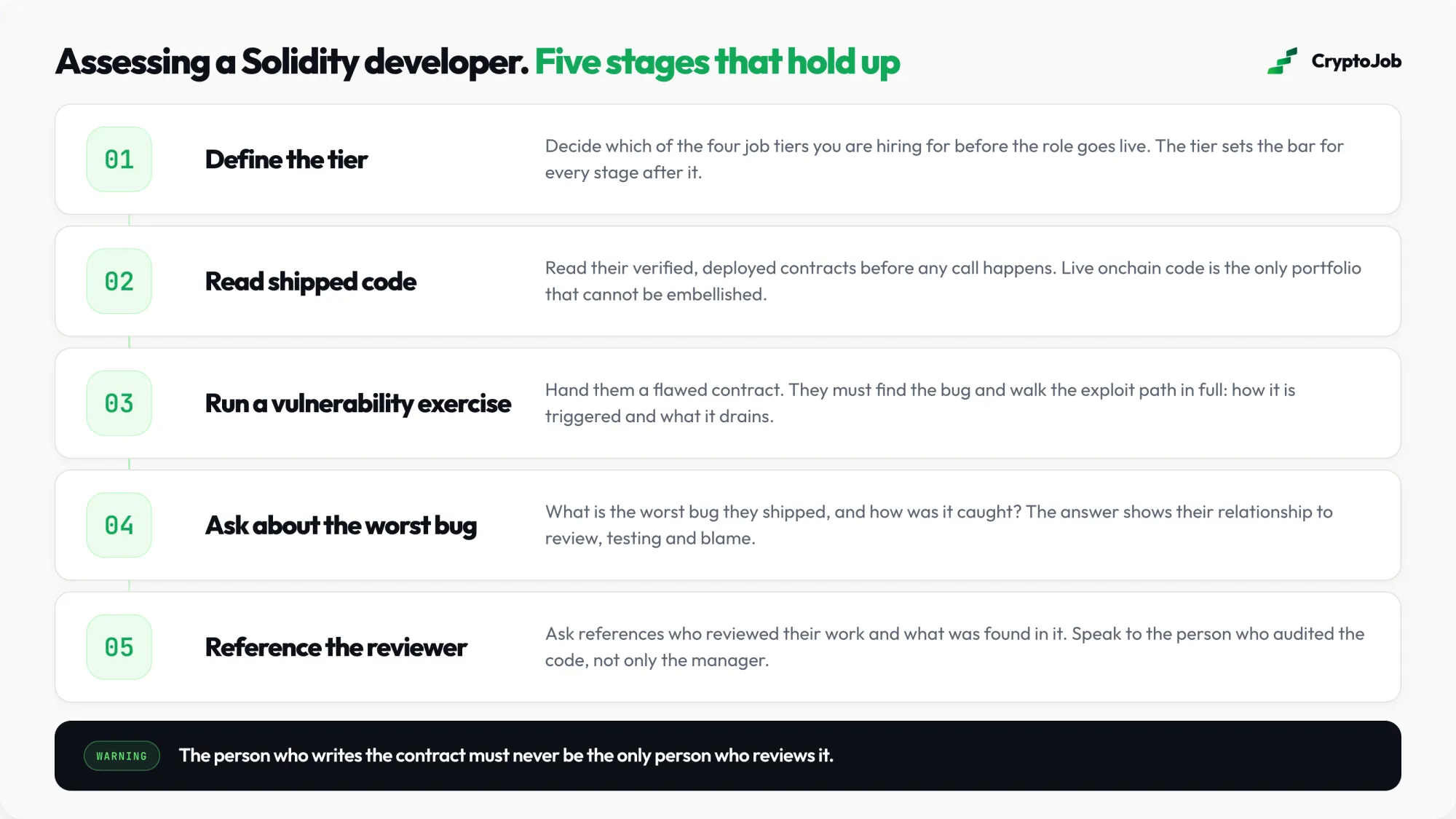
2.1 Read their deployed code first
Verified contracts on a block explorer are public. Before any interview, read something they have shipped and form your own view.
You are looking for defensive habits: access control, checks, effects and interactions ordering, sensible use of established libraries rather than reinventing them. Clean, boring code is the signal you want.
2.2 Ask about failures, specifically
Ask what the worst bug they ever shipped was and how it was caught. A candidate with real production experience has an answer and is not defensive about it.
Someone who has never shipped anything they regret has either not shipped much or is not being straight with you.
2.3 Test in a way that matches the job
Whiteboard algorithm puzzles tell you almost nothing about Solidity ability. Give a small, realistic exercise instead: here is a contract, find what is wrong with it and explain the exploit path.
That single exercise reveals security instinct, code comprehension and communication in about forty minutes.
3. Where do you find Solidity developers?
The strongest candidates are rarely applying through job boards, because they do not need to.
Public audit contest leaderboards are an underused source. People who place well in competitive audits can read adversarial code, which is exactly the instinct you want even in a build role.
Open source protocol contributors are another. Look at who is merging meaningful pull requests into projects adjacent to yours, not just who has the most stars.
Conference and hackathon output surfaces people early in their careers who are worth catching before the market prices them properly.
4. What should you pay, and how should you structure it?
Base bands are covered above. The structure question is where teams lose candidates they could have afforded.
Token grants typically add 30% to 100% on top of base at protocols. Standard structure is a four year vest with a one year cliff, plus a six to twelve month lockup after any token generation event.
Two warnings. First, the era of paying mostly in tokens is over, experienced candidates discount token components heavily and a package that looks generous will lose to a competitor offering more cash.
Second, budget for a signing bonus if you are recruiting from big tech. Candidates walking away from unvested equity need that offset, and it is frequently the deciding factor rather than base salary. Ranges run $10,000 to $100,000.
5. What are the most expensive hiring mistakes?
5.1 Economising on security
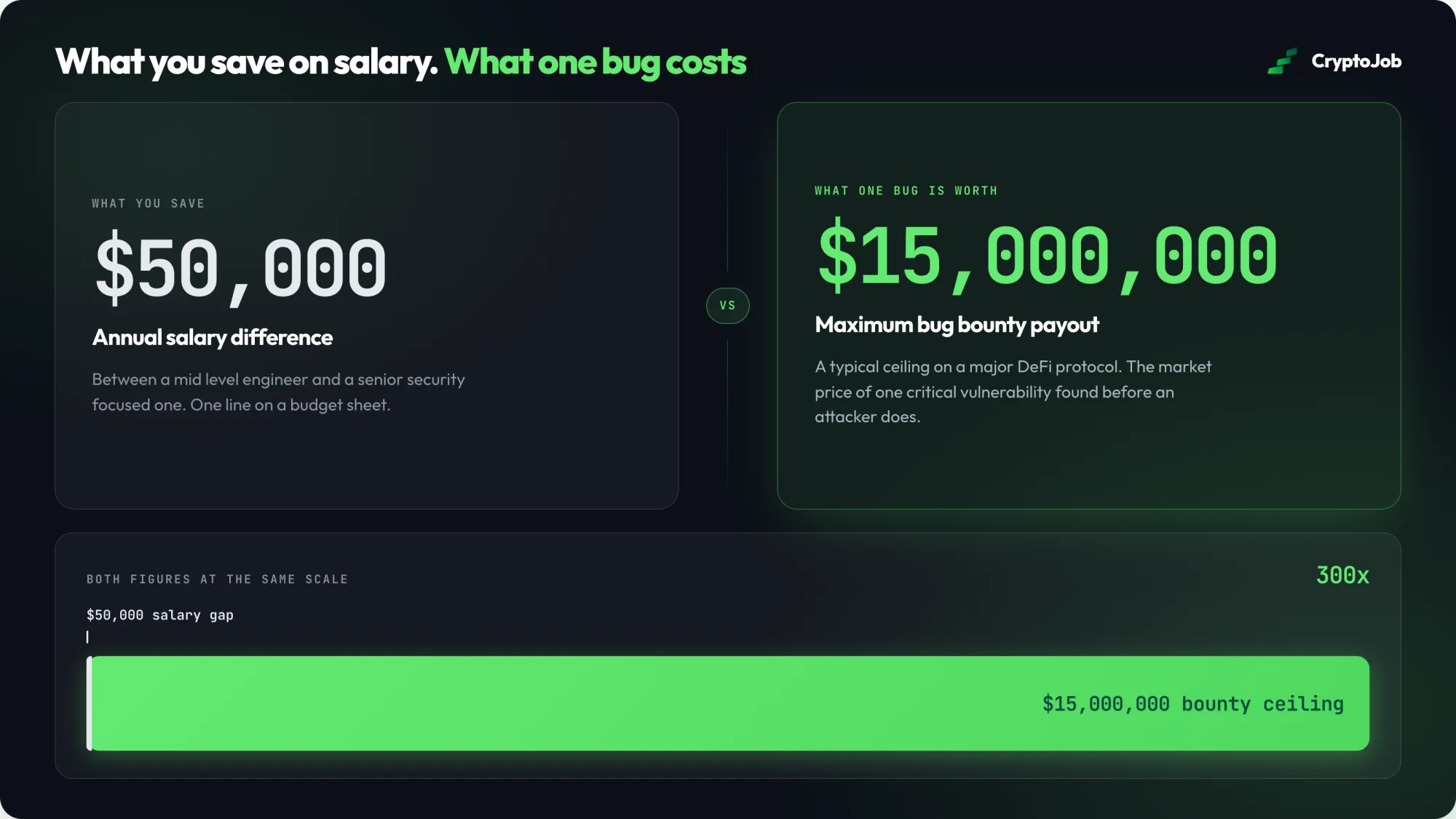
Teams reliably budget generously for a protocol architect and then treat security review as a line item to trim. That is backwards. The architect designs the vault; the security engineer is the reason it does not have a door an attacker walks through.
5.2 Letting one person write and review
Whoever writes the contract must not be the only person who reviews it. This is not a comment on anyone's ability, it is that authors cannot see their own assumptions and assumptions are where exploits live.
5.3 Hiring for language rather than judgement
Solidity syntax is learnable in weeks. Knowing which patterns are dangerous, which invariants must hold and where value can leak takes years.
A strong engineer from another systems background with six months of Solidity often outperforms someone who has written Solidity for three years without ever thinking adversarially.
Frequently asked questions
How much does it cost to hire a Solidity developer?
Base salaries run $100,000 to $250,000, with the median near $150,000. Senior engineers at established DeFi protocols command $200,000 or more before token compensation.
Should we hire a contractor or a full time Solidity developer?
Contractors suit defined, scoped builds. Anything holding ongoing value needs someone accountable long term, because the code will need monitoring and iteration well after launch.
Can a web2 engineer transition to Solidity?
Frequently yes, and strong systems engineers often make excellent Solidity developers. The gap is adversarial thinking rather than syntax, and it takes deliberate practice to close.
Do we still need an external audit if we hire strong engineers?
Yes. Independent review exists to catch what authors cannot see in their own work, and that limitation applies regardless of how good your engineers are.
How long does hiring a Solidity developer take?
Expect longer than a comparable web2 hire. The qualified pool is small, strong candidates are usually employed and rushing this particular role is how expensive mistakes get made.
Where to go from here
Assess on shipped code, define which of the four tiers you are hiring for and never let the person who wrote the contract be the only one who reviewed it.
To benchmark what comparable teams are advertising before you set your range, browse web3 jobs.