From Investment Banking to Crypto: What Actually Transfers
Bankers moving into crypto usually compete on the wrong ground. Your regulatory grounding is the scarce half, and institutions are paying up to $270K for it.

TL;DR
- Investment banking to crypto is easier than the reverse.
- Institutions pay up to $270,000 for digital asset roles.
- Your regulatory fluency is the asset, not the obstacle.
- Target institutional crypto first, protocols second.
If you are moving from investment banking to crypto, you have a considerable advantage over the people already there and most bankers get this exactly backwards.
They assume crypto natives are ahead of them and try to compete on blockchain knowledge. But the firms paying the most are largely seeking finance professionals with blockchain knowledge rather than blockchain people with finance curiosity.
More than 60% of Fortune 500 financial firms now run formal blockchain divisions, with advertised digital asset roles reaching $270,000 base before bonus. Those teams need your skills more than they need another protocol engineer. To see how the market looks, browse web3 jobs.

1. What actually transfers from investment banking?
More than you think, and it is worth being specific because vague claims about "transferable skills" do not help you write a CV.
| What you have | Where it lands in crypto |
|---|---|
| Securities structuring | Tokenisation and RWA product design |
| Settlement and custody knowledge | Digital asset custody, ETF operations |
| Regulatory and disclosure fluency | Compliance, licensing, policy |
| Financial modelling | Tokenomics design, treasury management |
| Institutional client relationships | Institutional sales, prime brokerage |
| Deal execution discipline | Corporate development, M&A, fundraising |
Notice that none of these require you to write code. The scarce combination in institutional crypto is regulatory grounding plus enough blockchain literacy to be credible, and you already hold the half that takes years to acquire.
2. Which crypto roles should a banker actually target?
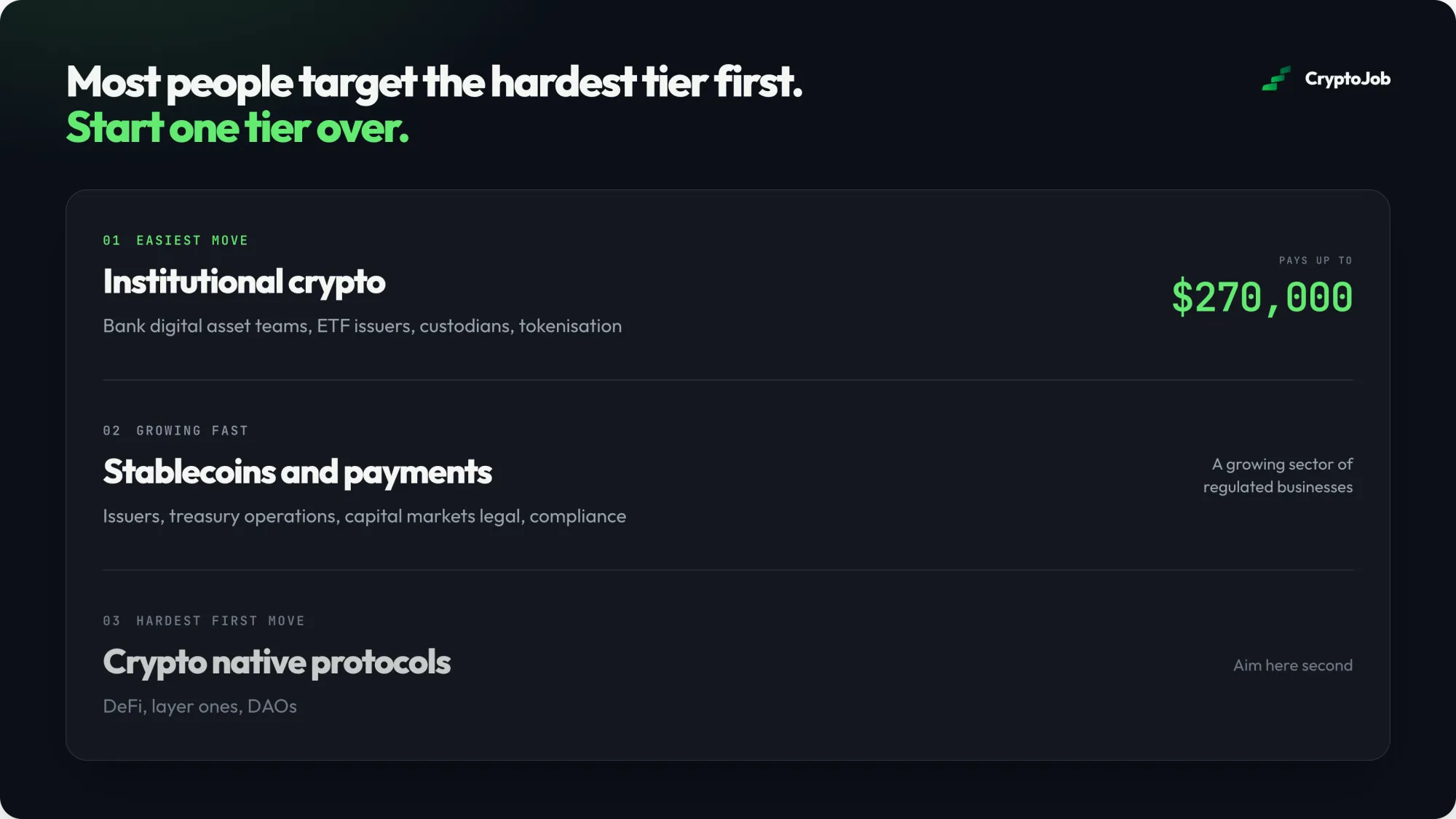
2.1 Institutional first
Bank digital asset divisions, asset manager tokenisation teams, ETF issuers and custodians. These are the highest probability targets because the hiring committee already speaks your language.
Advertised salaries in this segment reach $270,000 base for director level digital asset roles and $255,000 for senior engineering positions supporting digital asset platforms.
2.2 Stablecoin and payments second
Stablecoin issuers operate as regulated financial businesses and hire heavily for compliance, treasury operations, capital markets legal and institutional business development. This sector expanded through 2026 while much of crypto contracted.
2.3 Crypto native protocols last
Not because you cannot get there, but because it is the hardest first move. Protocols hire for cultural fluency and shipping speed, and a banking CV reads as a liability rather than an asset in that filter.
It becomes far easier after two years at an institutional crypto employer, when you have both halves.
3. What do you actually need to learn?
Less than you fear, but it has to be real rather than vocabulary deep.
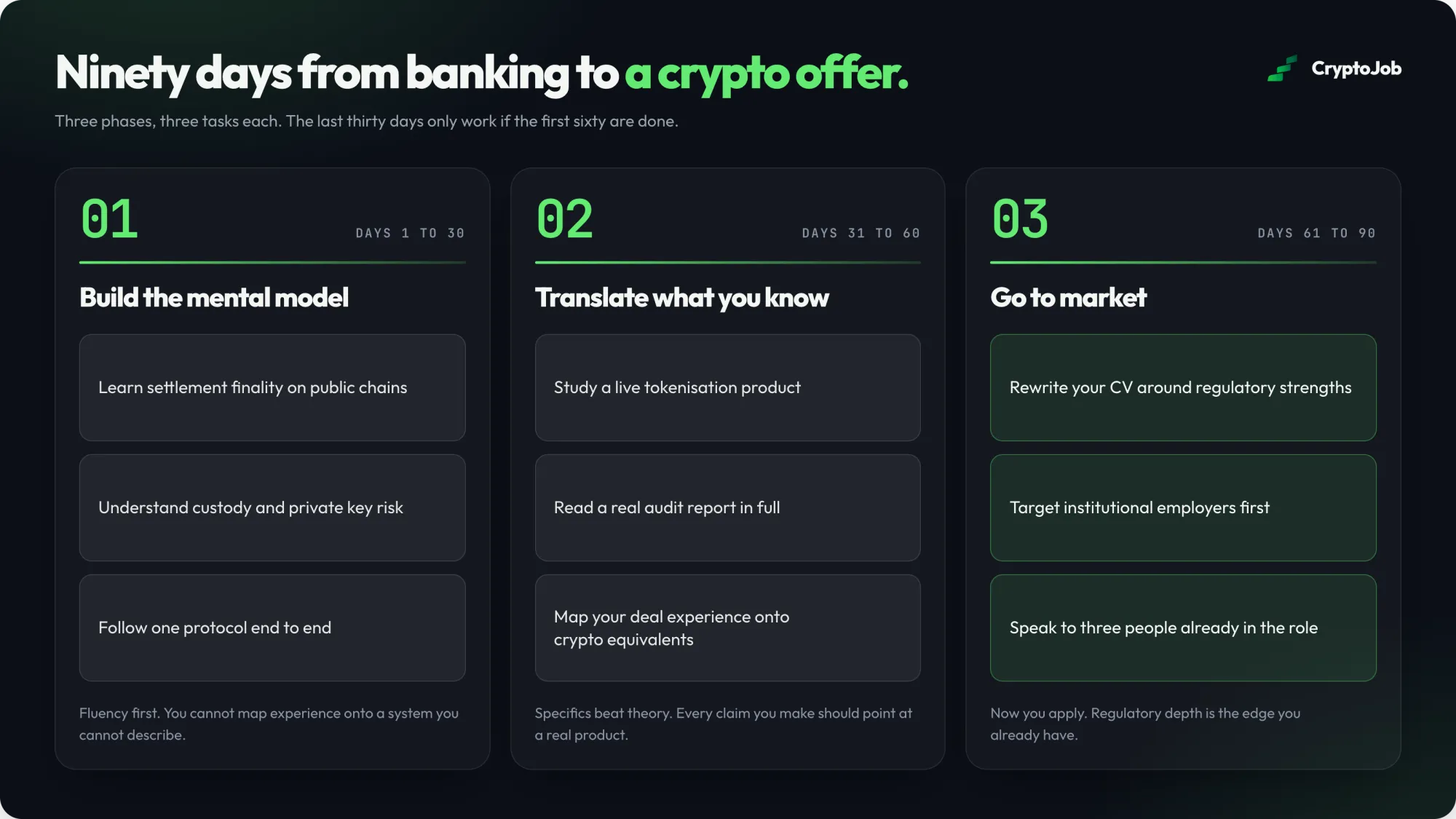
You need to explain settlement finality on a public chain and why it differs from T+2. You need to understand what custody means when the asset is a private key rather than a certificate, and why that changes the risk model. You need to know what a smart contract can and cannot enforce.
You do not need to write production Solidity. Attempting to position yourself as a technical hire is a common and costly mistake, it puts you in competition with people who have five years of it and abandons the ground where you are strong.
A practical test: could you sit in a design discussion and identify where a proposed structure would fail a regulator, and separately where it would fail technically? The first is your value. The second just needs to be good enough that engineers respect you.
4. How do you handle the pay conversation?
Honestly, this is where most banking transitions get uncomfortable, so it is worth planning for.
Institutional crypto base salaries are competitive and sometimes higher than equivalent banking roles. What is usually absent is the bonus structure you are used to, total compensation may be flatter, particularly if you are coming from a strong bonus year.
Crypto native protocols invert this. Lower base, but token grants that add 30% to 100% on top and carry genuine upside, alongside genuine risk of being worth nothing.
| Investment banking | Institutional crypto | Crypto protocol | |
|---|---|---|---|
| Base | Moderate to high | $200K to $270K senior | $150K to $250K senior |
| Variable | Large cash bonus | Smaller cash bonus | Token grants, 4-year vest |
| Volatility | Cycle dependent | Low | High |
| Hours | Notoriously long | Considerably better | Variable, intense in bursts |
5. What is the honest downside?
Two things worth weighing properly before you move.
The prestige ladder resets. Titles do not translate cleanly, and a VP at a bulge bracket firm does not automatically map onto anything. Some people find that liberating and others find it genuinely difficult.
The sector is also cyclical in a way banking is not. More than 7,254 crypto roles were cut across 47 companies in 2026. Institutional crypto teams weathered that far better than protocols did, which is another argument for entering through that door rather than the exciting one.
Frequently asked questions
Is it hard to move from investment banking to crypto?
Less hard than most bankers assume, provided you target institutional employers. More than 60% of Fortune 500 financial firms run blockchain divisions and actively seek finance professionals with blockchain knowledge.
Do I need to learn to code?
Not for most institutional roles. You need enough blockchain literacy to be credible in technical discussions, but positioning yourself as an engineering hire abandons your actual advantage.
Will I take a pay cut?
Base salaries are often comparable or higher, with senior institutional digital asset roles advertised up to $270,000. Total compensation may be flatter if you are used to large cash bonuses.
Which crypto employers hire bankers most readily?
Bank digital asset divisions, asset manager tokenisation teams, ETF issuers, custodians and stablecoin issuers. All operate as regulated financial businesses where your existing knowledge applies directly.
Can I move to a DeFi protocol later?
Yes, and it is considerably easier after institutional crypto experience, because you then hold both the regulatory grounding and the sector fluency protocols look for.
Where to go from here
The mistake is treating your banking background as something to overcome. It is the half of the equation that most crypto candidates cannot offer, and the institutions doing the most hiring are specifically looking for it.
Learn enough blockchain to be credible, target institutional employers first and stop competing on the ground where you are weakest. Browse web3 jobs to see what is currently open.