$PLUMBER: Who's Actually on the Other Side of Your Trade
Frank DeGods said oldheads were trading against plumbers. Someone tokenized the argument within hours. Nobody answered the actual question, so here's who is really on the other side.
TLDR
- Aug 11, 2026: Frank DeGods joked crypto veterans were trading against "plumbers"
- A developer deployed the PLUMBER token into the argument within hours
- It ran from under $1M to over $5M market cap on day one, on $14.2M volume
- Analyst Stitch flagged a roughly 60% bundle as the key risk
- The real answer: memecoin jobs paying $45k to $300k
On August 11, 2026, trader Frank DeGods posted that crypto oldheads were trading against plumbers.
The argument that followed is the most useful thing crypto Twitter has produced about careers all year. Commentator Threadguy pushed further, suggesting the legendary traders of 2017 to 2019 simply faced softer competition. Ansem pushed back hard.
He argued those years were brutal, full of scams, leverage wipeouts and tokens that later collapsed to near zero.
Then somebody did what crypto Twitter always does. A developer deployed a token called PLUMBER directly into the middle of the debate.
Nobody in that argument answered the actual question. Who is professionally on the other side of a retail trade? The answer is a list of job titles, and every one of them is hiring.
org) across these functions right now.
1. What happened with the PLUMBER token?
The mechanics are a clean case study in how attention converts to money, and who captures it.
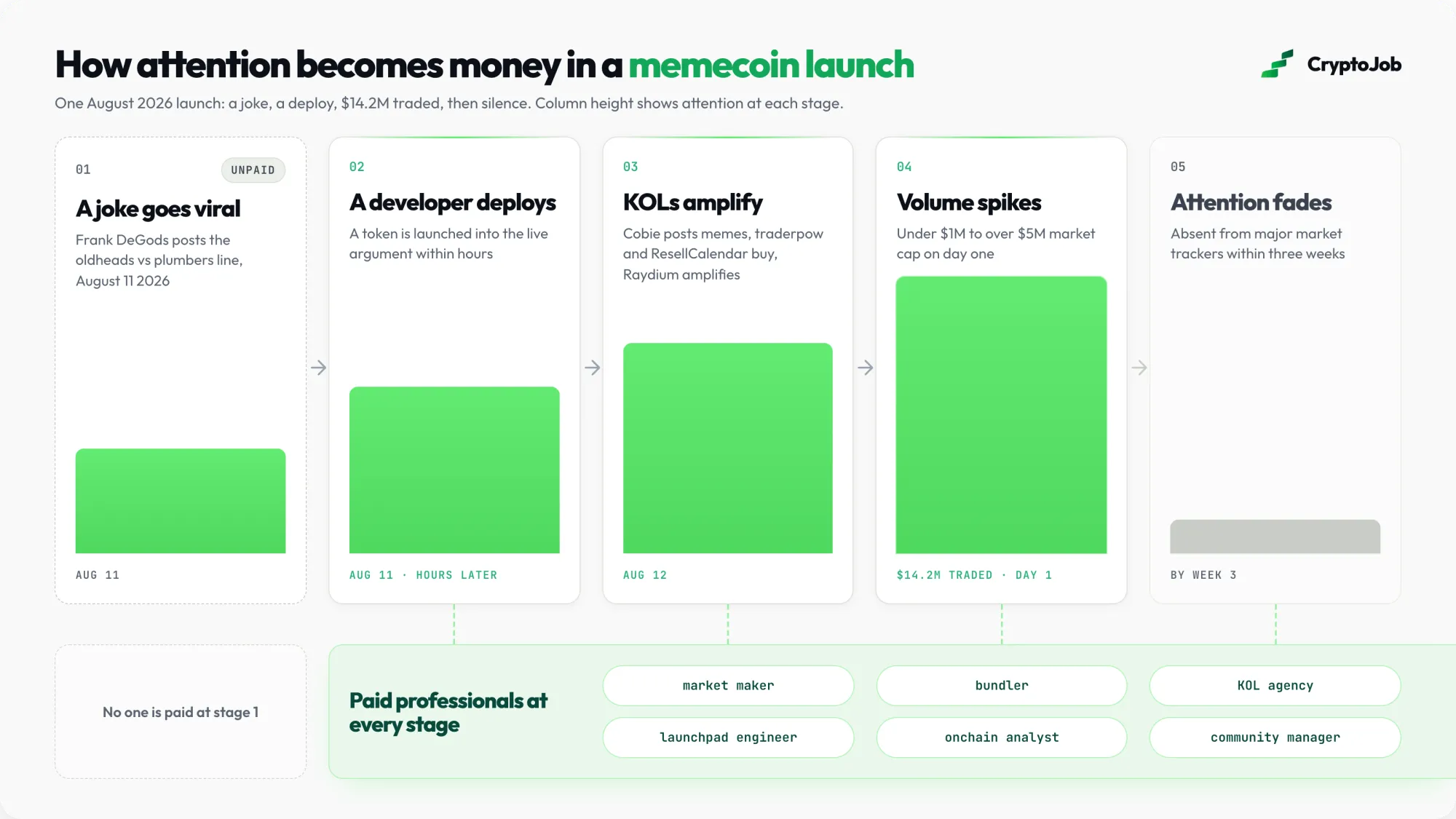
Meme researcher Stitch documented the sequence. As Stitch put it, PLUMBER didn't create the meme. The developer saw the "oldheads vs plumbers" debate heating up and deployed a token right into it.
2 million in trading volume. Moonshot verified it. Cobie posted plumber memes.
Traders including traderpow and ResellCalendar bought in. Raydium amplified it on August 12.
That's the familiar loop. Social attention draws key opinion leaders, capital follows, volume rises and fresh visibility pulls in more buyers.
Stitch also flagged the risk plainly. A bundle near 60% of supply could hit the market and trigger a sharp reversal.
An honest note on timing. This piece was written roughly three weeks after the launch, and PLUMBER no longer appears in major market trackers. That isn't a footnote. It's the point. The token lasted weeks. The jobs described below outlast every token like it.
2. So who are the "plumbers" actually trading against?
Not oldheads with good instincts. Professionals with job descriptions.
Market makers quote both sides of the book and manage inventory. When a token does $14.2 million of volume in a day, somebody is providing the liquidity that makes those fills possible, and earning the spread on every one.
Bundlers and snipe-bot operators are the uncomfortable answer. A 60% bundle means coordinated wallets acquired supply at launch. Building that tooling is technical work, and it is paid work.
KOLs and the agencies behind them. Amplification at the scale PLUMBER saw is rarely accidental. There is an entire marketing industry structured around producing it on demand.
Launchpad engineers built the bonding curve, the verification layer and the anti-bot systems that made a sixty-second deployment possible in the first place.
On-chain analysts like Stitch, who identified the bundle risk publicly while the chart was still going up.
Community managers, who run the Telegram, moderate the scam links and absorb the anger when it turns.
Retail is trading against all six. That's the honest answer to the debate.
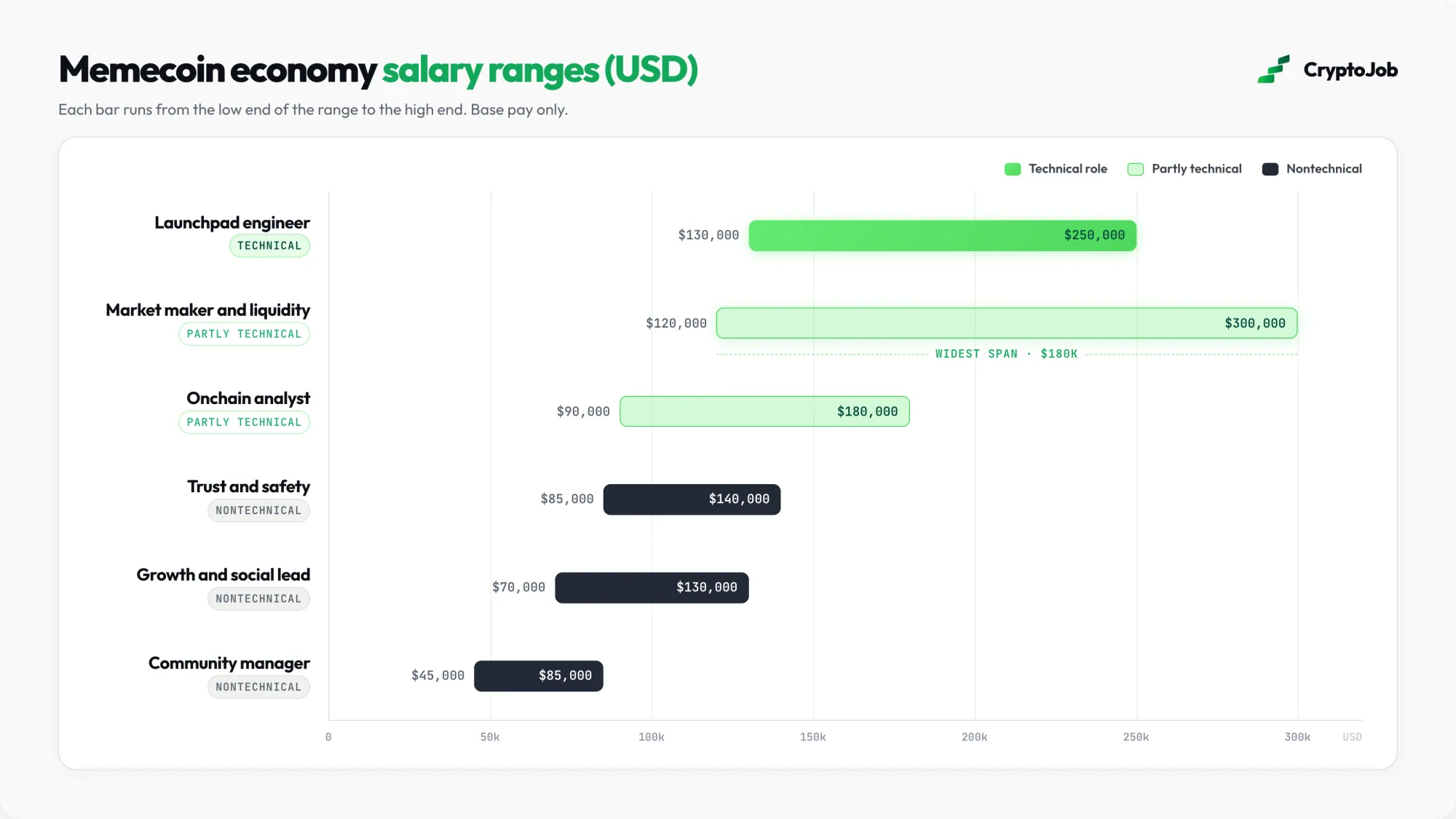
3. What do these memecoin jobs pay?
| Role | Typical range (USD) | Technical? | Common entry route |
|---|---|---|---|
| Community manager | $45k to $85k | No | Unpaid moderation, then contract, then salaried |
| Growth / social lead | $70k to $130k | No | Consumer marketing or a large personal account |
| On-chain analyst | $90k to $180k | Partly | SQL, Dune dashboards, public research |
| Launchpad engineer | $130k to $250k | Yes | Rust or Solidity plus DeFi mechanics |
| Market maker / liquidity | $120k to $300k+ | Partly | Trad-fi trading desk or self-taught quant |
| Trust and safety | $85k to $140k | No | Support, moderation, fraud ops |
These are directional ranges, not quotes. Compensation varies a lot by region, by company stage and by how much of the package is denominated in tokens. Token-weighted offers push headline figures up while adding real risk.
Negotiate your base as though the tokens will go to zero, because sometimes they do.
4. Are crypto market maker jobs realistic to get into?
They are the highest-paying roles on that table and the hardest to enter cold.
Most market-making hires come from traditional trading desks, where the core skills are identical. Inventory management, spread capture and risk limits all transfer directly. The crypto-specific layer is learnable in months.
The risk discipline is not.
The realistic alternative route is quantitative and self-taught. Build and publish backtests, demonstrate you understand adverse selection, then target smaller crypto-native firms rather than the established desks.
What does not work is a track record of profitable personal trading. Firms treat that as noise, because they cannot distinguish it from luck.
5. How do you get a crypto community manager job with no experience?
This is the genuine entry point, and it is deliberately unglamorous.
Moderate somewhere for free. Pick a project you actually follow and be visibly useful in the Discord for a few weeks. Answer the questions nobody else answers.
Convert that into a paid contract. Most first roles start at a few hundred dollars a month for defined hours, not a salary.
Then document outcomes. Holder count before and after. Median response time.
Scam links removed. Sentiment during the last drawdown. A screenshot of a crisis you handled well beats any certificate.
The cost is two to four months of unpaid effort. The benefit is that nobody asks about your degree.
6. What web3 marketing jobs come out of this?
The PLUMBER launch is a marketing case study whether or not anyone involved would use that word.
A joke became a running theme, the theme became a token and coordinated amplification turned it into $14.2 million of volume inside a day. The skills that produced that outcome are conventional marketing skills applied to an unconventional surface. Narrative timing and community seeding do most of the work.
Employers in this lane screen for one thing above all. They want to know whether you understand attention as a mechanic rather than a metric. Someone who can explain why the "oldheads versus plumbers" framing spread while a hundred other arguments didn't is more valuable than someone reciting engagement benchmarks.
7. What happens to these jobs when the token dies?
This is the question that actually matters, and PLUMBER answers it well precisely because it faded so fast.
When a token collapses, the people attached to that specific token lose their income. An anonymous deployer, a paid shiller, a contract community manager on a single project. All gone with the chart.
The people attached to the category do not. A market maker who quoted PLUMBER was quoting forty other tokens the same week. A launchpad engineer ships infrastructure that hosts thousands of launches.
An on-chain analyst who flagged the bundle has more work when things break, not less.
That distinction should drive how you evaluate any crypto job offer. Ask what happens to the role if the specific asset goes to zero. If the honest answer is that the role goes too, you are being paid in optimism.
The practical filter is simple. Find out where the revenue comes from. Fee-based businesses like exchanges, launchpads, analytics firms and market makers earn on activity in both directions.
Treasury-funded projects earn on the token holding its value. Both can be good jobs. Only one of them survives a drawdown.
8. Which of these roles is growing fastest?
Trust and safety, by a distance. It is also the least discussed.
Every launch cycle produces impersonation tokens, fake verification claims and drained wallets. PLUMBER had a verified listing on Moonshot precisely because verification became necessary. Somebody built and staffed that process.
On-chain analysis is second. Concentration risk is becoming a standard pre-trade check rather than a post-mortem, so exchanges and market makers are hiring for it directly instead of outsourcing to public researchers.
Community management remains the largest category by headcount but the most volatile by tenure. It is the easiest to enter and the easiest to lose.
9. Where does this leave the original argument?
Frank DeGods and Threadguy were arguing about whether early traders had it easier. Ansem said the early years were brutal.
All three were debating the wrong axis. The durable divide in crypto isn't oldheads versus newcomers. It's people who get paid regardless of direction against people who only get paid when the chart goes up.
PLUMBER made that concrete in about seventy-two hours. The token is effectively gone. The market makers, engineers, analysts and community managers who worked that launch were paid either way, and they are still employed.
If you'd rather be on that side of the trade, you can browse web3 jobs across market making, community, analytics and engineering.
FAQ
What is the PLUMBER memecoin?
A Solana token deployed on August 11 to 12, 2026, during a viral crypto Twitter debate sparked by Frank DeGods joking that crypto veterans were trading against "plumbers". It surged over 10,000% on day one before fading.
Do memecoin projects employ people?
Usually not. Tokens like PLUMBER typically have an anonymous deployer and no company behind them. Employment sits with the launchpads, exchanges, market makers, analytics firms and marketing agencies that serve the category.
What is the easiest memecoin job to get without experience?
Community management. The standard path is unpaid moderation for two to four months, then a part-time contract, then a salaried role. A degree is rarely required.
What does a "60% bundle" mean?
It indicates that around 60% of a token's supply was acquired by coordinated wallets at launch. Analysts treat it as a concentration risk, because that supply can be sold into retail demand later.
Are crypto market maker jobs open to career changers?
Yes, most commonly from traditional trading desks where risk and inventory skills transfer directly. Entering without that background is possible but usually requires a public quantitative portfolio.