Move Developer Jobs: The Honest Case for Sui and Aptos
Move developer jobs are few but lightly contested. Here is the honest pay picture across Sui and Aptos, and why it works better as a second language.

TL;DR
- Move developer jobs are scarce but poorly contested.
- Senior Rust engineers averaged $215,000 in 2025.
- Junior Move contract work can pay well below that.
- Treat Move as a second language, not a first.
Here is the honest position on Move developer jobs, which most career content will not give you: the market is real but small, and the pay distribution is unusually wide because of it.
Protocol level roles in the non EVM world command serious money. Senior Rust engineers, the closest well measured comparison, averaged $215,000 in 2025 against $198,000 for senior Solidity. But Move specific contract postings have also appeared at $86,000 to $90,000 for short engagements.
That gap tells you something important about how to approach this. To see what is currently open, browse web3 jobs.
1. What is Move and why does it exist?
Move is a smart contract language originally developed for Diem, Meta's abandoned payments project and subsequently adopted by Sui and Aptos, both founded by people who worked on that original research.
Its defining idea is resource oriented programming. Assets are first class types that cannot be accidentally copied or discarded, which structurally eliminates several bug classes that Solidity developers spend their careers guarding against.
That is a genuine engineering argument rather than marketing. Whether it translates into ecosystem dominance is a separate question, and one nobody can answer yet.
2. How big is the Move job market really?
Small. This is the part worth being straight about.
The major ecosystem employers are Aptos Labs, Aptos Foundation and Mysten Labs behind Sui. Each lists openings in the single digits to low teens at any given time, and not all of those are engineering roles. Some are community, growth or regional positions.
Beyond the core teams, demand comes from protocols building on these chains, which is a thinner and more volatile pool than the equivalent Ethereum ecosystem.
| Solidity | Move | |
|---|---|---|
| Job volume | High, consistent | Low, intermittent |
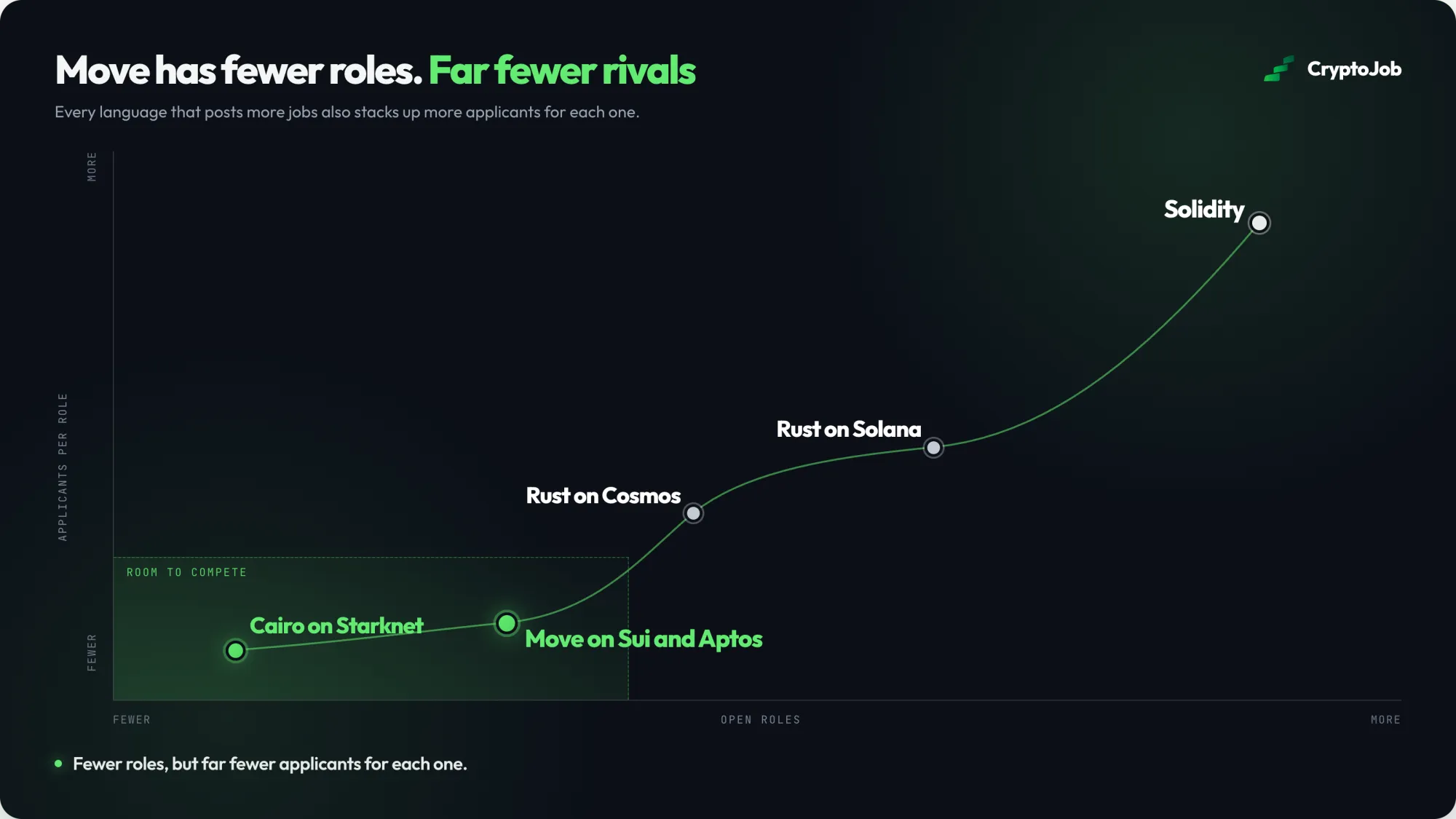
| Competition per role | Heavy | Light |
| Average salary | ~$150K, range $65K to $257K | Wide; protocol roles strong, contract work weak |
| Learning resources | Abundant | Limited |
| Career risk | Low, the ecosystem persists | Tied to two chains' success |
3. Does learning Move actually pay off?
It depends entirely on whether you treat it as a first language or a second.
As a first language it is a poor bet. You would be competing for a small number of roles with limited learning material and no fallback if either chain loses momentum.
As a second language it is a strong one. A developer who is already competent in Solidity and adds Move becomes eligible for a set of roles that most of the market cannot fill, without giving up access to anything.
The same logic applies to other non EVM stacks. Rust is no longer the outsider bet it was. It accounted for 58.5 percent of smart contract vacancies in 2025 against Solidity's 41.5 percent, the second consecutive year it has led. The genuinely small talent pools now are Move and Cairo, and that is where the scarcity premium actually sits.
4. What does the pay actually look like?
The wide distribution reflects two different markets that happen to share a language.
Protocol and infrastructure roles sit at the top. The Plexus State of Crypto Hiring Report 2026, drawing on 904 advertised roles, put senior Rust engineers at an average of $215,000 in 2025 against $198,000 for senior Solidity. Sui and Aptos protocol work sits in that Rust adjacent band.
Contract and freelance Move work sits considerably lower. One posting sought a Move developer for a three month engagement on Sui at an estimated $86,000 to $90,000, asking for six to twelve months of Move experience and an understanding of AMM and concentrated liquidity mechanics.
Reading those two data points together: employers pay well for people who can architect on these chains, and considerably less for people who can merely write in the language.
5. How do you get hired for Move work?
5.1 Ship something visible
The pool is small enough that one substantial public project genuinely gets noticed. This is the opposite of the Solidity market, where standing out requires far more.
Build something that uses Move's resource model deliberately rather than porting a Solidity pattern across. Reviewers can tell the difference immediately, and it is the main thing they are checking.
5.2 Go where the ecosystems are investing
Both foundations run developer programmes, grants and hackathons designed to grow their builder base. These are considerably easier to access than equivalent Ethereum programmes because fewer people apply.
Regional ecosystem activity matters too, several openings are explicitly focused on growing developer communities in specific markets rather than headquarters engineering.
5.3 Keep your EVM skills current
Not as a hedge exactly, but because the strongest candidates for Move roles are frequently people who understand both models well enough to explain the trade offs.
Frequently asked questions
Is Move worth learning in 2026?
As a second language alongside Solidity, yes. As your only smart contract language, it is a narrow bet tied to the success of two specific ecosystems.
How much do Move developers earn?
The range is wide. Senior Rust engineers, the closest well measured comparison, averaged $215,000 in 2025, while short term Move contract postings have appeared around $86,000 to $90,000.
Sui or Aptos, which should I learn for?
Both use Move but with meaningful differences in object model and execution. Learning the language transfers; the ecosystem specifics do not entirely. Pick based on which projects you actually want to work on.
Is it easier to get hired as a Move developer than a Solidity developer?
Per role, yes, there are far fewer applicants. But there are also far fewer roles, so overall job security is lower.
Can Solidity developers learn Move quickly?
The syntax is approachable within weeks, but the resource oriented model requires genuinely different thinking. Expect a few months before you are writing idiomatic Move rather than translated Solidity.
Where to go from here
Move is a specialisation bet, and it should be made with clear eyes. Small market, light competition, strong pay at the protocol level and real exposure to how two specific chains perform.
The sensible version is to add it rather than switch to it. To see what is currently open across both EVM and non EVM ecosystems, browse web3 jobs.
Related reading: Rust Developer Jobs in Crypto and Solana Developer Jobs.