$SIREN: When One Holder Erased $760 Million
SIREN collapsed 90% in five days. The people who called it in March, three months before it happened, all have job titles, and those jobs are hiring.

TLDR
- SIREN crashed about 90% in five days in June 2026, wiping $760M in market cap
- One entity sold 670M tokens, about 92% of supply, for $64.8M across two days
- ZachXBT and Bubblemaps flagged the concentration in March, three months early
- On-chain analyst jobs exist because the pattern is detectable in advance
- Forensics and risk roles pay $90k to $220k
It took $7.5 million of selling to erase $760 million of market cap.
That ratio is not a market failure. It is a job description.
SIREN, a BNB Chain token built around an AI agent concept, crashed roughly 90% in five days in June 2026. It wiped out $760 million in market capitalization and liquidated $2.4 million in long positions. On-chain intelligence firm Lookonchain later put the full tally at 670 million tokens, about 92% of total supply, sold across two days for $64.8 million.
The important part for your career is that several people saw it coming and said so publicly, months in advance. They all have job titles. If you want one of those jobs, you can browse web3 jobs across analysis, risk and compliance functions.

1. What are on-chain analyst jobs and why do they exist?
They exist because token concentration is measurable and public, and almost nobody checks it.
Here is the timeline, and note how early the warning came.
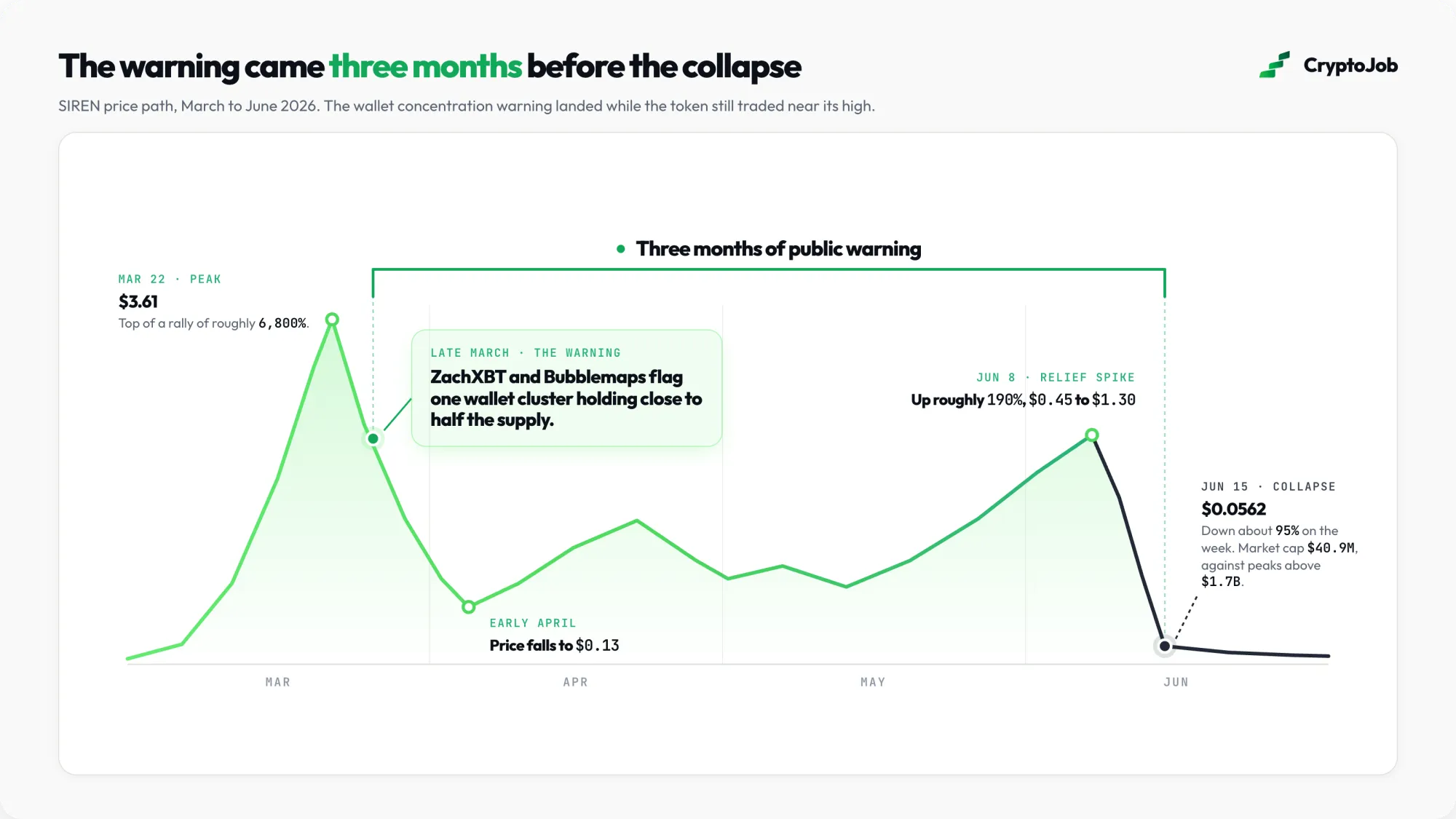
SIREN hit an all-time high of $3.61 on March 22, 2026, after rallying roughly 6,800%. Immediately afterward, on-chain investigator ZachXBT and analytics platform Bubblemaps both warned that a single cluster of wallets controlled close to half the supply. ZachXBT later linked those wallets to addresses connected to DWF Labs.
The token then collapsed nearly 70%, rallied again, and repeated the cycle several times through spring.
On June 8, it spiked nearly 190% from $0.45 to $1.30. Days later the distribution began in earnest. By June 15 SIREN traded near $0.0562, down roughly 95% on the week, with market cap collapsed to about $40.9 million from peaks that had once exceeded $1.7 billion.
The warning was public in March. The collapse came in June. That gap is the entire value proposition of the job.
2. What does a blockchain forensics career actually involve?
Four distinct functions, often confused with each other.
Wallet clustering. Identifying that hundreds of apparently unrelated addresses are controlled by one entity. In the SIREN case, analytics firm Spot On Chain reported that the entity behind the dump had accumulated nearly 90% of spot supply across hundreds of small, seemingly unrelated wallets. That was deliberate address fragmentation, designed to defeat exactly this analysis.
Flow tracing. Following proceeds after the fact. Lookonchain tracked that of the $64.8 million realised, $25.7 million moved to exchanges including Bitget and Bybit, while $39.1 million remained on-chain.
Risk scoring. Turning that analysis into a number a desk can act on before the event, not after.
Public research. The ZachXBT model of investigating and publishing. It is career-defining when it lands, and it is how many analysts build the reputation that gets them hired.
3. Who hires for crypto risk management jobs?
More employers than most candidates realise, and the demand runs both directions.
Exchanges need listing diligence, meaning every token gets reviewed before it goes live. Market makers need concentration analysis before they quote a book they can't exit. Funds and treasuries need position risk.
Analytics firms like Lookonchain, Bubblemaps, Nansen and Arkham sell the analysis as a product. Regulators and law enforcement hire the same skills for enforcement work.
| Role | Typical range (USD) | Core skill | Hires from |
|---|---|---|---|
| On-chain analyst | $90k to $180k | SQL, Dune, wallet clustering | Self-taught, public research |
| Blockchain forensics investigator | $110k to $200k | Flow tracing, case building | Law enforcement, audit |
| Risk manager (trading) | $130k to $220k | Position and liquidity risk | Trad-fi risk desks |
| Listings / diligence analyst | $80k to $140k | Tokenomics review | Finance, compliance |
| Compliance analyst | $85k to $150k | AML, sanctions screening | Banking compliance |
Analytics firms and exchanges pay conventional salaries. Trading-side risk roles pay more and often include performance components.
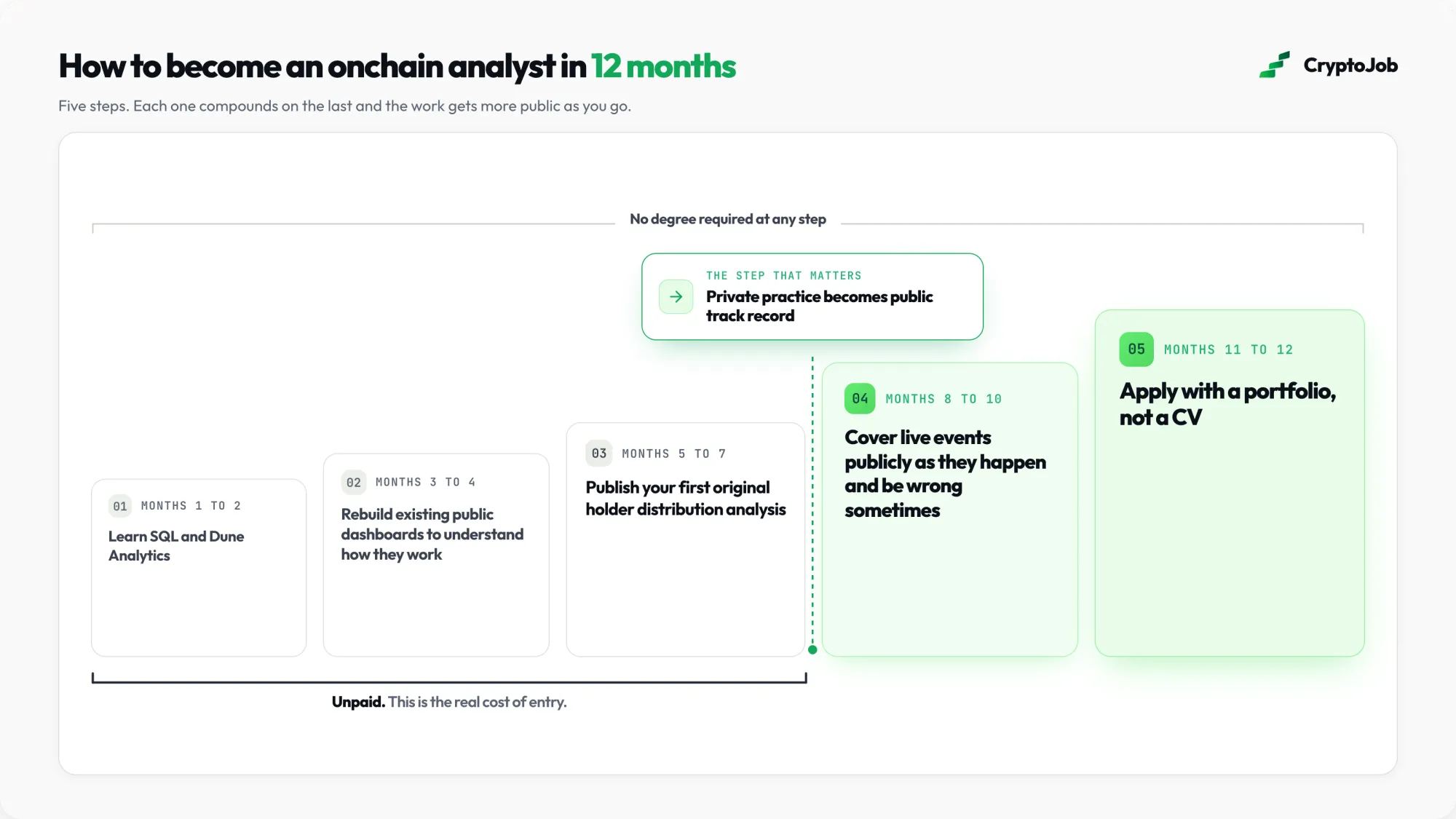
4. How do you get into on-chain analyst jobs without experience?
The entry route here is unusually meritocratic, because the raw data is public and free.
Learn SQL and Dune Analytics. Both are learnable in weeks, and Dune dashboards are the standard portfolio artefact in this field.
Then publish. Pick a live token, analyze its holder distribution and write up what you find, correctly and publicly, with your reasoning shown. ZachXBT built an entire career this way.
You are not competing on credentials. You are competing on whether your analysis holds up.
Be right in public often enough and hiring managers will find you. Be wrong in public and admit it, and you'll still be ahead of people who never published.
The uncomfortable truth is that this takes six to twelve months of unpaid work before it converts. The compensation is that no degree gates it.
5. What does the work actually look like day to day?
Less dramatic than the headline cases suggest, and mostly repetitive.
Distribution checks. Pull the holder list for a token, cluster addresses by funding source and behavior, and calculate what share the top entity controls. This is the check that would have flagged SIREN in March.
Funding-path tracing. Follow where wallets got their initial capital. Fragmentation is designed to defeat exactly this, since the SIREN entity accumulated across hundreds of small wallets that looked unrelated. The work is establishing that superficially separate addresses share an origin.
Liquidity depth analysis. Market cap is close to meaningless without it. A token can show a nine-figure valuation on a pool holding single-digit millions, which means the exit doesn't exist at anything near the quoted price.
Monitoring and alerting. Most of the job is automated surveillance on positions that already exist, not investigation of new ones. Dashboards that fire when a large holder moves.
Writing it up. The analysis is worthless if a trading desk or listings committee cannot act on it in five minutes.
Roughly 70% of the role is the first four items on repeat. The public investigations that build careers are the visible 5%.
6. Why didn't the warnings stop it?
This is the part worth sitting with, because it explains why these roles keep getting funded.
The analysis was correct and public. It changed almost nothing.
Analysts flagged the concentration in March. The token still rallied twice more before collapsing. Retail participants were particularly exposed because of the heavy reliance on a single dominant holder, but the information was available the entire time.
The pattern continued after the crash. Hundreds of brand-new wallets with clean funding histories began acquiring SIREN at distressed prices, and analysts suspect the original orchestrator was absorbing their own dumped supply cheaply, resetting the tokenomics for another cycle.
For a careers site, the lesson is direct. Detection and prevention are different jobs. Analysts detect.
Exchanges, market makers and compliance teams are the ones positioned to act. That's why demand for these skills sits inside institutions rather than outside them, and why the institutional roles pay more than the independent ones.
7. Does this job actually prevent anything?
Worth confronting, because it determines whether the role is satisfying or maddening.
Individually, often not. SIREN was flagged in March and still rallied twice more. The analysis was correct, public and free.
It didn't stop a single buyer.
Institutionally, yes. The value is not persuading retail. It is stopping an exchange from listing something it will have to delist, or preventing a market maker from quoting a book with no exit.
Those decisions happen quietly and never make headlines.
That is the trade in this career. Your best work is usually invisible, because it consists of losses that never happened. If you need public credit, the independent research route offers it.
If you want the salary and the leverage, the institutional route is where the decisions get made.
Where do you go from here?
If you like the investigative side, start with Dune and public writeups. If you want the salary faster, listings diligence and compliance analysis have lower barriers and clearer hiring pipelines.
Either way, the underlying skill is the same one that would have flagged SIREN in March. It comes down to reading who actually holds a token. You can browse web3 jobs across on-chain analysis, risk and compliance to see what's open.
FAQ
What is an on-chain analyst?
Someone who analyzes public blockchain data to assess holder concentration, fund flows and risk. The work is used by exchanges for listing diligence, by market makers for liquidity risk and by funds for position risk.
What happened to the SIREN token?
SIREN crashed roughly 90% in five days in June 2026, wiping $760 million in market cap. One entity sold approximately 670 million tokens, around 92% of supply, for $64.8 million across two days.
Was the SIREN collapse a hack?
No. On-chain analysis indicates it was not caused by a smart contract vulnerability or exploit, but by a deliberate spot market sell-off from an entity controlling over 92% of the active circulating supply.
Do you need a degree for blockchain forensics careers?
Usually not for analyst roles, where a public portfolio of correct analysis carries more weight. Formal qualifications matter more for compliance and law enforcement positions.
What tools do on-chain analysts use?
Dune Analytics and SQL are the baseline. Wallet-clustering and visualization tools such as Bubblemaps, Arkham and Nansen are widely used, alongside block explorers for manual tracing.