Proof of Work: How the Onchain Resume Took Over Crypto Hiring
Hiring managers read wallets, repos and leaderboards before resumes. How to build the public record that gets you hired.

TL;DR
- The onchain resume now outranks the PDF in crypto hiring
- Hiring managers check repos, wallets and leaderboards before interviews
- Contest rankings and shipped contracts function as verified credentials
- 4 building blocks let anyone assemble one in 90 days
Your onchain resume is being read whether you built one or not: crypto hiring managers now check GitHub activity, deployed contracts, audit contest leaderboards and governance participation before they open the PDF, because public, verifiable work answers questions no document can. This piece explains how proof of work became crypto's real credential system, what actually counts as signal and the ninety day plan for assembling a record that gets you hired.
The shift is rational rather than fashionable: in an industry with 450 applications on popular roles and rampant credential inflation, verifiable history is the only filter that scales. See how listings already reflect it when you browse web3 jobs and count how many ask for links before degrees.
The good news hides in the mechanism: this credential system is permissionless, which means outsiders can build it without anyone's approval.
1. What exactly is an onchain resume?
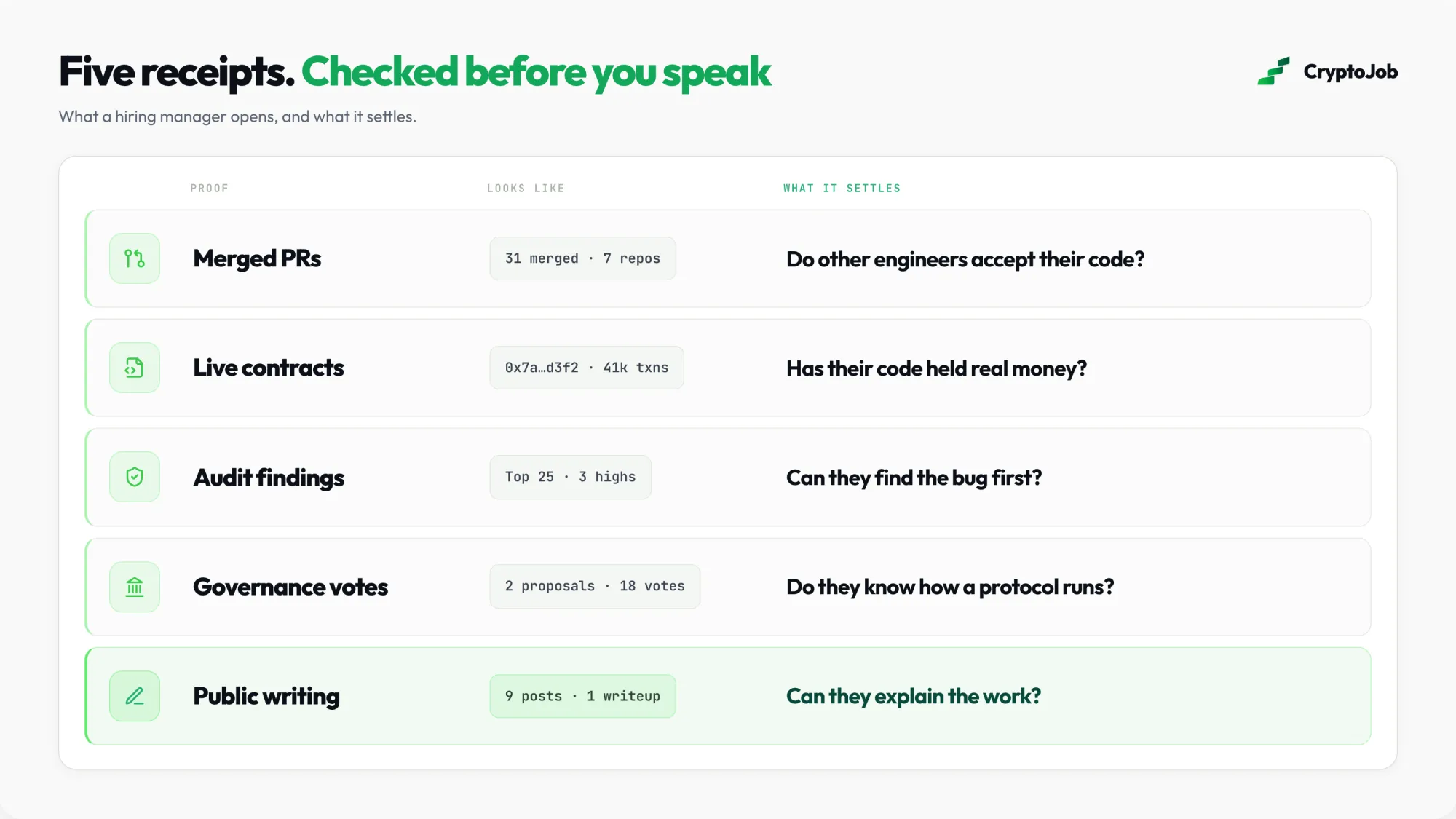
It is the sum of your publicly verifiable work: repositories and merged contributions, contracts you deployed and what they secured, audit and bounty results with your handle on leaderboards, governance posts and votes tied to your identity, plus the public writing that explains all of it and the content trail showing how you think.
Some of it is literally onchain, from deployments to DAO votes, and some lives on adjacent public rails like GitHub and contest platforms. The unifying property is that none of it can be inflated the way a resume bullet can.
Reputation protocols keep trying to formalize the bundle into portable credentials, and some hiring flows use them, but the informal version already governs: people simply look you up.
2. Why did crypto hiring shift to proof of work?
Volume forced it. With popular roles drawing hundreds of applicants and postings down sharply industry wide, screeners needed a filter faster than interviews and harder than keyword matching, and public work is exactly that.
Trust economics reinforced it. Crypto companies hand real value to small teams early, pseudonymous and global hiring is normal and degrees verify poorly across borders, so the industry standardized on evidence that verifies itself.
And the culture was primed from the start: open source roots, public block explorers and leaderboard native security work meant the infrastructure for reputation by receipts already existed before hiring adopted it.
3. What counts as strong signal versus noise?
Ranked and adversarial results top the hierarchy. Audit contest placements and bounty payouts are scored by strangers with money involved, which makes them the closest thing crypto has to standardized tests, and our audit contest earnings breakdown shows how lucrative that ladder became.
Shipped and used comes next: a contract with real value secured or merged contributions to known repositories, each carrying usage as its own testimony. A dozen tutorial forks carry none.
Sustained participation beats bursts everywhere. Two years of thoughtful governance posts or steady commits under one handle signals reliability that a single viral weekend cannot, and reviewers explicitly look for the time axis.
4. How do nontechnical people build onchain resumes?
Governance is the open door: writing genuinely useful forum analyses, delegating thoughtfully and voting with published reasoning builds a citable public record that DAO facing employers actively read, a path our DAO jobs guide maps in detail.
Operations people leave receipts too, from grant program deliveries logged onchain to multisig signing histories that prove trusted execution over time.
Community and content trails work the same way, from moderation history that protocol teams can verify to research threads that demonstrate judgment over time. Marketers and operators leave receipts too if they work in public.
Even credentials of presence help at the margins: verified event participation, completed ecosystem programs and contribution badges assemble into a timeline that supports the story your interviews tell.
5. What is the ninety day assembly plan?
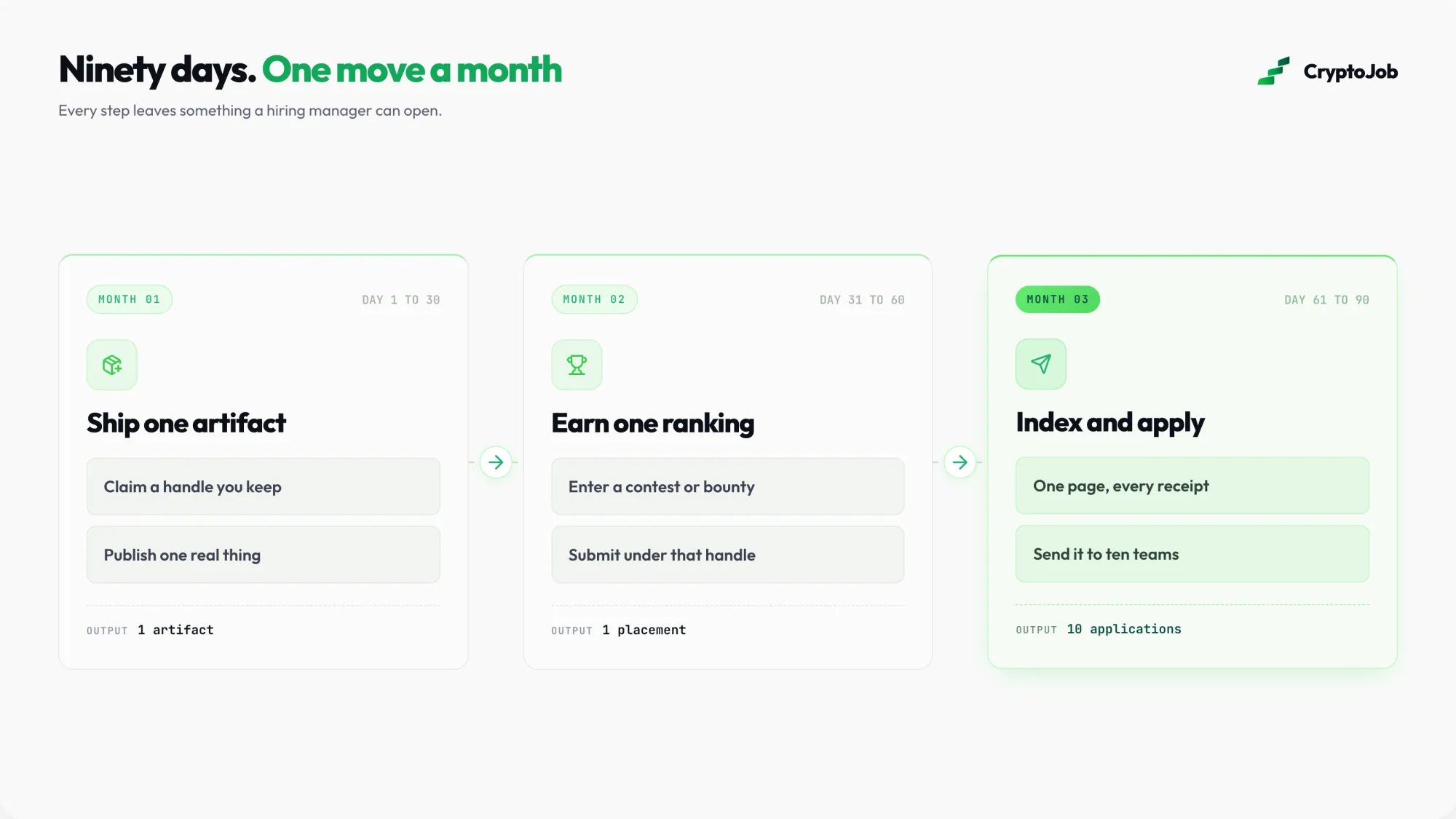
Days one through thirty: pick one lane matching your target role and ship the first artifact, meaning a deployed project or three substantive governance analyses, all under a consistent handle you will keep.
Days thirty one through sixty: add the adversarial rep, entering a beginner friendly audit contest or a bounty attempt, because one ranked result upgrades the entire record. Document everything as you go.
Days sixty one through ninety: consolidate into a single index page linking each receipt, then aim it at ten targeted applications. This is the same manufacturing logic as our web3 portfolio projects guide, pointed at verification rather than presentation.
Maintenance matters as much as assembly, because a record that stops updating reads like a career that did. One visible contribution a week sustains the signal: a merged fix, a governance comment with substance, a contest entry or a published query all count.
A strong month therefore looks unremarkable up close: four small receipts under one handle, each linked from your index page within a day of landing. Reviewers scrolling that cadence a year later see exactly the reliability they are hiring for, which no single spectacular weekend can fake.
One caution on the handle itself: pick a name you are willing to carry for years, because the value of the record comes from its continuity. Rebranding halfway through resets the search that a screener runs on you.
6. How should you present the record to employers?
One index page, receipts first. Lead with the two or three strongest verifiable items, each with a one line claim and the link that proves it, and let the traditional resume become the appendix.
Keep identity coherent. A consistent handle across GitHub and contest platforms lets a screener assemble you in one search, while scattered aliases waste your own evidence.
And narrate honestly, including the misses. A contest entry that placed mid table with a writeup of what you learned reads as trajectory, and reviewers in this industry consistently reward visible learning curves over polished emptiness.
7. How does the onchain resume compare with the traditional one?
| Dimension | Traditional resume | Onchain resume |
|---|---|---|
| Verification | Trust and reference calls | Self verifying links |
| Gatekeepers | Degrees, past employers | None, permissionless entry |
| Inflation risk | High, wording games | Low, receipts or nothing |
| Best use | Corporate screens, context | Crypto native hiring, proof |
8. What are the honest limits and risks?
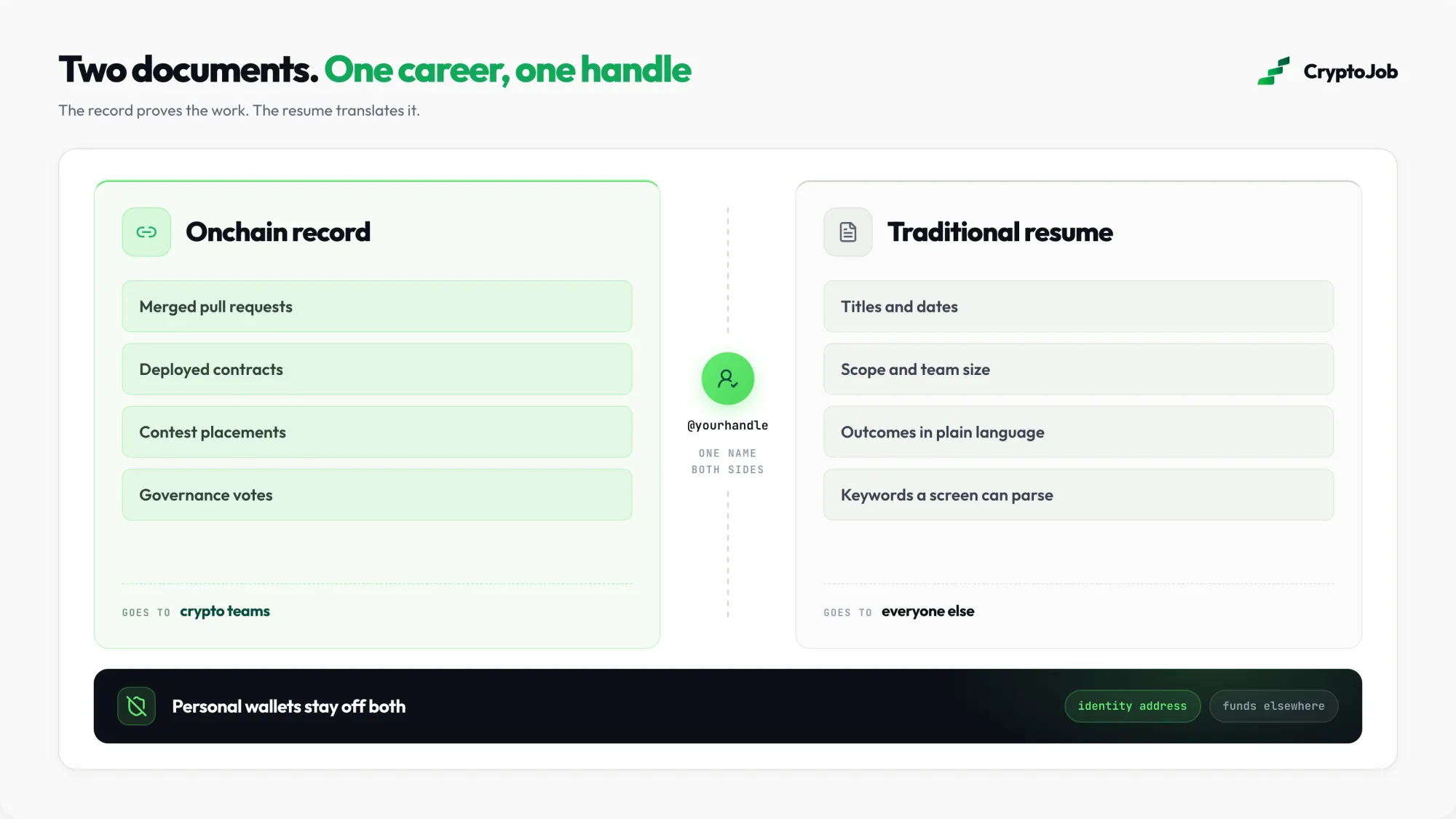
Privacy is the first tradeoff: a legible public record links your work to your wallets and opinions, so most professionals maintain deliberate separation between reputation identities and personal finances, which takes planning from day one.
Gaming exists and gets caught. Farmed commits, sybil governance and purchased followers are exactly the patterns reviewers learned to spot, and being caught inflating a proof system costs more than never having one.
And the corporate world still wants the PDF. Banks and HR screened employers run traditional processes, so the winning setup is bilingual: an onchain record for crypto native doors and a clean resume translating it for everyone else.
9. Which platforms formalize onchain reputation?
The contest platforms are the de facto credential registries: audit competition leaderboards and bounty programs publish ranked, dated results under persistent handles, and security hiring already treats those pages as transcripts.
Developer surfaces do the same job for builders, with GitHub graphs and deployment histories forming the record most engineering screens actually read, while ecosystems increasingly badge program completions and grant deliveries onchain.
Dedicated reputation protocols keep formalizing the rest, from builder score aggregators to attestation standards that let past collaborators sign verifiable endorsements. Adoption is uneven, but the direction is clear: portable credentials assembled from receipts rather than issued by institutions.
The practical guidance holds regardless of which platform wins: keep one handle, accumulate receipts where they are publicly rankable and let the aggregators index you, because every formalization wave rewards the people whose records already exist.
And resist optimizing for any single score, since reviewers weight coherent bodies of work above gamified numbers, exactly as they always did with publication counts elsewhere.
10. What should you do with this shift?
Accept that the lookup is already happening, then take control of what it finds. Ninety days of deliberate public work builds a record most applicants will never bother to assemble, which is precisely why it works.
Start the plan this week, keep the handle forever and browse web3 jobs to pick the ten openings your first receipts will be aimed at.
FAQ
Do employers really check onchain activity?
Crypto native ones routinely do, from GitHub and contest leaderboards to governance history, and many listings ask for links up front. Corporate employers still lead with traditional screens.
Can I build an onchain resume anonymously?
Yes, pseudonymous reputation is normal in crypto and several respected builders operate that way. Consistency of the handle matters far more than the legal name behind it.
How long does it take to build meaningful proof?
Ninety days of focused work produces a credible starter record, and six to twelve months of sustained public activity reaches the depth that senior roles respect.
Is the onchain resume only for developers?
No. Governance analysis, community history, research writing and operational contributions all leave verifiable trails, and DAO facing employers read them exactly like code.