Prediction Market Jobs: Working at Polymarket and Kalshi
Polymarket plans to more than double headcount in 2026 while Kalshi scales a $22B company on 120 people. Here is how to get hired.

TL;DR
- Prediction market jobs are one of the few crypto niches still expanding in 2026
- Polymarket planned to grow from 110 to 260 people during the year
- Kalshi runs on roughly 120 staff at a $22B valuation
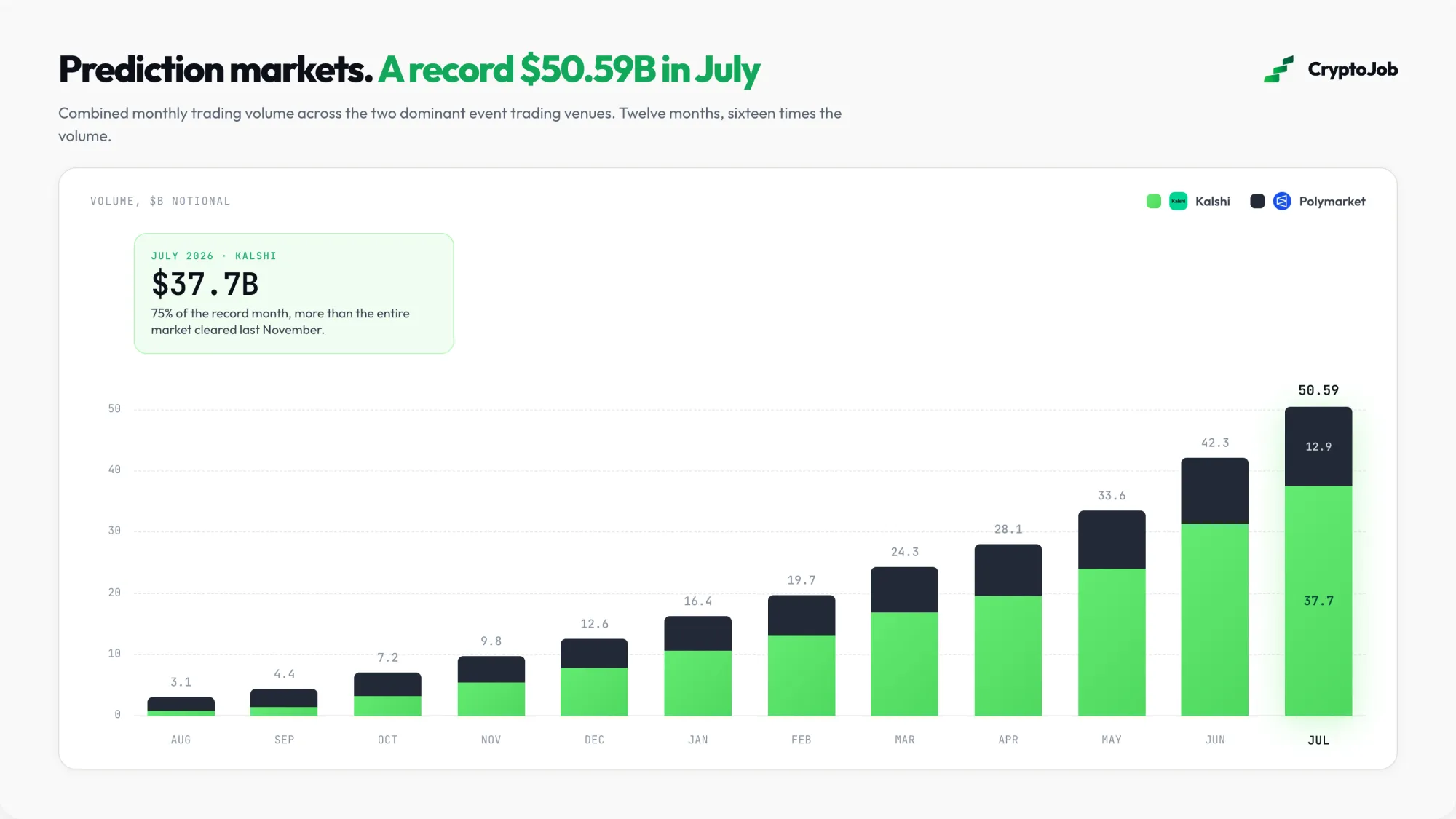
- July 2026 volume hit a record $50.59B across the major platforms
Prediction market jobs are the standout growth story of the 2026 crypto job market. Polymarket said in a job listing that it entered the year with 110 people and planned to reach 260 by year end, while Kalshi runs a $22 billion company on roughly 120 staff and is hiring across engineering, markets and compliance. This guide covers the open roles, the pay and the fastest ways in.
The hiring is real because the volume is real. Platforms processed a record $50.59 billion in trades in July 2026 according to The Block data, split roughly $37.7 billion to Kalshi and $12.9 billion to Polymarket, with NFL season and the US midterms expected to push activity higher. If you want to see what is open across the wider industry while you read, browse web3 jobs and set an alert for event markets.
These firms sit at the intersection of regulated derivatives and sports trading. That mix shapes who they hire.
1. Why are prediction market jobs booming while crypto hiring shrinks?
Most crypto subsectors cut staff through late 2025 and 2026, yet event markets kept compounding. Kalshi grew from a $2 billion valuation in mid 2025 to $22 billion after a $1 billion Series F in May 2026, with reports of an even larger round in discussion. Polymarket took an investment of up to $2 billion from ICE, the parent company of the NYSE, and has been raising again at a reported $15 billion.
Money like that funds headcount. Both firms are staffing like exchanges rather than startups, which means market operations, surveillance, risk and regulatory hires alongside engineers.
Incumbents entering the space add even more openings. Coinbase acquired The Clearing Company, a team stacked with Polymarket and Kalshi alumni, Robinhood teamed with Susquehanna to buy the MIAXdx derivatives exchange and Gemini has refocused much of its remaining business on predictions.
2. What roles do Polymarket careers include right now?
Polymarket is building a regulated US exchange after acquiring a derivatives exchange and clearing house, so its 2026 openings read like a hybrid of crypto startup and Wall Street venue. Public listings have asked for senior backend engineers with high frequency trading experience and trade surveillance analysts with prop trading backgrounds.
Senior hires show the direction. A former Nasdaq executive became chief risk officer, a former Robinhood executive runs compliance and Coinbase alumni lead regulatory and investigations work under US head Dan Lee.
Nontechnical openings cluster in growth, communications, market creation and operations. Understanding how odds and event resolution work matters more than a finance degree.
3. What do Kalshi jobs look like?
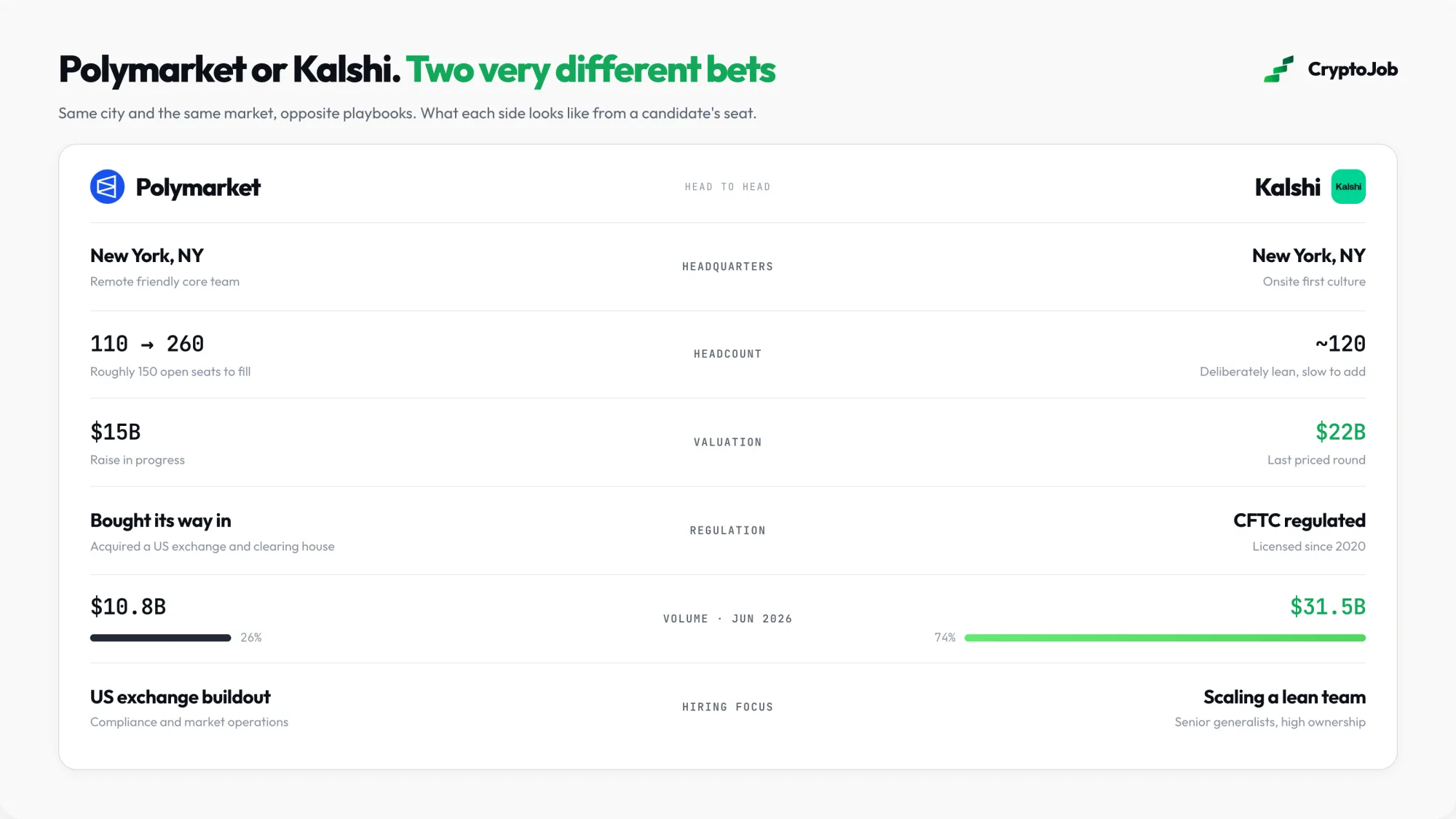
Kalshi is the CFTC regulated exchange of the pair and keeps its team deliberately small, which makes every seat senior in practice. Its founders said in early 2026 that the company had about 120 employees while clearing tens of billions in monthly volume, roughly $31.5 billion in June alone.
Openings concentrate in backend and infrastructure engineering, market operations, risk, legal and brand or growth. Sports drive about 80 percent of Kalshi volume per Pew Research, so people who understand sports trading or odds making have an edge.
Expect intensity. The company has a reputation for demanding hours and elite talent density, and a quant recruiting firm recently called it a new player in the market for top trading talent.
4. Who else is hiring for prediction market skills?
Four groups beyond the big two are worth tracking. Coinbase is integrating The Clearing Company team. Robinhood is building event contracts on its acquired exchange infrastructure. Gemini has concentrated resources on its predictions business. DraftKings and other sports betting operators are standing up their own exchange style products.
Regulators and service providers hire too. Kalshi adopted Nasdaq market surveillance technology, and the legal fights over sports contracts in several states mean law firms and compliance consultancies need people who understand this niche.
Career switchers from sportsbooks and trading firms are landing many of these seats. If that is your background, our guide on crypto quant and trading jobs maps the adjacent opportunities.
5. What is a realistic prediction market salary in 2026?
Neither company publishes salary bands, so treat the following as market based ranges that vary by seniority and location. Both firms are headquartered in New York and compete with trading firms for talent, which anchors pay to that market.
Backend and low latency engineers at this level of firm typically command $160K to $250K base in New York, with senior specialists above that. Market operations and surveillance roles generally sit around $90K to $160K, compliance and legal from $130K to $250K depending on seniority and growth or comms roles from $80K to $150K.
Equity is the real prize. Joining a company at 120 to 260 people that is valued in the tens of billions means even modest option grants can matter enormously, though paper valuations can fall as well as rise.
6. How do you break into prediction market jobs?
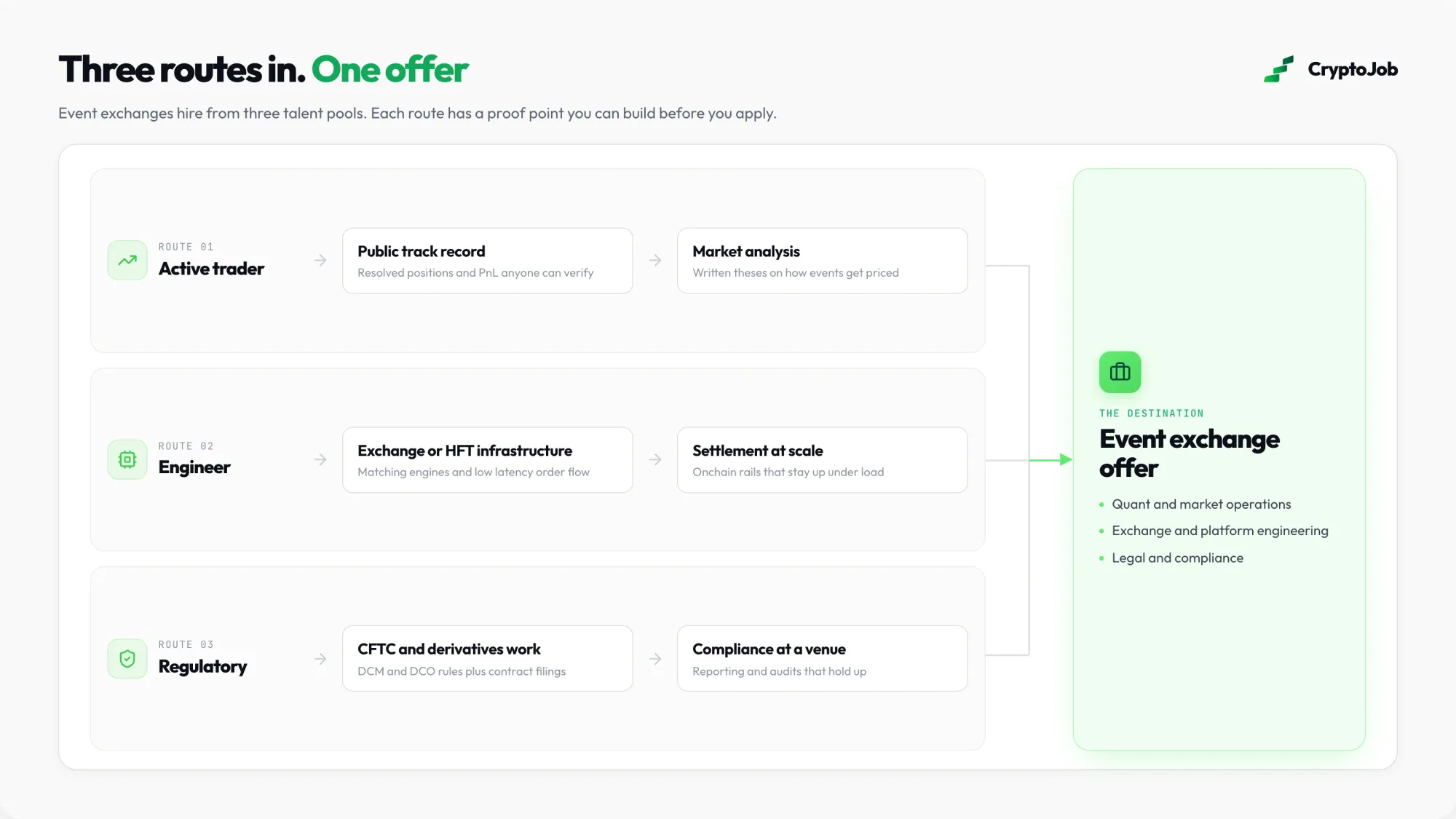
Route one is trading proof. Build a public track record on the platforms themselves, then write sharp market analysis referencing specific markets you called well. These companies famously hire power users.
Route two is transferable infrastructure skill. Exchange matching engines, risk systems, KYC tooling and surveillance software all exist in TradFi and sportsbooks, and hiring managers are pulling from both talent pools.
Route three is regulatory expertise. With state lawsuits over sports contracts active in 2026, lawyers and compliance leads who know CFTC rules are scarce and expensive. Our breakdown of crypto compliance and AML jobs covers how to position that experience.
7. What skills should you build before applying?
Learn how an orderbook works at a mechanical level: bids, asks, spreads, market making incentives and what happens when liquidity thins during a live event. Every function at these companies, from engineering through comms, benefits from that literacy, and interviews probe it constantly.
Add probability fluency. These are markets in probabilities, so being able to reason about calibration, expected value and how news should move a price separates serious candidates from tourists. Writing two or three public postmortems of markets you traded is the cheapest credential in the niche.
For technical candidates, the stack signals are consistent across listings: Go, Rust or C++ for exchange systems, Python and SQL for data and research roles and experience with matching engines or surveillance tooling from any regulated venue. For analysts, fluency with Dune style dashboards or sportsbook data pipelines maps over cleanly.
Domain reading rounds it out. Follow the CFTC docket and the state litigation closely, because interviewers at both firms expect informed opinions on where regulation lands.
8. How do Polymarket and Kalshi compare as employers?
| Factor | Polymarket | Kalshi |
|---|---|---|
| Team size in 2026 | 110 growing toward 260 | Roughly 120 |
| Valuation | Reported $15B raise underway | $22B after May 2026 round |
| Regulatory posture | Building US exchange after acquisitions | CFTC regulated exchange |
| Crypto exposure | Crypto native rails and audience | Fiat first with crypto features |
| Hiring emphasis | US buildout, surveillance, HFT engineering | Lean elite team, markets and infra |
9. How should you actually apply?
Skip the spray approach. Both companies are small enough that a specific application referencing real markets, a named product gap or a regulatory development gets read by someone with hiring power, and generic crypto resumes get filtered instantly.
Lead with proof over credentials. Link a trading history or a published analysis piece in the first line of your note, then keep the resume to one page. Founders at both firms have hired people directly off sharp public posts, which remains the most repeatable hack in this niche.
10. Is this niche durable enough to bet a career on?
Risks exist. Several state attorneys general are challenging sports contracts, and volumes swing with the sports and election calendar. A legal setback could slow hiring quickly.
The counterweight is who is funding the space. An NYSE parent, top venture firms and major quant shops are treating these platforms as exchange infrastructure, and exchange infrastructure tends to keep employing people through cycles. For a wider view of which niches are growing, read our crypto job market 2026 analysis and then browse web3 jobs to see live openings.
FAQ
Do I need crypto experience for prediction market jobs?
No. Kalshi runs largely on fiat rails and both firms hire heavily from sportsbooks and trading firms. Crypto familiarity helps most at Polymarket, where settlement runs onchain.
Are prediction market jobs remote?
Mostly no. Both leading firms concentrate teams in New York and value in person intensity, though some engineering and analyst roles list hybrid or remote options. Expect less remote flexibility than typical crypto startups.
What is the easiest first role to land?
Market operations and content or growth roles have the widest funnels. Demonstrated platform expertise, meaning a real trading history and sharp written analysis, substitutes for formal credentials more here than anywhere else in crypto.
How risky are these employers compared to exchanges?
Funding depth is exceptional and revenue is real, with Kalshi reportedly near $850 million in 2026 fee revenue. The main risks are regulatory rulings on sports contracts and valuation swings, which affect equity value more than job security so far.