Tokenization and RWA Engineer Jobs: The Institutional Growth Role
Tokenization sits where smart contracts meet securities law. Over 60% of Fortune 500 financial firms are hiring for it, at up to $270,000 base.

TL;DR
- Tokenization jobs sit where securities structuring meets smart contracts.
- Over 60% of Fortune 500 financial firms now run blockchain divisions.
- Senior digital asset roles at these firms reach $270,000 base.
- Even Vanguard is now hiring a head of digital assets.
Tokenization jobs are the clearest growth area in institutional crypto, and they demand an unusual combination: someone who can write a smart contract and also explain why a fund's transfer agent will refuse to approve it.
More than 60% of Fortune 500 financial firms now operate formal blockchain divisions, with tokenization consistently named as a core focus. Senior digital asset roles at these institutions have been advertised at up to $270,000 base before bonus.
To see how these compare against crypto native openings, browse web3 jobs.
1. What does a tokenization engineer actually do?
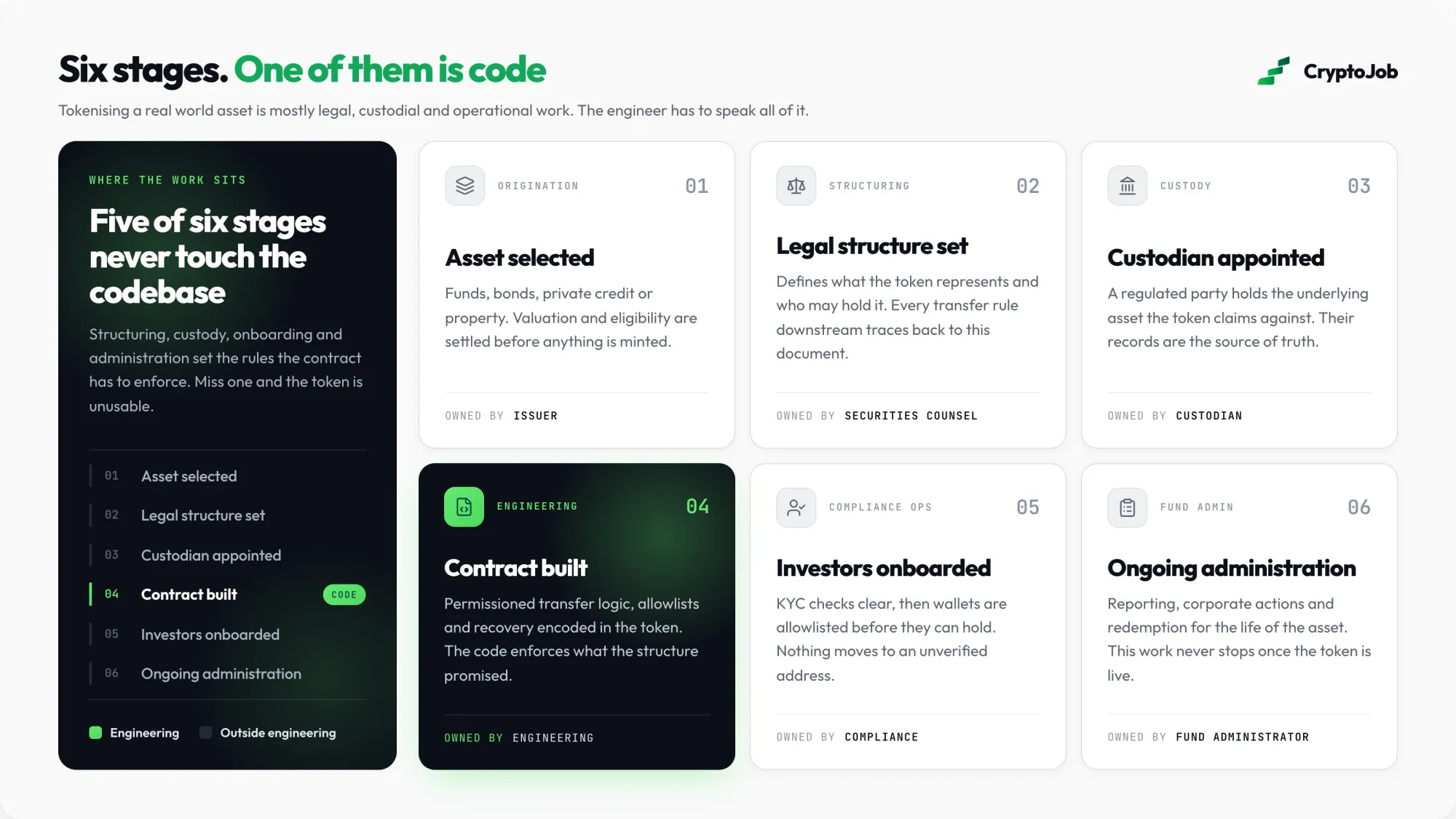
Tokenization means representing a real world asset: a money market fund, a bond, private credit, real estate, as a transferable token on a blockchain, in a way that satisfies the rules governing that asset.
That second clause is the whole job. Minting a token is trivial. Minting one that a regulated entity can legally issue, that a transfer agent can administer and that survives an audit is not.
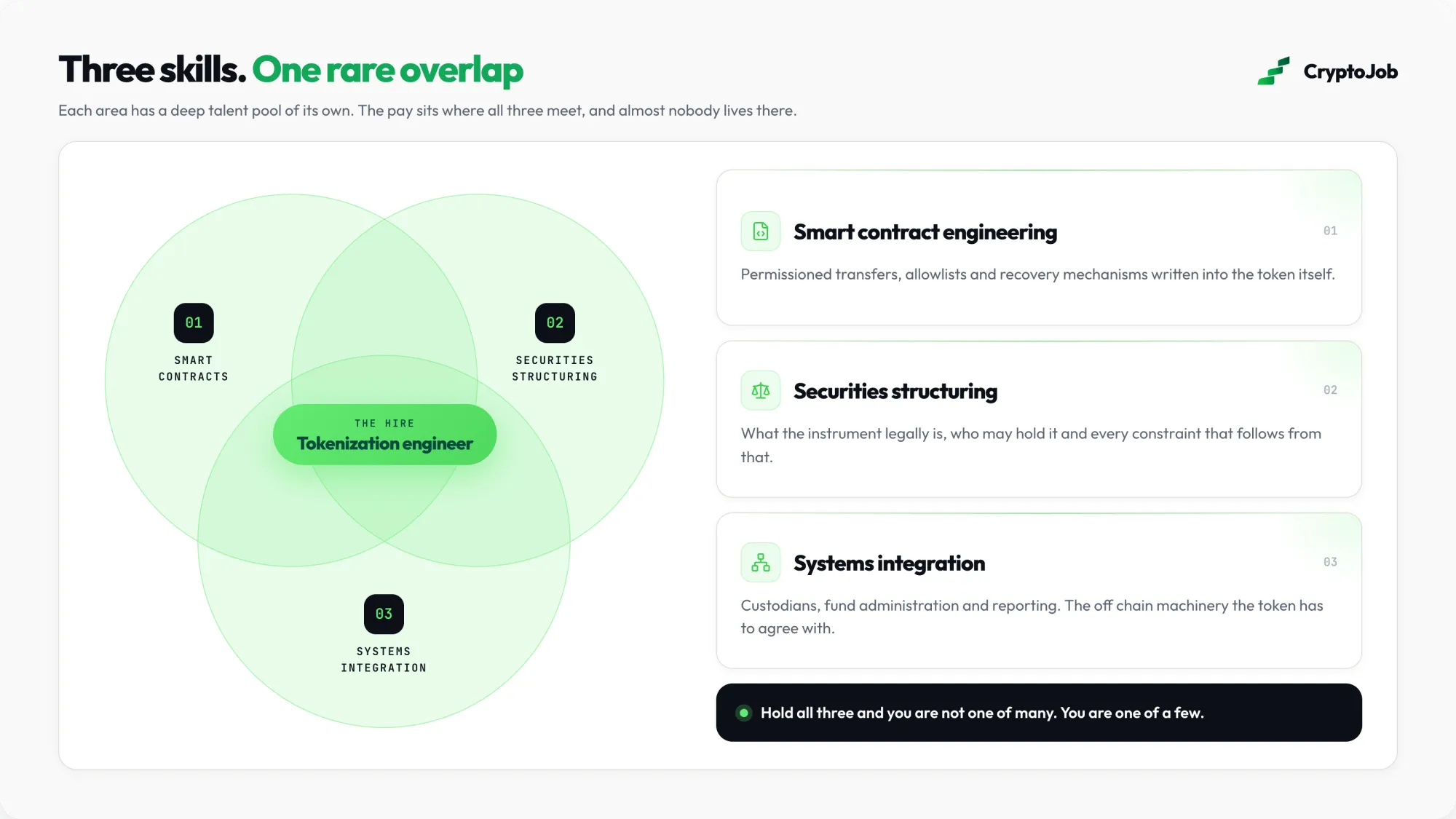
The work splits across three areas that rarely sit in one person's background.
| Area | What it requires |
|---|---|
| Smart contract engineering | Permissioned transfer logic, allowlists, forced transfer and recovery mechanisms |
| Securities structuring | Understanding what the underlying instrument legally is and what constrains it |
| Systems integration | Connecting on chain records to custodians, fund administrators and reporting |
Most candidates arrive with one of the three. The ones who get hired have demonstrably learned a second.
2. Why is tokenization hiring accelerating now?
Two things changed at once. Regulatory frameworks matured enough that large institutions could commit budget, and the largest asset managers moved first, which forced everyone else to respond.
The clearest signal is who is now hiring rather than how many. Vanguard, historically among the most sceptical major asset managers and a firm that refused to offer spot Bitcoin ETFs, began recruiting a head of digital assets to oversee tokenization, stablecoins and blockchain infrastructure, including custody strategy and regulatory engagement.
When a firm that publicly declined to touch the category starts building an executive function around it, the direction is not ambiguous.
3. What do tokenization and RWA roles pay?
Compensation follows institutional rather than crypto native structures: higher base, cash bonus, no tokens.
| Role type | Advertised range | Structure |
|---|---|---|
| Director, digital assets (asset manager) | Up to $270,000 | Base before bonus |
| Senior engineer, digital assets platform | Up to $255,000 | Base before incentives |
| Senior engineer (bank platform) | Up to $200,000 | Base |
These figures come from advertised institutional postings. The important structural difference from protocol work is what is absent, there is no token grant adding 30% to 100% on top and no possibility of outsized upside.
What you get instead is a salary that arrives regardless of what the market does, from an employer whose revenue does not depend on crypto prices.
4. How do you move into tokenization work?
4.1 From smart contract engineering
Your gap is the regulated asset side, and it is more learnable than it looks. Understand what a transfer agent does, why a security cannot simply move peer to peer and what "qualified custodian" means in practice.
Then build something that reflects it. A permissioned token contract with allowlist logic, forced transfer capability and a clear rationale for each restriction demonstrates the thinking better than any certification.
4.2 From capital markets or fund operations
Your regulatory fluency is the scarce half. What you need is enough technical credibility that engineers take you seriously in design discussions.
You do not need to write production Solidity. You do need to explain settlement finality on a public chain, why on chain records differ from a traditional register and where the reconciliation risks sit.
4.3 From neither
This is a hard first crypto role. The institutions hiring for it are looking for demonstrated depth on at least one side, and generalist enthusiasm does not clear that bar.
A more realistic route is entering an adjacent function: digital asset operations, custody, compliance and moving across once you have institutional context.
5. What should you expect from the hiring process?
Longer and more structured than anything crypto native. Institutional processes commonly run five to eight rounds across several months.
The technical assessment tends to be lighter than at a protocol, but the reasoning assessment is heavier. Expect to be asked how you would handle a scenario where on chain and off chain records diverge, or what happens when a token holder loses access to a wallet holding a regulated security.
Answering "they lose the asset" fails that question. The institution needs a recovery mechanism, and the fact that one is required shapes the entire contract design.
Frequently asked questions
What is a tokenization engineer?
Someone who builds systems representing real world assets as on chain instruments, combining smart contract development with the constraints of regulated securities.
What do tokenization jobs pay?
Advertised institutional digital asset roles have reached $270,000 base for director level and $255,000 for senior engineering, before bonus. Compensation is cash based rather than token based.
Do I need a securities background?
Not necessarily, but you need to acquire the knowledge. Understanding transfer agents, custody requirements and why permissioned transfers exist is essential regardless of where you started.
Is RWA tokenization actually growing or is it hype?
The hiring suggests genuine commitment. More than 60% of Fortune 500 financial firms run blockchain divisions, and previously sceptical firms including Vanguard have begun building executive level digital asset functions.
How does this compare to working at a DeFi protocol?
Higher base, no token upside, considerably slower pace and far more stability. It suits people who want the technology without the volatility.
Where to go from here
Tokenization sits at an intersection that very few people occupy properly, which is precisely why it pays what it does. The scarce combination is technical capability plus genuine understanding of regulated instruments.
Whichever side you are starting from, the other half is learnable in months rather than years. Browse web3 jobs to see what is open now.