Web3 Bounties and Grants: How to Get Paid Before Anyone Hires You
Stuck needing experience to get experience? Web3 bounties pay real money for real work and build a verifiable public record while you do it.

TL;DR
- Web3 bounties let you earn before anyone will hire you.
- Superteam Earn has paid contributors over $10.2 million.
- Content bounties start around 200 USDC; grants reach $400,000.
- Completed work becomes a verifiable public track record.
The hardest part of breaking into crypto is the circularity: employers want proof you can do the work, and you cannot get proof without someone employing you.
Web3 bounties and grants break that loop. You do real work for real projects, get paid in stablecoins and accumulate a public record while you are doing it. Superteam Earn alone has facilitated more than $10.2 million in earnings for contributors, reaching over 190,000 people across 2,520+ sponsors.
This guide covers where the opportunities are, what they pay and how to convert them into an actual job. To see what full time roles look like alongside this, browse web3 jobs.
1. What is the difference between a bounty and a grant?
They solve different problems and suit different stages, and conflating them wastes time.
| Bounty | Grant | |
|---|---|---|
| What it is | Open competition for a defined task | Funding to build something you propose |
| Who wins | Best submission takes the prize | Approved applicants, no direct competition |
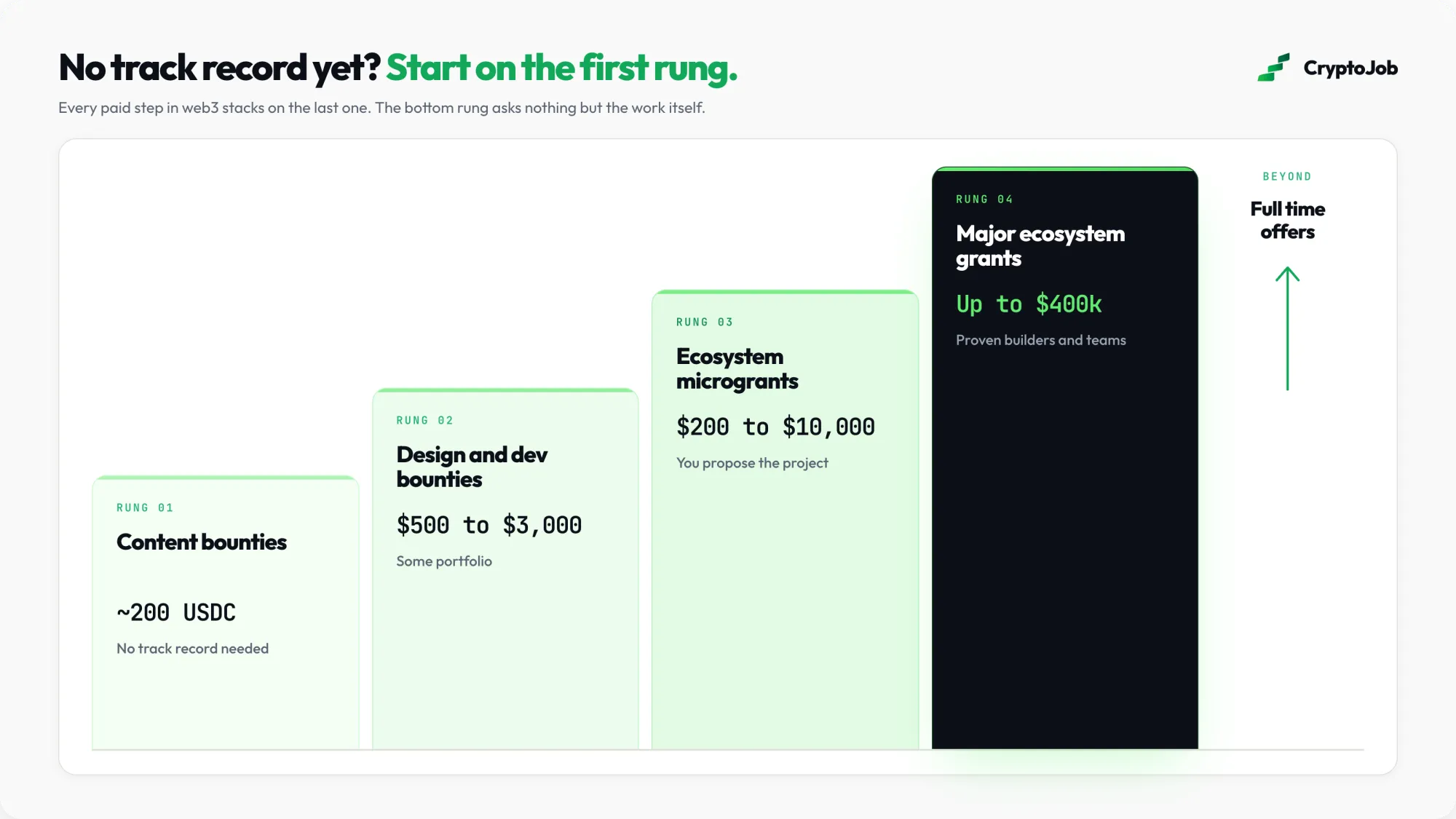
| Typical size | 200 USDC to a few thousand | $200 to $400,000 depending on programme |
| Time to payment | Days to weeks | Weeks to months |
| Best for | Starting from zero | You already have a project idea |
Start with bounties. They pay faster, require no proposal writing and build the record you will need to be taken seriously in a grant application.
2. Where do you find web3 bounties?
2.1 Superteam Earn
The most accessible entry point, aggregating bounties, grants, freelance projects and full time roles in one place. It is free for contributors, sponsors pay to post.
Crucially for beginners, the work is not all engineering. Categories span content (threads, articles, video), design (graphics, animation), development (apps, analytics tools) and open formats like contests and game jams.
Content bounties often start around 200 USDC, which is a realistic first target for someone with no crypto track record at all. Payment comes in stablecoins.
2.2 Ecosystem grant programmes
The major chains fund builders directly, and the amounts are considerably larger.
The Solana Foundation runs several tracks including core protocol development and tooling grants reaching up to $400,000, plus Solana Mobile Builder Grants at up to $10,000 per team. Superteam Grants offer equity free microgrants of $200 to $10,000, deliberately focused on emerging markets.
The Base ecosystem runs seasonal builder grant cohorts through the Coinbase Developer Platform, awarding $30,000+ per cohort with most individual grants landing between $3,000 and $10,000.
3. Why does bounty work convert into jobs?
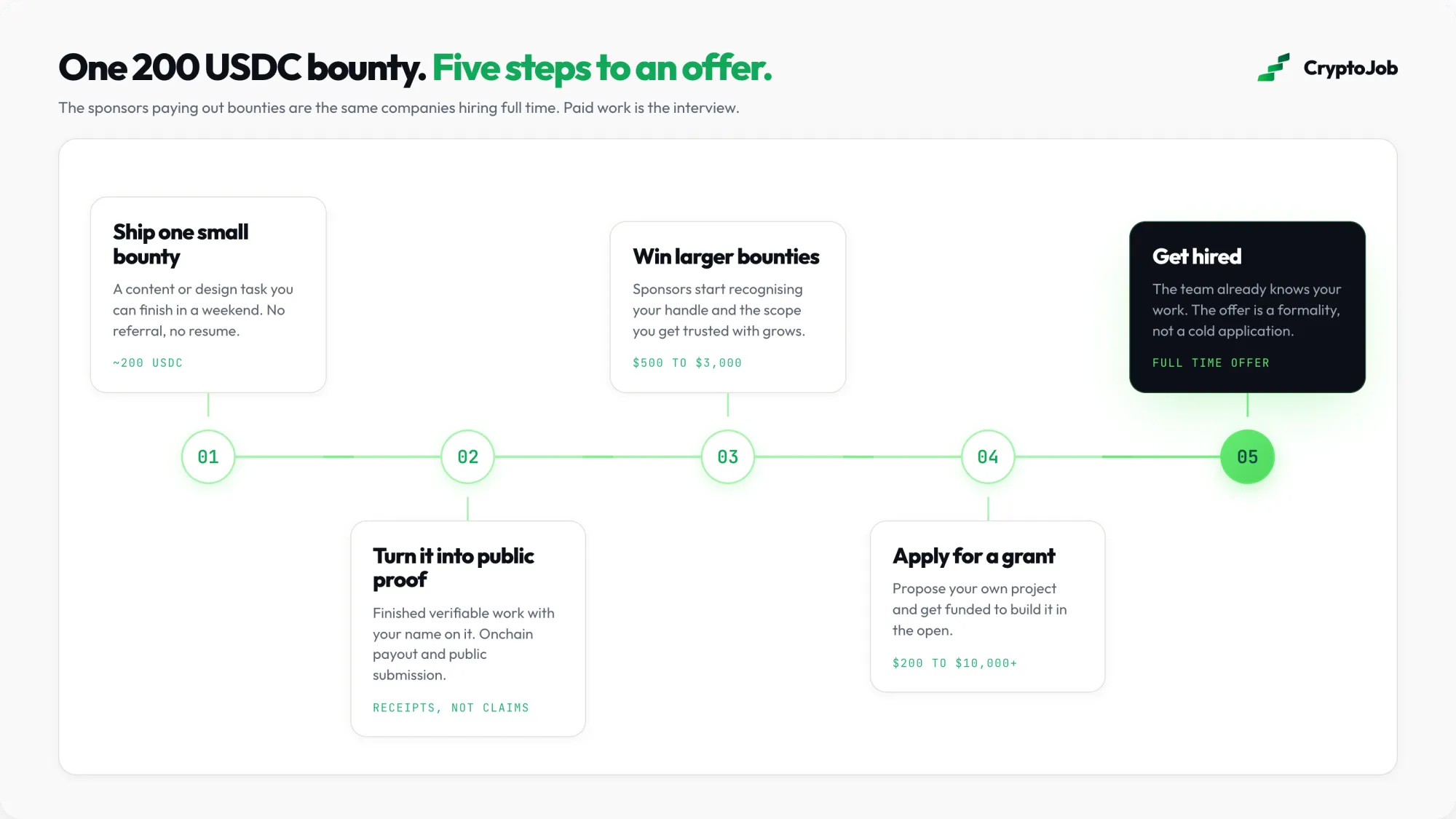
Because it produces exactly the evidence hiring managers cannot get from a CV.
Completed bounties are public and verifiable. Superteam Earn issues a Proof of Work record that updates as you complete work, functioning as an on chain resume that anyone can check without taking your word for anything.
There is also a relationship effect that is easy to underestimate. Sponsors posting bounties are the same companies hiring full time. Delivering good work on a $500 bounty puts you in front of someone with budget, which is a considerably better position than being one of four hundred applicants.
Several people in crypto describe getting their first role directly through work started on these platforms rather than through applications.
4. How do you actually win a bounty?
4.1 Pick where the field is thin
Newly posted bounties from smaller sponsors attract fewer submissions than headline competitions. Your odds on a $300 bounty with eight entrants beat a $5,000 bounty with two hundred.
Look for bounties requiring a combination rather than a single skill, writing plus technical understanding or design plus knowing how a protocol works. Those consistently draw fewer qualified submissions.
4.2 Read what previously won
Past winning submissions are usually public. Read several before writing anything, because they tell you what the sponsor actually values as opposed to what the brief says.
Sponsors are frequently more specific in their judging than in their posting.
4.3 Submit early and completely
Partial submissions almost never place. A modest idea executed fully beats an ambitious one delivered half finished, particularly when a judge is working through dozens of entries.
4.4 Treat the first few as paid learning
You will likely lose your first several. That is normal and it is not wasted, each submission is a portfolio piece regardless of whether it wins and you can show it.
5. Is this realistic income or just a stepping stone?
For most people, a stepping stone that happens to pay and that is genuinely valuable when you are trying to break in without savings.
A realistic first three months might be a handful of small content or design bounties totalling a few hundred to a couple of thousand dollars. That is not a living, but it is a public track record plus some income, which is considerably better than an unpaid portfolio project.
The people who turn it into real income tend to specialise. Becoming the person who reliably delivers a specific type of work for a specific ecosystem leads to repeat invitations and larger direct engagements.
One structural advantage worth noting: several of these programmes explicitly target emerging markets. If you are outside the traditional crypto hubs, the microgrant tracks are designed with you in mind rather than treating you as an afterthought.
Frequently asked questions
How much can you earn from web3 bounties?
Content bounties often start around 200 USDC, with development and design work reaching several thousand. Superteam Earn contributors have collectively earned more than $10.2 million as of early 2026.
Do you need to be a developer to earn from bounties?
No. Categories include content writing, video, design, animation and research alongside development. Content bounties are the most accessible starting point for people with no crypto background.
How are bounties paid?
Typically in stablecoins such as USDC or USDT. Some platforms use escrowed smart contracts so the reward is verifiably funded before you begin work.
Are crypto grants hard to get?
Larger ecosystem grants are competitive and expect a credible track record. Microgrants in the $200 to $10,000 range are considerably more accessible, particularly the tracks aimed at emerging markets.
Can bounty work actually lead to a job?
Frequently. The sponsors posting bounties are the same companies hiring full time, and completed work is public and verifiable, which solves the evidence problem that applications cannot.
Where to go from here
If you are stuck in the loop of needing experience to get experience, bounties are the most direct way out of it. Small, fast, paid and public.
Start with one modest content bounty this month rather than planning an elaborate portfolio project. And when the record starts building, browse web3 jobs to see what it qualifies you for.