Will AI Replace Crypto Jobs? Which Roles Are Safe in 2026
AI is already reshaping crypto hiring. The roles automating first, the ones that stay human and the moves that protect your career.

TL;DR
- AI will replace parts of crypto jobs, not most whole jobs, in 2026
- Weekly crypto code commits fell about 75 percent as AI absorbed developers
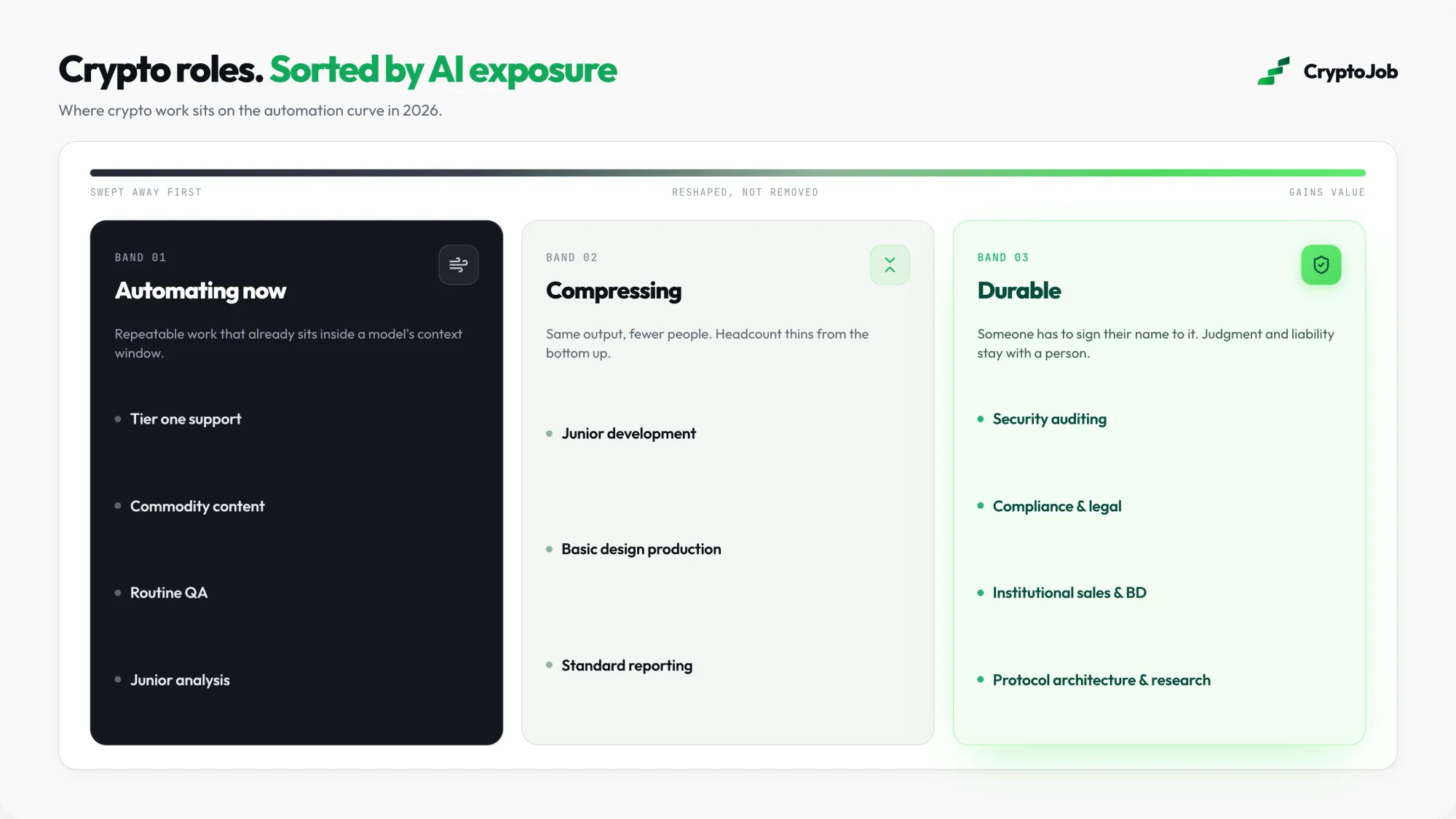
- Tier one support, commodity content, routine QA and junior analysis automate first
- Security, compliance, BD and protocol architecture stay firmly human
Will AI replace crypto jobs? Parts of them, visibly and already: chatbots absorbed tier one support tickets and AI coding tools compressed junior development work, while CoinDesk reported weekly crypto code commits down about 75 percent since early 2025 as developer attention shifted to AI projects. Yet whole categories remain stubbornly human, and new hybrid roles are growing. This guide separates the exposed roles from the durable ones and gives you the moves that protect a crypto career.
The honest frame is displacement plus creation happening at once, unevenly across functions. While you weigh your position, browse web3 jobs and notice how many current listings now require AI tool fluency as a feature, not a threat.
Context on scale: researchers projected around 502,000 AI attributed layoffs across industries in 2026, roughly nine times the prior year, and crypto is not exempt from a force that size.

1. Which crypto jobs is AI already replacing?
Tier one support went first. Exchanges deflect password resets and status questions to chatbots, so pure entry ticket roles shrank while escalation and fraud positions grew, a pattern covered across 2026 support listings.
Commodity content went with it. Explainer mills and low rate SEO writing were substituted almost entirely, splitting the writing market into a collapsed generic tier and a rising expert tier.
Junior technical work is compressing rather than vanishing. AI coding assistants let one mid level developer ship what took a small team, which raises the bar for entry level engineering everywhere, including crypto.
2. Which crypto jobs stay safe from AI in 2026?
Security and auditing lead the safe list. Exploits cost real money, judgment about novel attack surfaces resists automation and the July 2026 hardware wallet incident that drained over 1,000 wallets in under an hour reminded everyone why paranoid human review exists.
Compliance and legal stay human because accountability must be. Regulators sanction people and firms, not models, so BSA officers, counsel and licensing leads remain among the hardest hires in the industry.
Relationship work holds across the board: institutional sales, business development, partnerships and senior product leadership. Add protocol architecture and cryptography research, where AI assists brilliantly but originates little, and you have the durable core.
3. Why did crypto developer activity fall so hard?
Two forces stacked. Electric Capital's tracking shows monthly active crypto developers falling from a 2022 peak above 30,000 to the low 20,000s, with newcomers under one year of experience declining more than 50 percent in recent tracking, while established developers with two or more years hit record highs and now produce about 70 percent of commits.
Meanwhile AI created a gravitational alternative. LinkedIn documented 1.3 million new AI jobs globally between 2023 and 2025, with AI engineer roles growing thirteen times, and 2025 AI funding reached $211 billion per Crunchbase against roughly $19.7 billion for crypto per PitchBook.
The commit decline also reflects tooling, not just departure. When assistants write boilerplate, fewer humans push routine commits, so some of the measured drop is productivity concentrating rather than people vanishing.
Read together, this is consolidation rather than collapse: tourists left while veterans stayed, and the bar to enter rose. That reshapes who gets hired more than whether anyone does.
4. Where is AI creating new crypto jobs?
The convergence layer is hiring on both sides. Teams building payment rails and onchain identity for AI agents need people fluent in both stacks, and investors including Electric Capital have framed agent infrastructure as a core 2026 theme.
Inside existing companies, hybrid roles multiplied. Exchanges and institutions increasingly seek people who connect the two domains rather than pure specialists in either, per 2026 hiring commentary, from AI risk analysts on trading desks to automation leads inside support and operations.
The tooling supervisors are the quiet new class: prompt and workflow designers for compliance review, alongside QA engineers validating machine written code. Our guide to AI and crypto jobs maps this fastest growing intersection in detail.
5. How do you protect your crypto career from AI?
The displacement is uneven by company size as well, since lean startups automate aggressively while regulated giants move slowly under audit obligations, which makes employer choice itself a defensive decision.
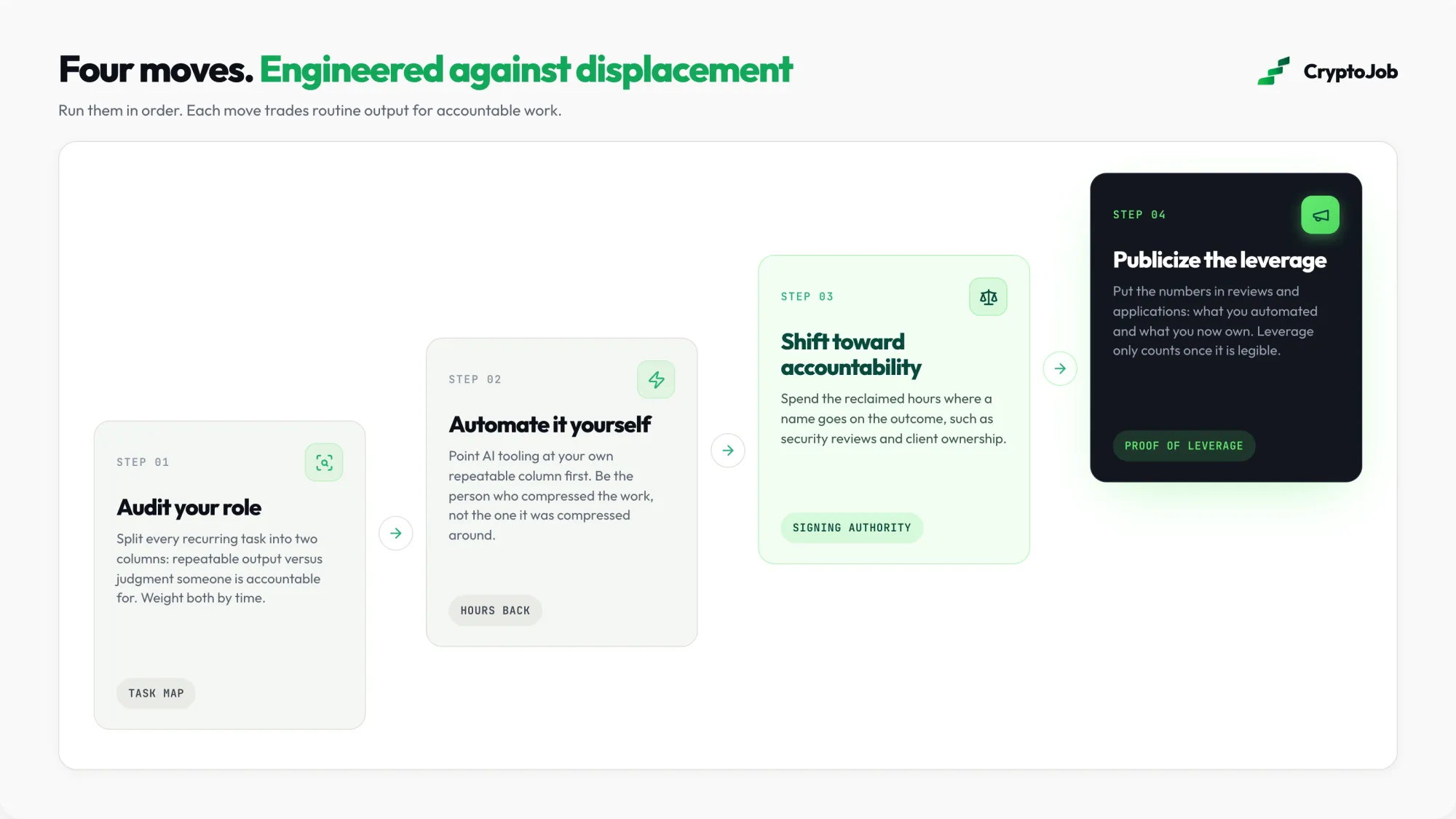
Move toward accountability. Roles where a human must sign, decide or be liable, meaning security, compliance, treasury and senior product, price AI as a tool rather than a rival.
Adopt the tools loudly. Candidates who demonstrate they ship faster with AI assistants are winning roles from those who compete against the software, and 2026 listings increasingly test for exactly this.
Own outcomes, not tasks. Task lists automate, but responsibility for an audit outcome or a client book does not, so climb from producing outputs to owning results as fast as your team allows.
6. How exposed is each major crypto role?
| Role family | AI exposure | What changes by 2027 | Best defensive move |
|---|---|---|---|
| Support and operations | High at tier one | Smaller teams, senior escalation focus | Fraud, VIP and tooling supervision |
| Content and marketing | High for generic work | Expert analysis premium grows | Own a beat, direct AI production |
| Engineering | Medium, junior heavy | Higher entry bar, faster seniors | Security depth plus AI fluency |
| Compliance and legal | Low | Headcount grows with regulation | Licensing and examination experience |
| Sales and BD | Low | Tools augment, relationships rule | Institutional network building |
7. How are crypto companies actually deploying AI today?
Support deflection came first and is now table stakes, with chatbots absorbing routine tickets at every major exchange. Fraud and surveillance came next, where models flag patterns across millions of transactions for human investigators to judge.
Engineering orgs run AI coding assistants as standard tooling, compressing routine implementation while seniors review harder than ever, since generated code still ships bugs confidently. Marketing teams draft with AI and edit by hand, and compliance teams pilot document review with lawyers signing everything.
Notice the constant across all of it: deployment created supervisor seats. Each automated workflow now has humans who tune it and own its failures, and those names appear in 2026 org charts where pure production roles used to.
8. Which skills pair best with AI tools in crypto?
Domain judgment tops the list, because AI output is only as good as the person who can spot when it is confidently wrong about a regulation or an attack surface. Deep crypto knowledge became more valuable the moment drafting became cheap.
Verification skills come second: testing, auditing, fact checking and security review all convert AI speed into shippable quality. Communication rounds it out, since explaining decisions to regulators and clients stays stubbornly human.
Build the habit publicly. Documenting how you use AI tools to ship faster, with your judgment visible in the corrections, is becoming its own portfolio genre and interviewers respond to it.
9. Should you still start a crypto career in 2026?
Yes, with your eyes open about which door you enter. The industry contraction documented in our crypto job market 2026 analysis plus AI pressure means fewer easy seats, while the durable functions keep hiring through it all.
Aim at the judgment heavy roles from day one or plan a fast route toward them. Entering through support or content still works precisely because those seats now come with automation tooling to master, which becomes your differentiator.
And remember the flip side of the disruption: every AI system touching money will need the security and compliance skills crypto people already have. Displacement stories dominate headlines while the layoff data in our crypto layoffs 2026 breakdown shows hiring and cutting happening simultaneously.
10. What is the honest bottom line?
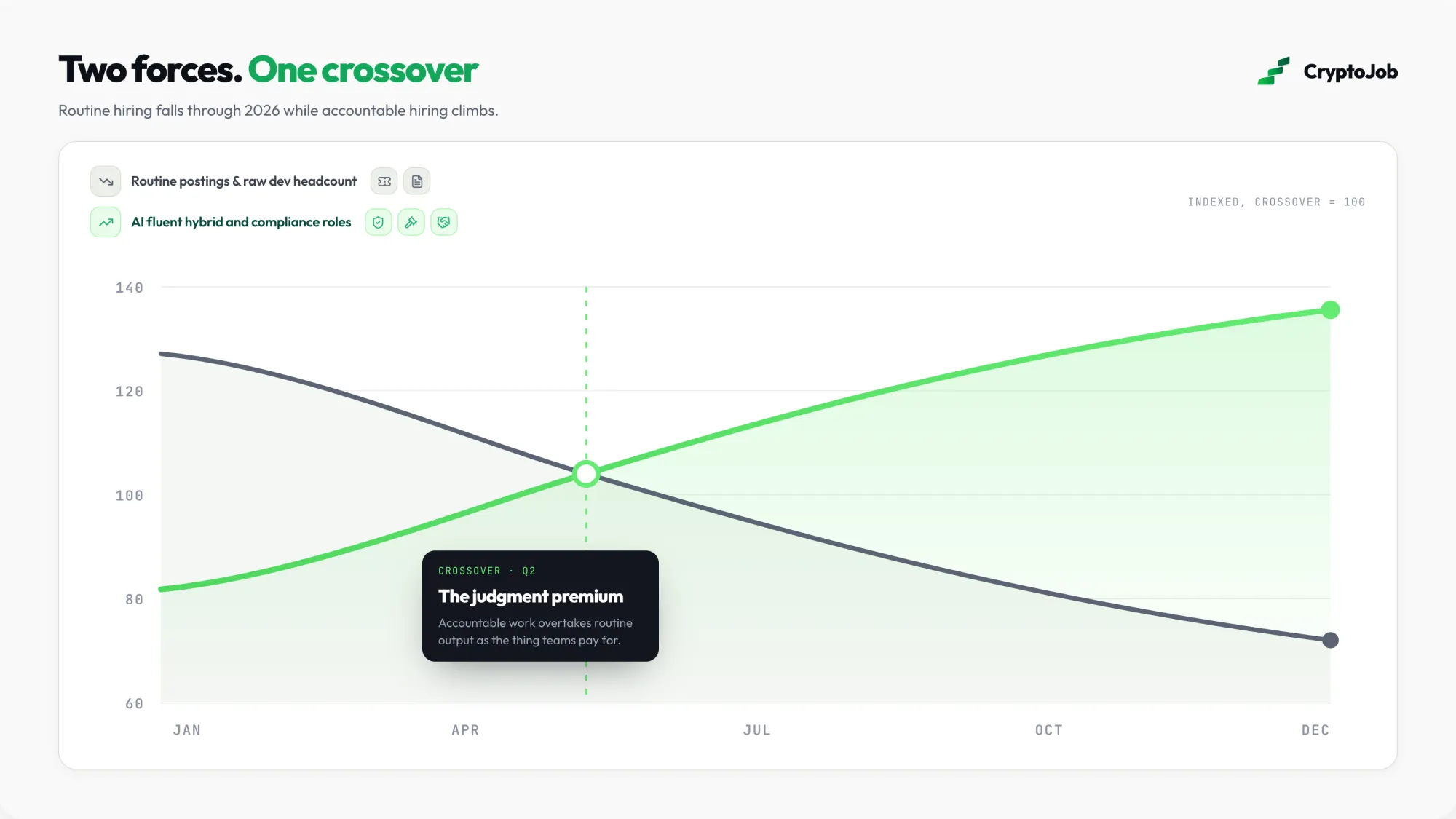
AI is not replacing crypto jobs wholesale, it is repricing them. Routine execution is losing value fast, judgment and accountability are gaining it and the people thriving are the ones who noticed early and repositioned.
Audit your own week against that split, automate your routine half before someone else does and steer toward the durable core. Then explore open crypto roles with fresh eyes for the jobs the machines are funding rather than the ones they are eating.
FAQ
Will AI replace crypto developers?
It is compressing junior development while making experienced builders more productive. Established developers now produce about 70 percent of crypto commits, so the market rewards depth plus AI fluency rather than headcount.
Which crypto job is safest from AI?
Security auditing and compliance lead, because both attach human accountability to high stakes decisions. Institutional sales and protocol architecture sit close behind.
Are AI plus crypto jobs real or hype?
Real and growing: agent payments and hybrid analyst roles both hired through 2026, backed by major venture theses on agent infrastructure.
Should I learn AI tools for a crypto job?
Yes, treat it as mandatory. Listings across support, content, engineering and operations now expect candidates to work with AI assistants, and demonstrated fluency is becoming a screening filter.